Driving Innovation in Data Science and AI: Proposing New Frontiers with the Leeds-Africa Hub
Luisa Cutillo
Department of Statistics, SoM
University of Leeds
l.cutillo@leeds.ac.uk

Leeds Africa Hub Networking Event 2024
My main recent interests


Ongoing Research with biomedical applications
- Networks (graphs) estimation
- Networks validation
- Metadata embedding in networks
- Graphical models
- ML and AI for medicine
- NGS applications
EDI and Educational Interests
- WiML board of Direcors, mentorship program
- Data Science tools and computational practices in education
- Leeds Inst. Teach. Excellence (LITE) Fellowship: Data Skills Literacy for Educators
- EDI and Skills Gap in Education: Office for Students (OfS) AI&DS scholarship funding (400K)



MSc Program Manager
-
MSc in Data Science and Analytics
-
MSc Statistics
-
MSc Statistics with Applications to Finance
My involvement in the
Leeds-Africa Hub
- Participated to the initial bid
- Kick-off meeting in Pretoria (bioinformatics tutorial & discussions)
- Participated to a few grants applications
- New Networking proposal with Leeds-Africa Hub: Expanding collaborations in health informatics and environmental AI
Research Focus Areas:
Health Data Science & Environmental AI
- ML for biomedical application: early disease detection, and understanding complex disease mechanisms.
- Human-Centered and Ethical AI: Focus on addressing health inequalities using qualitative data and AI models.
- Environmental Monitoring AI: Climate Impact Assessment on Biological Systems
ML for biomedical application:
- Cancer Detection and Treatment Stratification. GmGM can integrate multiple modalities to identify specific cancer subtypes and cellular interactions within tumors.
Building on our approach "GmGM: a Fast Multi-Axis Gaussian Graphical Model" (AISTAT 2024) can be used to:
early disease detection, and understanding complex disease mechanisms.
GmGM: a fast Gaussian graphical model for multi-modal data
ongoing PhD project (Andrew Bailey), AISTAT 2024
Gaussian multi-Graphical Model to construct sparse Graph estimation from tensor-variate data
-
Fast: We exploit a closed form solution of the scalable bigraphical lasso
-
Multimodal: arbitrarily many tensor-variate datasets with shared axes
-
Allows large dataset in short execution time (eg. run on datasets in the size of ~100 MB (4000x4000 64bit floats) < 1 minute)
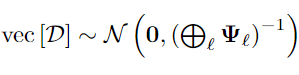
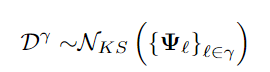
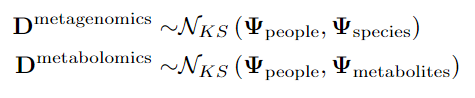
Single tensor dataset
arbitrary set of tensors
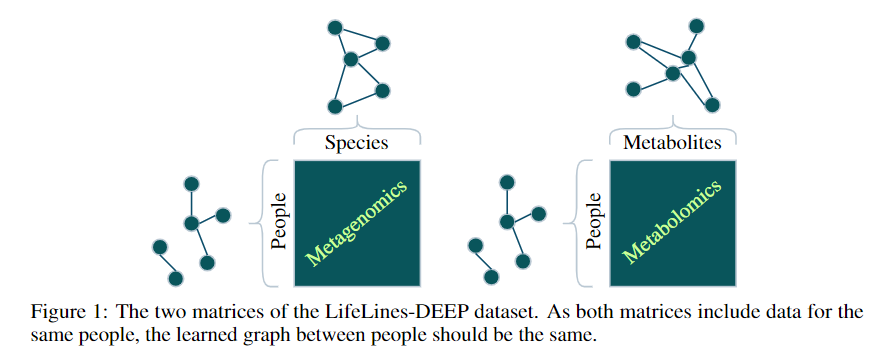
- Counts of microbial species in stools
-1000 peopleX2000 species (metagenomics) - Counts of metabolites in blood plasma
-1000 peopleX200 metabolites (metabolomics)
Human-Centered and Ethical AI
Ongoing collaboration with the NHS on AI Analysis of Voice to Aid Laryngeal Cancer Diagnosis - Mary Paterson PhD Project (CDT Medical AI)
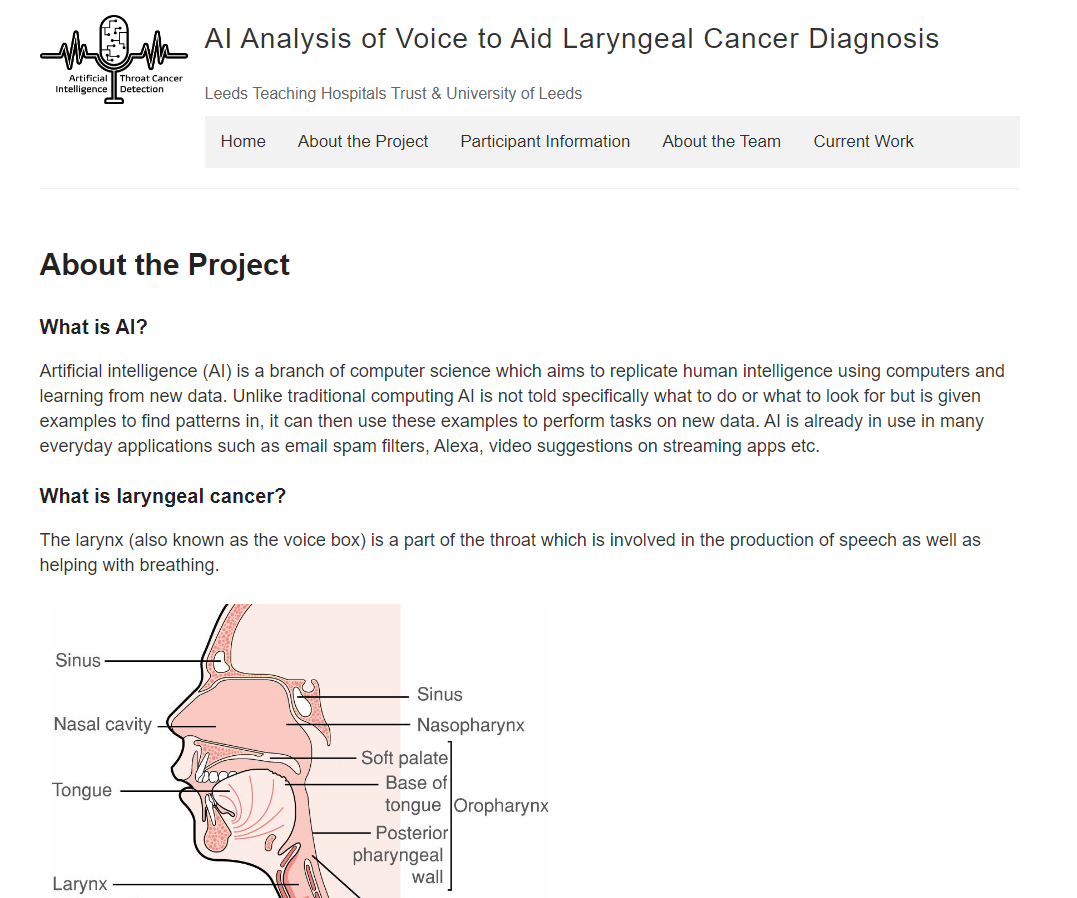
AI Analysis of Voice to Aid Laryngeal Cancer Diagnosis has potential to address health inequalities: providing accessible early-detection non invasive tools for at-risk or underserved populations.
Human-Centered and Ethical AI
- Human-Centered Design and Inclusivity
- Ethics and Transparency in Model Development
- Addressing Health Inequalities through Qualitative Data Integration
- Continuous Evaluation and Bias Monitoring
Climate Impact Assessment on Biological Systems
Environmental Monitoring AI:
understanding how environmental stressors—like rising temperatures and extreme weather—affect biological systems
Key questions :
- How does climate change alter gene expression?
- How resilient or vulnerable are biological networks to climate stress?
- And how can we quantify uncertainties to guide decision-making?
Understanding Uncertainty to Reduce Climate Risks
NERC Centre for Doctoral Training
Climate Impact Assessment on Biological Systems
Environmental Monitoring AI:
understanding how environmental stressors—like rising temperatures and extreme weather—affect biological systems
Impact:
- direct implications for agriculture, conservation, biodiversity, and public health.
- understanding how heatwaves affect crop development can help develop more resilient agricultural practices.
- insights into how marine life adapts to changing temperatures support biodiversity conservation and fisheries management.
Possible Directions:
Promoting Impactful Research, Building and Supporting Research Communities
- AI Pipeline for Healthcare Impact: Development of APIs and tools for clinical applications.
- Establishing interdisciplinary groups within the HUB (e.g., 'AI in Health', ' AI for Health Equity and Environmental Resilience').
- Mentorship programs targeting PhD students and early-career researchers to build the next generation of leaders.
- Jointly create conversion programs targeting non-STEM students to diversify the data science workforce.
Thanks!
Questions?
Leeds_Africa_Hub_Networking
By Luisa Cutillo