Intro to
Functional
JavaScript
Bianca Gandolfo
JavaScript Evangelist
slides: http://bit.ly/func-slides
exercises: http://bit.ly/func-exercises
Who is this for?
2-6mos experience learning JavaScript
Completed JS tutorial like Codecademy, CodeSchool, Khan Academy, or Bloc.io
Want to solidify fundamentals
Looking for more practice
Interested in getting into Hack Reactor

Part 1
Review and solidify core JS principles with project.
Part 2
Get started with functional methods.
After
Use foundation to grow as a JS engineer.


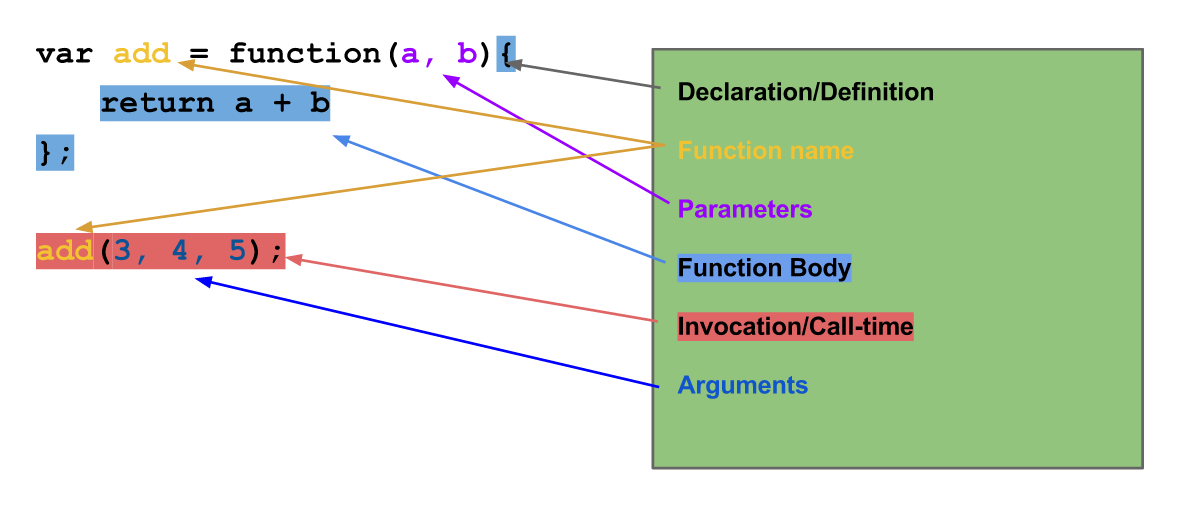
Anatomy
Scope
Overview
- Local
- Global
- Nested Scopes
- Precedence
- Block Scope
Local Scope
var func = function(){
  var local = true;
};

console.log(local);
var x = 'global!';var x = 'global!';
//inside a function
function encapsulate(){
z = 'global here, too!';
}var x = 'global!';
//inside a function
function encapsulate(){
z = 'global here, too!';
window.y = 'also global!';
}
Global Scope
Parent vs Child Scope
var g = 'global';

function blender(fruit) {
  var b = fruit;
  var y = 'yogurt';

  function bs() {
    alert( b + ' and ' + y + ' makes ' + b + ' swirl');
  }
  bs();
}

blender('blueberry');Privacy
var g = 'global';

function blender(fruit) {
  var b = fruit;
  var y = 'yogurt';

  function bs() {
    alert( b + ' and ' + y + ' makes ' + b + ' swirl');
  }
  bs();
}

blender('blueberry');
creating scopes
Precedence
var g = "global";

function go() {
  var l = "local";
  var g = "in here!";
  alert(g + " inside go");
}

go();
alert(g + " outside go");Block Scope
var inBlock = false;

for(var i = 0; i < 5; i++){
  var inBlock = true;
};

if(inBlock){
  console.log('Is there block scope? ' + !inBlock);
}
Exercise Time
Questions
Closure
Closure Example
var closureAlert = function(){
  var x = "Help! I'm a variable stuck in a closure!";
  var alerter = function(){
    alert(x);
  };
  alerter();
};Closure Example
var closureAlert = function(){
  var x = "Help! I'm a variable stuck in a closure!";

  var alerter = function(){
    alert(x);
  };

  setTimeout(alerter, 1000);

  console.log('will still run right after');
};Closure Example
var closureAlert = function(){
  var x = 0;
  var alerter = function(){
    alert(++x);
  };
  return alerter;
};

var funcStorer = closureAlert();
var funcStorer2 = closureAlert();
funcStorer();Closure Example
var add = function(num){
  var num1 = num;

  var addToNum1 = function(num2){
    return num1 + num2;
  };

  return addToNum1;
};Closure Example
function counter() {
  var n = 0;
  return {
    count: function() { return ++n; },
    reset: function() { n = 0; }
  };
};Closure Example
function counter() {
  var n = 0;

  return {
    count: function() { return n++; },
    reset: function() { n = 0; }
  };
};

var c = counter(), d = counter(); c.count();

d.count();
c.reset();
c.count();
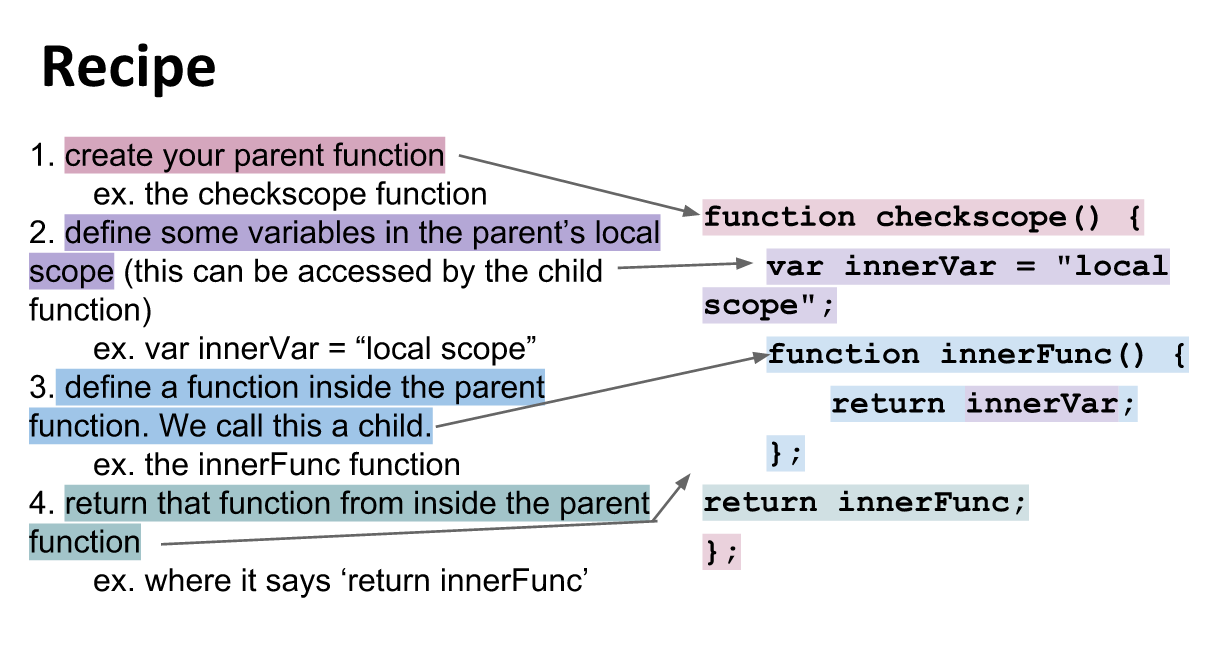
d.count();Recipe
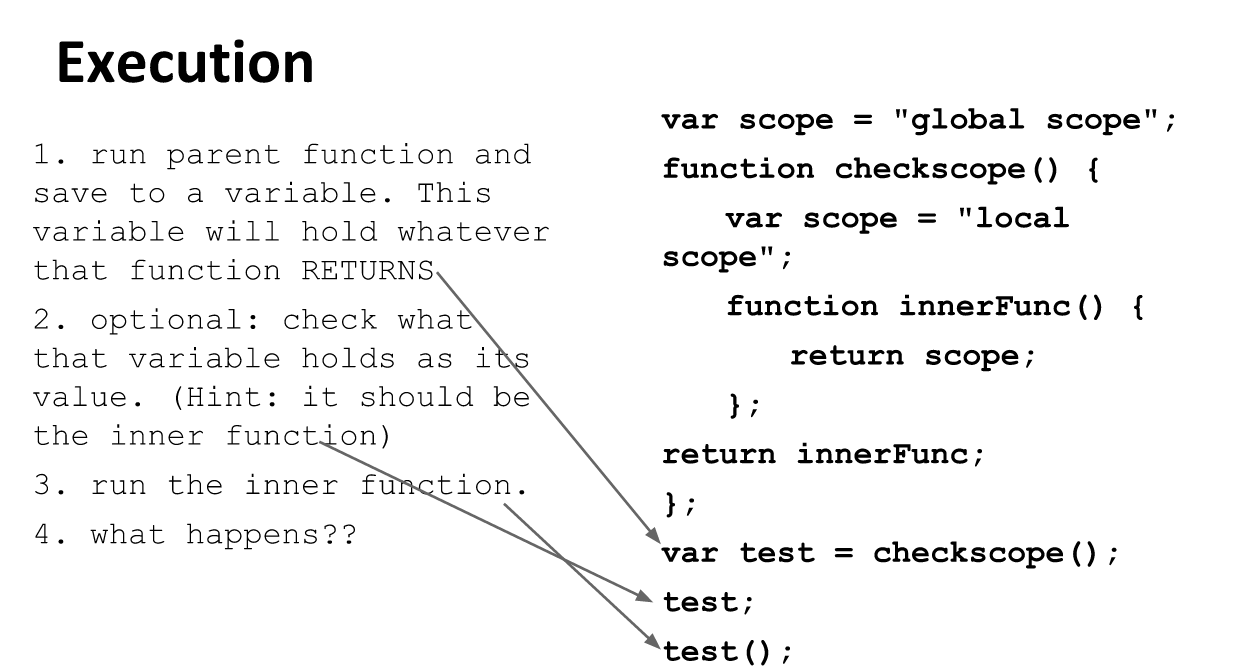
Execution
Gotcha!
var sayAlice = function(){

  var makeLog = function() {
    console.log(alice);
  };

  var alice = 'Why hello there, Alice!';

  return makeLog;
};var makeStopwatch = function(){
console.log('initialized');
var elapsed = 0;
console.log(elapsed);
var stopwatch = function(){
console.log('stopwatch');
return elapsed;
};
var increase = function(){ elapsed++; };
setInterval(increase, 1000);
return stopwatch;
};
var x = makeStopwatch();Module Pattern
var Module = function(){

  var privateProperty = 'foo';

  function privateMethod(args){
    // do something
  };

  return {
    publicProperty: "",
    publicMethod: function(args){
      // do something
    },
    privilegedMethod: function(args){
      privateMethod(args);
    }
  };
};Module Pattern
var Car = function(){

  var gasolineLevel = 10;

  function useGas(amt){
    if(gasolineLevel - amt < 0){
      console.log("out of gas :[");
    } else {
      gasolineLevel -= amt;
    }
  };

  return {
    radioStation: "104.5",

    changeStation: function(station){
      this.radioStation = station;
    },
    go: function(speed){ useGas(speed); }
  };
};Exercises
Questions
Higher- Order Functions and Callbacks
1. takes a function as an input (argument)
element.addEventListener("click", function(){

  console.log("element clicked!");

});
2. returns a function as the output
var add = function(num){
  var num1 = num;

  return addToNum1 = function(num2){
    return num1 + num2;
  };

};
Higher-Order Functions
var ifElse = function(condition, isTrue, isFalse){

  if(condition){
    isTrue;
  } else {
    isFalse;
  }
};

ifElse(true,

 function(){ console.log(true);},

 function(){ console.log(false);}

);
Callbacks
var ifElse = function(condition, isTrue, isFalse){
  if(condition){
    isTrue();
  } else {
    isFalse();
  }
};

var logTrue = function(){ console.log(true); };
var logFalse = function(){ console.log(false); };

ifElse(true,logTrue,logFalse);
Callbacks
var increment = function(n){ return n + 1; };

var square = function(n){ return n*n; };

var doMathSoIDontHaveTo = function(n, func){ return func(n); };

doMathSoIDontHaveTo(5, square);

doMathSoIDontHaveTo(4, increment);
Passing Arguments
var ifElse = function(condition, isTrue, isFalse){
  if(condition){
    isTrue();
  } else {
    isFalse();
  }
};
Passing Arguments
var ifElse = function(condition, isTrue, isFalse, arg){
  if(condition){
    isTrue(arg);
  } else {
    isFalse(arg);
  }
};
Passing Arguments
var ifElse = function(condition, isTrue, isFalse){
  if(condition){
    isTrue.apply(this, [].slice.call(arguments,3));
  } else {
    isFalse.apply(this, [].slice.call(arguments,3));
  }
};
[xtra credit]Passing Arguments
Exercises
Questions
Underscore.js
underscore.js
What is it? a utility library that provides functional methods for you to use in your JS.
Where is it? http://underscorejs.org/
Include it in your HTML:
Annotated Source:
http://underscorejs.org/docs/underscore.html
_.each() defined
_.each([1,2,3], function(val,i,list){
  console.log(val);
});
- Iterates over a list of elements, yielding each in turn to an iterator function.
- Each invocation of iterator is called with three arguments: (element, index, list). If list is a JavaScript object, iterator's arguments will be (value, key, list).
_.each() usage
//_.each(list, iterator)
var pocketmon = ['Charisaur', 'Bulbazard', 'Twomew'];_.each() usage
//_.each(list, iterator)
var pocketmon = ['Charisaur', 'Bulbazard', 'Twomew'];

var logger = function(val){
  console.log(val);
};_.each() usage
//_.each(list, iterator)
var pocketmon = ['Charisaur', 'Bulbazard', 'Twomew'];

var logger = function(val){
  console.log(val);
};

_.each(pocketmon,logger);Looping with _.each
function AnimalMaker(name) {
  return {
    speak: function () {
      console.log("my name is ", name);
    }
  };
};

var animalNames = ['', '', ''];
var farm = [];

for(var i = 0; i < animalNames.length; i++){
  farm.push(AnimalMaker(animalNames[i]));
}Looping with _.each
function AnimalMaker(name) {

  return {
    speak: function () {
      console.log("my name is ", name);
    }
  };
};

var animalNames = ['', '', ''];

var farm = [];

_.each(animalNames, function (name) {
  farm.push(AnimalMaker(name));
});_.map() defined
_.map([1,2,3], function(v,i,list){console.log(v)})
- Produces a new array of values by mapping each value in list through a transformation function (iterator).
- Each invocation of iterator is called with three arguments: (element, index, list). If list is a JavaScript object, iterator's arguments will be (value, key, list).
_.map() usage
//_.map(list, iterator)
var pocketmon = ['Charisaur', 'Bulbazard', 'Twomew'];_.map() usage
//_.map(list, iterator)
var pocketmon = ['Charisaur', 'Bulbazard', 'Twomew'];

var excitedArr = function(val){
  return val + '!!!';
};_.map() usage
//_.map(list, iterator)
var pocketmon = ['Charisaur', 'Bulbazard', 'Twomew'];

var excitedArr = function(val){
  return val + '!!!';
};

var excitedPocketmon = _.map(pocketmon,excitedArr);Looping with _.map
function AnimalMaker(name) {
  return {
    speak: function () {
      console.log("my name is ", name);
    }
  };
};

var animalNames = ['', '', ''];

var farm = []

_.each(animalNames, function (name) {
  farm.push(AnimalMaker(name));
});Looping with _.map
function AnimalMaker(name) {
  return {
    speak: function () {
      console.log("my name is ", name);
    }
  };
};

var animalNames = ['', '', ''];

var farm = _.map(animalNames, function (name) {
  return AnimalMaker(name);
});_.map vs _.each
function AnimalMaker(name) {
  return {
    speak: function () {
      console.log("my name is ", name);
    }
  };
};

var animalNames = ['', '', ''];

var farm = _.map(animalNames, function (name) {
  return AnimalMaker(name);
});

_.each(farm, function (animal) {
  animal.speak();
});Exercises
Questions
Copy of intro to func
By Matthew Gutierrez