Data Science
Theory of Neural Networks
Claudia Merger
13.12.2024
Generative Models
examples use cases:
- image generators
- physical observables (replace costly scientific simulations)
Task: Given some data \( \mathcal{D} \) from an unknown distribution \( p \)
Generate \( x \sim p \)
Task is solved by learning \( \, p_{\theta} \approx p\)

"happy data scientist"
"summer in Trieste"
"intelligent bamboo"





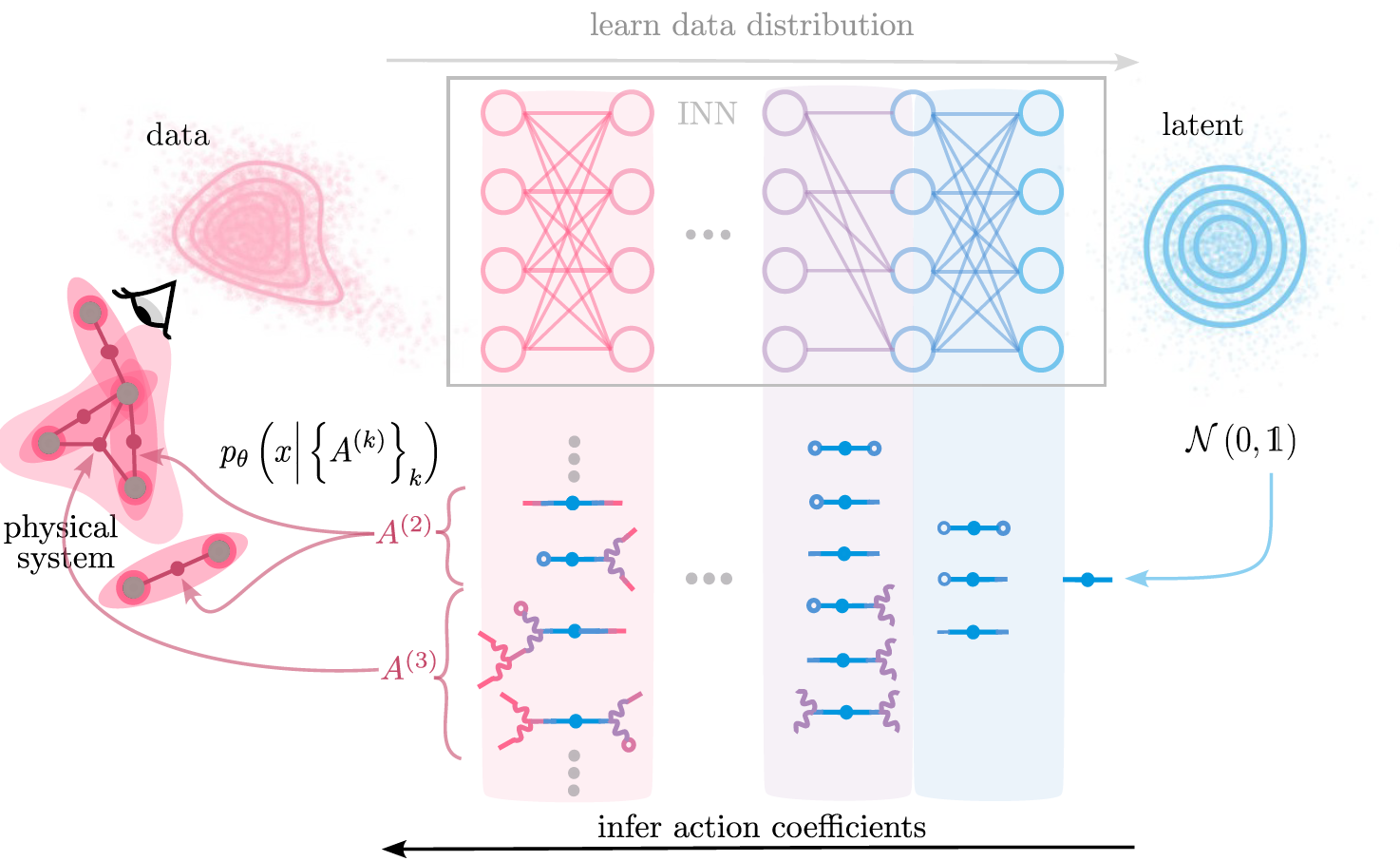
Example: Invertible neural networks
f_{\theta}
p_Z
NICE (Dinh et. al., 2015 ), RealNVP (Dinh et. al., 2017), GLOW (Kingma et. al. , 2018)
Learning through simplification
What do Invertible Neural Networks learn?
generate samples
Idea: describe system via interactions between its constituents
Example: Invertible neural networks
f_{\theta}
p_Z
NICE (Dinh et. al., 2015 ), RealNVP (Dinh et. al., 2017), GLOW (Kingma et. al. , 2018)
Infer interactions from trained neural network
Merger, Rene, Fischer, et. al. ‘Learning Interacting Theories from Data’. PRX, 2023
Example 2: Diffusion
f_{\theta}
p_Z
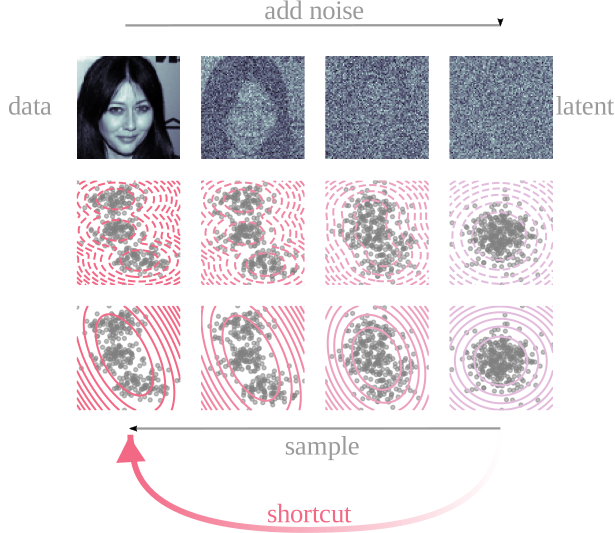
Ho, Jonathan, Ajay Jain, and Pieter Abbeel. ‘Denoising Diffusion Probabilistic Models’, 2020
Example 2: Diffusion
f_{\theta}
p_Z
Ho, Jonathan, Ajay Jain, and Pieter Abbeel. ‘Denoising Diffusion Probabilistic Models’, 2020
Diffusion models reverse the noising process by predicting the noise vector.
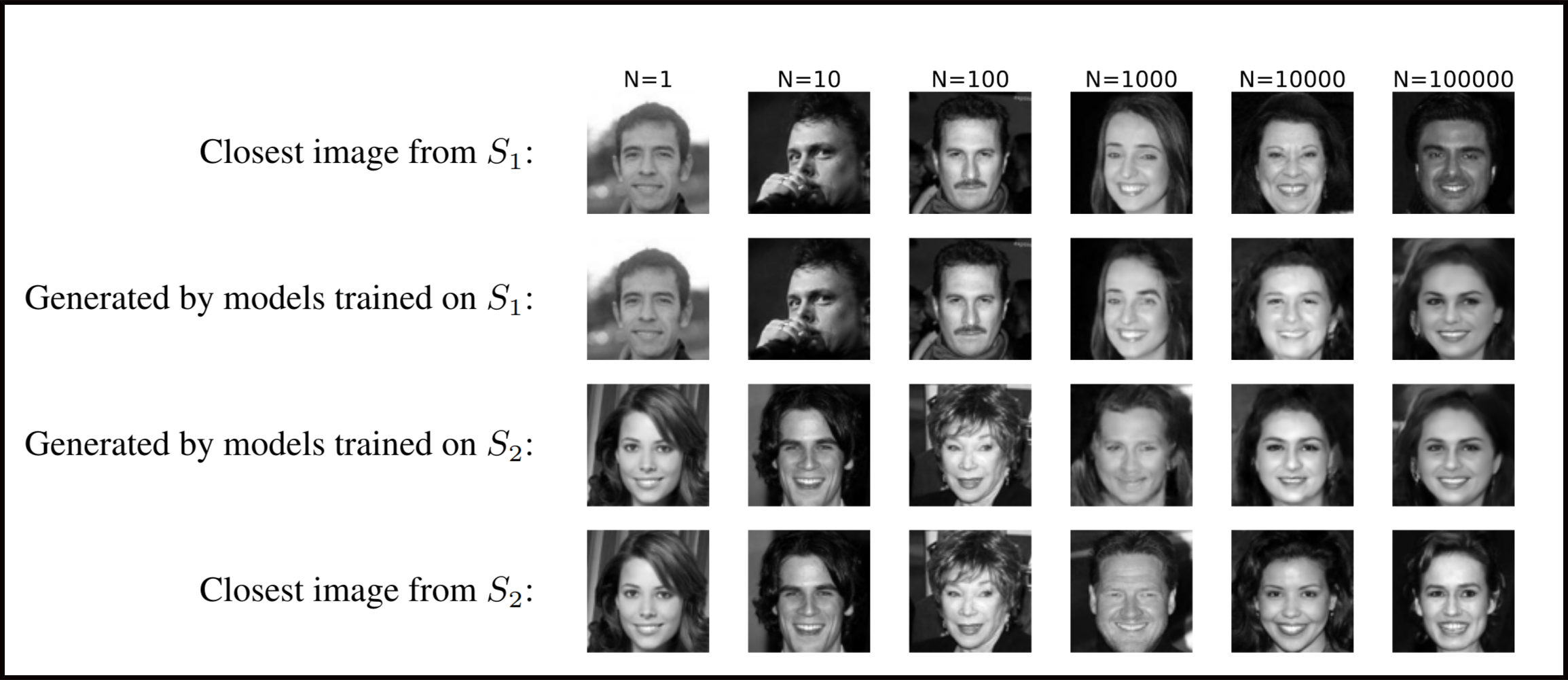
How much data do diffusion models need?
Can we predict when generalization happens?
\( \mathcal{D_A} \)
\( \mathcal{D_A} \)
\( \mathcal{D_B} \)
\( \mathcal{D_B} \)
\( \mathcal{D_B} \)
use \( \mathcal{D_A} \) to train \( \epsilon_A \)
use \( \mathcal{D_B} \) to train \( \epsilon_B \)
split data into
\( \mathcal{D_A},\mathcal{D_B} \)
Kadkhodaie, Z. et. al. Generalization in Diffusion Models Arises from Geometry-Adaptive Harmonic Representations’. April 2024.
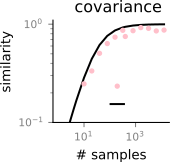
Can we predict when generalization happens?
Ansatz: Pairwise Interactions in the data?
\( \rightarrow \) covariance

\(p \)
\(p_{\theta} \)
diffusion
prediction
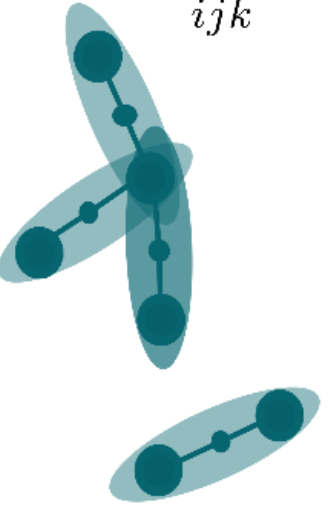
Summary: Understanding Generative Neural Networks
Task: Given some data \( \mathcal{D} \) from an unknown distribution \( p \)
Generate \( x \sim p \)
Task is solved by learning \( \, p_{\theta} \approx p\)
Questions:
- What can we learn from \(p_{\theta} \) about data?
- How close are \( p, \, p_{\theta} \) ?
\( p\)
\( \, p_{\theta} \)
\( \Rightarrow \) Interactions as a language to span model space.
\( \Rightarrow \) Representative of Group approach to understand Neural Networks and Learning
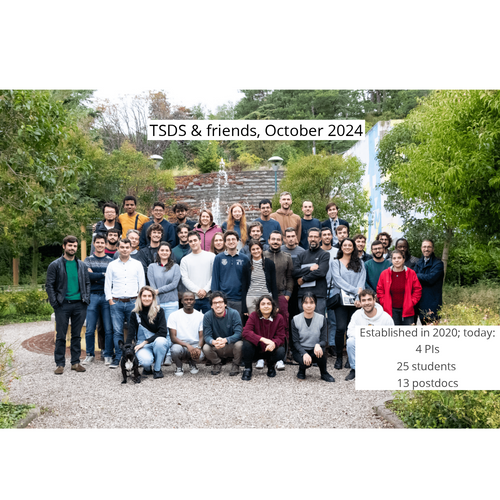
Theory of Neural Networks Group

Neural Architectures
Learning
Algorithms
Data statistics
computation in biol. systems
(and friends)
Physics Day Data Science
By merger