Electromagnetism
Introduction
- An electric current flowing through a conductor produces a magnetic field around it.
- If the current stops flowing, the magnetic field also disappears
- When current flows through a coil of wire (called solenoid) around a magnetically soft core, then the core gets magnetised
- = Magnet with north and south poles
- (There would be a magnetic field even without the core, but with a core present the field is even stronger)
- This is the basis of electromagnets
- See diagram in textbook, page 317
6.1 understand that an electric current in a conductor produces a magnetic field round it
6.2 describe the construction of electromagnets
Magnetic Field patterns
- A straight wire carrying a current will generate a field forming concentric circles around it
- See diagram on page 319
- Drawing the magnetic field direction correctly with respect to the direction of the current is important
- See diagram on page 319
- Right-hand rule = "Trick" to figure out direction of field arrows
- To represent the magnetic field in the plane of the paper/slide you're reading, often current that flow into the paper/slide and out of the paper/slide (i.e. towards you) are described
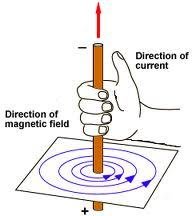
6.10 sketch and recognise magnetic field patterns for a straight wire, a flat circular coil and a solenoid when each is carrying a current
Magnetic field pattern for circular coil
- Pay attention the direction of the current and the direction of magnetic field lines
- The right hand rule still applies
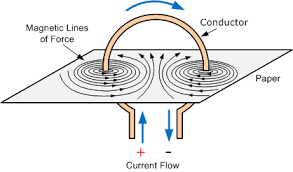
Magnetic field pattern
for solenoid
- (Pay attention to the current and field directions again)
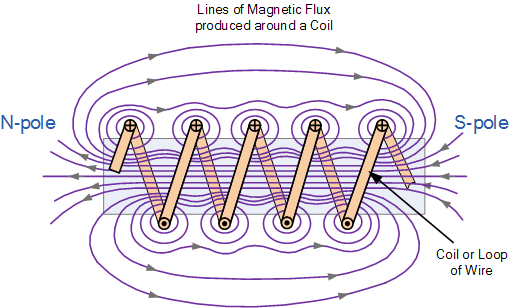
Title Text
- A charged particle (such as an electron) moving through a magnetic field experiences a force
- ...as long as it's not moving parallel to the field
- i.e. it has to be moving at an angle to the field
- the force will be "sideways" (try to veer the particle off its path)
- ...as long as it's not moving parallel to the field
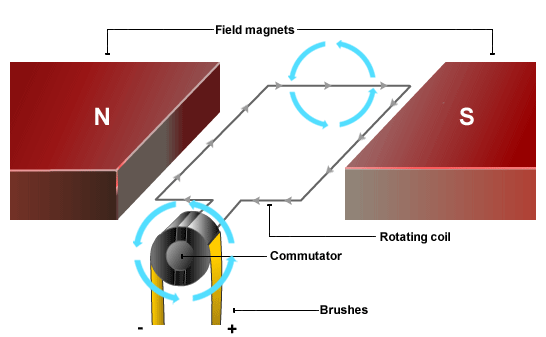
- This is why a current carrying wire (which basically consists of moving electrons) will experience a force in a magnetic field
- This is the principle by which the following work:
- motors
- loudspeakers
- This is the principle by which the following work:
6.11 understand that there is a force on a charged particle when it moves in a magnetic field as long as its motion is not parallel to the field
Electric Motor
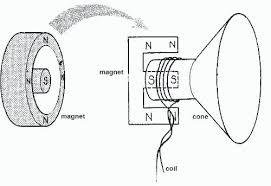
Loudspeaker
- Paper cone attached to coil of wire through which current flows
- The current changes (in according with the sound signal) and this changes the magnetic field caused due to the current
- This magnetic field interacts with the field due to the permanent magnet
- This causes backward and forward forces to be exerted on the wire/cone.
- The cone vibrates, making the air vibrate - this is heard as sound
Predicting the direction of the force
- Fleming's left hand rule lets us predict the direction of the force, if we know the direction of the current and the magnetic field
- See book, page 323
- Exercise: apply it to the motor diagram two slides ago to convince yourself of the direction of the motor's rotation
6.13 use the left hand rule to predict the direction of the resulting force when a wire carries a current perpendicular to a magnetic field
Force increases with increase in current and magnetic field
- like, duh?
Electromagnetism
By mindblah