Creating Cut Lists
for Hollywood and Broadway style flats
Hollywood and Broadway style flats have some key structural characteristics which you should be able to identify. Both flat styles have two stiles, two rails, and a various number of toggles (the number depends on the height of the flat). Stiles are the vertical pieces of lumber and rails are the horizontal pieces. Together, the two stiles and the two rails make up the outer frame of the flat, with the rails completely making up the top and bottom portions. The toggles are horizontal pieces that reside within the stiles, and they help give structural support to the flat.
More details on
Hollywood Flats
Hollywood Flats are flats that are constructed with the boards placed on their sides. To secure the boards to each other, they are often glued and nailed together, but they can also be screwed together.
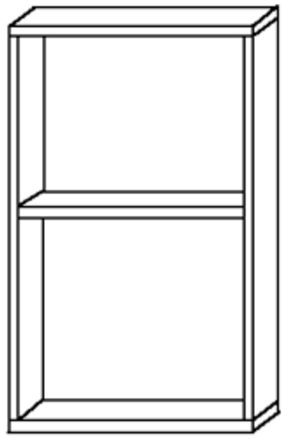
Here is an example of a Hollywood Flat. The rails make up the entire top and bottom, the stiles go in between those to add height, and the toggle(s) go in between those for support. Take notice on how the boards are placed on their sides.
More details on
Broadway Flats
Broadway Flats (aka Stage Flats) are flats that are constructed with the boards flat on their faces. To secure the boards to each other, various pieces of structural material are attacked to multiple boards at a time. These are called corner blocks, straps, half-straps, and keystones.
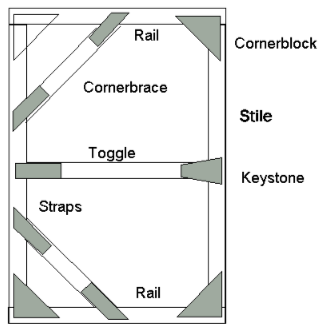
Here is an example of a Broadway Flat. The rails make up the entire top and bottom, the stiles go in between those to add height, and the toggle(s) go in between those for support. It is also common to have a cornerbrace on these flats for added support. Notice how all of the joints are held together with some piece of structural material.
Now I will show you the steps on
Creating the Cut List
for both Hollywood and Broadway style flats
Broadway
Hollywood
- Boards are on their wider face
- cut rails at total length for flat width
- subtract twice the actual width of the lumber from the flat height for your stile length
- subtract twice the actual width of the lumber from the flat width for your toggle length
- place a toggle around every two feet
- Boards are on their skinnier face
- cut rails at total length for flat width
- subtract twice the actual thickness of the lumber from the flat height for your stile length
- subtract twice the actual thickness of the lumber from the flat width for your toggle length
- place a toggle around every two feet
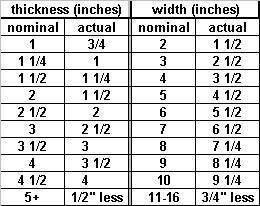
Lumber is measured in thickness x width.
You need to keep this in mind when you plan out what lengths of wood you actually need.
On the next slide I will include a chart that shows the actual thicknesses and widths of each nominal lumber measurements.
Example Cutlist:
I am given these measurements for a Broadway style flat. They want a flat that is 4ft x 8 ft. How would you make your cut list?
First I get my lumber measurements. I am using 1 x 4 planks, but the actual measurements are 3/4 x 3 1/2.
The flat is 4 ft. x 8 ft., so I automatically know my rail length is 4 ft.
I take 8 ft. and subtract 3 1/2 in. twice, to get 7 ft 5 in., which is my stile length.
I take 4 ft. and subtract 3 1/2 in. twice, to get 3 ft 5 in., which is my toggle length.

Now that I have all my lengths, I can make up my cut list for a 4 ft. x 8 ft. Broadway style flat:
2 Rails @ 4' - 0"
2 Stiles @ 7' - 5"
2 Toggles @ 3' - 5"
Creating Cutlists
By Mitchell Sigurdson