排程場演算法
+
約瑟夫問題
為什麼我會想講這兩個東西:
前幾次APCS的觀念題有考到,
然後我那時候不會寫 :)
自我介紹

我是112班16號的翁釩予
成電38屆 教學+網管
興趣:打code、剪輯影片、玩minecraft
discord: @mlgnotcool
中序infix 和 後序postfix
(是什麼可以吃嗎?)
中序 infix:
我們平常表示四則運算的方式
例如:(1+1*2)*2 = 6
後序 postfix:
電腦比較好算的方法
例如:112*+2* = 6
(不會有括號和先乘除的問題)
後序 怎麼算:
一直把數字加到一個stack內,如果遇到運算元時,
就把stack上的兩個數字取出來,算完之後再放回stack
舉例來說:
| 目前後序到哪 | stack (前面進出) | 說明 |
|---|---|---|
| 112*+2* | 原式 | |
| 12*+2* | 1 | 1 -> 把1放進stack |
| 2*+2* | 11 | 1 -> 把1放進stack |
| *+2* | 211 | 2 -> 把2放進stack |
| +2* | 21 | * -> 把2和1相乘 |
| 2* | 3 | + -> 把2和1相加 |
| * | 32 | 2 -> 把2放進stack |
| 答案: | 6 | * -> 把3和2相乘 |
給大家時間寫寫看 (應該不會太難)
(答案在下一頁)
#include <bits/stdc++.h>
#define endl '\n'
#define int long long
using namespace std;

string str; stack<int> nums;
signed main(){
    ios::sync_with_stdio(0); cin.tie(0);

    while (cin >> str){
        if (str == "+"){
            int x = nums.top(); nums.pop(); int y = nums.top(); nums.pop();
            nums.push(x + y);
        }else if (str == "-"){
            int x = nums.top(); nums.pop(); int y = nums.top(); nums.pop();
            nums.push(y - x);
        }else if (str == "*"){
            int x = nums.top(); nums.pop(); int y = nums.top(); nums.pop();
            nums.push(x * y);
        }else if (str == "/"){
            int x = nums.top(); nums.pop(); int y = nums.top(); nums.pop();
            nums.push(y / x);
        }else{
            nums.push(stoi(str));
        }
    }

    cout << nums.top() << endl;
}
排程場演算法
shunting yard algorithm
我們現在有一個中序表達式,
然後要我們轉成後序表達式:
排程場演算法!
這個演算法要做的事:
先準備一個stack來處存運算元,
並且做一個較order()的函式,來回傳這個運算元的等第
int order(char c) {
    if (c == '/' || c == '*') return 2;
    else if (c == '+' || c == '-') return 1;
    else return -1;
}
跑過中序的每個數字和運算元
1. 如果遇到數字,就直接輸出
2. 如果遇到 '(',就直接放到stack裡
3. 如果遇到 +-*/:
若stack最上方的運算元的等第>目前運算元的等第,就輸出和pop掉。
重複直到stack是空的 或 stack最上方的運算元的等第<=目前運算元的等第
4.如果遇到 ')',就從stack輸出和pop最上方的運算元,直到遇到'('為止
5.最後跑完之後,把stack剩下的東西都輸出
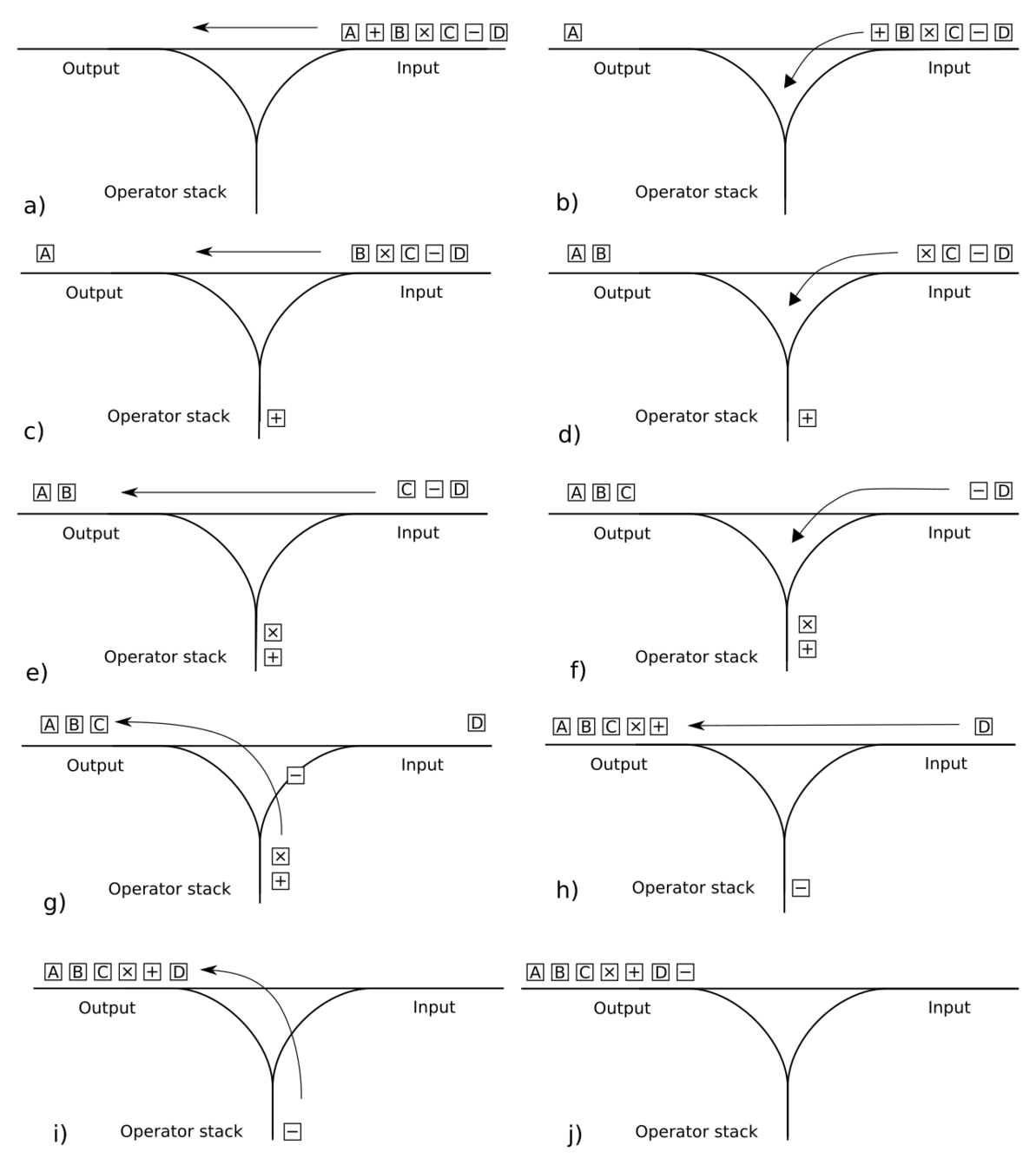
把它想像成這樣,數字直接過去,運算元要到下面的stack去
| 目前中序到哪 | stack (前面進出) | 目前輸出的 |
|---|---|---|
| (1+1*2)*2 | ||
| 1+1*2)*2 | ( | |
| +1*2)*2 | ( | 1 |
| 1*2)*2 | (+ | 1 |
| *2)*2 | (+ | 11 |
| 2)*2 | (+* | 11 |
| )*2 | (+* | 112 |
| *2 | 112*+ | |
| 2 | * | 112*+ |
| * | 112*+2 | |
| 112*+2* |
舉例來說:
為什麼會有用 (概略的解釋):
1.因為後序是先有兩個數字,再有運算元,
因此我們遇到運算元時先放stack之後處理。
2. 因為中序有先乘除後加減的問題,所以遇到新的運算元時,如果目前stack上有一個等第比較大的,那就要先處理。
3. 如果遇到(),就會先處理()裡面的東西,因此遇到 ) 時就要一路輸出直到遇到 (
#include <bits/stdc++.h>
#define endl '\n'
#define maxn 200005
using namespace std;

stack<char> oper; string str;
int order(char c) {
    if (c == '/' || c == '*') return 2;
    else if (c == '+' || c == '-') return 1;
    else return -1;
}
int main(){
    ios::sync_with_stdio(0); cin.tie(0);

    while (getline(cin, str)){
        for (int i=0; i<=str.size()-1; ++i){
            if (str[i] == ' ') continue;

            if (str[i] == '('){
                oper.push(str[i]);
            }else if (str[i] == '+' || str[i] == '-' || str[i] == '*' || str[i] == '/'){
                while (!oper.empty() && order(str[i]) <= order(oper.top())){
                    cout << oper.top() << " ";
                    oper.pop();
                }
                oper.push(str[i]);
            }else if (str[i] == ')'){
                while (oper.top() != '('){
                    cout << oper.top() << " ";
                    oper.pop();
                }
                oper.pop();
            }else{
                cout << str[i] << " ";
            }
        }

        while (!oper.empty()){
            cout << oper.top() << " ";
            oper.pop();
        }
        cout << endl;

    }
}
如果還是聽不懂的:
解釋影片
更多題目:
約瑟夫問題
Josephus Problem
假設我們現在有n個人排成一圈,從1開始數,
每數k個人(包含開始的那位),
那個人就必須離開圈圈,
那我們如何求出最後一位剩下的人呢?
舉例來說,n=5, k=2:
原本的人:1 2 3 4 5
出去的順序為:2 4 1 5 3
最後一位剩下的人就會是 3
直接用陣列模擬?
O(nk)

💥💥💥TLE💥💥💥
直接用陣列模擬?
如果我們只有要找出最後一位的話
就會有更快的解法
O(n)
*如果要找順序的話,就只能用比較慢的解法
我們會用到的方式是
在k固定的情況下,把1~n個人的最後一位
計算出來,並使用前一項來計算下一項
(就是遞迴或dp啦)
1. 先把全部數字用 0~n-1 表示,這樣比較好算,最後答案再+1就好
2. 先把遞迴的終止條件寫出來:
n=1時 -> 答案回傳 0
3. 想我們的轉移式:
第n項 = 先把第一個人去除掉後,再加前一項f(n-1)的解果
因為我們在去除掉第一位後,可以想像成f(n-1)的每個人都往後移k位,最後再%n防止超出界線
最後得到遞迴式:
f(n) = (f(n-1)+k) \% n
int josephus(int n){
    if (n == 1) return 1;

    return (josephus(n-1) + k) % n;
}
遞迴式
dp[1] = 0;
for (int i=2; i<=n; ++i){
    dp[i] = (dp[i-1]+k)%n;
}
dp式
空間 O(1)
*記得答案最後要加1
int s = 0;
for (int i=2; i<=n; ++i){
    s = (s+k)%n;
}O(nk)
#include <bits/stdc++.h>
#define endl '\n'
#define maxn 200005
using namespace std;

int n, curidx, p[maxn];
int main(){
    ios::sync_with_stdio(0); cin.tie(0); cout.tie(0);

    cin >> n;

    for (int i=1; i<=n; ++i){
        curidx = (curidx+1) % n;
        while (p[curidx] == 1) curidx = (curidx+1) % n;

        if (i==n) cout << curidx+1 << endl;
        else cout << curidx+1 << " ";


        p[curidx] = 1;
        while (p[curidx] == 1 && i!=n) curidx = (curidx+1) % n;
    }
}
O(n)
#include <bits/stdc++.h>
#define endl '\n'
using namespace std;

int n, m, k;

int josephus(int n){
    if (n == 1 || k == 0) return 0;

    --k;
    return (josephus(n-1)+m)%n;
}

int main(){
    ios::sync_with_stdio(0); cin.tie(0);

    cin >> n >> m >> k;

    cout << josephus(n)+1 << endl;
}
還是聽不太懂的:
解釋
約瑟夫問題 進階版
more Josephus Problem
(或許講不到,有興趣自己回家讀)
小補充:
k=2時,有分析數據得到解果的很快方法
前面講的有更快的解法,找最後一位有 O(log n) 解
找順序有 O(n logn) 解
(只是我前面說的APCS應該就夠用了)
有興趣可以自己學學 :)
要用到找順序的 O(n logn) 解
照理來說,如果用vector來存,並且用erase()
來移除要離開的那項的話,就會花到 O(n^2) 時間
但是我們可以用一個東西叫做 ordered set
他和set差不多,erase會是O(log n),
只是他有順序,可以找set裡的第幾項
#include <ext/pb_ds/assoc_container.hpp>
using namespace __gnu_pbds;
#define ordered_set tree<int, null_type, less<int>, rb_tree_tag, tree_order_statistics_node_update>
宣告:
#include <bits/stdc++.h>
#define endl '\n'
#define maxn 200005
using namespace std;

//ordered set
#include <ext/pb_ds/assoc_container.hpp>
using namespace __gnu_pbds;
#define ordered_set tree<int, null_type, less<int>, rb_tree_tag, tree_order_statistics_node_update>

int n, k, cur; ordered_set s;
int main(){
    ios::sync_with_stdio(0); cin.tie(0);

    cin >> n >> k;
    for (int i=1; i<=n; ++i) s.insert(i);

    for (int i=1; i<=n; ++i){
        cur = (cur + k) % s.size();

        auto it = s.find_by_order(cur);
        if (i==n) cout << *it << endl;
        else cout << *it << " ";

        s.erase(it);
    }
}
因為題目的k=2,會有一個很快的解法
我們的方法是將圈圈每次都減半,將每個人重新編號,最後有答案時再轉回原本的編號,用遞迴去做
O(log\ n)
最後每次的時間就會是:
遞迴的終止條件:
int josephus(int n, int k){
    if (n==1) return 1;
    if (k<=(n+1)/2){
        if (2*k>n) return (2*k)%n;
        else return 2*k;
    }
}
若剩下一個人,當然最後一個人就會是1
如果 k<=(n+1)/2 (考慮奇偶數)
那答案就會是2*k (可以自己列列看)
(也要考慮超出n的情況)
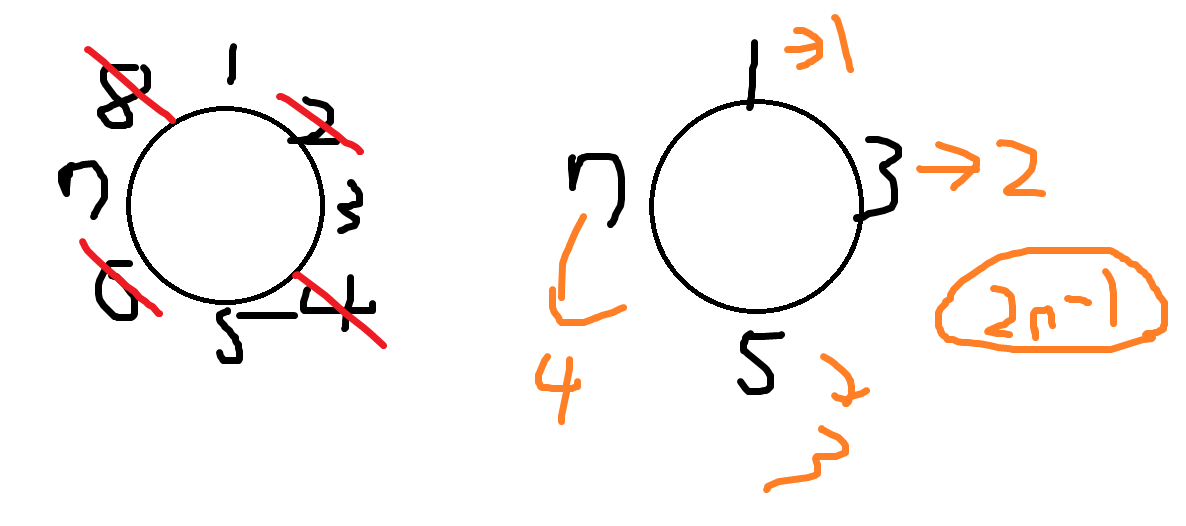
考慮n為偶數的情況,在刪掉一半和重新編號之後,轉回原本的編號只要2n-1就好了
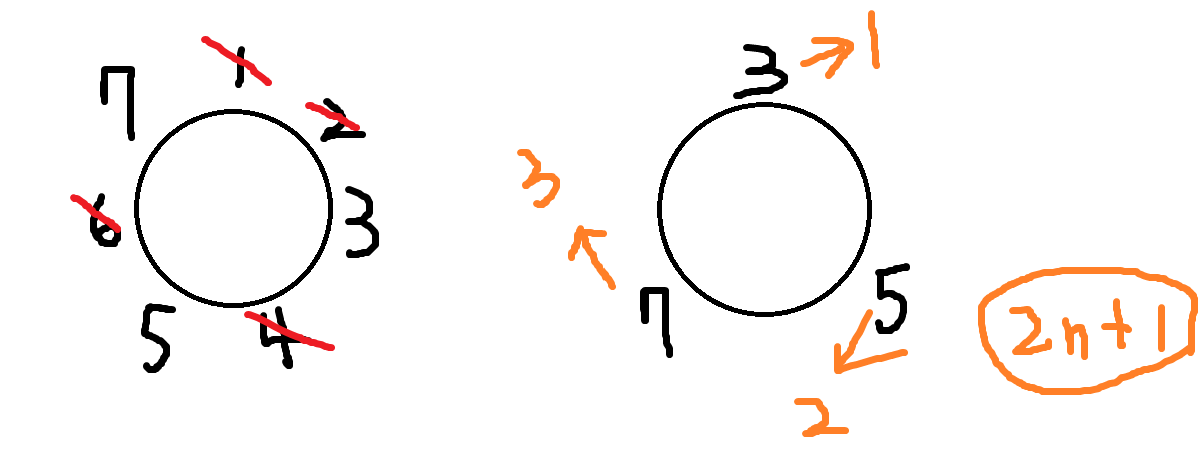
考慮n為奇數的情況,在刪掉一半和重新編號之後,轉回原本的編號只要2n+1就好了
最後的程式:
#include <bits/stdc++.h>
#define endl '\n'
using namespace std;

int q, n, k;

int josephus(int n, int k){
    if (n==1) return 1;
    if (k<=(n+1)/2){
        if (2*k>n) return (2*k)%n;
        else return 2*k;
    }

    int tmp = josephus(n/2, k-(n+1)/2);
    if (n%2==1) return 2*tmp+1;
    else return 2*tmp-1;
}

int main(){
    ios::sync_with_stdio(0); cin.tie(0);

    cin >> q;
    for (int i=1; i<=q; ++i){
        cin >> n >> k;
        cout << josephus(n, k) << endl;
    }
}
shunting yard + josephus problem
By MLGnotCOOL