The Respiratory System
Paul Enkiri
HEALTH 101
Nose
Normally air enters the body during inhalation through the nostrils.
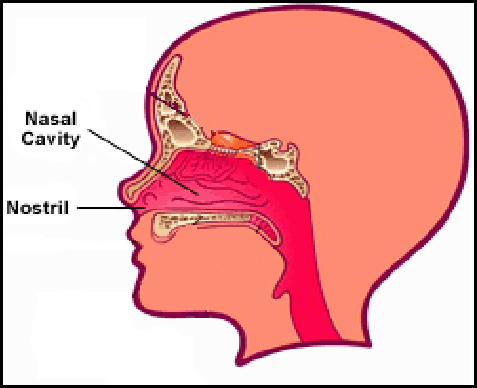
The nostrils act as a filtration system, warming and moistening the air as it passes through the mucous membrane.
After passing through the nasal passages, the air enters into the throat.
Pharynx and Trachea
From the nasal passage the air enters into the pharynx (throat) which is a common passageway for both food and air.
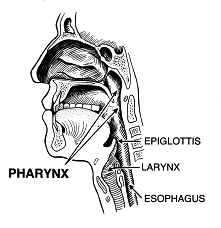
The pharynx divides into two passageways that are separated by a small flap of tissue called the epiglottis. The trachea (windpipe) leads air from the pharynx to the lungs. The epiglottis diverts food away from the trachea into the esophagus (food tube) which leads to the stomach.
Pharynx and Trachea (continued)
Normally, this action works automatically, keeping food out of the trachea and air out of the esophagus. But if the muscles in the pharynx are not coordinated, food or liquid could enter the trachea instead of the esophagus.
If a person is unresponsive, normal swallowing controls do not operate. First aiders should never pour liquid into the mouth of an unresponsive victim. The liquid could flow into the windpipe, causing suffocation.
Lungs
The lungs occupy most of the chest cavity and is where oxygen is infused into red blood cells and waste gasses are exhaled.
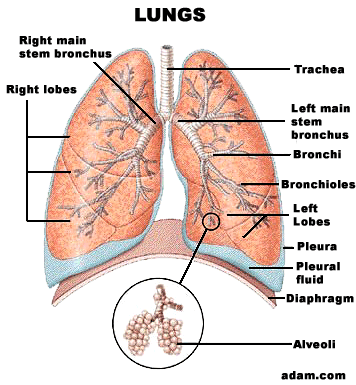
From the trachea, air flows into two main tubes called bronchi. There is a bronchi for each lung
The bronchus divides and subdivides like the branches of a tree, with the smallest bronchioles ending in tiny air sacs called alveoli.
Lungs (continued)
These air sacs are enclosed in a network of capillaries and are separated by very thin walls.
Here, oxygen combines with the hemoglobin of red blood cells to form oxyhemoglobin, and is then dispersed to the rest of the body.
At the same time carbon dioxide and other waste gasses in the blood transfer into the air sacs and are then exhaled from the body.
The Mechanics of Breathing
Breathing is possible due to a muscle known as the diaphragm, which divides the abdomen from the chest.
When the diaphragm contracts, the chest expands, which draws air into the lungs. This is called inhalation. This is when an exchange of oxygen an carbon dioxide take place. When the diaphragm relaxes, pressure is exerted onto the lungs causing the air to flow out. This is called exhalation.
The Mechanics of Breathing (continued)
Children and infants have smaller respiratory systems than adults and are more easily obstructed.
Average Rate of Breathing at Rest:
Adults: 12 - 20 breaths per minute
Children: 15 - 30 breaths per minute
Infants: 25 - 50 breaths per minute
Normally breathing rates slow when a person is at rest, and speeds up during vigorous activities.
Signs of inadequate breathing include an unusual breathing rate, cool/clammy skin that is pale or blue, and nasal flaring
The End
RESPITORY SYSTEM
By penkir1