



Renato Cordeiro Ferreira
Scientific Programmer @ JADS | PhD Candidate @ USP | Co-founder & Coordinator @CodeLab
Characterizing the Complexity of
ML-Enabled Systems
https://renatocf.xyz/cain26-slides
2026
Renato Cordeiro Ferreira
Institute of Mathematics and Statistics (IME)
University of São Paulo (USP) – Brazil
Jheronimus Academy of Data Science (JADS)
Technical University of Eindhoven (TUe) / Tilburg University (TiU) – The Netherlands
Paper
Slides
Former Principal ML Engineer at Elo7 (BR)
4 years of industry experience designing, building, and operating ML products with multidisciplinary teams
B.Sc. and M.Sc. at University of São Paulo (BR)
Theoretical and practical experience with Machine Learning and Software Engineering
Scientific Programmer at JADS (NL)
Currently participating of the MARIT-D European project, using ML techniques for more secure seas
Ph.D. candidate at USP (BR)
Researching about SE4AI, in particular about MLOps and software architecture of ML-Enabled Systems
Renato Cordeiro Ferreira
https://renatocf.xyz/contacts
My goal is to characterize
how complexity emerges
in the software architecture
of ML-enabled systems
Research Questions
What are the system components that describe
the architecture of ML-enabled systems?
What are the dimensions of complexity that affect
the architecture of ML-enabled systems?
RQ1
RQ2
RQ2
How does complexity correlate with the components of the architecture of ML-enabled systems?
RQ3
Research Methodology
Reference Architecture
+
Complexity Model
Academic and Industry-based case studies
of MLES
Application
and validation
of the complexity model using the case studies
Complexity Model
Data
Model
Code
Schema
Sampling
Volume
Algorithms
More Training
Experiments
Business Needs
Bug Fixes
Configuration
Axis of Change for ML
Based on "Continuous Delivery for Machine Learning", by Danilo Sato, Arif Wider, and Christoph Windheuser -- https://martinfowler.com/articles/cd4ml.html
Data
Model
Code
Volume
Value
Velocity
Variety
Veracity
Dynamism
Explainability
Staleness
Choreography
Flexibility
Scalability
Adaptability
Availability
Reliability
Performance
Data
Volume
Value
Velocity
Variety
Veracity
Small / Big
Batch / Mini-Batch / Streaming
Structured / Unstructured / Mixed
Bronze / Silver / Gold
Poor / Rich
Model
Dynamism
Explainability
Staleness
Choreography
Flexibility
Frequency of Concept Drift
Frequency of Data Drift
Combination of Models
Number of (hyper)parameters
Interpretability of Results
Code
Scalability
Adaptability
Availability
Performance
Resiliency
Expected increase of demand
Expected service level agreement
Expected limitations on runtime
Expected tolerance to faults
Expected flexibility to changes
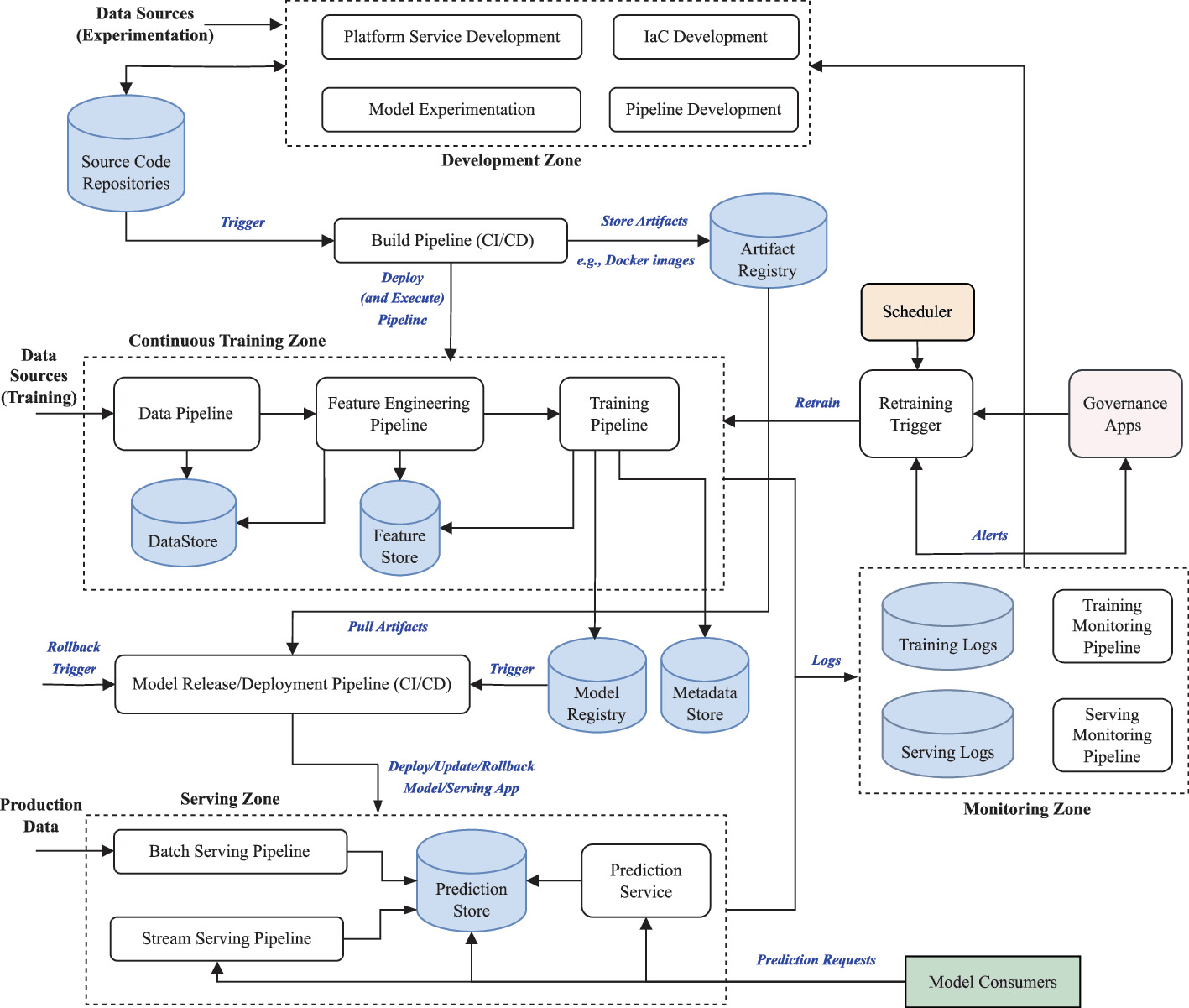
Reference Architecture
for ML-Enabled Systems
Published at:
ECSA 2025
MLOps in Practice:
Requirements and a Reference Architecture from Industry
renatocf.xyz/ecsa25-paper
Published at:
DS @ CAIN 2025
A Metrics-Oriented Architectural Model
to Characterize Complexity on
ML-Enabled Systems
renatocf.xyz/cain25-paper
Case Study #1
SPIRA
Published at:
SADIS @ ECSA 2025
Making a Pipeline
Production-Ready:
Challenges and
Lessons Learned in the
Healthcare Domain
https://renatocf.xyz/sadis25-paper
renatocf.xyz/sadis25-paper
Data Collection App
Scientific Initiation 2021
Francisco Wernke
Streaming
Prediction Server
+ Client API / App
Capstone Project 2022
Vitor Tamae
Highly Availability
with Kubernetes
Capstone Project 2023
Vitor Guidi
Redesign Continuous Training Subsystem
Capstone Project 2023
Daniel Lawand
CI/CD/CD4ML on
Training Pipeline
Capstone Project 2024
Lucas Quaresma
+ Roberto Bolgheroni
Case Study #2
OCEAN GUARD
Published at:
SummerSOC 2025
MLOps with
Microservices:
A Case Study in the Maritime Domain
renatocf.xyz/ssoc25-paper
Research Team
MSc Students
Innovation Team
PDEng Trainees
Ui Dev Team
Hired Developers
Core Dev Team
Scientific Programmers
Published at:
SAiP @ ICSA 2026
Reusability
in MLOps:
Leveraging Ports and
Adapters to Build a
Microservices Architecture
for the Maritime Domain
renatocf.xyz/icsa26-paper
v3
v4
v5
Feedback & Next Steps
Defense?!
please
Some welcome feedback...
1
2
How can I best execute the practitioner validation?
3
How can I best illustrate the complexity model?
How can I best introduce the case studies?
Characterizing the Complexity of
ML-Enabled Systems
https://renatocf.xyz/cain26-slides
2026
Renato Cordeiro Ferreira
Institute of Mathematics and Statistics (IME)
University of São Paulo (USP) – Brazil
Jheronimus Academy of Data Science (JADS)
Technical University of Eindhoven (TUe) / Tilburg University (TiU) – The Netherlands
Paper
Slides
By Renato Cordeiro Ferreira
How can the complexity of ML-enabled systems be managed effectively? The goal of this research is to investigate how complexity affects ML-enabled systems (MLES). To address this question, this research aims to categorize dimensions of architectural complexity that characterize the complexity of MLES. The goal is to support architectural decisions, providing a guideline for the inception and evolution of these systems.