Strategy for Indigenous Development
by
Inter-American Development Bank
2006
The need for the Strategy
- Bank's new vision since 1994
- correlation between indigenous peoples (IP) and poverty levels
- the potential of IP' cultural and natural heritage for their development (+ society)
Current Strategy seeks to enhance the Bank's contribution to the development with identity of IP
Before 1994
- governmental policies: assumption that IP sociocultural characteristics hinder development
Why is the Strategy specific for IP? Because:
- they have specific culture
- higher compatibility with sustainable development
- they exhibit political and cultural diversity
- they voice demands for greater autonomy
The indigenous peoples of Latin America and the Caribbean are at once the heirs and creators of an important natural, cultural, and social heritage that has been eroded by policies of exclusion, integration, and/or assimilation that dominated government actions until the 1950s.
Development with identity stresses
- harmonious interaction of IP with their environment
- conservation of resources in a long run (maximization of profit in a short run)
- respect for the principles of equity, interconnectedness, reciprocity, solidarity
Diagnostic assessment - 1st movie
(Indigenous peoples in Latin America)
Details not covered in the movie:
- wealth of IP's civilizations in the pre-Columbian times
- today: 20-25% of poor people of the region are IP (45-50% in rural areas)
- IP are getting poorer even though they are less vulnerable to economic crises
Many organizations question the relevance of conventional indicators and insist on the need to supplement them with others that take into account fundamental indigenous values consistent with their own concept of development and identity, such as the quality of the environment, legal protection of their territories, access to natural resources and spaces for exercising their spirituality, and the quality of social capital within their communities and organizations.
The Bank's experience
- potential adverse impacts on IP communities
- environmental and social quality control procedures
- today: 20% of projects that are ethnospecific
Lessons learned
While significant progress has been made in the number of projects that specifically include indigenous peoples, a significant percentage of projects which, although they implicitly and
theoretically include indigenous peoples among the beneficiaries, lack distinct ethno-specific or socioculturally appropriate mechanisms and never, in practice, manage to benefit the indigenous segment of the target population
What follows is a marriage of organizational, financial, managerial jargon with the below main points:
- Strategy objectives
- Major strategic focuses and priorities for Bank action
- Implementation activities
- Performance indicators
Each word is scrupulously chosen and an overall impression is that the Strategy is an artwork, a pure perfection, and that it will overcome all the difficulties of the real life.
Regional development banks - the great unknowns
2010 / Swiss Alliance of Development Organizations (alliancesud.ch)
In the case of the regional development banks, the snag lies in their strong focus on infrastructure mega-projects. Such projects may indeed serve the overall economy of a country or region and benefit large foreign corporations. But the poor rarely derive any direct benefit.
Regional development banks are also criticized for hardly involving the local people in project planning and implementation. Often not even the most basic project information is translated into the local languages. Large infrastructure projects frequently lead to expropriations and evictions and cause massive environmental damage. Moreover, civil society organizations voice the criticism that the affected people have little access to review mechanisms for the purposes of reporting abuses.
On paper, the development banks have responded to the criticism (e.g., excellent internal guidelines for project screening, consultation with civil society and for dealing with displaced persons).
In reality, however, the problems persist. The involvement of communities and their organizations is still optional. Governments, project teams and regional banks are under no real obligation to address the concerns of the population. Moreover, the practical implementation of the guidelines is flawed. [...] only a tiny fraction of the affected population has ever been consulted on several major projects.
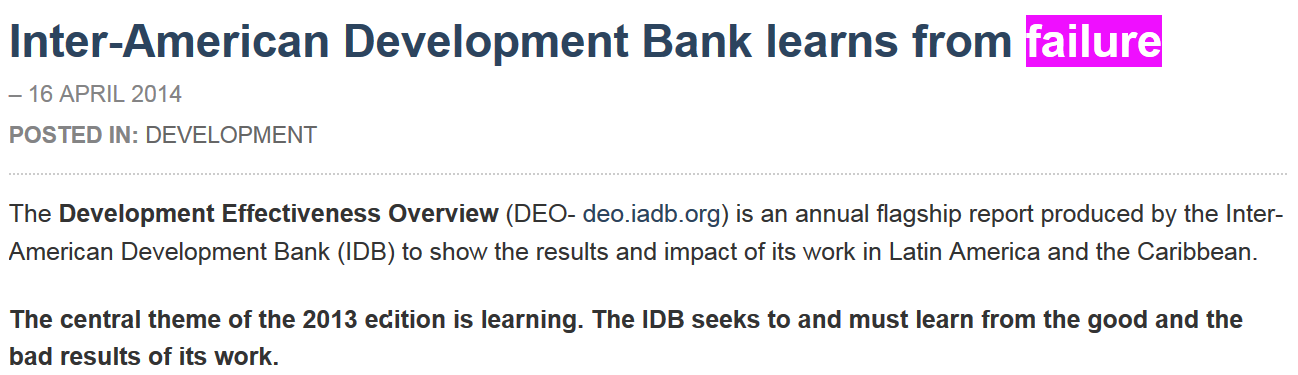
"In a novel way, IDB documents a series of failures http://deo.iadb.org/2013/en/tools/why-embrace-failure/ in six areas of the operational work and how they are learning from them. For example, the Bank learned that the privatization of water service does not always produce positive results and that institutional, political and legal aspects can derail the best technical designs. These lessons help to formulate better projects in the future. “If we do not learn from failure, what can happen is what Coco Chanel once famously sentenced: ‘Don’t spend time beating on a wall, hoping to transform it into a door.’, Veronica Zavala says in the editor’s Blog."
2nd movie
(Brazilian Indigenous Leader about Carbon Trading Scheme (REDD) - a False Solution to Climate Change)
Question
What do people like we can do to help people like them preserve their unique culture and develop with dignity?
Thank you!
© Piotr Kurczewski
mindfulness - compassion - love - empathy

4th presentation
By roninhoodi
4th presentation
Constructing an Environmental State: Eco-governmentality and other Transnational Practices of a ‘Green’ World Bank