Study of Optimal Mixing
Hsu, Hung-Wei
Prof. Yu, Tian-Li
2017.01.16
Outline
- Recap : Pasting Problem
- Again : Pasting Problem
Pasting Problem
1
1
1
1
0
0
0
1
0
1
1
0
Optimal solution
Target solution
\text{Paste }\,\mathcal{O}{(logn)} \Rightarrow \text{Supply} \,\,2^{c\log{n}}=n^{c}
Properties of Good Topologies
-
Tree structure / Loop structure
- Random instances
- 0-1 loss subfunction
We have discussed on problems with following properties
Counter Example
We have found counter example in 2d spin glass problem
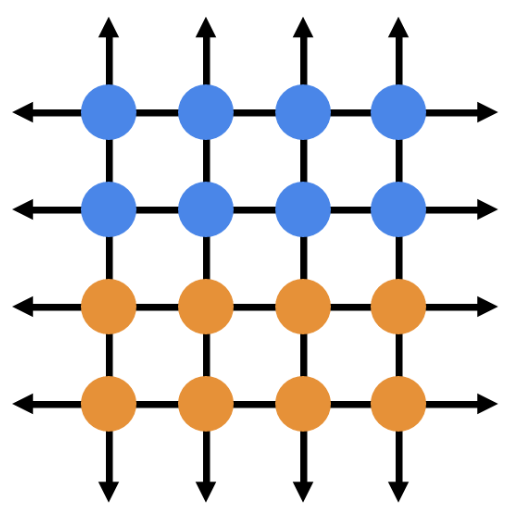
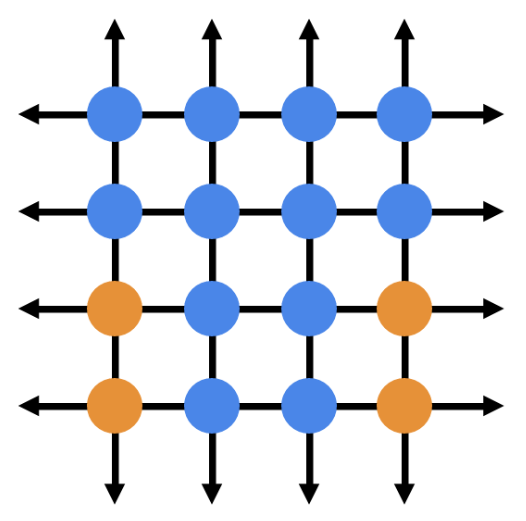
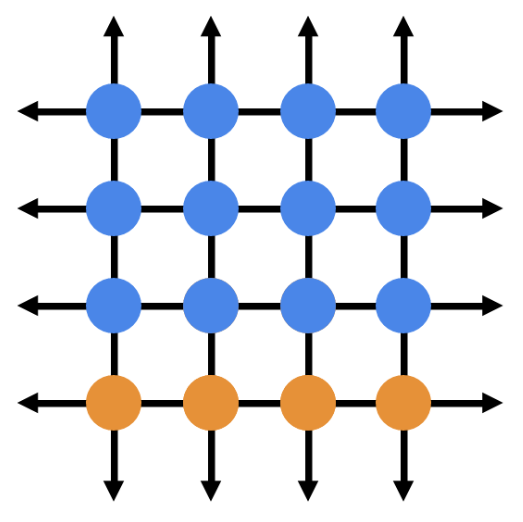
\frac{n}{4}
\sqrt{n}
An elegant approach
An elegant approach
- Find the area different to optimal solution
- Estimate the distribution of these areas size
- Bound the value by integration
Expected result
We first try exponential distribution :
\int_{0}^{N}2^{n}\,pdf\left(n\right)\,dn = \mathcal{O}\left(N^{2}\right)
pdf \left( n \right) = \lambda \, e^{-\lambda n}
\lambda \geq \ln{2}
We need :
pdf \left( n \right) = Cn\,2^{-n}
A Smarter Way
-
Ability to cut large areas into small ones
-
Apply a recusive method
-
Probability model
Order Assumption
+1
+3
-2
Order Assumption (recursive)
p_{1}
p_{2}
p_{3}
\int_{0}^{N}2^{n}\,pdf\left(n\right)\,dn
Selection of Cut
Cut path non-overlapping
\sum_{c \in C_{+} }f\left(c\right) = I
Conduct Experiments
-
Square shape
-
Use half-binomial distribution on boundary
-
Let the optimal solution fixed (all bit 1's)
-
Random instance
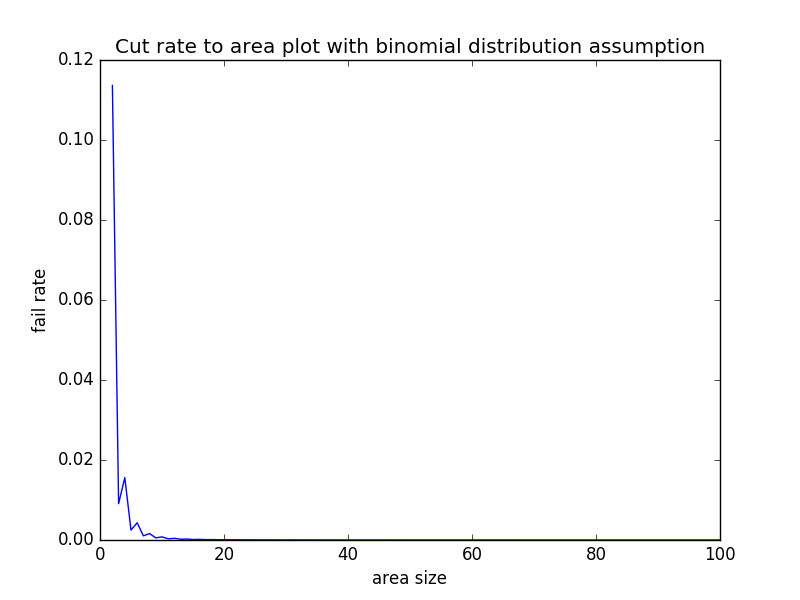
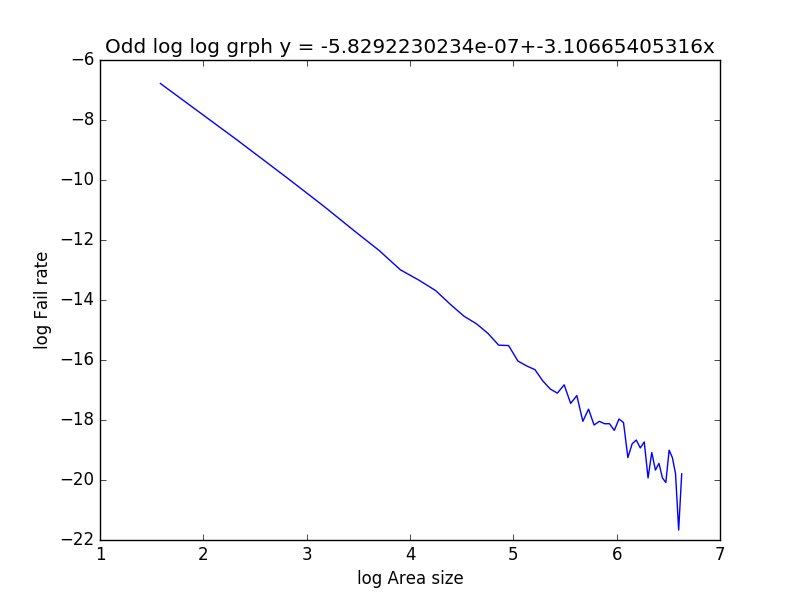
Fail Rate
Seems to be polynomial decay
Recursive Method
-1
+3
-2
Equal cut
-3
+3
-3
Zero boundary
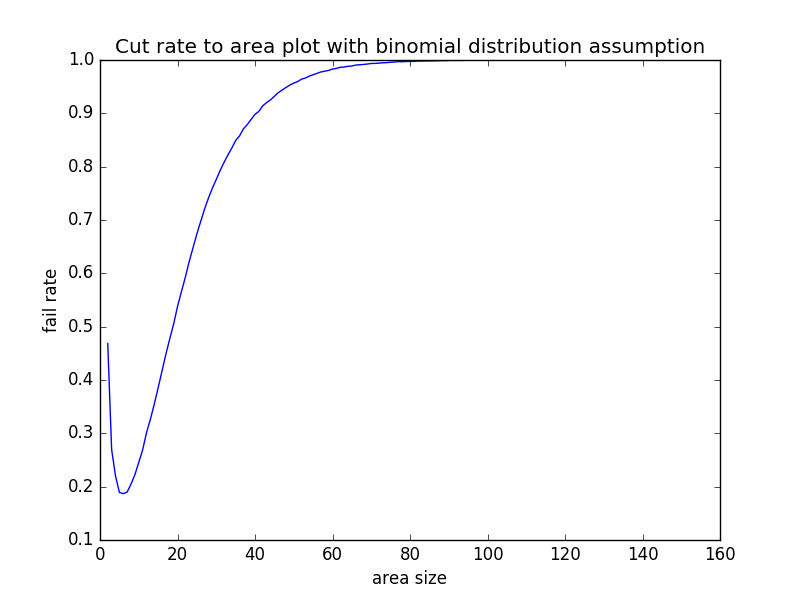
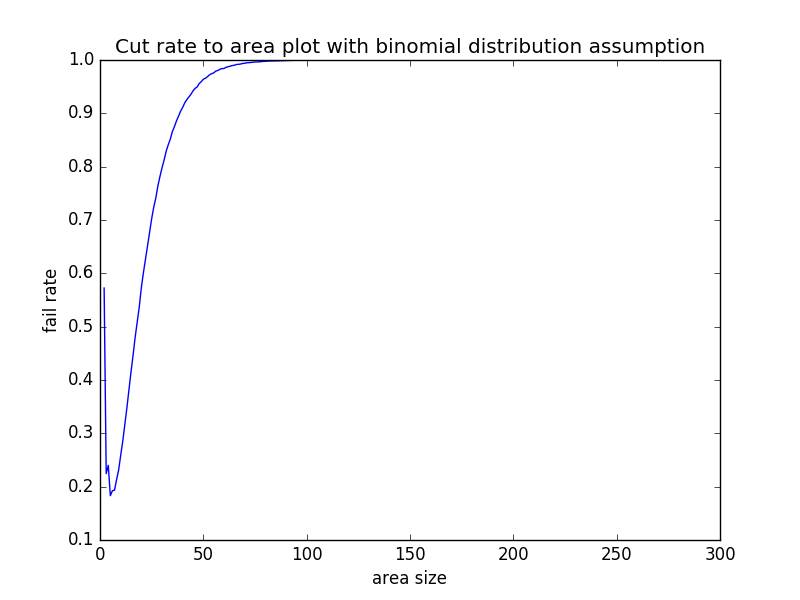
Fail Rate
Equal cut
Zero boundary
Fail rate grows as area increases
Cut selection
- + cut paths
- Z-shape cut paths
- General cut paths
\sum_{c \in C_{+} }f\left(c\right) = I
\sum_{c \in C_{+} }f\left(c\right) = I
\sum_{c \in C_{g} }f\left(c\right) = 2^{N-2}I
Sum
Path
Order
\mathcal{O}(\sqrt{N})
\mathcal{O}(N)
\mathcal{O}(2^{N-1})
Path
Overlapping
No
Yes
Yes
Another Problem
In 2d spin glass problem, the complement of optimal solution is also an optimal solution.
So when generating instances, it's not sufficient to use half binomial distribution
But we don't know what is the distribution of optimal solution
By-pass the Problem
- Find what kind of instance will not have a legal cut path
- Boundary
- Inner
- Conduct brute force experiment with general cut paths to find all these structures
- Derive some properties from observation
0
0
0
0
1
1
1
1
Properties :
- For degree 2 node
- ...
- ...
- For degree 1 node
- ...
- ...
Too restricted!!!
Back to Cut Path
We are now discuss on general cut path :
If we flip a inner region, it will never gain!
Means there are two optimal solutions
But we can choose the most similar one as reference
Back to Cut Path
So now we will always have legal cut path:
- A cut with outer region
- A legal cut must have positive gain with its outer region part only
Outer region
Inner region
Outer region part
Inner region part
Similar scheme
p_{1}
p_{2}
p_{3}
How to compute p?
What probability model to be used?
Probability Model
- Random bits for instance
- Randomly select region
- We want the conditional probability :
P\{\nexists \text{ cut}|A\,\,\text{is optimal}\}
=\frac{P\{\nexists \text{ cut}\wedge A\,\,\text{is optimal}\}}{P\{A\,\,\text{is optimal}\}}\leq C2^{-|A|}
A Sufficient Condition
- A region A with flip(Inner region) <= 0
- Outer region of A is identical to some optimal solution
Finally
Flip from outer region
Scheme
p_{1}
p_{2}
p_{3}
Easier to compute
About p
p^{\prime}+p^{\prime}(1-p^{\prime})+p^{\prime}(1-p^{\prime})^{2}+...
End
Study of Optimal mixing
By 許泓崴
Study of Optimal mixing
Individual Study of DSMGA2 by Sammy & Franky