Analysis Population Size of Optimal Mixing
許泓崴, 廖翊雲
指導教授:于天立 教授
2017.06.27
Outline
- Recap : Pasting Problem
- Again : Pasting Problem
\text{General Lower Bound }\mathcal{O}\left(\log{L}\right)
\text{Experiment curve }\approx\mathcal{O}\left(\log{L}\right)
\text{Population Size}
\text{Upper bound of lower bound for chain structure }\mathcal{O}\left(L^{2}\right)
\text{Upper bound of lower bound for loop structure }\mathcal{O}\left(L^{3}\right)
Pasting Problem
1
1
1
1
0
0
0
1
0
1
1
0
Optimal solution
Target solution
\text{Paste }\,\mathcal{O}{(logn)} \Rightarrow \text{Supply} \,\,2^{c\log{n}}=n^{c}
\text{Expected cost }\,\mathbb{E}{\left[ 2^{len} \right]} =\mathcal{O}{(n^c)}
\text{However,}\quad\mathbb{E}{\left[ 2^{len} \right]} \geq2^{\mathbb{E}{\left[ len\right]}}
Properties of Good Topologies
-
Tree structure / Ring structure
- Random instances
- Identical subfunction
We have discussed on problems with following properties
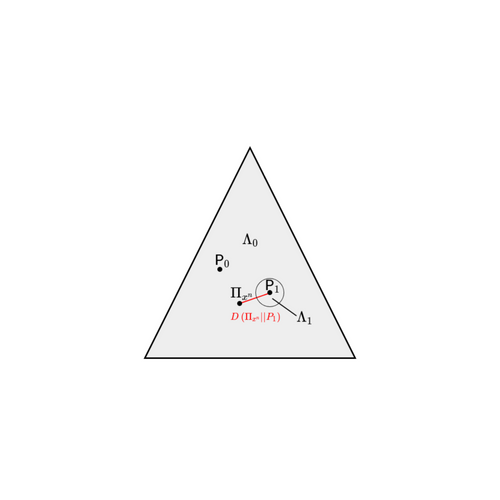
Counter Example
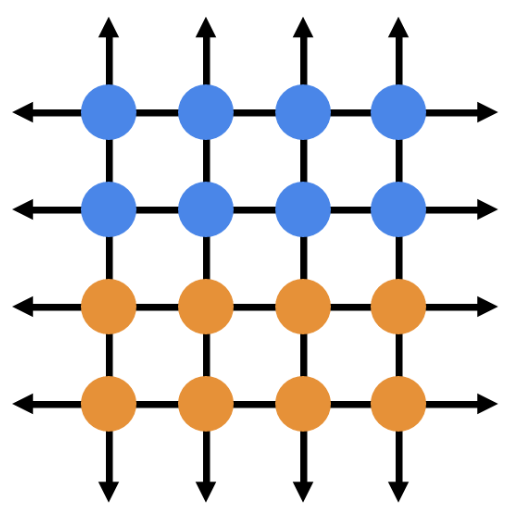
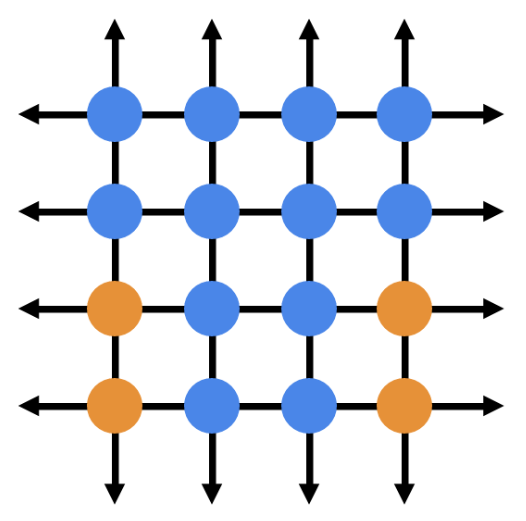
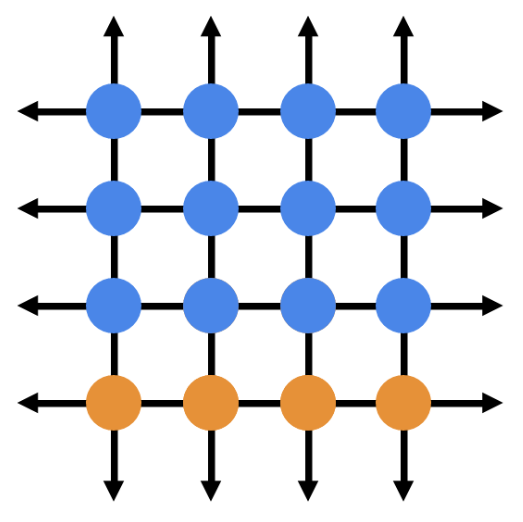
We have found counter example in 2d spin glass problem
\frac{n}{4}
\sqrt{n}
Flip from outer region
Flip from corner
Last semester
This semester
Outer Region
Fail
Success
Success
Fail
Degree 2, 3 nodes are important
topology dependent
\Rightarrow
Back to Ring Structure
We want to solve NK landscape
| Identical sub function | |
| Spin-glass like sub function | |
| value = {0, 1, 2, 3} sub function |
\mathcal{O}(1)
\mathcal{O}(1)
\mathcal{O}(1)
Longest differnet segment length
proportion of longest different segment k is exponential to k
First flip method
Concept
From head, flip first met segment
P\left[\textrm{length}=l\right] = p^{-\left(l+1\right)}
Result
| chain | ||
| ring | ||
| comb |
p=\frac{1}{2}
p<\frac{1}{2}
\mathcal{O}(l^2)
\mathcal{O}(l^3)
\mathcal{O}(l)
\mathcal{O}(l)
\mathcal{O}(l^{m+1})
\mathcal{O}(lc^{m})
Problem
- Bound direction
- Subfunction size
Bound Direction
Upper of lower = ??
Subfunction Size
\mathbb{E}\left[2^{k\times\textrm{seg length}}\right] \gg \left( \mathbb{E}\left[2^\textrm{seg length}\right]\right)^{k}
Tighter upper : DP
Upper of lower
\mathcal{O}(l\ \log l)
Lower of Lower bound
C(l)=1+\sum\limits_{k=0}^{l-1}2^{-l}{l \choose k}C(l-k)
C(l)\leq 1+\frac{1}{2}C(\frac{l}{2}) + \frac{1}{2}C(l)
C(l)\leq 2 +
2C(\frac{l}{2}) \leq2\lceil\log_{2}{l}\rceil
C(l)=\Sigma_{i=2}^{\infty}{i\left(\left(1-2^{-(i-1)}\right)^l-\left(1-2^{-(i-2)}\right)^l\right)}
C(l)\ge-\Sigma_{i=2}^{k-1}{\left(1-2^{-(i-1)}\right)^l}+k+\left(1-2^{-(k-1)}\right)^l
C(l)\ge (1-\frac{1}{e})\log_2 l -2
experiment, lower of lower
upper of lower bound
l\log l
\log l
End
Analysis Population Size of Optimal Mixing
By 許泓崴
Analysis Population Size of Optimal Mixing
Individual Study of DSMGA2 by Sammy