Linear Regression

Cornell CS 3/5780 · Spring 2026

(down arrow to see handout slides)

1. Setup and Assumptions

1. Setup and Assumptions

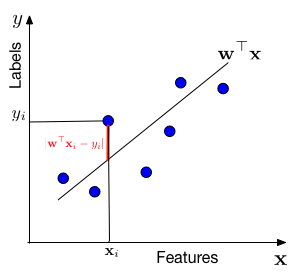
  • Data Assumption: \(y_i \in \mathbb{R}\) (real-valued labels) and \(\mathbf x_i \in \mathbb{R}^d\)
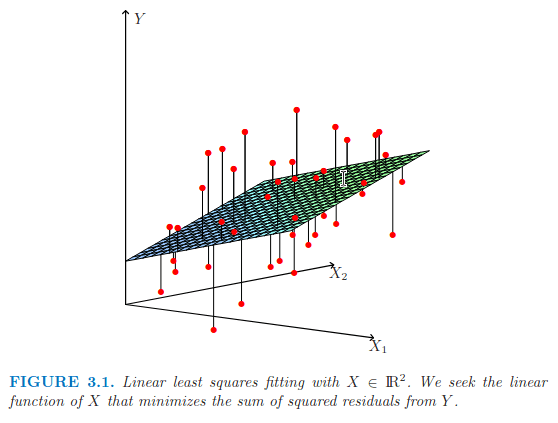
  • Model Assumption: data looks like a "line" through the origin, with small errors $$ y_i = \mathbf{w}^\top\mathbf{x}_i + \epsilon_i \quad \text{where } \epsilon_i \text{ is small} $$
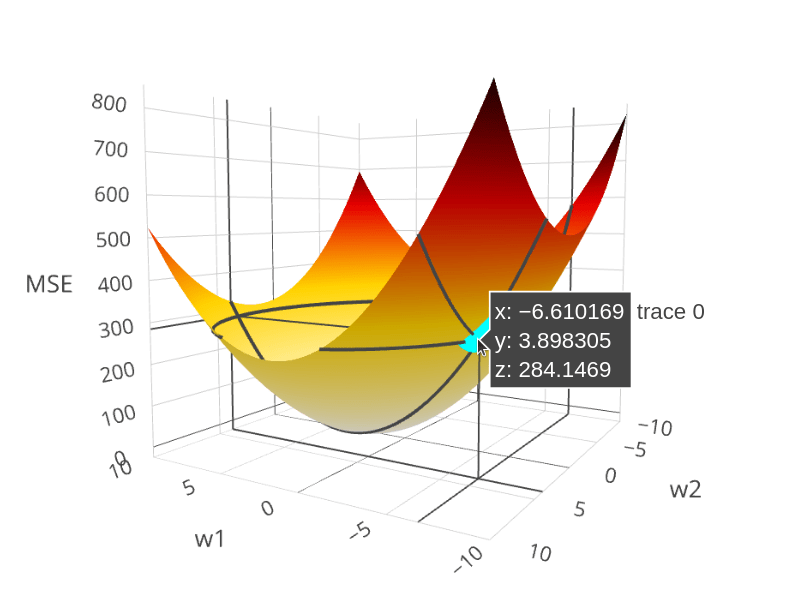
  • Ordinary Least Squares: minimize the sum of squared errors $$ \min_{\mathbf{w}} \frac{1}{n}\sum_{i=1}^n (\mathbf{x}_i^\top\mathbf{w} - y_i)^2 $$
  • MLE connection: This learning objective is equivalent to MLE (maximizing \(P(D|\mathbf{w})\)) under the probability model assumption: $$ y_i|\mathbf{x}_i \sim N(\mathbf{w}^\top\mathbf{x}_i, \sigma^2) \quad \Rightarrow \quad P(y_i|\mathbf{x}_i, \mathbf{w}) = \frac{1}{\sqrt{2\pi\sigma^2}}e^{-\frac{(\mathbf{x}_i^\top\mathbf{w}-y_i)^2}{2\sigma^2}} $$

2. Solving the minimization

2. Solving the minimization

  • Gradient: the gradient of the learning objective $$ \nabla_{\mathbf{w}} L(\mathbf{w})  = \frac{2}{n}\sum_{i=1}^n \mathbf{x}_i (\mathbf{x}_i^\top\mathbf{w} - y_i) $$
  • At optimum: gradient is equal to zero $$\frac{2}{n}\sum_{i=1}^n \mathbf{x}_i (\mathbf{x}_i^\top\mathbf{w} - y_i) = \mathbf{0}  \iff \sum_{i=1}^n \mathbf{x}_i \mathbf{x}_i^\top\mathbf{w} = \sum_{i=1}^n \mathbf{x}_i y_i  $$
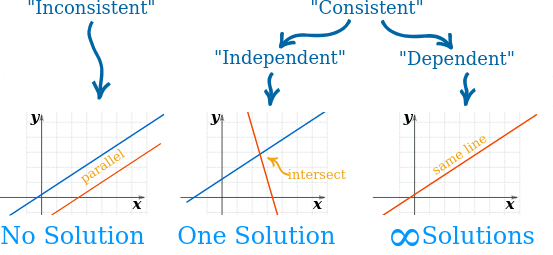
  • This is a system of linear equations that we need to solve for \(\mathbf{w}\)
  • Matrix notation: \(\mathbf{X} = [\mathbf{x}_1, \ldots, \mathbf{x}_n]\in\mathbb R^{d\times n}\), \(\mathbf{y} = [y_1, \ldots, y_n] \in\mathbb R^{1\times n}\) $$ \mathbf{X}\mathbf{X}^\top\mathbf{w} = \mathbf{X}\mathbf{y}^\top $$

3. Solving system of linear equations

3. Solving system of linear equations

$$ \mathbf{X}\mathbf{X}^\top\mathbf{w} = \mathbf{X}\mathbf{y}^\top $$

  • If \(\text{rank}(\mathbf{X}) = d\) (full rank): then \(\mathbf{X}\mathbf{X}^\top\) is invertible
    • Occurs when \(n \geq d\) and data spans feature space
    • Unique solution: the standard closed-form solution $$ \mathbf{w}^* = (\mathbf{X}\mathbf{X}^\top)^{-1}\mathbf{X}\mathbf{y}^\top $$
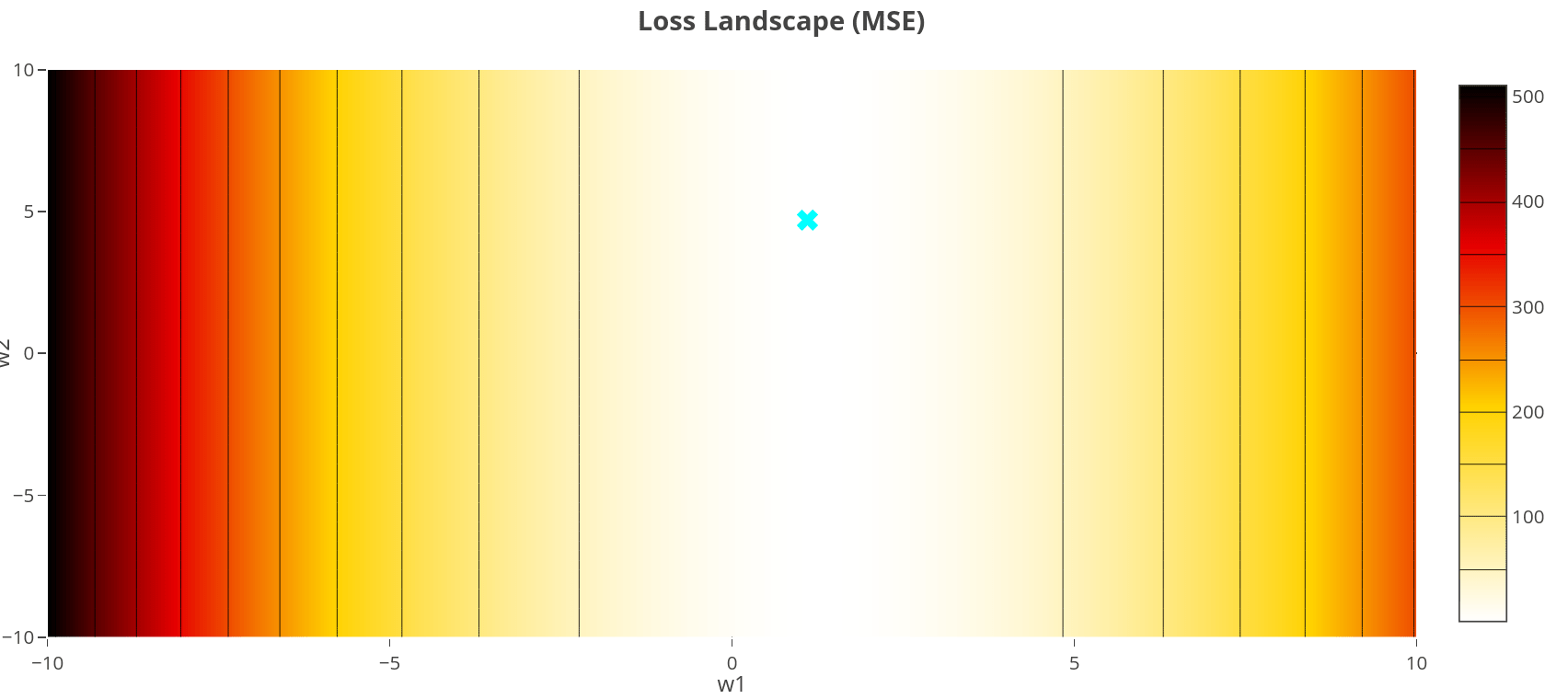
  • If \(\text{rank}(\mathbf{X}) < d\): then \(\mathbf{X}\mathbf{X}^\top\) is not invertible
    • Fewer data points than features (\(n < d\)) OR data lies in lower-dimensional subspace
    • Infinitely many solutions achieve the same minimum loss

4. Decomposing the Weight Vector

  • Any weight vector can be decomposed: \(\mathbf{w} = \mathbf{w}_{\parallel} + \mathbf{w}_{\perp} \)
    • \(\mathbf{w}_{\parallel}\) lies in column space of \(\mathbf{X}\): \(\mathbf{w}_{\parallel} = \mathbf{X}\mathbf{v}\) for some \(\mathbf{v}\)
    • \(\mathbf{w}_{\perp}\) lies in null space of \(\mathbf{X}^\top\): \(\mathbf{X}^\top\mathbf{w}_{\perp} = \mathbf{0}\)
    • They are orthogonal: \(\mathbf{w}_{\parallel}^\top\mathbf{w}_{\perp} = 0\)
  • Key observation: prediction depends only on \(\mathbf{w}_{\parallel}\)! $$ \mathbf{x}_i^\top\mathbf{w} = \mathbf{x}_i^\top(\mathbf{w}_{\parallel} + \mathbf{w}_{\perp}) = \mathbf{x}_i^\top\mathbf{w}_{\parallel} + \underbrace{\mathbf{x}_i^\top\mathbf{w}_{\perp}}_{=0} = \mathbf{x}_i^\top\mathbf{w}_{\parallel} $$ Thus, any two weight vectors with the same \(\mathbf{w}_{\parallel}\) achieve the same loss.
  • Solution set (affine subspace): $$ \{\mathbf{w}^*_{\parallel} + \mathbf{w}_{\perp} : \mathbf{w}_{\perp} \in \text{null}(\mathbf{X}^\top)\} $$
  • Minimum-norm solution: Unique solution where \(\mathbf{w}_{\perp} = \mathbf{0}\) defined by pseudoinverse $$ \mathbf{w}^*_{\text{min-norm}} = \mathbf{X}^\top(\mathbf{X}\mathbf{X}^\top)^{\dagger}\mathbf{y} $$

5. (Stochastic) Gradient Descent

5. (Stochastic) Gradient Descent

  • Gradient descent: Starting from \(\mathbf{w}^{(0)}\), with learning rate \(\eta > 0\): $$ \mathbf{w}^{(t+1)} = \mathbf{w}^{(t)} - \eta \frac{2}{n}\sum_{i=1}^n \mathbf{x}_i (\mathbf{x}_i^\top\mathbf{w}^{(t)} - y_i) $$
  • SGD: Approximate gradient using single random data point \(i\) $$ \mathbf{w}^{(t+1)} = \mathbf{w}^{(t)} - \eta \cdot 2\mathbf{x}_i(\mathbf{x}_i^\top\mathbf{w}^{(t)} - y_i) $$
  • Key observation: gradient is in the column space because it is a linear combination of \(\mathbf x_i\) (columns of the data matrix \(\mathbf{X}\))
  • (S)GD updates only change \(\mathbf{w}_{\parallel}\), never \(\mathbf{w}_{\perp}\)
  • (S)GD will converge to min-norm solution if initialized at \(\mathbf{w}^{(0)} = \mathbf{0}\).

6. Ridge Regression

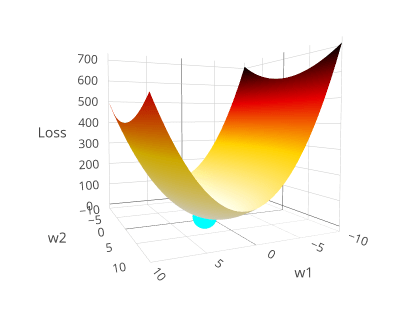
\(\lambda=0\)

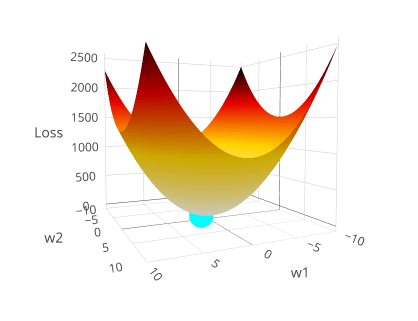
\(\lambda=1\)

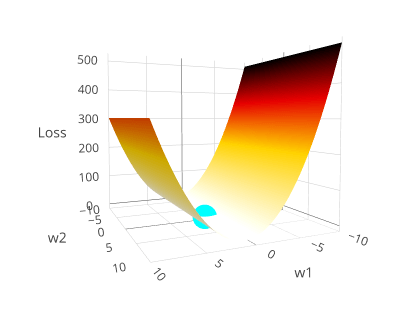
\(\lambda=10\)

6. Ridge Regression

  • Data & Model Assumption: Same setup \(y_i = \mathbf{w}^\top\mathbf{x}_i + \epsilon_i\), but now we also assume weights are small.

  • Ridge Objective: minimize squared errors plus a penalty on weight size, where \(\lambda > 0\): $$ \min_{\mathbf{w}} \frac{1}{n}\sum_{i=1}^n (\mathbf{x}_i^\top\mathbf{w} - y_i)^2 + \lambda\|\mathbf{w}\|_2^2 $$

  • MAP connection: This objective is equivalent to MAP estimation, maximizing \(P(\mathbf{w}|D) \propto P(D|\mathbf{w})P(\mathbf{w})\), with the Gaussian prior: $$ P(\mathbf{w}) = \frac{1}{\sqrt{2\pi\tau^2}}e^{-\frac{\mathbf{w}^\top\mathbf{w}}{2\tau^2}} \quad \Rightarrow \quad \lambda = \frac{\sigma^2}{n\tau^2} $$

  • Closed-form solution: Set gradient to zero and solve (always unique): $$ \mathbf{w}^* = (\mathbf{X}\mathbf{X}^\top + n\lambda\mathbf{I})^{-1}\mathbf{X}\mathbf{y}^\top $$

7. Summary

Ordinary Least Squares (unregularized):

  • From MLE with Gaussian noise assumption
  • Closed form (minimum norm): \(\mathbf{w} = (\mathbf{X}\mathbf{X}^\top)^{\dagger}\mathbf{X}\mathbf{y}^\top\)
  • GD from origin \(\implies\) minimum-norm solution (implicit regularization!)

Ridge Regression (regularized):

  • From MAP with Gaussian prior on weights
  • Closed form: \(\mathbf{w} = (\mathbf{X}\mathbf{X}^\top + n\lambda\mathbf{I})^{-1}\mathbf{X}\mathbf{y}^\top\)
  • Always has unique solution, more stable

Linear Regression

By Sarah Dean

Private

Linear Regression