Research in Education
Prof. Sarah Cohn
4/28/26

Why Library?
-
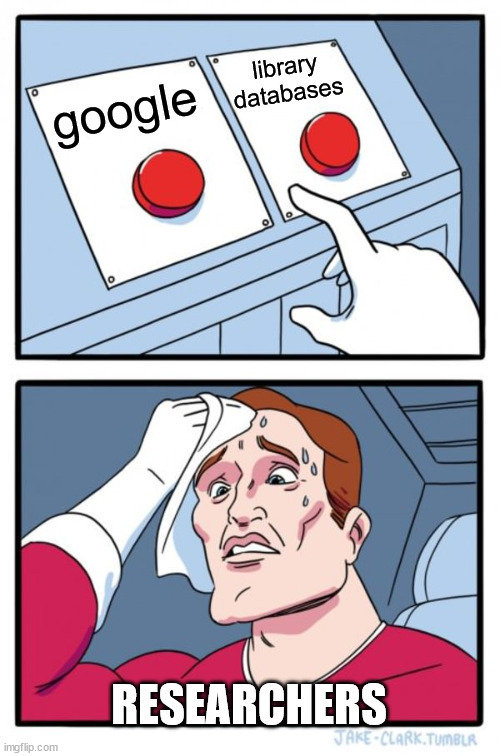
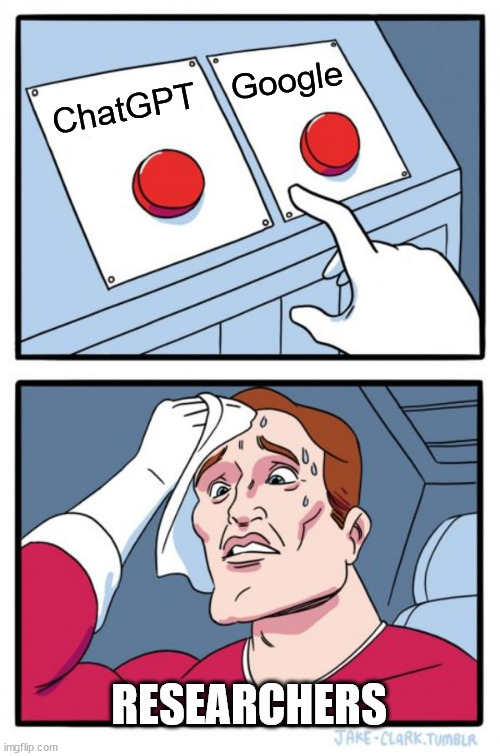
One isn't better than the other
-
Different information needs require different places to search.
-
-
The library is a resource for you as CCNY students
-
Utilize all the tools available to you.
-
Librarians are nice and helpful!
-
LLMs & Generative AI
-
Fake sources
-
Cognitive offloading
-
What do you give up when you outsource thinking and the process of learning to a machine?
-
-
How we learn!
-
Process, problem solving, failure
-
-
Environmental concerns
-
Is it worth it?
-
Searching as
Exploration
-
Searching for information is often nonlinear and iterative--back and forth.
-
You might not find the exact 'answer' to your questions.
-
Think of your sources as puzzle pieces, each with their own bit of information or context that work together to provide a complete picture.
(strategic)
Scholarly
Peer Reviewed
Academic
An empirical research article reports the results of a study that uses data derived from actual observation or experimentation.
- Introduction
- Method
- Results
- Discussion
Not all articles published in a scholarly journal are peer reviewed.
Not all peer reviewed articles are empirical.
Think about different ways to describe your topic in individual words or phrases.
1.
Identify your key words
Combine 2 or more search terms, adding any relevant filters.
2.
Build a search & test it out
Do the results look promising, interesting, or relevant? If not, change a search term and try again.
Repeat until you're seeing relevant articles.
3.
Evaluate the results & change the search as needed
Use
AND
to connect terms
learning styles AND myth AND evidence
combining different terms
=
different results
visual learners AND reading styles AND evidence
Use
"..."
for phrases or names
"learning styles" AND myth AND evidence
"visual learners" AND reading styles AND evidence
Database filters are your friends!
Built-in tools to help focus or redirect your searching.
What are concepts that are relevant, but less specific?
Think about ways to broaden your search.
Education Source
Our most comprehensive database for research in education, with 1,700 full text journals.
ERIC
An education database provided by the US government. Scholarly sources & conference proceedings.
Taylor & Francis
Multi-disciplinary database, with a strong focus on education.
OneSearch
Multi-disciplinary database with peer-reviewed journal articles, books, & media.
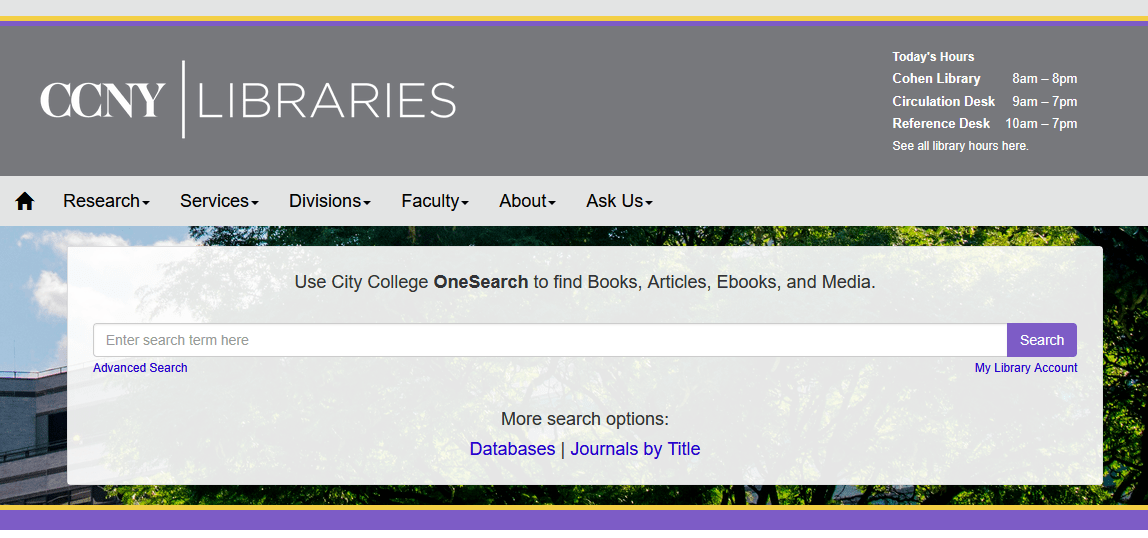
library.ccny.cuny.edu
Getting Help
Sarah Cohn
scohn@ccny.cuny.edu
ccny.libcal.com/appointments/scohn
Reference Desk
Monday-Friday 10am-7pm
Friday 10am-4pm
library.ccny.cuny.edu/chat
Lorenzetti Spring 2026
By Sarah Cohn
Lorenzetti Spring 2026
Edu