Introduction to Prototypes
Overview
- Prototype Chain
- Internal Prototypes
- `.prototype` property
- `new` Keyword
- `.__proto__` vs `.prototype`
The Prototype Chain
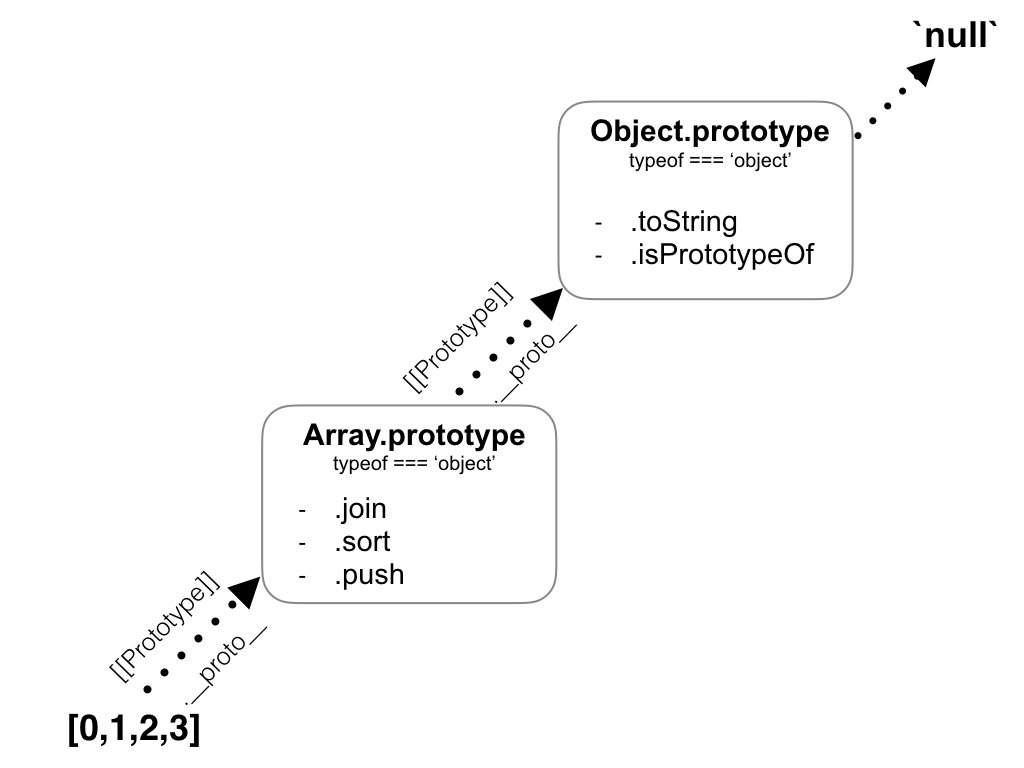
- Objects have links to other objects, via the internal [[Prototype]] object and the Prototype Chain.
- The internal [[Prototype]] is accessed when a property (or method) is called on an object but the property isn't present on the current object.
Object 1
Object 2
Object 3
null
The Prototype Chain
const mySundae = ['cherry', 'vanilla', 'sprinkles'];

const yourSundae = ['chocolate', 'hot fudge', 'walnuts'];

mySundae.join("");

yourSundae.join("");
mySundae
.length
0: 'cherry'
1: 'vanilla'
2: 'sprinkles
yourSundae
.length
0: 'chocolate'
1: 'hot fudge'
2: 'walnuts
Array.prototype
.join
.pop
.push
Prototype Chain
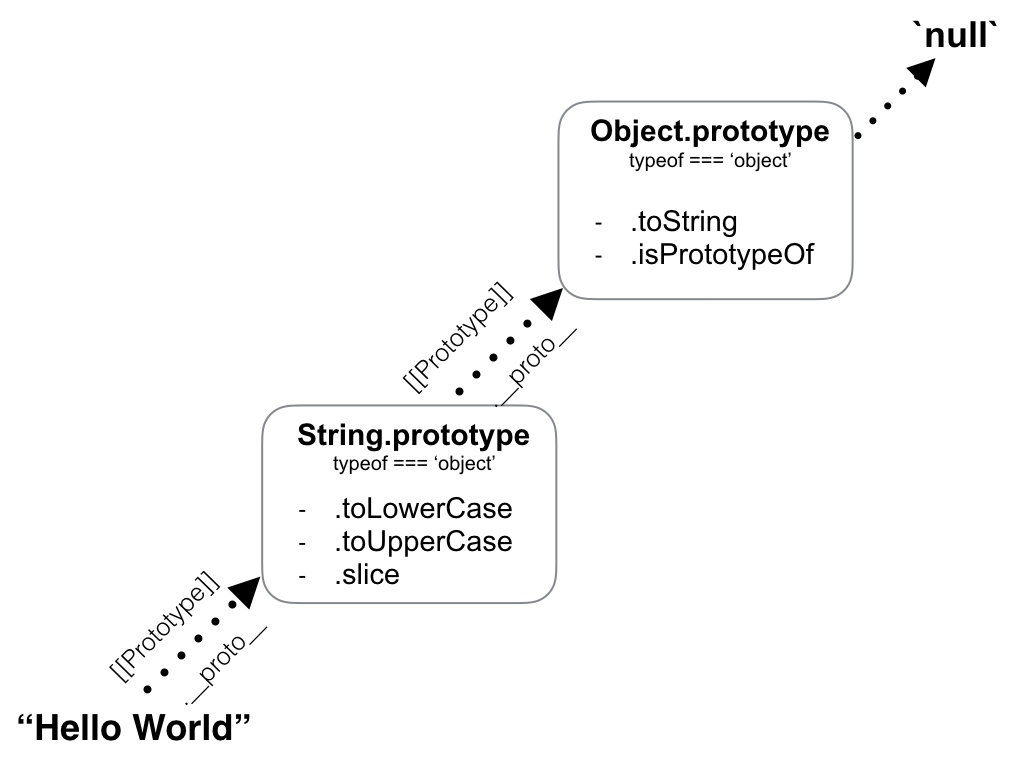
Prototype Chain
Functions & the `.prototype` property
- Only Function objects have a `.prototype` property.
- Function objects also have an internal prototype.
- The `.prototype` is NOT the internal prototype.
- .__proto__ === internal prototype.
function helloWorld(){
}

/*helloWorld.prototype = {
    constructor: helloWorld
// internal Prototype === Object.prototype
}*/
What is the `.prototype` property used for?
...before answering this, we need to look into constructor functions!
Prototype Chain and `.prototype Recap
- All values have an "internal prototype" that links the value to another object. This is the prototype chain
- The `.prototype` property is a property on all function objects, it is not the same object as the INTERNAL prototype.
- Does a function object have an internal prototype AND a `.prototype` property?
What is a Constructor Function?
A Constructor Function returns an object called an instance, when it is invoked with the `new` keyword
function Person(name){
  this.age = 0;
  this.name = name;
}
var karen = new Person('Karen');
/* karen = {
age:0,
name: 'Karen',
} */Why do we need to create objects?
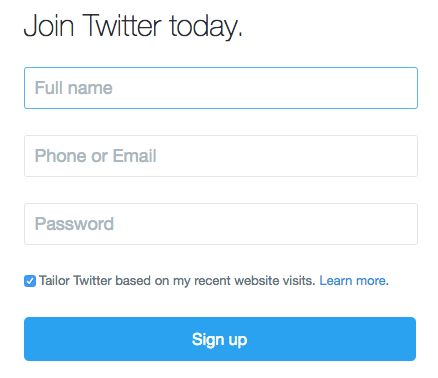
Create an Account
Account Info Saved
- An Object is created after User Data is stored in a Database.
- We need to create the object programmatically...Twitter engineers do not add users manually.
- Every "Twitter User" object will have standard properties and functions.
- Use a "Constructor" function to create the Twitter User Objects
var scottTwitter = {
name: 'Scott',
email: 'email@email.com',
password: '.....',
handle: '@Scott',
followers: []
_id: 012345,
joined: Thu March 01 2019 07:36:30 GMT-0500 (EST)
}
The `new` keyword
- Used with a "constructor" function.
- Invokes the constructor function.
var karen = new Person('Karen');

/* karen = {
  age:0,
  name: 'Karen',
} */The Four Actions of the `new` Keyword
- Invokes the constructor function.
- Creates an empty Object.
- Links the `.prototype` property of the constructor function to the internal prototype of the empty object.
- Assigns the empty object to the "this".
- Implicitly returns "this" (which is the object created).
1. NEW: Invokes the constructor
The "new" keyword invokes the constructor function.
function Person(name) {
this.age = 0;
this.name = name;
}
// STEP 1: new invokes Person
var karen = new Person('Karen');

/* karen = {
  age:0,
  name: 'Karen',
} */2. NEW: Creates an empty object
- Creates an empty object.
- The internal prototype of the empty object is assigned to the constructor functions `.prototype` property.
function Person(name) {
// STEP 2: {} the internal prototype === Person.prototype
 this.age = 0;
 this.name = name;
}

// STEP 1: new invokes Person
var karen = new Person('Karen');

/* karen = {
  age:0,
  name: 'Karen',
} */
3. NEW Assigns the "this" keyword
Assigns the "this" keyword to the object created by the new keyword.
function Person(name) {
// STEP 2: {} the internal prototype === Person.prototype
// STEP 3: this = {} (object created in STEP2)
 this.age = 0;
 this.name = name;
}

// STEP 1: new invokes Person
var karen = new Person('Karen');

/* karen = {
  age:0,
  name: 'Karen',
} */
4. returns "this"
- Implicitly returns the "this" keyword.
function Person(name) {
// STEP 2: {} the internal prototype === Person.prototype
// STEP 3: this = {} object created in STEP 2
 this.age = 0;
 this.name = name;
/* STEP 4: return this
    - this === {age:0, name:'Karen'}
    - internal prototype === Person.prototype */
}

// STEP 1: new invokes Person
var karen = new Person('Karen');

/* karen = {
  age:0,
  name: 'Karen',
} */
Instance
An "instance" is an object created by a constructor function.
function Person(name) {
 this.age = 0;
 this.name = name;
 this.speak = function(){
   return 'hello';
 }
 this.eat = function(){
   return "I'm full!";
 }
}
var karen = new Person('Karen');
var scott = new Person('Scott');
karen
age
name
speak
eat
scott
Person.prototype
age
name
speak
eat
constructor: Person
Method Placement
- Universal methods should be placed on the `.prototype` object.
- Instead of multiple copies/versions of the methods, there is only one method shared across every instance.
- Easier to maintain and keeps code "DRY".
- Let's see an example.
Method Placement
function Person(name) {
 this.age = 0;
 this.name = name;
}
Person.prototype.speak = function(){
   return 'hello';
 }
Person.prototype.eat = function(){
   return "I'm full!";
}
var karen = new Person('Karen');
var scott = new Person('Scott');

karen.speak();
scott.eat();
karen
age
name
scott
Person.prototype
age
name
constructor: Person
eat
speak
`.__proto__` vs `.prototype`
- .__proto__ is a function that shows the "internal prototype" of an object.
- A property with an "_" normally indicates the property should be private or untouched.
-
.__proto__ is great for inspecting the prototype chain with developer tools, but, it should never be used in
code .
deck
By Scott D'Alessandro