Underline = Cmd+u
More symplectic structures
on the space of space curves
(and the space of wave functions)
April 2025 @ Chalmers University of Technology (online)
Sadashige Ishida (ISTA)

Purpose of this talk
To discuss a collaborative project
To introduce myself and some taste of my work
Introduction to myself
Sadashige, a PhD student @ ISTA (near Vienna)
Introduction to myself
Geometry & Dynamics in Math
Sadashige, a PhD student @ ISTA (near Vienna)
Introduction to myself
Geometry & Dynamics in Math, Physics, CS
Sadashige, a PhD student @ ISTA (near Vienna)
Dynamics as \(\infty\)-dim geometry
e.g. fluids, optimal transport, shapes
Introduction to myself
Geometry & Dynamics in Math, Physics, CS
Sadashige, a PhD student @ ISTA (near Vienna)
Dynamics as \(\infty\)-dim geometry
e.g. fluids, optimal transport, shapes
+ their finite-dim approximations
a.k.a. discretization
Introduction to myself
Dynamics as \(\infty\)-dim geometry
e.g. fluids, optimal transport, shapes
Geometry & Dynamics in Math, Physics, CS
+ their finite-dim approximations
a.k.a. discretization
Sadashige, a PhD student @ ISTA (near Vienna)
Introduction to myself
Geometry & Dynamics in Math, Physics, CS
Sadashige, a final year PhD student @ ISTA (near Vienna)
Introduction to myself
Dynamics as \(\infty\)-dim geometry
e.g. fluids, optimal transport, shapes
Geometry & Dynamics in Math, Physics, CS
+ their finite-dim approximations
a.k.a. discretization
Sadashige, a final year PhD student @ ISTA (near Vienna)
Introduction to myself
Dynamics as \(\infty\)-dim geometry
e.g. fluids, optimal transport, shapes
Geometry & Dynamics in Math, Physics, CS
+ their finite-dim approximations
a.k.a. discretization
Sadashige, a final year PhD student @ ISTA (near Vienna)
Overview
On the shape space of space curves,
only one symplectic structure was known.
We found more.
Joint with
Martin Bauer Peter Michor


Overview
This is an experimental study.
One can define different dynamics by inputting different Hamiltonians.
But what if we use different symplectic structures to invoke different dynamics?
We tried it for space curves
Symplectic structure is a sandbox
for Hamiltonian dynamics
Space with
a symplectic structure \(\Omega\)
A function \(H\)
Dynamics \(V_H\)
Symplectic structure is a sandbox
for Hamiltonian dynamics
A symplectic structure \(\Omega\)
A function \(H\)
Dynamics
Symplectic structure is a sandbox
for Hamiltonian dynamics
A symplectic structure \(\Omega\)
A function \(H\)
Dynamics
i.e. 2-form
- closed \(d\Omega=0\)
- non-degenerate \(\operatorname{ker}\Omega = 0\)
$$ dH = \Omega(V_H, \cdot)$$
$$ \dot x =V_H$$
Symplectic structure is a sandbox
for Hamiltonian dynamics
A symplectic structure \(\Omega\) is a 2-form on a manifold \(X\) s.t.
Symplectic structure is a sandbox
for Hamiltonian dynamics
A symplectic structure \(\Omega\) is a 2-form on a manifold \(X\) s.t.
- closed i.e. \(d\Omega=0\)
Symplectic structure is a sandbox
for Hamiltonian dynamics
A symplectic structure \(\Omega\) is a 2-form on a manifold \(X\) s.t.
- non-degenerate i.e. the map $$\flat: TX\to T^*X$$ $$ \qquad v\to \Omega(v, \cdot )$$ is injective
- closed i.e. \(d\Omega=0\)
Symplectic structure is a sandbox
for Hamiltonian dynamics
Symplectic structure is a sandbox
for Hamiltonian dynamics
For \(H \colon X\to \mathbb{R}\),
Hamiltonian vector field \(V_H\in \Gamma(TX)\) is the one
$$ dH = \Omega(V_H, \cdot). $$
Symplectic structure is a sandbox
for Hamiltonian dynamics
For \(H \colon X\to \mathbb{R}\),
Hamiltonian vector field \(V_H\in \Gamma(TX)\) is the one
$$ dH = \Omega(V_H, \cdot). $$
The Hamiltonian dynamics
$$\dot x=V_H(x).$$
Why Hamiltonian dynamics?
Has nice properties.
E.g.
- \(H\) is preserved in dynamics.
- If \(H\) is invariant under some group action, there is a conserved quantity.
Spaces with symplectic structures
and Hamiltonian dynamics
\(T^*M^n\)
\(T^*\operatorname{SDiff}(M)\)
Celestial mechanics
\(C^\infty(M,\mathbb{C})\)
Schrödinger equation
Incompressible fluids
Spaces with symplectic structures
and Hamiltonian dynamics
\(T^*M^n\)
\(T^*\operatorname{SDiff}(M)\)
Celestial mechanics
\(C^\infty(M,\mathbb{C})\)
Schrödinger equation
Incompressible fluids
We consider the space of space curves
Spaces with symplectic structures
and Hamiltonian dynamics
\(T^*M^n\)
\(T^*\operatorname{SDiff}(M)\)
Celestial mechanics
\(C^\infty(M,\mathbb{C})\)
Schrödinger equation
Incompressible fluids
We consider the space of space curves
(and the space of wave functions).
We consider the space of space curves
Spaces with symplectic structures
and Hamiltonian dynamics
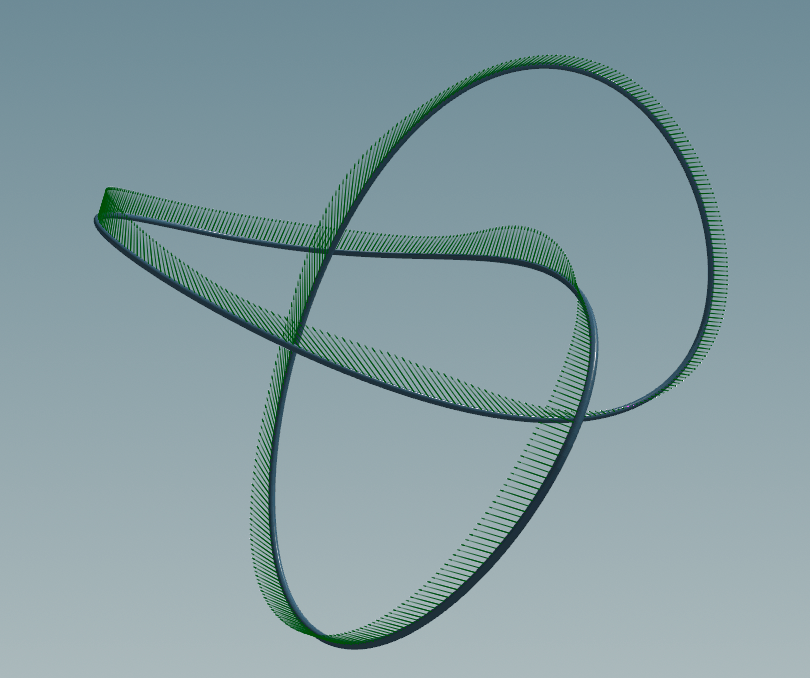
The space of space curves
$$\operatorname{Imm}(\mathbb{S}^1,\mathbb{R}^3)=\{ c\colon \mathbb{S}^1\to\mathbb{R}^3, \partial_\theta c\neq 0 \ \forall \theta\in\mathbb{S}^1 \}$$
Parametrized curves
The space of space curves
$$\operatorname{Imm}(\mathbb{S}^1,\mathbb{R}^3)=\{ c\colon \mathbb{S}^1\to\mathbb{R}^3, \partial_\theta c\neq 0 \ \forall \theta\in\mathbb{S}^1 \}$$
Parametrized curves
$$T_c\operatorname{Imm}(\mathbb{S}^1,\mathbb{R}^3)=C^\infty(\mathbb{S}^1,\mathbb{R}^3)$$
Tangent space
The space of space curves
$$\operatorname{UImm}(\mathbb{S}^1,\mathbb{R}^3)=\operatorname{Imm}(\mathbb{S}^1,\mathbb{R}^3)/\operatorname{Diff}^+(\mathbb{S}^1)$$
Unparametrized curves a.k.a. shape space
The space of space curves
$$\operatorname{UImm}(\mathbb{S}^1,\mathbb{R}^3)=\operatorname{Imm}(\mathbb{S}^1,\mathbb{R}^3)/\operatorname{Diff}^+(\mathbb{S}^1)$$
Unparametrized curves a.k.a. shape space
$$\operatorname{UImm}(\mathbb{S}^1,\mathbb{R}^3)$$
$$\operatorname{Imm}(\mathbb{S}^1,\mathbb{R}^3)$$
\[\Bigg\downarrow \pi\]
\[\curvearrowright\]
$$\operatorname{Diff}^+(\mathbb{S}^1)$$
The space of space curves
$$\operatorname{UImm}(\mathbb{S}^1,\mathbb{R}^3)=\operatorname{Imm}(\mathbb{S}^1,\mathbb{R}^3)/\operatorname{Diff}^+(\mathbb{S}^1)$$
Unparametrized curves a.k.a. shape space
Tangent space
$$T_{[c]}\operatorname{UImm}(\mathbb{S}^1,\mathbb{R}^3)=T_c\operatorname{Imm}(\mathbb{S}^1,\mathbb{R}^3)/\ker d\pi_c$$
$$\operatorname{UImm}(\mathbb{S}^1,\mathbb{R}^3)$$
$$\operatorname{Imm}(\mathbb{S}^1,\mathbb{R}^3)$$
\[\Bigg\downarrow \pi\]
\[\curvearrowright\]
$$\operatorname{Diff}^+(\mathbb{S}^1)$$
The space of space curves
$$\operatorname{UImm}(\mathbb{S}^1,\mathbb{R}^3)=\operatorname{Imm}(\mathbb{S}^1,\mathbb{R}^3)/\operatorname{Diff}^+(\mathbb{S}^1)$$
Unparametrized curves a.k.a. shape space
Tangent space
$$T_{[c]}\operatorname{UImm}(\mathbb{S}^1,\mathbb{R}^3)=T_c\operatorname{Imm}(\mathbb{S}^1,\mathbb{R}^3)/\ker d\pi_c$$
$$\operatorname{UImm}(\mathbb{S}^1,\mathbb{R}^3)$$
$$\operatorname{Imm}(\mathbb{S}^1,\mathbb{R}^3)$$
\[\Bigg\downarrow \pi\]
\[\curvearrowright\]
$$\operatorname{Diff}^+(\mathbb{S}^1)$$
\(\{a.\partial_\theta c \mid a\in C^\infty(\mathbb{S}^1)\}\)
curve tangent
The space of space curves
$$\operatorname{UImm}(\mathbb{S}^1,\mathbb{R}^3)=\operatorname{Imm}(\mathbb{S}^1,\mathbb{R}^3)/\operatorname{Diff}^+(\mathbb{S}^1)$$
Unparametrized curves a.k.a. shape space
Tangent space
$$T_{[c]}\operatorname{UImm}(\mathbb{S}^1,\mathbb{R}^3)=T_c\operatorname{Imm}(\mathbb{S}^1,\mathbb{R}^3)/\ker d\pi_c$$
$$\eqsim\{h \in T_c \operatorname{Imm}(\mathbb{S}^1,\mathbb{R}^3)\mid h\perp \partial_\theta c \}$$
$$\operatorname{UImm}(\mathbb{S}^1,\mathbb{R}^3)$$
$$\operatorname{Imm}(\mathbb{S}^1,\mathbb{R}^3)$$
\[\Bigg\downarrow \pi\]
\[\curvearrowright\]
$$\operatorname{Diff}^+(\mathbb{S}^1)$$
\(\{a.\partial_\theta c \mid a\in C^\infty(\mathbb{S}^1)\}\)
curve tangent
Canonical symplectic structure on \(\operatorname{UImm}(\mathbb{S}^1,\mathbb{R}^3)\)
The Marsden-Weinstein structure
\[\Omega_{[c]}\colon T_{[ c]}\operatorname{UImm}\times T_{[ c]}\operatorname{UImm}\to \mathbb{R},\]
Canonical symplectic structure on \(\operatorname{UImm}(\mathbb{S}^1,\mathbb{R}^3)\)
\[\Omega_{[c]}\colon T_{[ c]}\operatorname{UImm}\times T_{[ c]}\operatorname{UImm}\to \mathbb{R},\]
The Marsden-Weinstein structure
\[\Omega_{[c]}([h],[k])=\int_{\mathbb{S}^1}\langle D_s c\times h, k\rangle ds\]
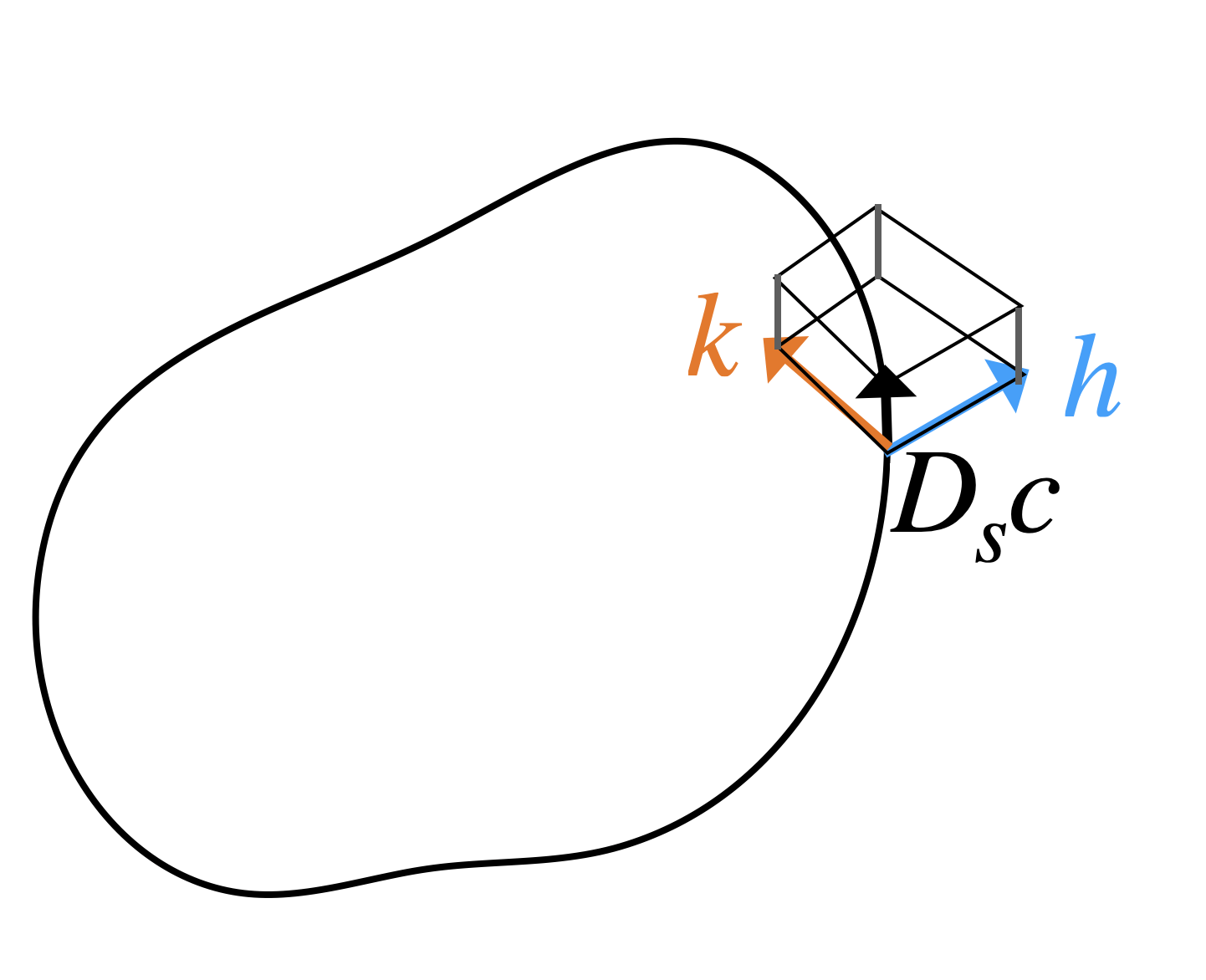
where
\[D_s = \frac{\partial_\theta }{|\partial_\theta c|}, \quad ds = |\partial_\theta c| d\theta \]
unit tangent
Canonical symplectic structure on \(\operatorname{UImm}(\mathbb{S}^1,\mathbb{R}^3)\)
\[\Omega_{[c]}\colon T_{[ c]}\operatorname{UImm}\times T_{[ c]}\operatorname{UImm}\to \mathbb{R},\]
Symplectic!
The Marsden-Weinstein structure
\[\Omega_{[c]}([h],[k])=\int_{\mathbb{S}^1}\langle D_s c\times h, k\rangle ds\]
where
\[D_s = \frac{\partial_\theta }{|\partial_\theta c|}, \quad ds = |\partial_\theta c| d\theta \]
unit tangent
Canonical symplectic structure on \(\operatorname{UImm}(\mathbb{S}^1,\mathbb{R}^3)\)
\[\Omega_{[c]}\colon T_{[ c]}\operatorname{UImm}\times T_{[ c]}\operatorname{UImm}\to \mathbb{R},\]
Closed \(d\Omega=0\),
Symplectic!
The Marsden-Weinstein structure
\[\Omega_{[c]}([h],[k])=\int_{\mathbb{S}^1}\langle D_s c\times h, k\rangle ds\]
where
\[D_s = \frac{\partial_\theta }{|\partial_\theta c|}, \quad ds = |\partial_\theta c| d\theta \]
unit tangent
Canonical symplectic structure on \(\operatorname{UImm}(\mathbb{S}^1,\mathbb{R}^3)\)
\[\Omega_{[c]}\colon T_{[ c]}\operatorname{UImm}\times T_{[ c]}\operatorname{UImm}\to \mathbb{R},\]
Closed \(d\Omega=0\),
Symplectic!
The Marsden-Weinstein structure
\[\Omega_{[c]}([h],[k])=\int_{\mathbb{S}^1}\langle D_s c\times h, k\rangle ds\]
where
\[D_s = \frac{\partial_\theta }{|\partial_\theta c|}, \quad ds = |\partial_\theta c| d\theta \]
Non-degenerate \(\ker \Omega_{[c]}=[0]=\{a.D_s c \mid a \in C^\infty(\mathbb{S}^1)\}\)
unit tangent
Hamiltonian flow
E.g.
Hamiltonian \(H = \operatorname{Length}([c])\)
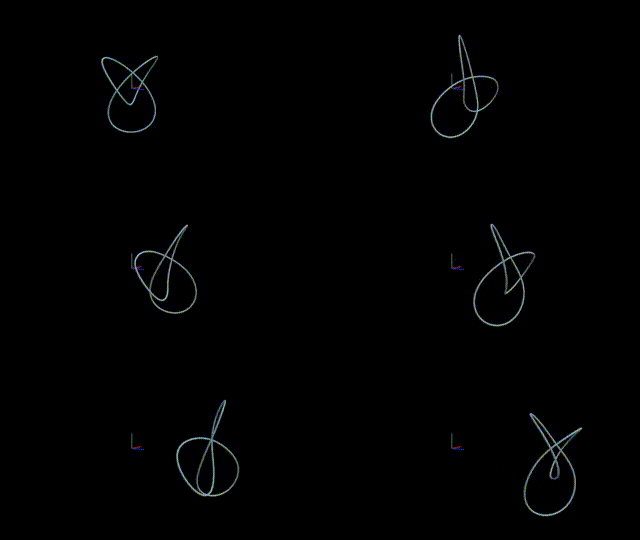
Binormal flow
Dynamics \(V_H=[D_s c \times D_s^2 c]\)
Hamiltonian flow
E.g.
Hamiltonian \(H = \operatorname{Length}([c])\)
Binormal flow
Dynamics \(V_H=[D_s c \times D_s^2 c]\)
A completely integrable system
More symplectic structures?
More symplectic structures?
Remember
A symplectic structure \(\Omega\) defines a Hamiltonian dynamics \(V_H\) via $$dH=\Omega(V_H,\cdot).$$
More symplectic structures?
A different \(\Omega\) defines different \(V_H\).
Remember
A symplectic structure \(\Omega\) defines a Hamiltonian dynamics \(V_H\) via $$dH=\Omega(V_H,\cdot).$$
More symplectic structures?
A different \(\Omega\) defines different \(V_H\).
But only one \(\Omega\) is known on \(\operatorname{UImm}\).
Remember
A symplectic structure \(\Omega\) defines a Hamiltonian dynamics \(V_H\) via $$dH=\Omega(V_H,\cdot).$$
More symplectic structures?
A different \(\Omega\) defines different \(V_H\).
We found more
But only one \(\Omega\) is known on \(\operatorname{UImm}\).
Remember
A symplectic structure \(\Omega\) defines a Hamiltonian dynamics \(V_H\) via $$dH=\Omega(V_H,\cdot).$$
More symplectic structures?
A different \(\Omega\) defines different \(V_H\).
We found more
But only one \(\Omega\) is known on \(\operatorname{UImm}\).
Remember
A symplectic structure \(\Omega\) defines a Hamiltonian dynamics \(V_H\) via $$dH=\Omega(V_H,\cdot).$$
by combining 2 hints.
Hint 1. Trend in shape analysis
Hint 1. Trend in shape analysis
a Riemannian metric on \(\operatorname{Imm}\)
$$ g(h,k)=\int_{\mathbb{S}^1} \langle h,k\rangle ds$$
Hint 1. Trend in shape analysis
a Riemannian metric on \(\operatorname{Imm}\)
$$ g(h,k)=\int_{\mathbb{S}^1} \langle h,k\rangle ds$$
a suitable operator
$$L\colon T\operatorname{Imm}\to T\operatorname{Imm}. $$
Hint 1. Trend in shape analysis
a Riemannian metric on \(\operatorname{Imm}\)
$$ g(h,k)=\int_{\mathbb{S}^1} \langle h,k\rangle ds$$
New metric $$g^L(h,k)\coloneqq g(h,Lk) $$
a suitable operator
$$L\colon T\operatorname{Imm}\to T\operatorname{Imm}. $$
e.g. \(L_c=\operatorname{id}_c\),
$$g^{\operatorname{id}}_c(h,k)=\int_{\mathbb{S}^1} \langle h,k\rangle ds$$
Hint 1. Trend in shape analysis
e.g. \(L_c=\operatorname{id}_c\),
$$g^{\operatorname{id}}_c(h,k)=\int_{\mathbb{S}^1} \langle h,k\rangle ds$$
e.g. \(L_c=\lambda(c)\) with a conformal factor \(\lambda\colon \operatorname{Imm}\to \mathbb{R}_{>0}\)
$$g^{\lambda}_c(h,k)=\lambda(c)\int_{\mathbb{S}^1} \langle h,k\rangle ds$$
Hint 1. Trend in shape analysis
e.g. \(L_c=\operatorname{id}_c\),
$$g^{\operatorname{id}}_c(h,k)=\int_{\mathbb{S}^1} \langle h,k\rangle ds$$
e.g. Sobolev-type differential operator \(L_c=\operatorname{id}-D_s^2\)
$$g^{\operatorname{id}-D_s^2}_c(h,k)=\int_{\mathbb{S}^1} \langle h,k\rangle -\langle h, D_s^2 k \rangle ds = \int_{\mathbb{S}^1} \langle h,k\rangle + \langle D_s h, D_s k \rangle ds $$
Hint 1. Trend in shape analysis
e.g. \(L_c=\lambda(c)\) with a conformal factor \(\lambda\colon \operatorname{Imm}\to \mathbb{R}_{>0}\)
$$g^{\lambda}_c(h,k)=\lambda(c)\int_{\mathbb{S}^1} \langle h,k\rangle ds$$
Hint 2. Liouville form
i.e. there is a 1-form \(\Theta\) s.t. \(\Omega=d\Theta\).
Marsden-Weinstein form \(\Omega\) is exact
Hint 2. Liouville form
Marsden-Weinstein form \(\Omega\) is exact
\(\Theta\) is given by
$$\Theta_{[c]}([h])=\frac{1}{3}\int_{\mathbb{S}^1}\langle D_s c\times c, h\rangle ds=g^{\operatorname{id}}\left(\frac{1}{3}D_s c\times c, h\right).$$
i.e. there is a 1-form \(\Theta\) s.t. \(\Omega=d\Theta\).
Hint 1 + Hint 2
Let's define a 1-form
$$\Theta_{[c]}^{\color{blue}L}([h])\coloneqq g^{\color{blue}L}\left(\frac{1}{3}D_s c\times c, h\right)= \frac{1}{3} \int_{\mathbb{S}^1} \langle D_s c \times c, {\color{blue}L} h\rangle ds $$
Hint 1 + Hint 2
and a 2-form $$\Omega^L\coloneqq d\Theta^L$$
Let's define a 1-form
$$\Theta_{[c]}^{\color{blue}L}([h])\coloneqq g^{\color{blue}L}\left(\frac{1}{3}D_s c\times c, h\right)= \frac{1}{3} \int_{\mathbb{S}^1} \langle D_s c \times c, {\color{blue}L} h\rangle ds $$
$$\Omega^L\coloneqq d\Theta^L$$
Does \(\Omega^L\) define a symplectic structure on \(\operatorname{UImm}\)?
Hint 1 + Hint 2
with \(\Theta_{[c]}^L([h])\coloneqq \frac{1}{3} \int_{\mathbb{S}^1} \langle D_s c \times c, L h\rangle ds \)
Closeness. OK because it is exact \(d\Omega^L=dd\Theta^L=0\)
$$\Omega^L\coloneqq d\Theta^L$$
Does \(\Omega^L\) define a symplectic structure on \(\operatorname{UImm}\)?
Hint 1 + Hint 2
with \(\Theta_{[c]}^L([h])\coloneqq \frac{1}{3} \int_{\mathbb{S}^1} \langle D_s c \times c, L h\rangle ds \)
Closeness. OK because it is exact \(d\Omega^L=dd\Theta^L=0\)
$$\Omega^L\coloneqq d\Theta^L$$
Does \(\Omega^L\) define a symplectic structure on \(\operatorname{UImm}\)?
Hint 1 + Hint 2
with \(\Theta_{[c]}^L([h])\coloneqq \frac{1}{3} \int_{\mathbb{S}^1} \langle D_s c \times c, L h\rangle ds \)
Non-degeneracy on \(\operatorname{UImm}\) ?
i.e. \(\ker \Omega_c^L = [0] = \{a. D_s c \mid a \in C^\infty(\mathbb{S}^1)\}\)
Closeness. OK because it is exact \(d\Omega^L=dd\Theta^L=0\)
$$\Omega^L\coloneqq d\Theta^L$$
Does \(\Omega^L\) define a symplectic structure on \(\operatorname{UImm}\)?
Non-degeneracy on \(\operatorname{UImm}\) ?
i.e. \(\ker \Omega_c^L = [0] = \{a. D_s c \mid a \in C^\infty(\mathbb{S}^1)\}\)
Need to check case by case.
Hint 1 + Hint 2
with \(\Theta_{[c]}^L([h])\coloneqq \frac{1}{3} \int_{\mathbb{S}^1} \langle D_s c \times c, L h\rangle ds \)
Symplectic structure
induced by a conformal factor
$$\Omega^\lambda\coloneqq d\Theta^\lambda$$
Theorem
With a conformal factor \(\lambda\colon \operatorname{UImm}\to \mathbb{R}_{>0} \),
is a symplectic structure on \(\operatorname{UImm}\)
Symplectic structure
induced by a conformal factor
$$\Omega^\lambda\coloneqq d\Theta^\lambda$$
Theorem
With a conformal factor \(\lambda\colon \operatorname{UImm}\to \mathbb{R}_{>0} \),
is a symplectic structure on \(\operatorname{UImm}\)
if \(\Theta^\lambda\) is NOT invariant under scaling (\(c\to c+t c\) with \(t >0\)).
Symplectic structure
induced by a conformal factor
$$\Omega^\lambda\coloneqq d\Theta^\lambda$$
Theorem
With a conformal factor \(\lambda\colon \operatorname{UImm}\to \mathbb{R}_{>0} \),
is a symplectic structure on \(\operatorname{UImm}\)
If \(\Theta^\lambda\) is invariant under scaling, \(\Omega^\lambda\) is NOT symplectic on \(\operatorname{UImm}\),
but becomes symplectic in another space! (Check out our paper)
if \(\Theta^\lambda\) is NOT invariant under scaling (\(c\to c+t c\) with \(t >0\)).
Open problem
Is there a non-conformal \(L\) making \(\Omega^L\coloneqq d\Theta^L\) symplectic?
Open problem
Is there a non-conformal \(L\) making \(\Omega^L\coloneqq d\Theta^L\) symplectic?
Conjecture
Squared curvature \(L|_\theta=1+\kappa^2_c(\theta)\) defines a symplectic structure.
Open problem
Is there a non-conformal \(L\) making \(\Omega^L\coloneqq d\Theta^L\) symplectic?
Conjecture
Squared curvature \(L|_\theta=1+\kappa^2_c(\theta)\) defines a symplectic structure.
Result in preparation
Squared scale \(L|_\theta=|c(\theta)|^2\) defines a symplectic structure.
Remember, different symplectic structures induce different dynamics \(V_H\) from the same Hamiltonian \(H\).
Hamiltonian dynamics from \(\Omega^\lambda\)
Remember, different symplectic structures induce different dynamics \(V_H\) from the same Hamiltonian \(H\).
Hamiltonian dynamics from \(\Omega^\lambda\)
From \(\Omega^\lambda\) with a conformal factor \(\lambda\colon \operatorname{UImm}\to \mathbb{R}_{>0}\), we get


\(V_H\)
(Marsden-Weinstein)
\(\Omega^{\operatorname{id}}\)
\(\Omega^{\operatorname{Length}([c])^{-1/10}}\)
\(\Omega^{\operatorname{Length}([c])^{2}}\)
Simulation of Hamiltonian dynamics
Hamiltonian dynamics \(V_H\) of total squared-scale $$H([c])=\int_{\mathbb{S}^1}|c|^2 ds$$
\(H\) is preserved in all of them.

Our paper has a disclaimer
We do not guarantee any correctness of (even short-time behavior) dynamics in our simulation
Simulation of Hamiltonian dynamics
Future work
Symplectic structure on the space of discrete space curves?
Toward a symplectic integrator for space curves.
Our paper has a disclaimer
We do not guarantee any correctness of (even short-time behavior) dynamics in our simulation
Simulation of Hamiltonian dynamics
Other spaces?
Other spaces?
The linear Schrödinger equation
$$i\partial_t \psi + \Delta \psi =0$$

Other spaces?
The linear Schrödinger equation
$$i\partial_t \psi + \Delta \psi =0$$
is the Hamiltonian flow for $$H(\psi)=\int\frac{1}{2} |\nabla\psi|^2 dx $$
Other spaces?
The linear Schrödinger equation
$$i\partial_t \psi + \Delta \psi =0$$
is the Hamiltonian flow for $$H(\psi)=\int\frac{1}{2} |\nabla\psi|^2 dx $$
on the space of wave functions \(X=C^\infty(\mathbb{T}^d,\mathbb{C})\)
Other spaces?
$$\Omega_\psi(h,k)=\int \operatorname{Im} h\bar k \ dx\quad \quad h,k \in T_\psi X=C^\infty(\mathbb{T}^d,\mathbb{C}) $$
with a symplectic structure \(\Omega\)
More symplectic structures?
This symplectic structure \(\Omega\) has a Liouville form \(\Theta\)
i.e. \(\Omega=d\Theta\).
More symplectic structures?
This symplectic structure \(\Omega\) has a Liouville form \(\Theta\)
i.e. \(\Omega=d\Theta\).
Can get more symplectic structures by
$$\Omega^L=d\Theta^L$$
with different operators \(L\colon TC^\infty(\mathbb{T}^d,\mathbb{C})\to T C^\infty(\mathbb{T}^d,\mathbb{C})\) ?
More symplectic structures?
This symplectic structure \(\Omega\) has a Liouville form \(\Theta\)
i.e. \(\Omega=d\Theta\).
Can get more symplectic structures by
$$\Omega^L=d\Theta^L$$
with different operators \(L\colon TC^\infty(\mathbb{T}^d,\mathbb{C})\to T C^\infty(\mathbb{T}^d,\mathbb{C})\) ?
Yes, and it has a consequence.
Can we do the same job?
The 2-form $$\Omega_\psi(h,k)=\int \operatorname{Im} h\bar k \ dx$$ has a Liouville form
$$\Theta_\psi(h)= - \frac{1}{2}\int \operatorname{Im} h \bar\psi\ dx$$
Let's apply \(L=1-a_1\Delta+a_2\Delta^2-\cdots \pm a_n \Delta^n\) to \(\Theta\) with \(a_1,\ldots, a_n \geq 0\) to define $$ \Theta^{L}_\psi(h)=\int \operatorname{Im} (1-a_1\Delta+a_2\Delta^2-\cdots \pm a_n \Delta^n) h \bar\psi\ dx$$
Then \(\Omega^L\coloneqq d\Theta^L\) defines a symplectic form!
Do the same job
With \(\Omega^L\) for \(L=1-a_1\Delta-a_2\Delta^2-\cdots - a_n \Delta^n\) we get
$$i\partial_t \psi + (1-a_1\Delta-a_2\Delta^2-\cdots - a_n \Delta^n)^{-1}\Delta \psi =0$$
as the Hamiltonian flow of $$H(\psi)=\int\frac{1}{2} |\nabla\psi|^2 dx $$
Hamiltonian flows
Proposition
Family of equations
$$i\partial_t \psi + (1-a_1\Delta+a_2\Delta^2-\cdots \pm a_n \Delta^n)^{\textcolor{red}{-1}}\Delta \psi =0$$
for different choices of coefs \(a_1,\ldots,a_n\geq 0\)
Hamiltonian flows
Proposition
Family of equations
$$i\partial_t \psi + (1-a_1\Delta+a_2\Delta^2-\cdots \pm a_n \Delta^n)^{\textcolor{red}{-1}}\Delta \psi =0$$
for different choices of coefs \(a_1,\ldots,a_n\geq 0\) are
the Hamiltonian systems for the same Hamiltonian
$$H(\psi)=\int\frac{1}{2} |\nabla\psi|^2 dx $$
but for different symplectic structures on \(C^\infty(\mathbb{T}^d,\mathbb{C})\).
Hamiltonian flows
$$i\partial_t \psi + (1-a_1\Delta+a_2\Delta^2-\cdots \pm a_n \Delta^n)^{-1}\Delta \psi =0$$
are all explicitly solvable.
Hamiltonian flows

\(i\partial_t \psi + \Delta \psi =0\)
Schrödinger equation
$$i\partial_t \psi + (1-a_1\Delta+a_2\Delta^2-\cdots \pm a_n \Delta^n)^{-1}\Delta \psi =0$$
are all explicitly solvable.
Hamiltonian flows

\(i\partial_t \psi + \Delta \psi =0\)
\(i\partial_t \psi + (1-a_1 \textcolor{blue}{\Delta})^{-1}\Delta \psi =0\)
Schrödinger equation
somewhat blurred?
$$i\partial_t \psi + (1-a_1\Delta+a_2\Delta^2-\cdots \pm a_n \Delta^n)^{-1}\Delta \psi =0$$
are all explicitly solvable.
Hamiltonian flows

\(i\partial_t \psi + \Delta \psi =0\)
\(i\partial_t \psi + (1-a_1 \textcolor{blue}{\Delta})^{-1}\Delta \psi =0\)
\(i\partial_t \psi + (1+a_2\textcolor{blue}{ \Delta^2})^{-1}\Delta \psi =0\)
Schrödinger equation
somewhat blurred?
direction reversed!?
$$i\partial_t \psi + (1-a_1\Delta+a_2\Delta^2-\cdots \pm a_n \Delta^n)^{-1}\Delta \psi =0$$
are all explicitly solvable.
Why care?
$$i\partial_t \psi+ \sqrt{1-\Delta} \ \psi =0$$
Semi-relativistic Schrödinger equation
Why care?
$$i\partial_t \psi+ \sqrt{1-\Delta} \ \psi =0$$
Semi-relativistic Schrödinger equation
is usually obtained from the standard symplectic structure \(\Omega\) and the modified Hamiltonian
$$\tilde H(\psi)=\sqrt{f(H(\psi)^2)+c^2}$$
with a certain function \(f\) and light speed \(c\).
Why care?
Can we get the semi-relativistic equation
without changing the Hamiltonian but changing the symplectic structure?
$$i\partial_t \psi+ \sqrt{1-\Delta} \ \psi =0$$
Yes.
And can be obtained as the limit of flows \(\{V_H^n\}_n\) induced from structures \(\{\Omega_n\}_n\),
Why care?
Yes.
And can be obtained as the limit of flows \(\{V_H^n\}_n\) induced from structures \(\{\Omega_n\}_n\),
$$\Omega^n(h,k)=\int \frac{|\xi|^2}{1+b_1|\xi|^2 - b_2 |\xi|^4 + \ldots \pm b_n |\xi|^{2n}} \operatorname{Im} \mathcal{F}h(\xi) \overline{\mathcal{F}k} (\xi) d\xi$$
with some coefficients \(\{b_i\}_i\).
Why care?
Conclusion
A method to introduce different symplectic structures.
Conclusion
Consequence
- Different dynamics form the same Hamiltonian
- Same system from different settings \((\Omega_A, H_A)\) and \((\Omega_B, H_B)\).
A method to introduce different symplectic structures.
Conclusion
Consequence
- Different dynamics form the same Hamiltonian
- Same system from different settings \((\Omega_A, H_A)\) and \((\Omega_B, H_B)\).
A method to introduce different symplectic structures.
Potential applications?
- Modeling many phenomena
- Investigating many conserved quantities
Future work A
Do the same machinery to find more symplectic structures on other \(\infty\)-dim manifolds.
Future direction
Toward a paradigm for modeling dynamics by varying not only the Hamiltonian but the geometric (symplectic) structure of state spaces.
Future work
Future work
Our paper has a disclaimer
We do not guarantee any correctness of (even short-time behavior) dynamics in our simulation
Thanks!
- Space curves: preprint on arXiv 2407.19908
- Wave functions: in-preparation
Sadashige.Ishida@ist.ac.at
Chalmers_symplectic_space_curves
By sdsgisd