Deadlock Prevention
Deadlocks in DBMS
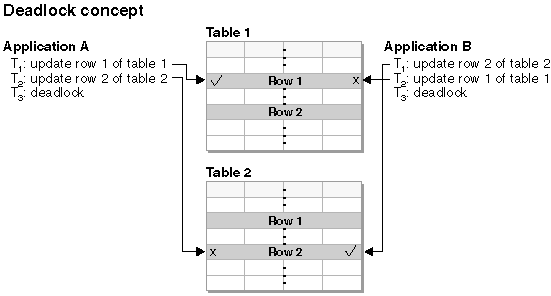
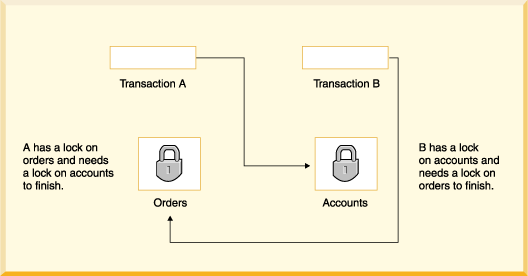
In a multi-process system, deadlock is an unwanted situation that arises in a shared resource environment, where a process indefinitely waits for a resource that is held by another process.
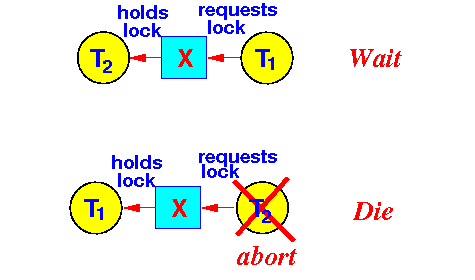
Wait-die scheme
It is a non-preemptive technique for deadlock prevention. When transaction Ti requests a data item currently held by Tj, Ti is allowed to wait only if it has a timestamp smaller than that of Tj (That is Ti is older than Tj), otherwise Ti is rolled back (dies).
In this scheme, if a transaction requests to lock a resource (data item), which is already held with a conflicting lock by another transaction, then one of the two possibilities may occur −
(1) If TS(Ti) < TS(Tj) − that is Ti, which is requesting a conflicting lock, is older than Tj − then Ti is allowed to wait until the data-item is available.
(2) If TS(Ti) > TS(tj) − that is Ti is younger than Tj − then Ti dies. Ti is restarted later with a random delay but with the same timestamp.
Wound-wait scheme
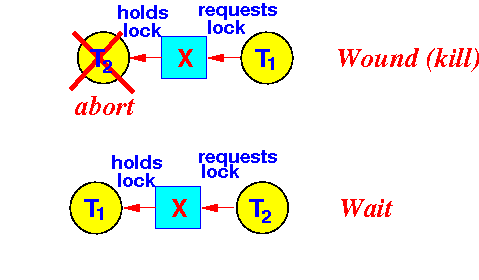
It is a preemptive technique for deadlock prevention. It is a counterpart to the wait-die scheme. When Transaction Ti requests a data item currently held by Tj, Ti is allowed to wait only if it has a timestamp larger than that of Tj, otherwise Tj is rolled back (Tj is wounded by Ti).
In this scheme, if a transaction requests to lock a resource (data item), which is already held with conflicting lock by some another transaction, one of the two possibilities may occur −
(1) If TS(Ti) < TS(Tj), then Ti forces Tj to be rolled back − that is Ti wounds Tj. Tj is restarted later with a random delay but with the same timestamp.
(2) If TS(Ti) > TS(Tj), then Ti is forced to wait until the resource is available.
Deadlock
By Alaukik