The Multi-Dimensional Approach to Linguistic Analyses of Genre Variation
an overview of methodology and findings
(Biber, D., 1992)
Tobias Anton
Corpus Linguistics
05.06.2019
Course: 8.3409
Tobias Anton
- Intro & Motivation
-
Methodology
- Data preparation
- Factor Analysis -
Findings
- e.g. genres over time
- statistical extension -
Critique / Discussion
- ...on the basis of a sloppy reproduction
The Multi-Dimensional Approach to Linguistic Analyses of Genre Variation
Course: 8.3409
Corpus Linguistics
Schedule
Introduction
The Multi-Dimensional Approach to Linguistic Analyses of Genre Variation
Course: 8.3409
Corpus Linguistics
- genres
- register / dialect
- historical development
- languages
How to find meaningful structure?
The multidimensional approach aims to find meaningful underlying structure to explain linguistic variation across several domains like:
The Multi-Dimensional Approach to Linguistic Analyses of Genre Variation
Course: 8.3409
Corpus Linguistics
Basic assumptions of the model:
- it is corpus based (seems 'twas important to note in the days of yore)
- it's computer based, thus enabling distributional analysis
- aims for linguistic/statistical analysis, not individual stylistic constructions
- different kinds of text differ linguistically
- multiple parameters of variation are operative in any domain
- it's a quantitative approach
- quantities are interpreted functionally
(statistical co-occurence implies shared functionality) - it combines macro- and microscopic approaches (e.g. variation across all genres as well as within specific ones)
Introduction
The Multi-Dimensional Approach to Linguistic Analyses of Genre Variation
Course: 8.3409
Corpus Linguistics
basic assumptions of the model:
- it is corpus based (seems 'twas important to note in the days of yore)
- it's computer based, thus enabling distributional analysis
- aims for linguistic/statistical analysis, not individual stylistic constructions
- different kinds of text differ linguistically
- multiple parameters of variation are operative in any domain
- it's a quantitative approach
- quantities are interpreted functionally
(statistical co-occurence implies shared functionality) - it combines macro- and microscopic approaches (e.g. variation across all genres as well as within specific ones)
Introduction
The Multi-Dimensional Approach to Linguistic Analyses of Genre Variation
Course: 8.3409
Corpus Linguistics
basic assumptions of the model:
5. multiple parameters of variation are operative in any domain
no single dimension is adequate in itself to account for the range of linguistic variation in a language
- Douglas, 1992
Introduction
Methodology
The Multi-Dimensional Approach to Linguistic Analyses of Genre Variation
Course: 8.3409
Corpus Linguistics
Methodology
Biber (1992) used:
-
LOB- and London-Lund Corpora
- LOB: 500 texts / 2000 words each
- LL: 100 (spoken) texts / 5000 words each - CLAWS tagging system
- ultimately resulting in:
- 481 texts (written & spoken)
- 67 linguistic features
- 23 major genre categories
(and small recap)
The Multi-Dimensional Approach to Linguistic Analyses of Genre Variation
Course: 8.3409
Corpus Linguistics
Selected examples of Feature-Classes:
- tense and aspect markers
- questions
- lexical specifity
- pronouns and proverbs
- place and time adverbials
- passives
- negation
- modals
Methodology
The Multi-Dimensional Approach to Linguistic Analyses of Genre Variation
Course: 8.3409
Corpus Linguistics
Methodology
The Multi-Dimensional Approach to Linguistic Analyses of Genre Variation
Course: 8.3409
Corpus Linguistics
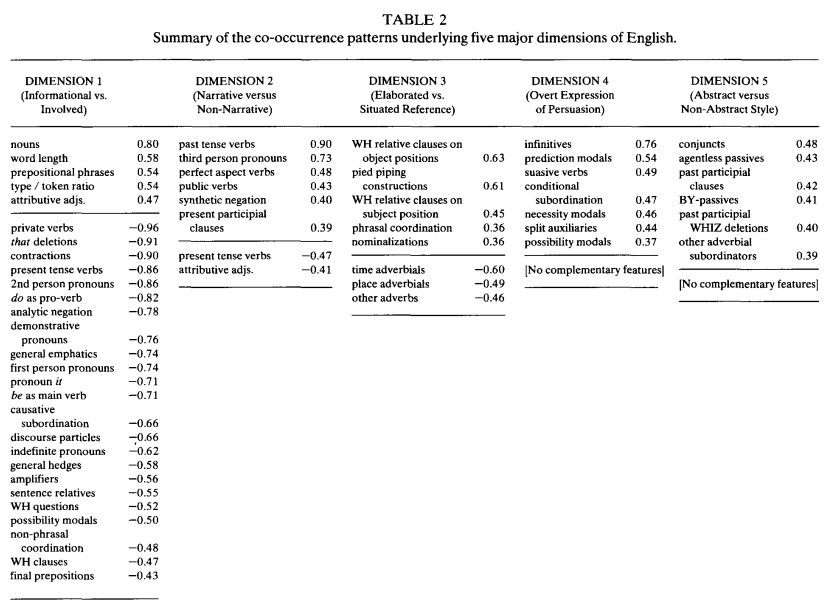
Dimension composition in detail:
Dimension 2: Narrative vs. Non-narrative
positive loadings:
- past tense verbs
- third person pronouns
- perfect aspect verbs
- public verbs
- synthetic negation
- present participle clauses
0.90
0.73
0.48
0.43
0.40
0.39
negative loadings:
- present tense verbs
- attributive adjs.
-0.47
-0.41
Methodology
The Multi-Dimensional Approach to Linguistic Analyses of Genre Variation
Course: 8.3409
Corpus Linguistics
Dimension composition in detail:
Dimension 2: Narrative vs. Non-narrative
positive loadings:
- past tense verbs
- third person pronouns
- perfect aspect verbs
- public verbs
- synthetic negation
- present participle clauses
0.90
0.73
0.48
0.43
0.40
0.39
negative loadings:
- present tense verbs
- attributive adjs.
-0.47
-0.41
Factor/Dimension labels are highly interpretative!
Methodology
The Multi-Dimensional Approach to Linguistic Analyses of Genre Variation
Course: 8.3409
Corpus Linguistics
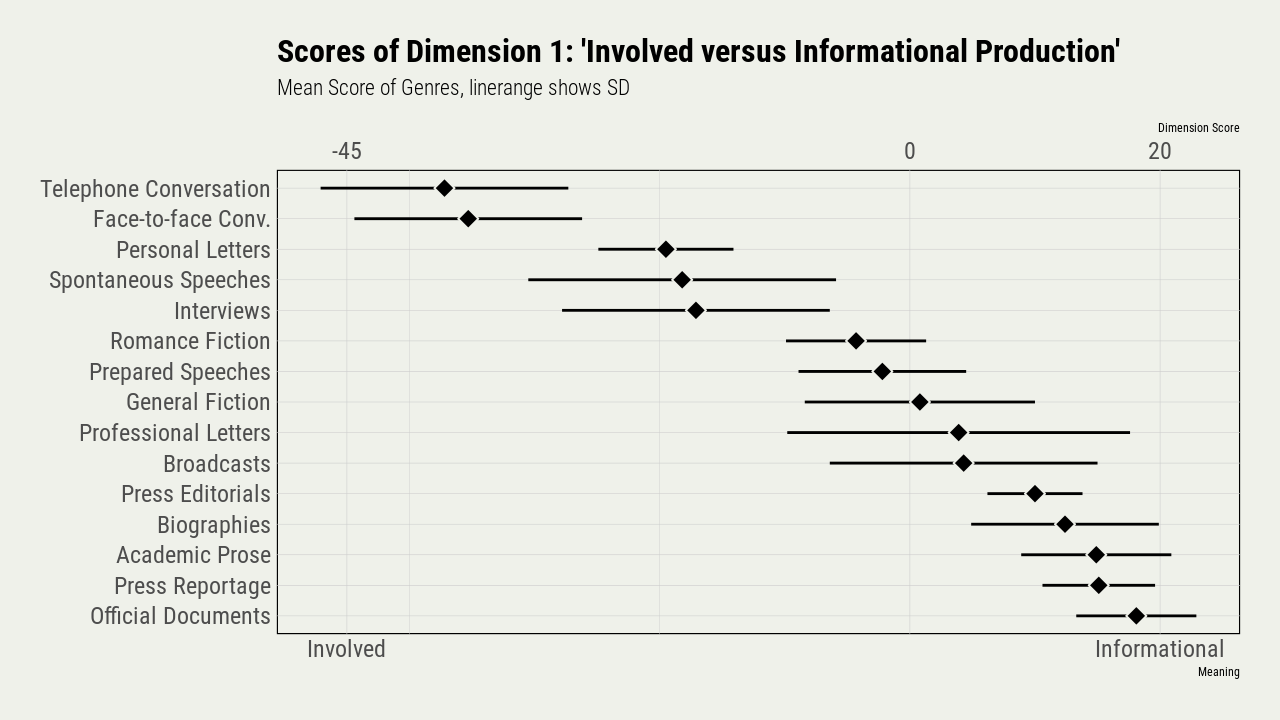
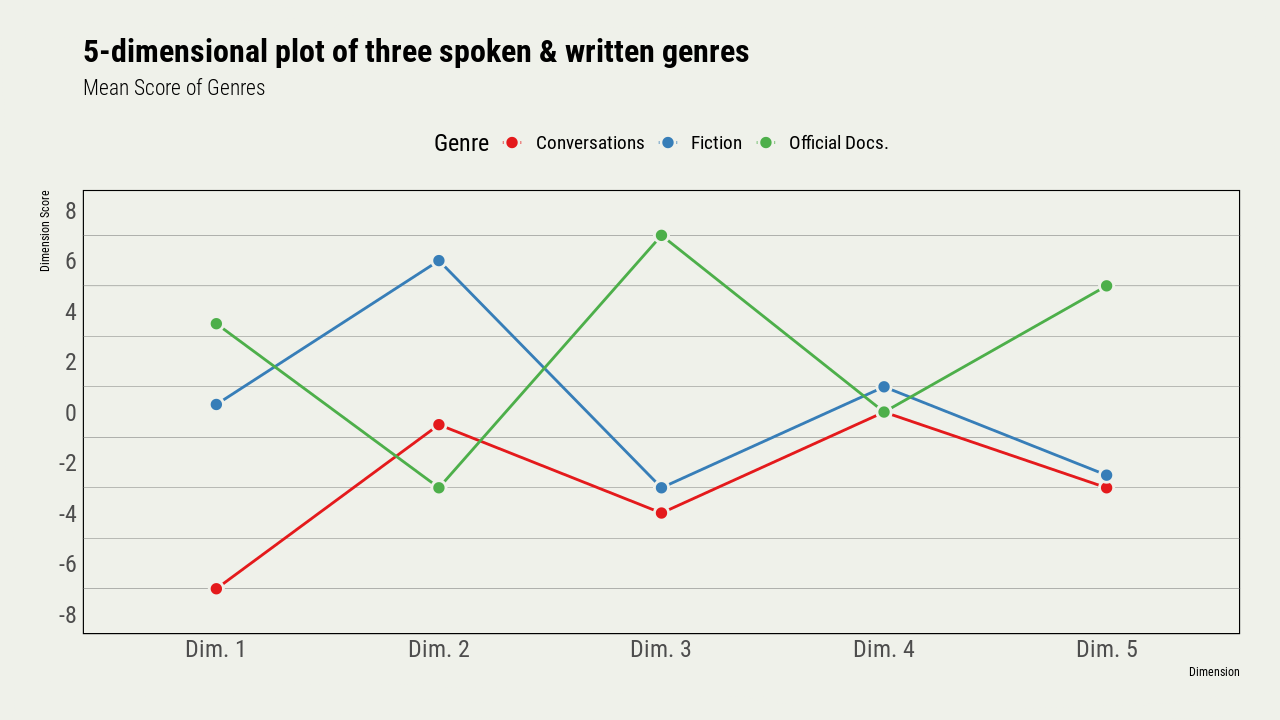
5 basic dimensions of variation
-
Informational vs Involved
+ nouns, word length
- private verbs, that deletions, contractions - Narrative vs Non-narrative
-
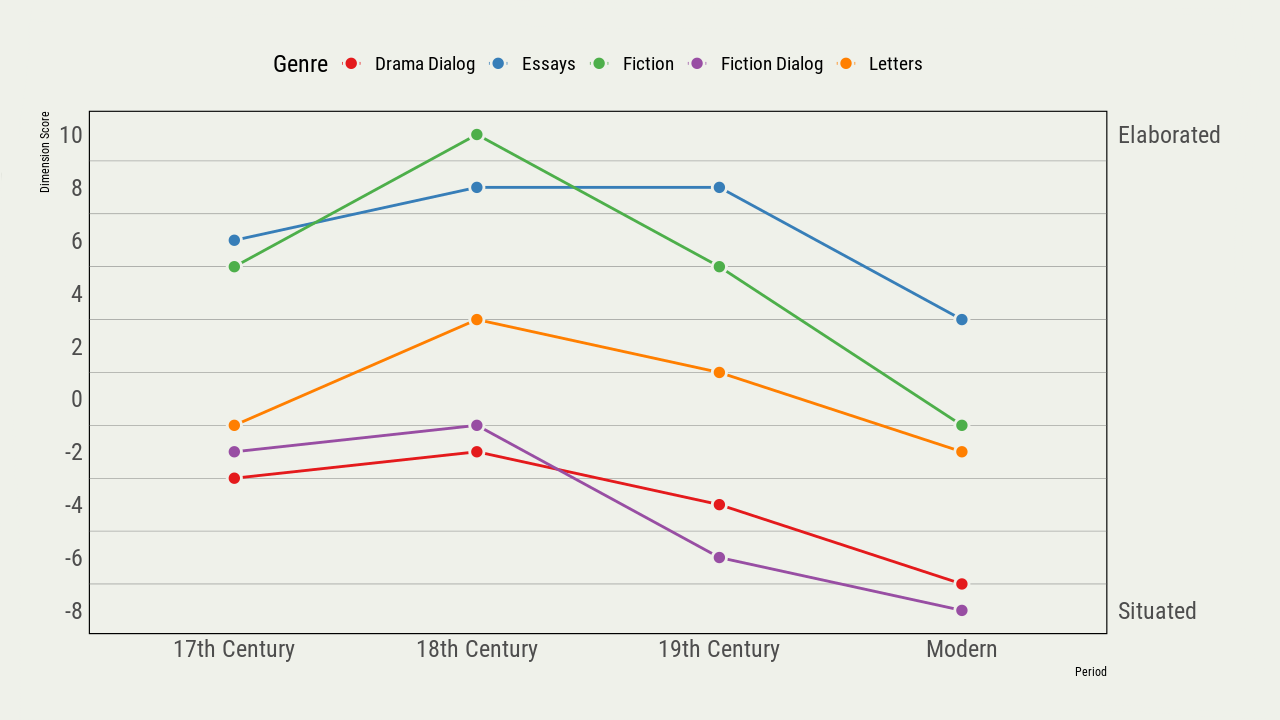
Elaborated vs Situated Reference
+ WH relative clauses on sub- & object positions
- time & place adverbials -
Overt Expression of Persuasion (Argumentation)
+ infinitives, prediction modals -
Abstract vs Non-abstract Style
+ conjuncts, agentless passives, BY-passives
Methodology
The Multi-Dimensional Approach to Linguistic Analyses of Genre Variation
Course: 8.3409
Corpus Linguistics
Methodology
The Multi-Dimensional Approach to Linguistic Analyses of Genre Variation
Course: 8.3409
Corpus Linguistics
Methodology
Findings
The Multi-Dimensional Approach to Linguistic Analyses of Genre Variation
Course: 8.3409
Corpus Linguistics
Findings
Grabe (1987):
- investigation between genres and audience level
- genres: social science, natural science, humanities...
- audience: academic, introductory university, popular - four dimensions identified
-
associations / differences found among both
==>implying linguistic importance
Findings
The Multi-Dimensional Approach to Linguistic Analyses of Genre Variation
Course: 8.3409
Corpus Linguistics
Biber (1991)
Analysis of primary school reading texts
- texts are "notably different from adult genres" ¯\_(ツ)_/¯
- also huge differences among each other
- 2nd grade science texts are more
- involved and interactive (dim 1)
- situated (dim 3)
than more advanced science texts - but also more involved & interactive than basal reading texts
primary school science text are probably no good marker for scientific literacy
Findings
The Multi-Dimensional Approach to Linguistic Analyses of Genre Variation
Course: 8.3409
Corpus Linguistics
Biber & Finnegan (1992)
Study on historical development of English genres
The Multi-Dimensional Approach to Linguistic Analyses of Genre Variation
Course: 8.3409
Corpus Linguistics
What is (a) genre?
text varieties that are readily recognized and "named" within a culture.
opposed to text types, which are
text varieties that are defined linguistically
Findings
The Multi-Dimensional Approach to Linguistic Analyses of Genre Variation
Course: 8.3409
Corpus Linguistics
What is (a) genre?
text varieties that are readily recognized and "named" within a culture.
opposed to text types, which are
text varieties that are defined linguistically
categorized perceptually
(not necessarily linguistically coherent)
categorized by linguistic dimension
(coherent by definition)
Findings
Findings
The Multi-Dimensional Approach to Linguistic Analyses of Genre Variation
Course: 8.3409
Corpus Linguistics
Statistical extension
Cluster Analysis on the basis of dimension scores (Biber, 1989):
- identifies Intimate Interpersonal & Informational Interaction
(instead of a single interactive/dialog type) - no single expository type, but...
- Scientific Exposition; informational, elaborated, abstract
- Learned Exposition; less abstract and technical
- General Narrative Exposition; informational elaboration - no single narrative type:
- General Narrative Expostion
- Imaginative Narrative; rather involved
Findings
The Multi-Dimensional Approach to Linguistic Analyses of Genre Variation
Course: 8.3409
Corpus Linguistics
MD Analysis of other languages
Dimensions in other languages convey different function
Kim & Biber (1993) analyzed Korean and found:
- Informational Interaction versus Explicit Elaboration
- Discourse Chaining versus Discourse Fragmentation
- Stance
- Narrative Concern
- Honorification
Discussion / Critique
The Multi-Dimensional Approach to Linguistic Analyses of Genre Variation
Course: 8.3409
Corpus Linguistics
Roundup
- Distributional analysis of co-occuring linguistic features across a wide range of genres
- Identification of underlying linguistic and textual constructs
- Model/Method can be used to address sociolinguistic and stylistic issues regarding their respective linguistic variation
Discussion / Critique
The Multi-Dimensional Approach to Linguistic Analyses of Genre Variation
Course: 8.3409
Corpus Linguistics
Discussion
- What do you think about this approach?
- are the assumptions justified?
- ...or the model?
- are the dimensions appropriate?
- are they sufficient?
- Any (b)ad-hoc hypotheses interesed in to able to test with this?
- Is InfoWars actually waging war on information?
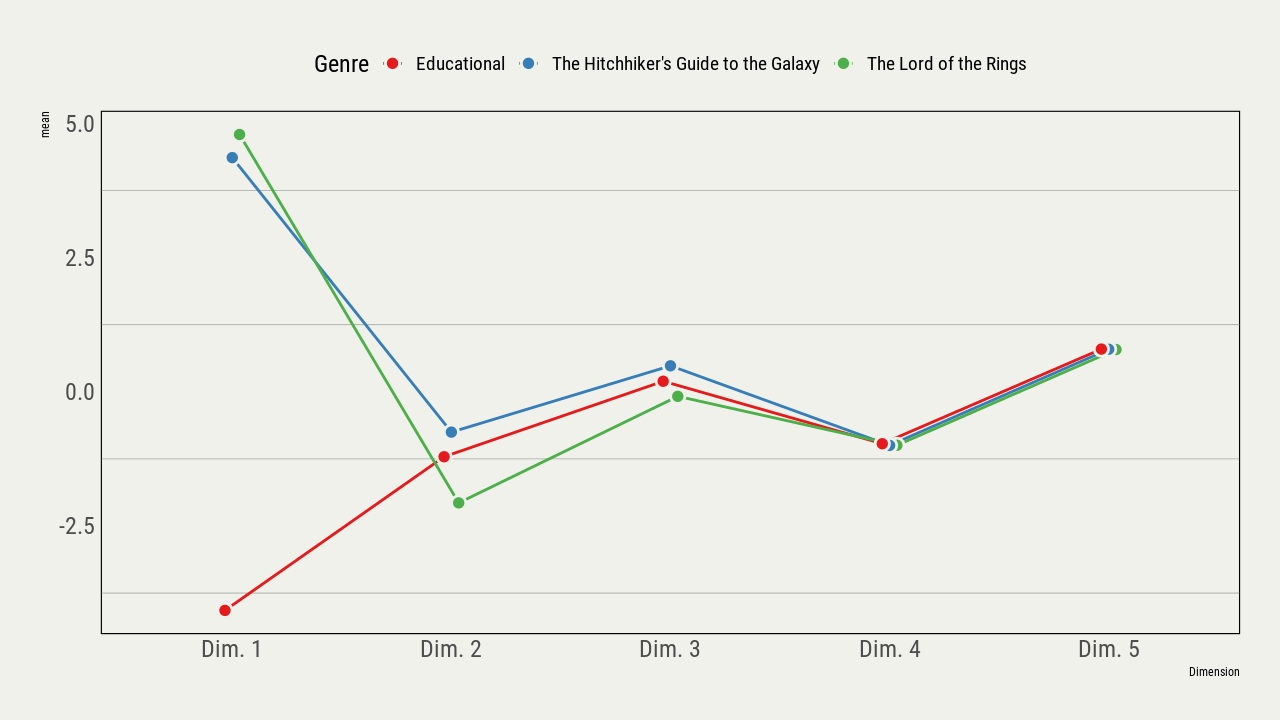
- How do hi-fantasy, satirical sci-fi and scientific literature differ?
Discussion / Critique
The Multi-Dimensional Approach to Linguistic Analyses of Genre Variation
Course: 8.3409
Corpus Linguistics
Discussion
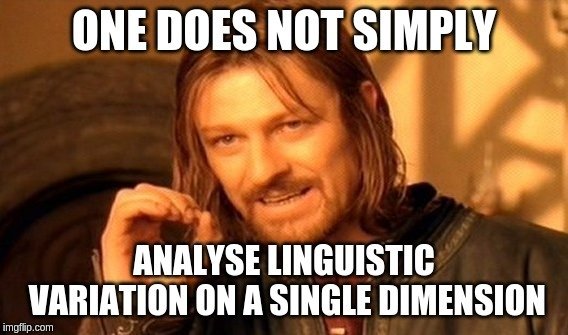
no single dimension is adequate in itself to account for the range of linguistic variation in a language
- Douglas, 1992
Discussion / Critique
The Multi-Dimensional Approach to Linguistic Analyses of Genre Variation
Course: 8.3409
Corpus Linguistics
Discussion
no single dimension is adequate in itself to account for the range of linguistic variation in a language
- Douglas, 1992
Discussion / Critique
The Multi-Dimensional Approach to Linguistic Analyses of Genre Variation
Course: 8.3409
Corpus Linguistics
Discussion
Discussion / Critique
The Multi-Dimensional Approach to Linguistic Analyses of Genre Variation
Course: 8.3409
Corpus Linguistics
Critique
- They don't mention any statistics regarding the dimensions
- Variance explanied per dimension / in total
- How they dealt with unclear loadings (if at all)
MDA to genre analyses
By Tobias Anton
MDA to genre analyses
Corpus Linguistics (SoSe'19): The Multi-Dimensional Approach to Linguistic Analyses of Genre Variation