Angular

Angular
- $q / $http after each step run $digest
- a lot of excess code for component declaration
Angular classy help to make more cleaner
- no default CLI commands
- no default way to build application
- directive attributes
Angular + require
define(function(require){

  var Module = require('../../module'),
      Url = require('../src/url');


    // do something
});
Angular + require plugins
define(function(require){

  var Module = require('module!@'),
      Url = require('src!url'),
      controller = require('controller!demo');


    // do something
});
define(function(require){
require('controller!demo');
require('controller!home');
require('src!url');
require('src!ui/loading-overlay');
require('directive!hello-world');
});Files that require all project scripts
Angular + require
NOT OK!1

Angular components
angular.module('application')
    .controller('application.demo', [
            '$scope', 'foo', 'bar',
          function($scope, foo, bar) {

              $scope.visible = true;

              $scope.click = function() {};

              function calc() {

              }


              $scope.export = function() {

              }
          }
    ]);
Controller
In green box - attr and methods that available in view.
Angular templates
<div ng-if="isVisible">
  <date-picker
    ng-model="model"
    range="true"
    min-date="min_value"
    max-date="max_value"
    highlite-range="config.highlite"
    ng-show="isVisible"></datepicker>

  <comple-select
    ng-model="model"
    items="items"
    normalize-names="normalizers.names"
    ng-select-link="hierarchy.getItems()"
    in-popup="true"></complex-select>
</div>
A lot of logic in templates
Angular templates
<div ng-controller="app.demo">
  <div ng-if="isVisible" id="toggle">
    <select

      ng-model="model"

      ng-options="item.id as item.name for item in items">
    </select>
  </div>
</div>
If model type is not object or array - its changes will be visible only at div#toggle scope. Because ng-if creates additional scope
Angular controllers
angular.module('application')
    .controller('application.demo', ['$scope',
      function($scope) {

        function click() {}
        function save() {}

        /**
         * $scope methods and variables
         */
        angular.extend($scope, {
          click: click,
          save: save
        });

        function initWatchers() {
          $scope.$watch('foo', function(value){});
        }

        function init() {
          initWatchers();
        }


        init();
      }
    ]);
Code standart for default angular controllers
ngx
import { Controller } from 'ngx';

class Demo { }

Controller('application.demo')
 .route('/')
 .src(Demo);
angular.module('application')
.controller('application.demo', ['$scope',
function($scope) {
}
]);
angualr.module('application')
.config(['$routeProvider',
function ($routeProvider) {
$routeProvider.when('/', {
controller: 'application.demo',
templateUrl: 'demo.html'
reloadOnSearch: false
});
}
]);Angular
Controller
ngx
import { Directive } from 'ngx';

class Controller {}

Directive('hello-world')
  .scope({
    name: '='
  })
  .controller(Controller);
angular.module('application')
.directive('helloWorld', [
function(){
return {
restrict: 'E',
replace: true,
templateUrl:
'...../hello-world.html',
scope: {
'name': '='
},
controller: ['$scope', function($scope) {}]
}
}
]);
Angular
Directive
ngx directive
import { Directive } from 'ngx';

class Controller {}

Directive('hello-world')
  .scope({
    name: '='
  })
  .controller(Controller);
Available flow methods:
- scope
- defaults
- controller
- api
- dependencies
- template
- templateUrl
If directives template is not defined - ngx will try to find template at same dir with same name - 'hello-world.html'
ngx directive api
import { Directive } from 'ngx';

class Controller {}

class HelloWorld {
  constructor($scope) {
    this.scope = $scope;
  }

  toggle() {
   this.scope.visible = !this.scope.visible;
  }

}

Directive('hello-world')
  .scope({
    name: '='
  })
  .api(HelloWorld)
  .controller(Controller);
import { Controller } from 'ngx';
class Demo extends Base {
toggle() {
this.api('hello-world').toggle();
}
}
Controller('application.demo')
.route('/')
.src(Demo);Directive
Controller
ngx directive api
import { Controller } from 'ngx';

class Demo extends Base {
  toggle() {

   this.api('hello-world.first').toggle();

  }
}

Controller('application.demo')
 .route('/')
 .src(Demo);
Controller
Template
<hello-world api-key="first"></hello-world>

<hello-world api-key="second"></hello-world>
ngx directive with ng-model
import { Directive } from 'ngx';

class Controller {}

Directive('hello-world')
 .controller(Controller)

 // name of local ng-model variable
 .model('localModel')

 // func call if local model changed
 // works with promises
 .validation(function() {});
<div>
 <switch ng-model="visible"></switch>
 <multi-select ng-model="localModel">
 </multi-select>
</div>
<hello-world ng-model="value"></hello-world>hello-world.js
hello-world.html
template
ngx directive with ng-model
import { Directive } from 'ngx';

class Controller {}

Directive('hello-world')
 .controller(Controller)

 // name of local ng-model variable
 .model('localModel')

 // func call if local model changed
 // works with promises
 .validation(function() {});
angular.module('application')
  .directive('helloWorld', [
    function(){
      function validate() { ... }

      return {
        restrict: 'E',
        replace: true,
        require: 'ngModel',
        templateUrl: 'src/tpl/hello-world.html',
        scope: {
          'model': '=ngModel'
        },
        controller: ['$scope', function($scope) {}],
        link: function(scope, element, attrs, ngModel) {
          ngModel.$render = function() {
            scope.localModel = ngModel.$viewValue;
          }
          scope.onChange = function(){
            var value = scope.localModel;

            if (validate(value)){
              ngModel.$setViewValue();
            }
          }
        }
      }
    }
  ]);
instead of →
Provide runtime flow:
- Controller
- Directive
- Route
- Factory
and other features
Provide node.js api for compiling.


npm install ngxbower install ngxvar ngx = require('ngx');ES6 source maps
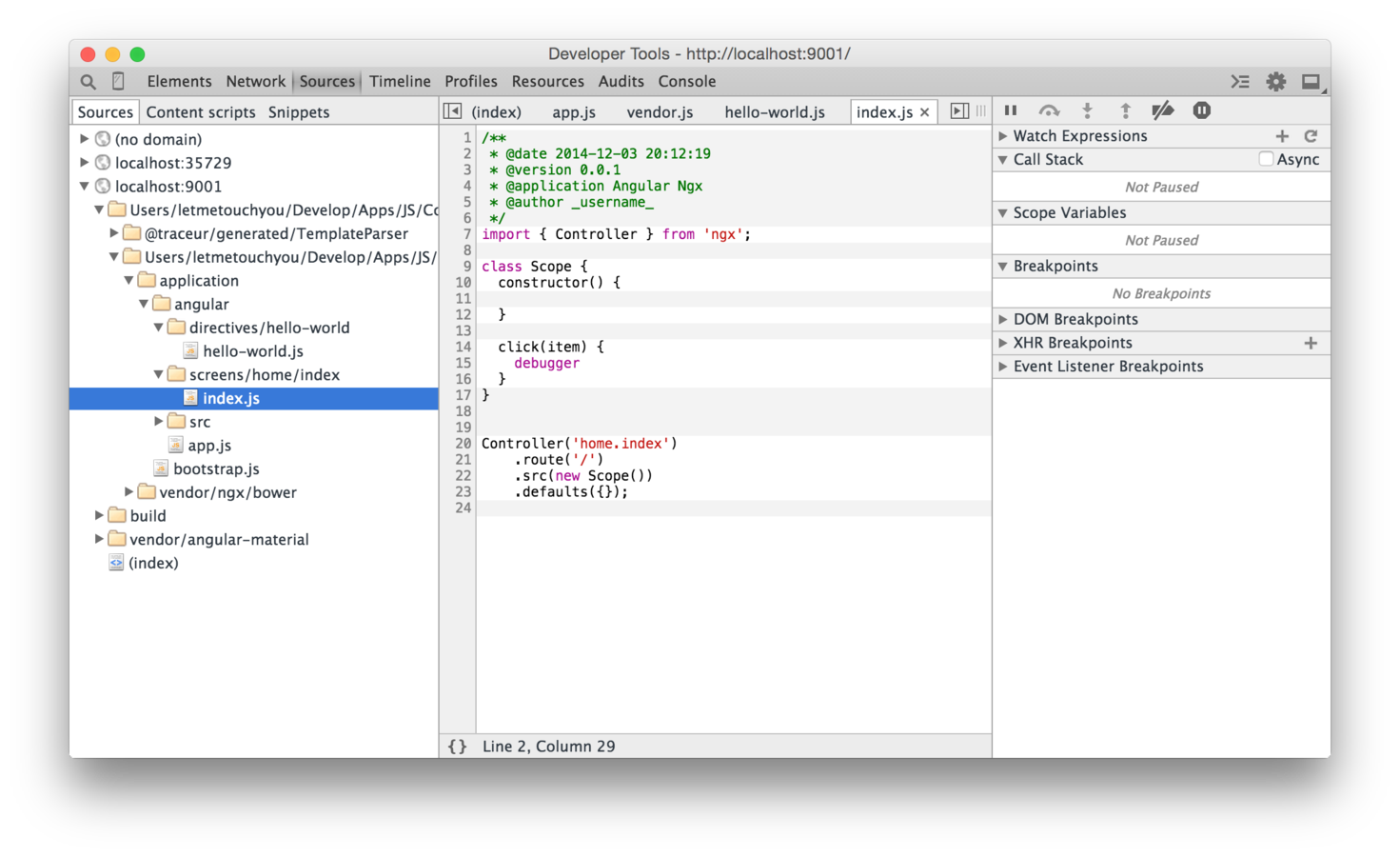
Compatible with default angular application
import { Controller } from 'ngx';

class Scope {}


Controller('home.index')
    .route('/')
    .src(Scope);


// default angular controller
angular.module('application')
    .controller('home.demo', [function() {

         }
    ]);
ES6
Use traceur for compilation
About ES6
How we use ES6
- Classes instead of $scope
- ES6 Promises instead of $q
- Types (harmony proposal)
Types
import {context, promise} from 'structs';

class StatisticController {

 load(params:context):promise {
   // ....
 }
}
import { Tcomb as T } from 'tcomb';
var Filter = T.struct({
value: T.list(T.Num),
operation: T.enums('equal more less')
});
export var context = T.struct({
id: T.Num,
filters: T.list(Filter)
});As structs and assertion we use tcomb
Could be used on dev env. On prod could be disabled when compiling without changes in code
var ngx = require('ngx');

var Instance = ngx({...});

Instance.setOptions({
    types: !!isDev
});We dont use all experimental functions. We hope that when ES6 will release - we just remove builder and all will be OK :)
- annotations
- types
- other not ES6 features
@Directive({
  selector: ['blink']
});
class Blink {
  constructor(element:Element,
              options:Options,
              timeout: Timeout) {
   ...
  }
}
Thanx
valeriy.sorokobatko@gmail.com
Angular and ES6
By Valerii Sorokobatko