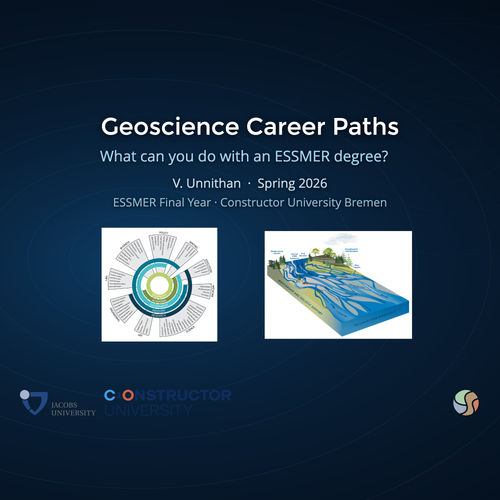
Geoscience Career Paths
What can you do with an ESSMER/ESS BSc degree?
V. Unnithan · Spring 2026
BSc Final Year · Constructor University Bremen


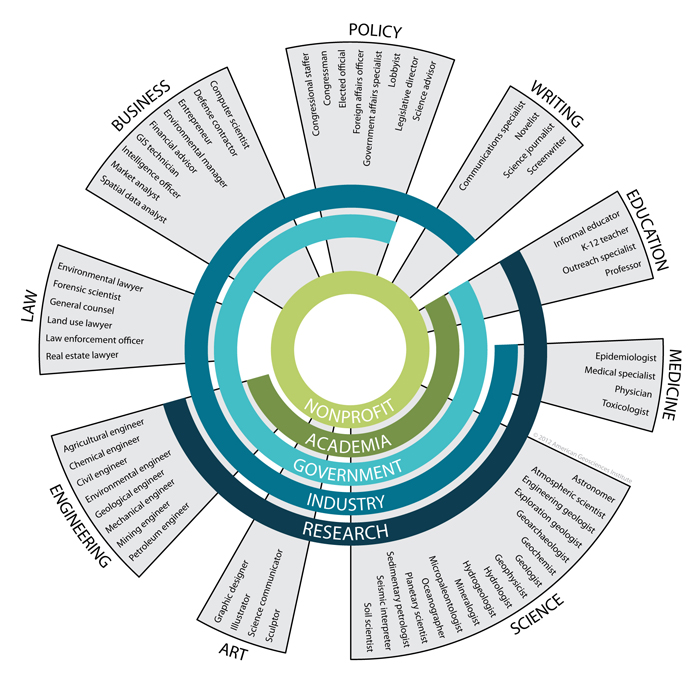
The Braided River
How geoscience careers actually work
"There is no single entry point to the geoscience workforce. Like a braided river, careers branch, merge, and shift in response to opportunity, further study, and personal development."
— American Geosciences Institute, Workforce Program
Where do geoscientists work?
| Sector | Share (Europe, approx.) |
|---|---|
| Industry & consulting | ~35% |
| Government agencies | ~30% |
| Research institutes | ~15% |
| Academia | ~15% |
| NGOs, policy, other | ~5% |
Proportions shift significantly by country and specialisation (above has a US focus)
Image: https://www.grow-geocareers.com/assets/images/mbr-2.jpg
The 2×2 career map
RESEARCH
↑
PUBLIC ←───────┼───────→ PRIVATE
↓
 APPLIED
Where does each career sit? — build this together on the board
Public + Research
- Germany: AWI · GEOMAR · MARUM · Hereon · GFZ Potsdam
- Netherlands: NIOZ · TNO / GDN
- Belgium: RBINS / OD Nature
- Scandinavia: NGU (NO) · GEUS (DK) · SGU (SE)
- Southern Europe: OGS Trieste (IT) · IEO / CSIC (ES)
- International: University posts · DFG · NWO · ERC projects
Public + Applied
- Germany: BGR · BSH · Umweltbundesamt · NLWKN
- Netherlands: Rijkswaterstaat · Deltares · KNMI
- Norway: Norwegian Polar Institute · NORSAR · NIVA
- Sweden: SMHI
- EU agencies: EEA · Copernicus / CMEMS
- International: IOC/UNESCO · IAEA Monaco
Private + Applied
- Survey & geophysics: Fugro · TGS · CGG · PGS
- Marine tech: Kraken Robotics · Kongsberg · Teledyne
- Offshore energy: Equinor · Aker BP · Ørsted · RWE · Vattenfall
- Dredging / civil: Boskalis · Van Oord · DEME · Jan De Nul
- Consulting: Rambøll · COWI · WSP · ARCADIS · TAUW
- NGI: geotechnical research & consulting (Norway)
The wildcard quadrant
Cuts across all four sectors
- Geo data science — domain knowledge + Python / ML
GROW career pathways · AGI Data Science Compass - Science communication — journalism, museums, outreach
EGU SciComm · AGI Science Writing Compass - ESG & sustainability consulting — natural capital, reporting
ESG Today careers · Earthworks sustainability listings - Catastrophe risk / insurance — natural hazard modelling
Verisk / AIR Worldwide · Moody's RMS - Marine spatial planning — Blue Economy, EIA
EU MSP Platform · EMODnet - Planetary geoscience — ESA, DLR, analogue fieldwork
ESA Careers · DLR Careers · Europlanet / GMAP
Track 1 — Marine Geoscience & Geophysics
| Programme | Institution |
|---|---|
| M.Sc. Marine Geosciences | CAU Kiel / GEOMAR |
| M.Sc. Marine Geosciences | Univ. of Bremen / MARUM |
| M.Sc. Ocean & Climate Physics | Univ. of Hamburg |
| M.Sc. Geophysics | Univ. of Hamburg |
| M.Sc. Applied Geosciences (EMR) | RWTH Aachen |
| M.Sc. Earth System Data Science | Leipzig University |
All English-taught
Track 2 — Environmental Science & Earth System
| Programme | Institution |
|---|---|
| M.Sc. CLEWS | Univ. of Potsdam / GFZ |
| M.Sc. Environmental Sciences | Univ. of Trier |
| M.Sc. Env. & Resource Management | BTU Cottbus |
| M.Sc. Env. Science & Technology | TU Berlin |
| M.Sc. Environmental Engineering | TU Munich |
| M.Sc. Env. Risks & Human Security | Bonn / UNU-EHS |
All English-taught
Track 3 — Geochemistry & Resources
| Programme | Institutions |
|---|---|
| M.Sc. Geosciences (geochemistry) | Göttingen · Frankfurt |
| M.Sc. SINReM (joint degree) | Freiberg + Ghent + Uppsala |
SINReM covers the full raw materials value chain across 3 countries.
EIT AVSA scholarships available. English throughout.
Track 4 — Marine Environment & Blue Economy
Erasmus Mundus joint programmes
| Programme | Partners |
|---|---|
| MER+ Marine Env. & Resources | Southampton · Bilbao · Bordeaux · Liège |
| CoMEM Coastal & Marine Eng. | NTNU · TU Delft · UPC · Southampton |
| Oceans & Lakes | Ghent · VUB · Amsterdam |
Full scholarship (tuition + ~€1,200/month) for competitive applicants.
Start preparing 12 months before the deadline.
Track 5 — Sustainability & Policy
| Programme | Institution |
|---|---|
| M.Sc. Sustainability Science | Leuphana Univ. Lüneburg |
| M.Sc. Environmental Governance | Univ. of Freiburg |
| M.Sc. Env. & Resource Economics | Univ. of Heidelberg |
For careers in NGOs, international organisations, ESG consulting, and policy
Applying — practical notes
- DAAD database: daad.de/international-programmes
- EU applicants: deadline typically 15 July for winter semester start
- Scholarships: DAAD · Deutschlandstipendium · Erasmus Mundus
- For Erasmus Mundus: start preparing 12 months before deadline
Why this matters now!!
- Many German agency roles require an MSc for entry
- Industry is more flexible — some hire BSc directly
- The right MSc shapes which sector quadrant you can enter
- ~85% of German programmes are admission-free
- Most public universities charge no tuition fees
Language Considerations
German federal agencies and many consultancies German (B2–C1); remember the program might be in English but the "rest" is in German!
Check job postings. Look at what they actually require.
e.g. Earthworks
German Applications
German application norms differ from UK, US, and Dutch conventions. A complete German application typically includes:
- Anschreiben — a formal cover letter, addressed to a named person, no more than one page
- Tabellarischer Lebenslauf — a reverse-chronological CV, typically 1–2 pages, with a professional photograph in the top-right corner
- Zeugnisse — copies of all relevant certificates: Abitur/equivalent, university transcripts, internship certificates (Praktikumszeugnisse), work references (Arbeitszeugnisse)
International students who have never applied for a German job are often unaware of the photograph convention (professional photo) and the expectation of complete Zeugnisse.
Career videos & profiles
Geoscience Career Paths · Earth Science Resources · YouTube
youtube.com/playlist?list=PLMMDmhBiy7uFq__T7epiuPD9Jzz9rWjwD
GROW · Geoscience Resources on Opportunities in the Workforce
AGI · Workforce Infographic + Career Compass
profession.americangeosciences.org/learning/workforce-infographic

Job boards
ResourceURL
| EAGE Industry Jobs | eage.org/…/careers-in-the-industry |
| First Break Recruitment Special | - 2010 - |
| Earthworks Jobs | earthworks-jobs.com |
| EURAXESS | euraxess.ec.europa.eu/jobs |
| DAAD Programmes | daad.de/international-programmes |
Key employers
Professional societies
- EAGE — European Assoc. of Geoscientists & Engineers (NL-based)
Student membership · Laurie Dake Challenge · Annual Conference Job Centre - EGU — European Geosciences Union
Annual Assembly Vienna · student memberships · career sessions - DGGV — Deutsche Geologische Gesellschaft
- Geological Society of London — international membership available
Country Profiles
The Netherlands is exceptionally relevant for ESSMER graduates given Constructor University's location and the Dutch strand within the ESSMER programme. The Dutch geoscience employment landscape is characterised by a well-funded public research sector, a very active dredging and maritime engineering industry, and strong coastal/water management institutions that are internationally recognised.
Key public research employers
-
NIOZ — Royal Netherlands Institute for Sea Research (Texel and Yerseke): the national oceanographic institution, with research departments spanning ocean systems, coastal systems, marine microbiology/biogeochemistry, and estuarine/delta systems. NIOZ employs staff from over 30 nationalities and works largely in English. It is part of the NWO-I umbrella organisation, which sets employment conditions. Positions range from MSc/PhD studentships to postdoc and permanent researcher roles. NIOZ is a direct analogue to AWI/GEOMAR and should be a familiar name to Dutch-heritage students.
-
TNO / Geological Survey of the Netherlands (GDN): TNO is an independent applied research organisation employing around 3,000 specialists. The Geological Survey of the Netherlands is housed within TNO and covers subsurface modelling, groundwater, geothermal, and geo-ICT. TNO was voted the Netherlands' most attractive employer in 2021. It offers a trainee programme (three rotations over two years) and runs regular internship/graduation projects — a concrete pathway for final-year BSc/MSc students. Work at TNO/GDN spans x=40 to x=640 from fundamental research to direct policy and industry advice.
-
Deltares: a leading international institute for applied research in water, subsurface, and infrastructure, headquartered in Delft. Deltares is frequently cited as a career destination for marine science MSc graduates (Utrecht University career page lists it prominently). The institute works on coastal resilience, flood risk, and sediment dynamics — highly relevant to ESSMER environmental track students. English is a common working language given extensive international project work.
-
KNMI — Royal Netherlands Meteorological Institute: hires in atmospheric and ocean-atmosphere science; relevant for climate-oriented ESSMER graduates.
-
Rijkswaterstaat: the Dutch government body responsible for water and road infrastructure. Hires environmental engineers, hydrologists, and coastal scientists; relevant for environment-track students interested in public-sector applied work.
Industry: dredging and maritime engineering
The Netherlands is home to two of the world's largest dredging and marine civil engineering companies:
- Boskalis (Papendrecht): seabed surveys, port construction, offshore installation, and pipeline trenching. Actively hires geoscientists and survey specialists. Regularly cited in Dutch marine science graduate career pages.
- Van Oord (Rotterdam): dredging, offshore wind foundations, and subsea cable laying. A growing employer as North Sea offshore wind expands.
Both companies work internationally and hire from European universities. CVs in English are standard for international positions; Dutch is useful for domestic roles.
Language and application norms
The Netherlands is one of the most English-friendly labour markets in Europe. At research institutes, universities, and large international companies, English is the primary working language and applications are accepted in English. For Rijkswaterstaat and some municipal/provincial agencies, Dutch is expected. The Dutch CV convention is more similar to UK/international norms than German norms — no mandatory photograph, concise format, cover letter in Dutch or English depending on the employer. The motivatiebrief (cover letter) is taken seriously; a generic letter will not stand out.
Belgium is a smaller but distinctive geoscience labour market, split across French- and Dutch-speaking institutions. The marine science community is concentrated around Ghent, Brussels, and the Flemish coast, and is closely connected to North Sea governance networks.
Key public research employers
-
RBINS — Royal Belgian Institute of Natural Sciences (Brussels): a federal scientific institute of over 450 staff. Its marine activities sit within the Operational Directorate Natural Environment (OD Nature), which runs the MUMM (Management Unit of the North Sea Mathematical Models) programme — around 60 people working on North Sea modelling, monitoring, and Marine Strategy Framework Directive implementation. OD Nature manages the Belgian oceanographic vessel and coordinates long-term environmental monitoring of offshore wind farms (WinMon.BE). RBINS also houses the Geological Survey of Belgium. It is a direct entry point for students interested in marine environmental monitoring, numerical modelling, and science-policy interface work.
-
VLIZ — Flanders Marine Institute (Ostend): the Flemish marine knowledge centre, coordinating the Belgian marine data infrastructure (LifeWatch, EMODnet) and running the research vessel Simon Stevin. VLIZ is an important node in the European marine data network and hires data managers, information scientists, and research support staff alongside scientists.
-
Universities: Ghent University (Marine Biology, Geology departments), Université Libre de Bruxelles (ULB), and KU Leuven are the main geoscience research universities. PhD positions are the primary academic entry route.
Industry
Belgium has a notable offshore wind sector in the Belgian Part of the North Sea (BPNS), with companies including DEME (Zwijndrecht) — one of the world's largest dredging and marine civil engineering firms, closely comparable to Boskalis — and Jan De Nul Group. Both hire geotechnical survey specialists and marine engineers. For ESSMER students with survey/geophysics skills, these are realistic employers.
Language and application norms
Belgium's linguistic division matters practically. Positions at VLIZ and Flemish universities are typically advertised in Dutch (with English often acceptable); RBINS Brussels positions may appear in French, Dutch, or English depending on the directorate. Applications to federal institutions are often bilingual. For students with neither French nor Dutch, English-language positions exist but are more limited than in the Netherlands — targeting international projects (Horizon Europe, EMODnet) rather than domestic agency roles is often the more realistic short-term path.
Norway is the single most important Scandinavian destination for ESSMER-profile graduates with geophysics, marine geology, or offshore survey skills. The Norwegian Continental Shelf is the most technically advanced offshore operating environment in the world.
Public research employers
-
NGU — Geological Survey of Norway (Trondheim): the national geological survey, equivalent to BGR. Covers bedrock and Quaternary geology, marine geology, groundwater, and mineral resources. Hires geologists, geophysicists, and geochemists. English widely used internally.
-
NGI — Norwegian Geotechnical Institute (Oslo, with offices in Houston and Perth): internationally renowned for geotechnical engineering and engineering geosciences, including offshore geohazards, submarine slope stability, and arctic geosciences. A not-for-profit foundation bridging research and consulting. Particularly relevant for students interested in submarine mass failures, seabed geomechanics, and natural hazards — themes that intersect directly with ESSMER research areas. Recruits internationally.
-
NORSAR (Kjeller): Norwegian seismic array and seismological research. Relevant for geophysics-oriented students.
-
Norwegian Polar Institute (Tromsø): research in Svalbard and the Arctic/Antarctic. Hires for polar fieldwork, glaciology, marine geology, and environmental monitoring.
-
NIVA — Norwegian Institute for Water Research: environmental water science, relevant for environment-track students.
-
NORCE (Bergen): applied research covering climate, energy, environment. One of Norway's largest research organisations.
-
CICERO (Oslo): climate research institute, relevant for students with a climate/policy orientation.
Industry
The offshore energy sector in Norway is enormous relative to the country's population. Key employers for ESSMER graduates include:
-
Equinor (Stavanger): Norway's state-controlled energy major, the world's largest offshore operator. Has a dedicated Petroleum Energy & Geoscience graduate programme (two-year rotational programme, highly competitive). Actively recruiting for energy transition roles — CCS, offshore wind, hydrogen — alongside conventional petroleum. English is the working language in technical teams; Norwegian improves integration and is needed for senior roles.
-
Aker BP (Fornebu): second major Norwegian oil operator on the NCS. Similar profile to Equinor.
-
Kongsberg Maritime (Kongsberg): a world-leading marine technology and instrumentation company. Develops multibeam echosounder systems, AUV/ROV technology, and dynamic positioning systems. Highly relevant for ESSMER students with instrumentation interests — and a direct connection to the kind of equipment used on RV Heincke.
-
Subsea 7, TechnipFMC, Aker Solutions: subsea engineering companies with geoscience-adjacent roles in pipeline routing, seabed surveys, and geohazard assessment.
Language and practical notes
English is widely spoken and used in technical environments, particularly in the offshore industry and at research institutes. Norwegian is not required to enter the sector but is expected within 1–2 years for most permanent roles, particularly in public-sector organisations and for career progression. Norway is not in the EU but is in the EEA, meaning EU citizens have free movement rights. Salaries are high; living costs (especially in Stavanger and Oslo) are correspondingly high. The folkeregistrering (population registration) and Norwegian tax card are the first bureaucratic steps for new arrivals.
ealistic short-term path.
Denmark is important for ESSMER graduates particularly in offshore wind — Denmark is where offshore wind was invented (Vindeby, 1991) and the country remains a global leader.
Key employers and institutions
-
GEUS — Geological Survey of Denmark and Greenland (Copenhagen): an internationally oriented public research institute, established 1888. Covers geology, hydrogeology, Greenlandic geology, and marine geology. Actively hires internationally and has a well-organised page for international newcomers. English is used in research; Danish more prevalent in administrative roles. GEUS has particular expertise in Arctic and Greenland geology — a distinctive niche.
-
DTU Aqua (Technical University of Denmark, Aquatic Resources): major fisheries and marine environment research institute.
-
Ørsted (Fredericia/Copenhagen): the world's largest offshore wind developer, spun off from the Danish state energy company. Has geoscience roles in site survey, foundation design support, and environmental impact. A flagship employer for students interested in the energy transition.
-
Rambøll, COWI, WSP (major Danish/Nordic engineering consultancies): all hire geoscientists and environmental scientists for infrastructure, coastal, and environmental projects across Scandinavia and internationally.
Language: Danish is required for most public-sector roles in the longer term; English is widely used in industry and at research institutes. Danish is relatively accessible for Dutch speakers — worth mentioning to Dutch-heritage students.
Sweden's geoscience sector is led by its mining and mineral extraction industry (a major global player), its offshore wind expansion, and its strong university research base.
Key employers
-
SGU — Geological Survey of Sweden (Uppsala): the national geological survey. Covers bedrock, Quaternary, marine geology, and groundwater. Hires geologists and hydrogeologists. Swedish required for most positions.
-
SMHI — Swedish Meteorological and Hydrological Institute: covers oceanography, hydrology, and atmospheric science. Relevant for climate/environment-track students.
-
Universities: Stockholm University (Department of Geological Sciences, Baltic Sea research), Uppsala University, and the University of Gothenburg (marine sciences) are major research centres. PhD positions accessible to EU/EEA applicants.
-
Mining industry: LKAB, Boliden, and international mining companies with Swedish operations hire economic geologists, geophysicists, and environmental geoscientists. Less directly relevant to marine ESSMER but worth noting for resource-track students.
Language: Swedish is generally required for domestic roles. English is strong across academia and tech. For non-Swedish speakers, international companies and EU-funded research projects are the most accessible entry points.
Italy
Key research institutions**
-
OGS — Istituto Nazionale di Oceanografia e di Geofisica Sperimentale (Trieste): Italy's national institute for oceanography and applied geophysics, directly comparable to AWI in scope. OGS covers physical, chemical, and biological oceanography, marine geology, geophysics, seismology, and polar science. It operates the icebreaker R/V Laura Bassi and the oceanographic vessel R/V OGS Explora. OGS is the Italian national coordinator for EURO-ARGO and is an active partner in ECCSEL (carbon capture infrastructure). It runs an annual Summer School and an Advanced Master in Sustainable Blue Economy in collaboration with the University of Trieste — a concrete entry point for ESSMER graduates interested in the Blue Economy. OGS hires through public competition (concorso); positions are also filled through EU project contracts (assegni di ricerca, contratti a tempo determinato). English is the working language for international research; Italian is increasingly expected for permanent roles.
-
INGV — Istituto Nazionale di Geofisica e Vulcanologia (Rome, with sections in Bologna, Catania, Naples, Palermo): the national institute for geophysics and volcanology. INGV is Italy's principal institution for seismology, volcanology, and solid earth geophysics. Less directly marine in focus but covers submarine volcanoes and seismic hazard in Mediterranean coastal zones — relevant to students interested in geohazards.
-
CNR — Consiglio Nazionale delle Ricerche (National Research Council): the largest Italian public research organisation, with marine science concentrated in institutes such as the ISMAR (Institute of Marine Sciences, Venice/Trieste/Bologna/Ancona) and ISAC (Institute of Atmospheric and Climate Sciences). CNR institutes hire through competitive calls and EU project funding.
-
International organisations based in Italy: the IAEA Marine Environment Laboratories in Monaco (adjacent to northern Italy) hire marine environmental scientists; the Abdus Salam ICTP in Trieste has earth system science programmes. These are worth flagging as realistic targets for internationally mobile graduates.
Practical notes for non-Italian speakers
The Italian academic and public research system is more closed to non-Italian speakers than the German system. Concorso positions require Italian for administrative and teaching components. EU project-funded positions (often advertised in English, shorter-term) are the most accessible route in. Graduates interested in Italy are advised to contact research groups directly with a speculative application (candidatura spontanea) or apply for specific EU-funded project calls. Italian is not a prerequisite for a postdoc at OGS or CNR but significantly improves the prospect of converting to a permanent position.
Spain
Key research institutions**
-
IEO — Instituto Español de Oceanografía (Madrid, with nine coastal oceanographic centres from A Coruña to the Canary Islands): Spain's national oceanographic institute, a public research organisation (OPI) under the CSIC umbrella since 2022. IEO employs around 700 people (80% research staff) and operates five major oceanographic vessels, including the R/V Ramón Margalef and R/V Ángeles Alvariño. Its research covers physical, chemical, biological, and geological oceanography, fisheries sustainability, and marine environmental monitoring. IEO is Spain's representative in most international marine science forums. Job vacancies are now advertised through the CSIC website (since January 2022) via public competition; project-based contracts are also available. English is used in international research teams; Spanish is essential for permanent roles and for integration in Spanish oceanographic centres.
-
CSIC Marine Institutes: beyond IEO, several CSIC institutes focus on marine and earth sciences:
- ICM — Institut de Ciències del Mar (Barcelona): physical and biological oceanography, marine geology. One of Spain's leading marine research centres.
- ICCM — Instituto de Ciencias del Mar y Limnología (various)
- IIM — Instituto de Investigaciones Marinas (Vigo): fisheries biology, oceanography, aquaculture.
- IGME — Instituto Geológico y Minero de España (Madrid): the national geological survey, covering subsurface geology, hydrogeology, geoheritage, and geological hazards.
-
Universities: the University of Barcelona, Universitat Politècnica de Catalunya (UPC), University of Vigo, and University of Cádiz are active in marine and earth sciences. PhD positions are advertised in English and accessible to EU citizens.
Offshore energy context
Spain is expanding its offshore wind sector (the Canary Islands and the Bay of Biscay are key development zones) and is a significant player in marine spatial planning for Atlantic and Mediterranean waters. Environmental impact assessment consultancies and offshore wind developers (Iberdrola, Repsol, EDP Renewables) are emerging employers for marine geoscientists as the sector matures.
Practical notes for non-Spanish speakers
Spanish (castellano) is required for most permanent public-sector positions and is strongly preferred at CSIC institutes. For EU-project contract positions and PhD studentships, English is usually sufficient and such posts are increasingly advertised in English. The oposición system (highly competitive civil service examination, held infrequently) is the route to permanent IEO/CSIC positions and is practically inaccessible to non-Spanish speakers in the short term. Students with a genuine interest in Spain should be directed towards: (1) CSIC-advertised PhD or postdoc contracts (contrato predoctoral / Juan de la Cierva fellowships), (2) EU-funded Horizon Europe positions, or (3) a Spanish language investment alongside their research profile.
Text
Your ESSMER degree is not a channel.
It is a delta!
check out .. contact ..
Geoscience Careers - 2026
By Vikram Unnithan