Optimizing JavaScript
Adapted from Alon Zakai (Mozilla)
Profiling
We can use developer tools to analyze program performance. How about fishies?
Performance Pitfalls
You have to be careful with strings.
var s = "hello";
s += " world";
s += "!";

var s = ["hello", " world", "!"].join("");
Performance Pitfalls
Although JS is garbage collected, memory leaks
can still occur via closure.
function makeClosure() {
    var data = {"foo": 0};
    return function() {
        return data['foo']++;
    };
}
Compiling to JavaScript
JavaScript is standards-based and the only language that runs in all web browsers
You can run only JavaScript in browsers, but you can write in another language - if you compile it to JavaScript
Compiling to JavaScript:
Nothing New!
- 2006: Google Web Toolkit (GWT), Java to JS
- 2007: pyjamas, Python into JS
Adoption
- Java (GWT) used in Blogger, many enterprise apps
- C# (Script#) used in Microsoft Office Web Apps
Plenty of Languages
- Jeremy Ashkenas's list has many dozens
- Two main kinds:
- Established languages: C, C++, Java, C#, Python, etc.
- New languages intended for compilation to JavaScript: CoffeeScript, TypeScript, Dart, Roy, etc.
- I'll focus on C and C++
I'll also focus on performance
Doesn't matter for all codebases, but tends to matter more in large ones
Why is compilation to JS useful?
1. Preference for other languages
- Static typing
- Existing tools
2. Performance
JavaScript engines have gotten fast enough to run large compiled codebases
Late 2008/early 2009: V8, TraceMonkey, and Nitro were released, and the race for JavaScript speed was on
That race enabled running large compiled codebases
Performance: Beyond "enabling"
Compiled JavaScript can be faster than "regular" handwritten JavaScript
Wait, compiled JavaScript is a subset of JavaScript! How can it be faster?
One Step Back:
How Compilation Works
C/C++ => LLVM => Emscripten => JavaScript
LLVM Optimizations
LLVM's optimizer uses type information to perform many useful optimizations. Decades of work have gone into developing optimization passes for C/C++ compilers.
...dce, inline, constmerge, constprop, dse, licm, gvn, instcombine, mem2reg, scalarrepl...
LLVM Optimizations
These optimization are only available for compiled code!
Running them manually on a "normal" JavaScript codebase would be hard and make the code less maintainable
JS Engine Optimizations - 1
Modern JavaScript engines infer types at runtime
This especially helps on code that is implicitly typed - which is exactly what compiled code is!
  function compiledCalculation() {
    var x = f()|0;  // x is a 32-bit value
    var y = g()|0;  // so is y
    return (x+y)|0; // 32-bit addition, no type or overflow checks
  }
JS Engine Optimizations - 2
Modern JavaScript engines optimize typed arrays very well
  var MEM8  = new Uint8Array(1024*1024);
  var MEM32 = new Uint32Array(MEM8.buffer); // alias MEM8's data

  function compiledMemoryAccess(x) {
    MEM8[x] = MEM8[x+10]; // read from x+10, write to x
    MEM32[(x+16)>>2] = 100;
  }
Compiled C/C++ uses a typed array as "memory"
Microbenchmarks
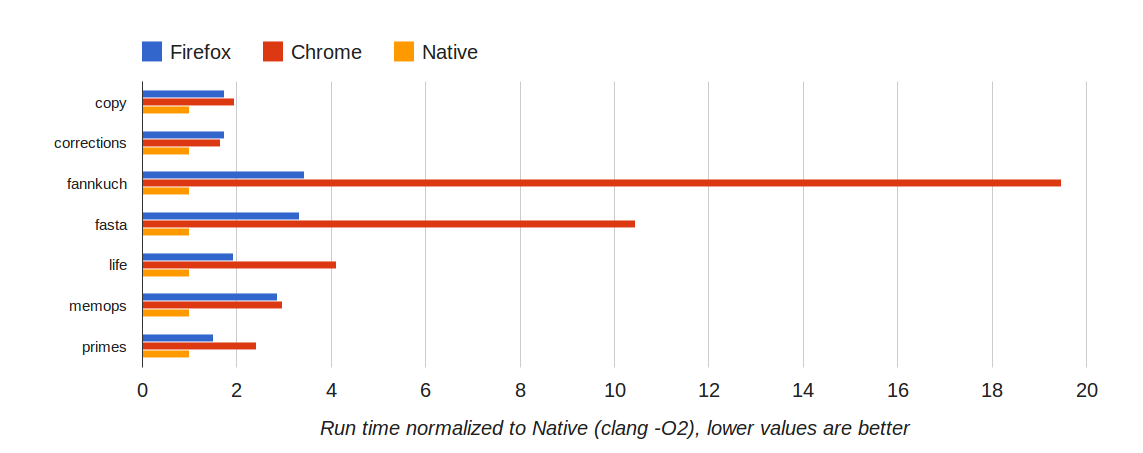
Realistic/large benchmarks
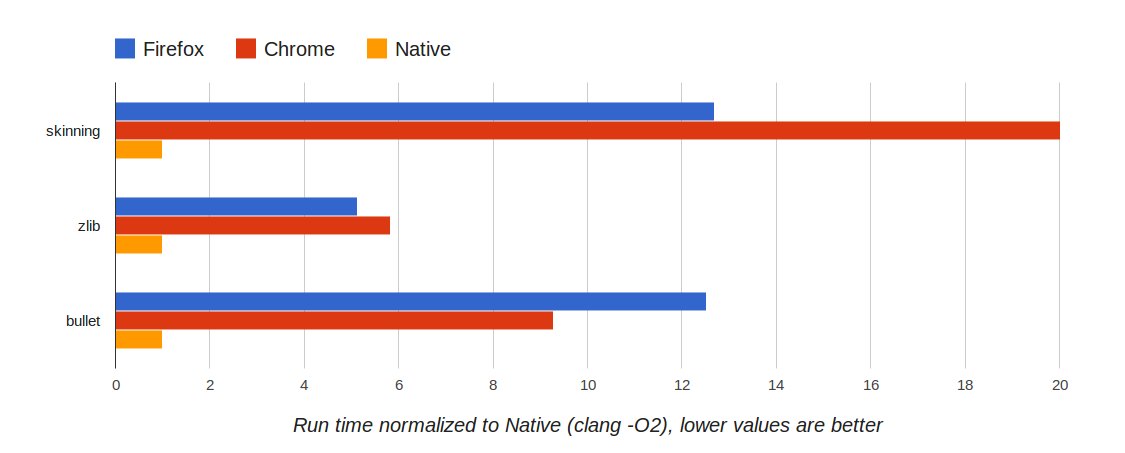
Can we do better?
Yes!
asm.js
  function strlen(ptr) { // calculate length of C string
    ptr = ptr|0;
    var curr = 0;
    curr = ptr;
    while (MEM8[curr]|0 != 0) {
      curr = (curr + 1)|0;
    }
    return (curr - ptr)|0;
}- Ensure that ptr is always an integer
- Read an integer from address curr
- Additions and subtractions are all 32-bit
asm.js
asm.js code avoids potential slowdowns in code: no variables with mixed types, etc.
asm.js code does only low-level assembly-like computation, precisely what compiled C/C++ needs (and hence the name)
asm.js - Formal type system benefits
Type check output of a C/C++ to JavaScript compiler
Type check input to a JavaScript engine at runtime
asm.js - Runtime Optimizations
Variable types pop out during type checking. This makes it possible to do ahead of time (AOT) compilation, not only just in time (JIT)
asm.js - Runtime Optimizations
JavaScript engine has a guarantee that there are no speed bumps - variable types won't change, etc. - so it can generate simpler and more efficient code
asm.js - Runtime Optimizations
The asm.js type system makes it easy to reason about global program structure: function calls, memory access, etc.
How much faster are we
talking here..?
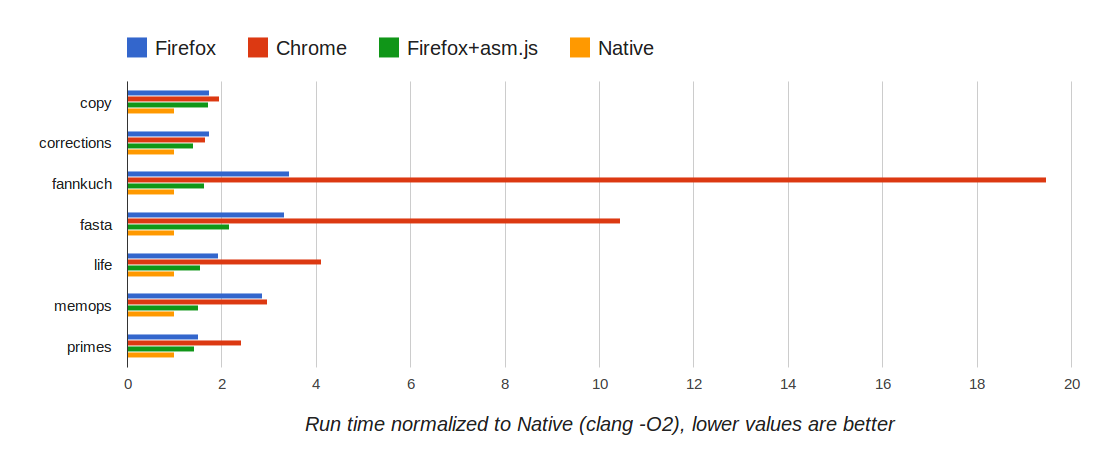
Microbenchmarks
Realistic/large benchmarks
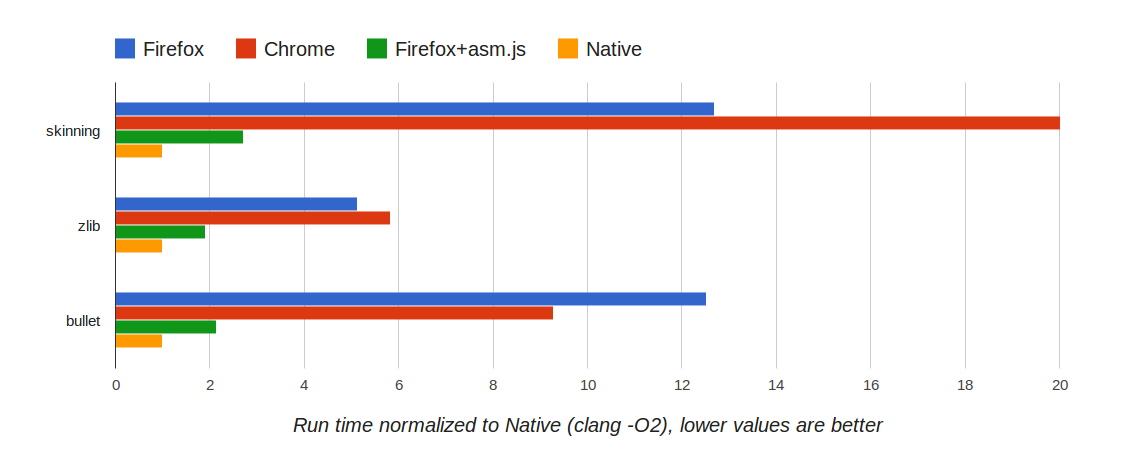
asm.js
Code can run around 2X slower than native - comparable to Java, C# - and will get even faster
Optimizations can be done quickly and straightforwardly in existing JavaScript engines - not a new VM or JIT, just some additional optimizations to existing engines
asm.js
Code is just a subset of JavaScript (like Crockford's "Good Parts") so already runs in all browsers
Not a new language
Trying asm.js now
Compile your code using emscripten with ASM_JS=1
Run it in a build of Firefox from this branch
Not supported yet: C++ exceptions, setjmp/longjmp
...Just C/C++?
C/C++ compiled to JavaScript can be fast (and even faster with asm.js). But what about other languages?
Not just C/C++!
Many languages can be compiled to C, C++ or LLVM IR, which means they can be compiled to JavaScript with the same approach and benefits
Compiling to JavaScript:
Current state of the art
- C/C++: Mature
- Java, C#, Objective-C: Good
- Python, Ruby, Lua: Needs work
Dynamic Languages
Entire C/C++ runtimes can be compiled and the original language interpreted with proper semantics, but this is not lightweight
Source-to-source compilers from such languages to JavaScript ignore semantic differences (for example, numeric types)
Fast Java, C#
Actually, Java and C# have a similar predicament: Both languages depend on special VMs to be efficient
Source-to-source compilers for them lose out on the optimizations done in those VMs
AOT compilers for them can at least gain LLVM-type optimizations - but still something is missing
A Unified Approach?
Should we compile entire VMs from C/C++ to JavaScript, and implement JavaScript-emitting JITs?
Seems the only way to run most languages with perfect semantics + maximum speed
This is why I believe C/C++ to JavaScript translation is the core issue regarding compilation to JavaScript
Conclusion
Statically-typed languages and especially C/C++ can be compiled effectively to JavaScript
Expect the speed of compiled C/C++ to get to just 2X slower than native code, or better, later this year
98-232: Optimizing Javascript
By Will Crichton