Datomic
"the most interesting database you've never heard of"



zilvinasu

A long time ago in a database far, far away....


- General-purpose db
- Value-oriented semantics
- Multiple labels:
- NoSQL
- Graph db
- Transactional store
- Logic db
- Targets 96% use cases of relational databases
“ANYONE WHO STOPS LEARNING IS OLD, WHETHER AT TWENTY OR EIGHTY.”
HENRY FORD
Who uses?








Why? 🧐
-
Powerful alternative to SQL
- Forget SQL injections
-
Flexible deployment
-
Read do not impact write
-
Database as a value
-
Entity modelling
-
Schema flexibility
-
Time Travel
-
Upsert everything
-
Learning is fun!
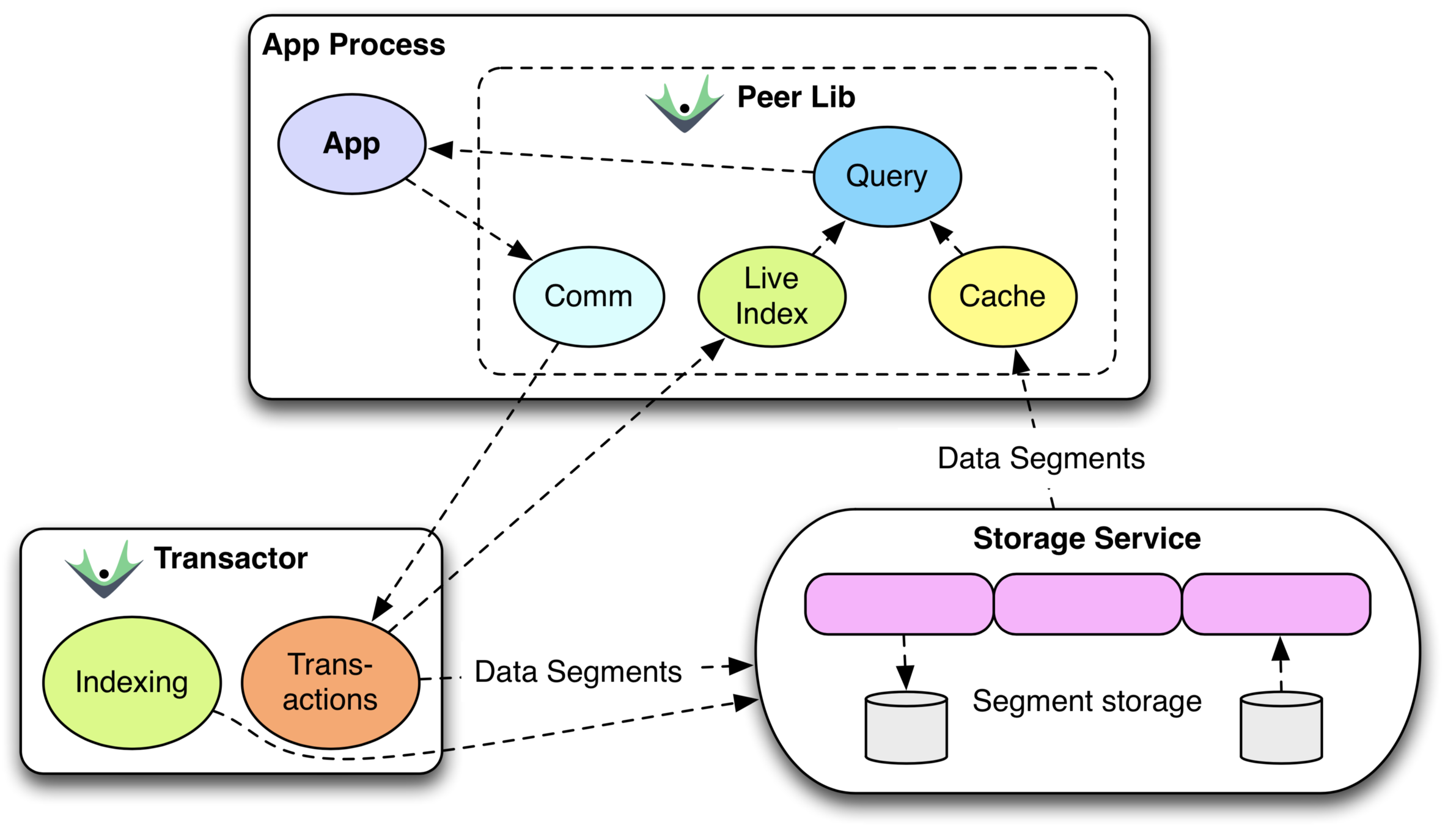
Components ⛓
Tech details 🥚
Storage Services
-
Data is elsewhere
- Dev: File system, in-memory
- Production: PostgreSQL, DynamoDB, Cassandra
- Data stored in the index (covered index)
Reads
- Multi-threaded
- Different APIs
- Client connects to underlying storage
- Infinitely scales
- Independent of anything else
- Failover using Load Balancer
Writes
- Single-threaded
- Different API
- Vertical scaling
- Failover support
Transactions
- You must complete transaction
- Queued executions
- Requires no coordination
- Executed when written to the backing storage
- Peers update eventually
Structure
- DB value in the client is just an immutable map
- Queries are executed on the value
- Value itself is lazy
- Backed by Last Recently Used cache
Deployment ⚙️
AWS CloudFormation☁️
On-Premise 💻
Data model 𝌭
[e a v t added?]
Datoms
entity
attribute
value
transaction
SQL Example
| id | first_name | last_name | |
|---|---|---|---|
| 100 | JSON | McNugget | mcnugget@mailinator.com |
| 101 | Jo | Jenkins | jenkins@mailinator.com |
table: person
Datomic Example
[[100 :person/first-name "JSON"]
 [100 :person/last-name  "McNugget"]
 [100 :person/email      "mcnugget@mailinator.com"]

 [101 :person/first-name "Jo"]
 [101 :person/last-name  "Jenkins"]
 [101 :person/email      "jenkins@mailinator.com"]]
Evolving Schema 👷♀️
Main ideas
- Defining attributes
- Grouping attributes
- "Transact" like any other data
Datoms again!
{;; attribute's unique name
 :db/ident       :person/first-name

 ;; one or many
 :db/cardinality :db.cardinality/one

 ;; i.e. string, boolean, long, ref, uuid ...
 :db/valueType   :db.type/string     ;; value type

 ;; what's the purpose of your attribute?
 :db/doc         "Person's name"}
[{:db/ident :person/first-name
:db/cardinality :db.cardinality/one
:db/valueType :db.type/string
:db/doc "First name of the person"}
{:db/ident :person/last-name
:db/cardinality :db.cardinality/one
:db/valueType :db.type/string
:db/doc "Last name of the person"}
{:db/ident :person/email
:db/cardinality :db.cardinality/one
:db/valueType :db.type/string
:db/doc "Email of the person"}](d/transact
conn
[{:db/ident :person/first-name
:db/cardinality :db.cardinality/one
:db/valueType :db.type/string
:db/doc "First name of the person"}])More
{:db/unique      :db.unique/identity
 :db/fulltext    true
 :db/noHistory   true
 :db/isComponent true}
Things to keep in mind
- Use migrations (i.e. conformity)
- Leverage partitions
- Schema is easily polluted
- Attributes available for any entity
Sailing through the data ⛵️
Datalog
- Query language used for Datomic
- Syntactic subset of Prolog
- Influenced by SPARQL (RDF query language)
- Different APIs are available
- Query API
- Pull API
- Entity API
Query API
;; pull all of the entity attributes
;; by matching the email
[:find ?email
 :where [?e :person/email ?email]]
;; actual example using the datomic api
(d/q
'[:find ?email
:where [?e :person/email ?email]]
db)
=> #{["jenkins@mailinator.com"] ["mcnugget@mailinator.com"]}Pull API
- Similar to GraphQL
- Hierarchical selections for data
- Lookup Refs
(d/pull
 (d/db conn)
 [:person/last-name :person/first-name]
 [:email "jenkins@mailinator.com"])

=> #:person{:last-name "Jenkins", :first-name "Jo"}
Entity API
;; getting lazy values
(d/entity
 (d/db conn)
 [:person/email "jenkins@mailinator.com"])
=> #:db{:id 17592186045419}

(d/entity (d/db conn) 17592186045419)
=> #:db{:id 17592186045419}
Writing data ✏️
- Sent in form of transactions
- Data structures following rules
- List containing either data to be added or retracted
Two options
;; lower-level list-based
; List of format [command e a v]
; Command is either :db/add or :db/retract
[[:db/add "gm-tid" :person/first-name "JSON"]
 [:db/add "gm-tid" :person/last-name "McNugget"]
 [:db/add "gm-tid" :person/email "mcnugget@mailinator.com"]]


;; higher-level map-based
[{:db/id             100
  :person/first-name "JSON"
  :person/last-name  "McNugget"
  :person/email      "mcnugget@mailinator.com"}]
Database Functions
- Avoiding race conditions
- Part of the transaction process
- Functions are entities
- Written in:
- Clojure 😎
- Java 💩
Example
;; in schema
 {:db/ident :person/normalize-last-name
  :db/fn    #db/fn
             {:lang   "clojure"
              :params [db email]
              :code
              (let [person (d/entity db [:person/email email])
                    normalized (clojure.string/upper-case (:person/last-name person))]
                [{:db/id            (:db/id person)
                  :person/last-name normalized}])}

;; make use of that
(d/transact conn [[:person/normalize-last-name "mcnugget@mailinator.com"]])

=>
#object[datomic.promise$settable_future$reify__4751
        0x230b0540
        {:status :ready,
         :val {:db-before datomic.db.Db, @e7f03ab :db-after, datomic.db.Db @106f37f,
               :tx-data [#datom[17592186045419 64 "MCNUGGET" 13194139534317 true]
                         #datom[17592186045419 64 "McNugget" 13194139534317 false]],
               :tempids {}}}]
Fancy stuff 💄
Peers cache the data
Query DB as if TX was applied
Query history for the entity changes
Log extraction
Fits good with Event-driven architectures
Not so Good
One must write selective enough queries
Only one writer transactor 🥺
Proprietary 🤯
Lack of answers in the holy bible

Party hard with Datomic 🎉
Forget the SQL
Add data about transactions themselves
It's not meant for
Big Strings
Export data to
AWS S3
Homework 🕵️♀️
- Datomic docs
- Chapter 6 in "Professional Clojure" book
- Alternatives: JUXT CRUXT
The End

🏷 We're hiring!
Datomic: the most interesting database you've never heard of
By Žilvinas Urbonas
Datomic: the most interesting database you've never heard of
Example project: https://github.com/zilvinasu/datomic-presentation