Network Perfomance
Dr. Alexios Louridas
Today
-
Channel capacity, nominal & effective
-
Channel utilization
-
Delay and jitter
-
Packet loss and errors
Network Measures


Nominal Channel
The maximum number of bits that can be transmitted for a unit of time (eg: bits per second)
Depend on bandwidth, CPU processing.

Effective Channel
Dependent on overheads of the protocols and algorithms used.
Effective capacity of a channel is always less than the nominal
-
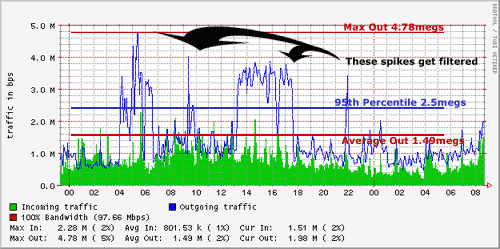
The smallest value that is larger than 95% of the values in a given sample
-
The smallest value that is larger than 95% of the values in a given sample
-
Or rather, the peaks are discarded from consideration
-
-
Why is this important in networks?
-
Gives you an idea of the standard, sustained channel utilization.
-
ISPs use this measure to bill customers with “larger” connections.
-
-
95th Percentile Explained
-
Processor delays
-
Buffer delays
-
Transmission delays
-
Propagation delays
Reasons for Delay

Transmission Delay
d = \frac{S}{N}
d = \frac{1024}{1*10^8} = 10.24 micro seconds
The time required to push all the bits in a packet on the transmission medium in use
For N=Number of bits, S=Size of packet, d=delay
For example, to transmit 1024 bits using Ethernet at (100Mbps):
Propagation Delay
P_d = \frac{D}{s} \\
D = \text{distance to travel} \\
s = velocity
The time it takes for a signal to travel through a transmission medium, such as a cable, from one point to another.
It is a measure of the time it takes for a signal to travel from the source to the destination, taking into account the speed of the signal in the transmission medium.
1
Network congestion: When there is too much data being sent over a network
2
Router or switch problems: not enough buffer size
3
Bad cabling or weather: Damaged connectors or cables, adverse weather conditions
5
Latency: packets take too long to travel from the source to the destination
4
Interference: from other devices or environmental factors
6
Hardware and Software Failures: Broken cables, network card bugs
Packet Loss

Little's Law
principle in queueing theory named after John D.C. Little.
the average number of customers in a stable system is equal to the average arrival rate multiplied by the average time that a customer spends in the system
L=\lambda W
In a steady state the mean arrival rate (λ) of packets into a system is equal to the mean output rate (throughput) of packets departing the system
L = \lambda W
The total number of bits, packets, processes, threads (L) in a system is given by:
where W is the mean total time spent in the system processing
W=W_{ibuffer} + W_{processing} + W_{obuffer} + ..
Little's law explained
Jitter
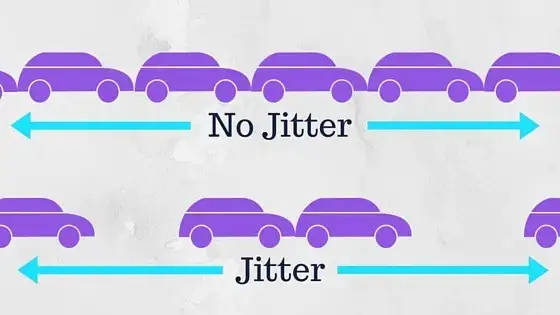
Packet arrival rate varies. Jitter measures this variability. Applications have a tolerance level.
Packet arrival
Packet departure
Add Headers
Queue - Buffer
Single Service Queue
Packet arrival
Packet departure
Add Headers
Queue - Buffer
Multi Service, single Queue
Packet departure
Packet departure
Packet arrival
Packet departure
Add Headers
Queue - Buffer
Multi Service, Multi Queue
Packet arrival
Packet arrival
Packet departure
Packet departure
Queuing Models
WHat are they?
A mathematical representations of a network system that involves waiting in buffer etc
Deterministic
Assumes that the arrival and service times of packets are fixed and known in advance.
Probabilistic
Assumes that the arrival and service times of customers are random variables and can follow a particular probability distribution.
\lambda = \text{Mean number of arrivals per time unit} \\
\mu = \text{Mean number of service per time unit}\\
N = \text{Number of servers}

Relationships
If λ > μ, then your system would start dropping packets in t seconds.
If λ ≤ μ, there shall be no reason for a buffer?


Queue Type Notations
Using Kendall notation
Arrival Distribution / Service Distribution / Number of Servers
M/M/1
M/M/m
G/G/3
M stands for "Markovian", implying a distribution
D stands for Deterministic
G for general
m being a number

Why network perfomance is important?
User experience: Poor network performance can result in slow response times, lost data, and other issues that can negatively impact user experience.
Business productivity: Slow or unreliable networks can result in lost time and opportunities, while high-performing networks can help organizations work more efficiently and effectively.
Competitive advantage: Network performance can be a key factor in determining an organization's competitiveness.
Cost savings: Network performance can also impact an organization's bottom line by reducing costs associated with network downtime, maintenance, and support.
Network Perfomance
By Alexios Louridas