Network Layer
-
OSPF
Dr. Alexios Louridas
What are we going to see?
-
RIP has a limit of 15 hops. A network that spans more than 15 hops (15 routers) is considered unreachable.
-
RIP cannot handle Variable Length Subnet Masks (VLSM). Given the shortage of IP addresses and the flexibility VLSM gives in the efficient assignment of IP addresses, this is considered a major flaw.
-
Periodic broadcasts of the full routing table consume a large amount of bandwidth. This is a major problem with large networks especially on slow links and WAN clouds.
-
RIP converge is slower than OSPF. In large networks convergence gets to be in the order of minutes.
-
RIP routers go through a period of a hold-down and garbage collection and slowly time-out information that has not been received recently. This is inappropriate in large environments and could cause routing inconsistencies.
-
RIP has no concept of network delays and link costs. Routing decisions are based on hop counts. The path with the lowest hop count to the destination is always preferred even if the longer path has a better aggregate link bandwidth and less delays.
-
RIP networks are flat networks. There is no concept of areas or boundaries. With the introduction of classless routing and the intelligent use of aggregation and summarization, RIP networks have fallen behind.
RIP Limitations


OSPF
- With OSPF, there is no limitation on the hop count.
- OSPF uses IP multicast to send link-state updates. This ensures less process resource consumption on routers that do not listen to OSPF packets. Updates are only sent in case routing changes occur instead of periodically. This ensures efficient bandwidth.
- OSPF has better convergence than RIP. This is because routing changes are propagated instantaneously and not periodically.
- OSPF allows for better load balancing.
- OSPF allows for a logical definition of networks where routers can be divided into areas. This limits the explosion of link state updates over the whole network. This also provides a mechanism to aggregate routes and decrease the unnecessary propagation of subnet information.
- OSPF allows for routing authentication through different methods of password authentication.
- OSPF allows for the transfer and tagging of external routes injected into an Autonomous System. This keeps track of external routes injected by exterior protocols such as BGP.

Link-State protocols
OSPF is a link-state protocol. Think of a link as an interface on the router. The state of the link is a description of that interface and of its relationship to its neighbor routers.
A description of the interface would include, for example, the IP address of the interface, the mask, the type of network it is connected to, the routers connected to that network and so on.
The collection of all these link-states would form a link-state database.
-
Starting Assumptions
-
Each node is assumed to be capable of finding out the state of the link to its neighbours and the cost of each link.
-
-
Aim
-
Each node to know the least-cost path to any destination.
-
-
Mechanism 1
-
A solid and reliable way to provide link-state information to all nodes in the network.
-
-
Mechanism 2
-
To be able to calculate the routes from the sum of all the accumulated link-state knowledge.
-
OSPF
Reliable Flooding
Store most recent LSP from each node
Forward LSP to all nodes but one that sent it
Generate new LSP periodically (timer); increment SEQNO
Start SEQNO at 0 when reboot
Decrement TTL of each stored LSP; discard when TTL=0
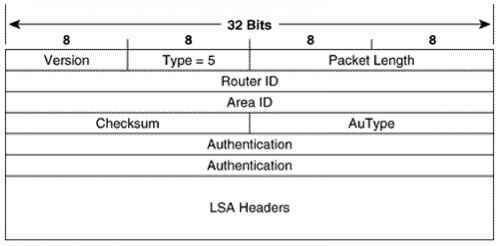
Link State Routing (Routing Table)
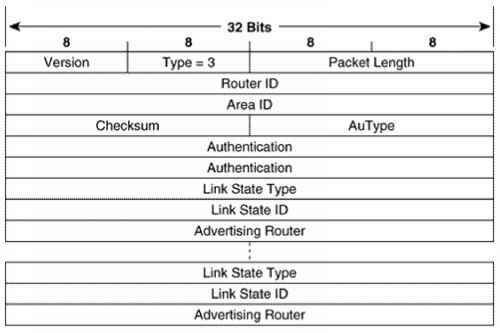
Link State Packet (LSP)
ID of the node that created the LSP
Cost of link to each directly connected neighbour
Sequence number (SEQNO)
Time-to-live (TTL) for this packet
Link State Request Packet
Link State Acknowledgement Packet
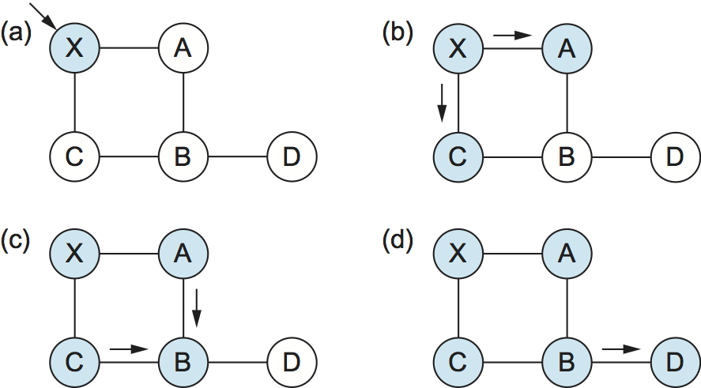
Reliable Flooding
Flooding of link-state packets.
(a) LSP arrives at node X;
(b) X floods LSP to A and C;
(c) A and C flood LSP to B (but not X);
(d) flooding is complete
| Step | Confirmed | Tentative | Comments |
|---|---|---|---|
| 1 | (D,0,--) | Since D is the only new member of the confirmed list, look at its LSP. | |
| 2 | (D,0,--) | (B,11,B) (C,2,C) | D's LSP says we can reach B through B at cost 11, which is better than anything else on either list, so put it on Tentative list; same for C. |
| 3 | (D,0,--) (C,2,C) | (B,11,B) | Put lowest-cost member of Tentative (C) onto Confirmed list. Next, examine LSP of newly confirmed member (C). |
| 4 | (D,0,--) (C,2,C) | (B,5,C) (A,12,C) | Cost to reach B through C is 5, so replace (B,11,B). C's LSP tells us that we can reach A at cost 12. |
| 5 | (D,0,--) (C,2,C) (B,5,C) | (A,12,C) | Move lowest-cost member of Tentative (B) to Confirmed, then look at its LSP. |
| 6 | (D,0,--) (C,2,C) (B,5,C) | (A,10,C) | Since we can reach A at cost 5 through B, replace the Tentative entry. |
| 7 | (D,0,--) (C,2,C) (B,5,C) (A,10,C) | Move lowest-cost member of Tentative (A) to Confirmed, and we are all done. |
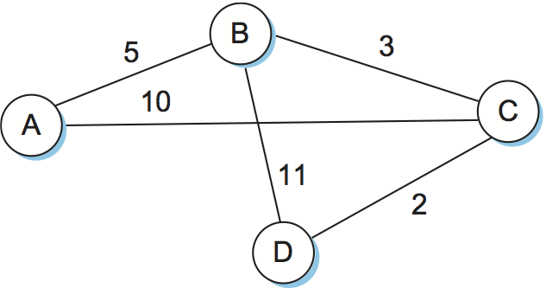
Example of Building a route table for Link State Routing
Authentication of Routing Messages
Open Shortest Path First Protocol (OSPF)
Additional Hierarchy
Load Balancing
Multiple Cost Metrics
Send information from one node to many other nodes, and the entire network can thus be impacted by bad information from one node. For this reason authenticating routing messages has become very important.
OSPF introduces another layer of hierarchy into routing by allowing a domain to be partitioned into areas. A router within a domain only needs to know how to get to the right area reducing the amount of information in the routing table.
Allows multiple routes to the same place to be assigned the same cost and will cause traffic to be distributed evenly over those routes, thus making better use of the available network throughput.
For each link, multiple cost metrics for different Types of Services (ToS) (e.g., satellite link cost (more delay involved) set low for best effort ToS; high for real-time ToS)
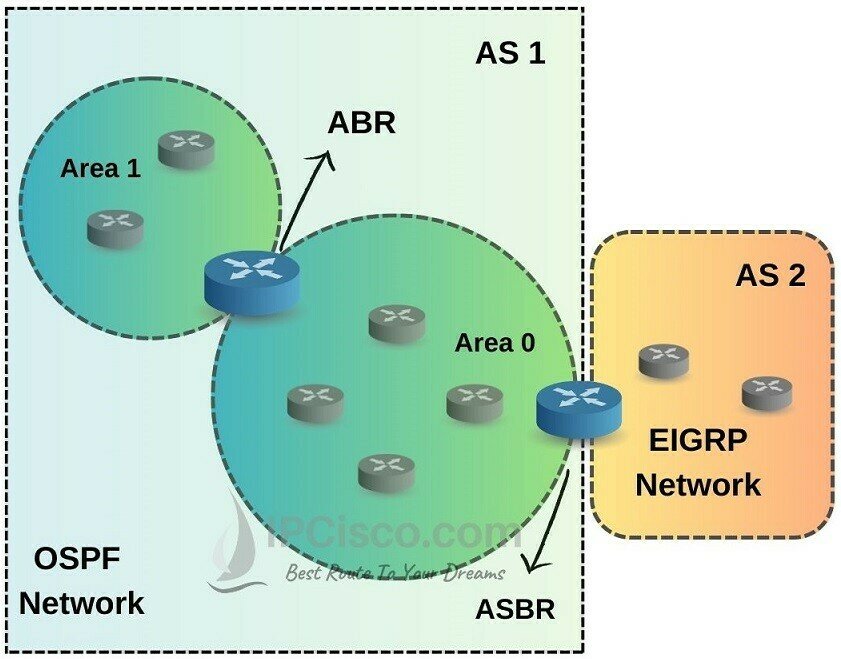
Areas and Border Routers
- Areas are introduced to put a boundary on the explosion of link-state updates. Floods and calculation of the Dijkstra algorithm on a router is limited to changes within an area.
-
All routers within an area have the exact link-state database. Routers that belong to multiple areas, and connect these areas to the backbone area are called area border routers (ABR).
-
ABRs must therefore maintain information that describes the backbone areas and other attached areas.
-
Routers that act as gateways (redistribution) between OSPF and other routing protocols (IGRP, EIGRP, IS-IS, RIP, BGP, Static) or other instances of the OSPF routing process are called autonomous system boundary router (ASBR). Any router can be an ABR or an ASBR.
Backbone and Area 0
-
OSPF has special restrictions when multiple areas are involved. If more than one area is configured, one of these areas has be to be area 0. This is called the backbone.
-
It is good network design practice to start with area 0 and then expand into other areas later on.
-
The backbone has to be at the centre of all other areas, that is, all areas have to be physically connected to the backbone.
-
The reason is that OSPF expects all areas to inject routing information into the backbone and in turn the backbone disseminates that information into other areas.
-
Routes that are generated from within an area (the destination belongs to the area) are called intra-area (Notation of 0 within routing table)
-
Routes that originate from other routing protocols (or different OSPF processes) and that are injected into OSPF via redistribution are called external routes.

Virtual links
- To an area that does not have a physical connection to the backbone
- To patch the backbone in case discontinuity of area 0 occurs.
-
Number of router per area:
-
What kind of CPU power do you have in that area?
-
What topology is used by OSPF
-
Do you have a lot of external LSAs in the network?
-
-
Number of Neighbours
-
Number of Areas
- Full Mesh vs Partial Mesh
- Memory Issues
- Normally, a routing table with less than 500K bytes could be accommodated with 2 to 4 MB RAM; Large networks with greater than 500K need 8 to 16 MB, or 32 to 64 MB if full routes are injected from the Internet.
OSPF Design tips

Copy of Network Layer - OSPF
By Alexios Louridas