Rip It Up And Start Again
A Look At The New Multiplatform ASP.NET
Front Matter
- Introduction
- Group Pitch
- Approach/Background
- Brief Overview
Why The Changes?
- The Javascript ecosystem is the elephant in the room.
- How does ASP.NET MVC compare?
Javascript Frameworks
- Pros:
- Clientside logic.
- Don't need to hit the server to do stuff.
- Works in all modern browsers, so works on all modern platforms.
- Cons
- Clientside logic.
- Browser Javascript VMs (by design) provide a limited programming platform.
ASP.NET MVC
- Pros
- Serverside.
- Has a stronger, more mature programming platform to work with.
- Easier to secure.
- Cons
- Serverside.
- Harder to make responsive applications
- Not cross-platform. At all.
- Built on paradigms that the web is evolving past
Wait, What About WebAPI?
- WebAPI continues to be the best thing about ASP.NET.
- Has matured into a good, solid, well-designed RESTful API framework.
- Only knock against it in the server world is the Windows-only limitation.
Microsoft's Problem
-
The world outside of Microsoft-land is very different.
- Many (most) web developers don't use Windows-only frameworks.
-
MS was actively hostile to open-source and cross-platform
- IE made web developer's lives miserable for over a decade.
-
Webdev is suddenly very important.
- Microsoft needs web developers more than web developers need Microsoft.
But Then
- A lot of things happened at once.
- Nadella became CEO.
- OWIN/Katana were released (hosting abstraction).
- Mono/Xamarin started taking off (multiplatform .Net)
- A new generation of MS guys like David Fowler (SignalR creator and now ASP.NET 5 architect) started doing cool stuff.
- Massive chunks of .NET and ASP.NET were open-sourced, and development started to move onto Github.
The New Microsoft
- For reals this time.
- Remember "Embrace, Extend, Exterminate"?
- They gave up on the Exterminate part because it wasn't working.
One Requires The Other
- So the clear push from Microsoft is to take pages from open-source projects and bring
- Cross-platform support
- Modularity
- Integration with established tooling
..to the entire development platform
"You have no credibility if you try to go cross-platform and you're not open-source. If you want to go cross plat you need to go open source."
The 3 Pillars Must Change
- IIS optional
- Windows optional
- Visual Studio optional
- Not possible without reworking core aspects of Microsoft's development platform.
- .Net Framework (The Framework)
- ASP.NET (The Platform)
- Visual Studio (The Tooling)
- Not possible without reworking core aspects of Microsoft's development platform.
.Net
(Aka The Fork)
And Then There Were Three
- There are currently 3 (!) officially supported .Net runtimes:
- .Net Core 5 (The new, completely open-source, completely multiplatform one)
- .Net 4.6 (The monolithic, Windows-only one you know and love)
- Mono (The weird one Miguel de Icaza tried to get Linux people to use even before Microsoft cared about multiplatform)
.Net Core 5
- Essentially a fork.
- Why a fork?
- Microsoft has published a lot of the existing .Net framework code already.
- But there are (apparently) legal/business reasons they can't/won't open source it.
- .Net 4.6 will "never be on Github"
- Chunks of it of it just aren't portable to non-Windows platforms (Forms, etc)
.Net Core 5
- So we have what amounts to a new framework.
- Much more modular, and "optimized for the cloud".
- Open-sourced from day 1, developed out in the open on Github.
- Multiplatform from day 1.
- Has Roslyn-enabled features not supported by the existing framework.
- Mandatory system-level runtime installs are gone, even on Windows.
.Net Core 5
- You get all the features of the new Roslyn runtime with Core 5.
- On-the-fly in-memory compilation.
- Which if you're a developer means you won't see a discrete compile step anymore.
- I am sad to report that WebForms will never be supported with Core 5.
- I am actually not sad to report that.
.Net 4.6
- 4.x is the last of the monolithic system-level .Net releases.
- 4.6 will get updates.
- There are Core 5 features that will never come to 4.6.
- .Net 4.x is the last version of .Net that will work the way you're used to.
Mono
- 3rd party Xamarin .Net implementation.
- Mono is a Microsoft-supported host for ASP.Net 5 apps just like Core 5 and .Net 4.6.
- Core 5 is a bit unstable now, Mono is still the best option for Linux or OS X.
- I also suspect MS will drop Mono when Core 5 comes fully online.
- Currently it's 100% supported, and all the Core 5 unit tests are required to pass on Mono.
ASP.Net 5+
(Aka MVC 6)
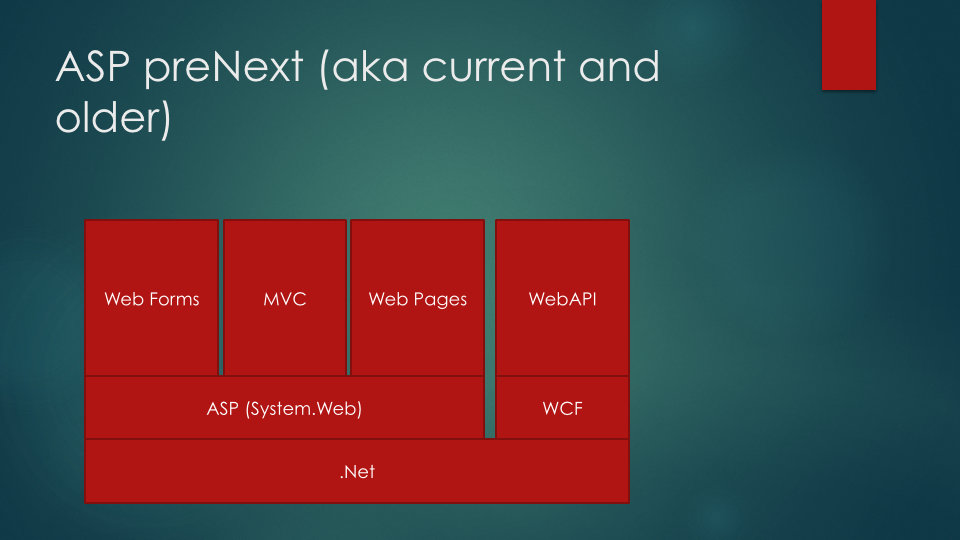
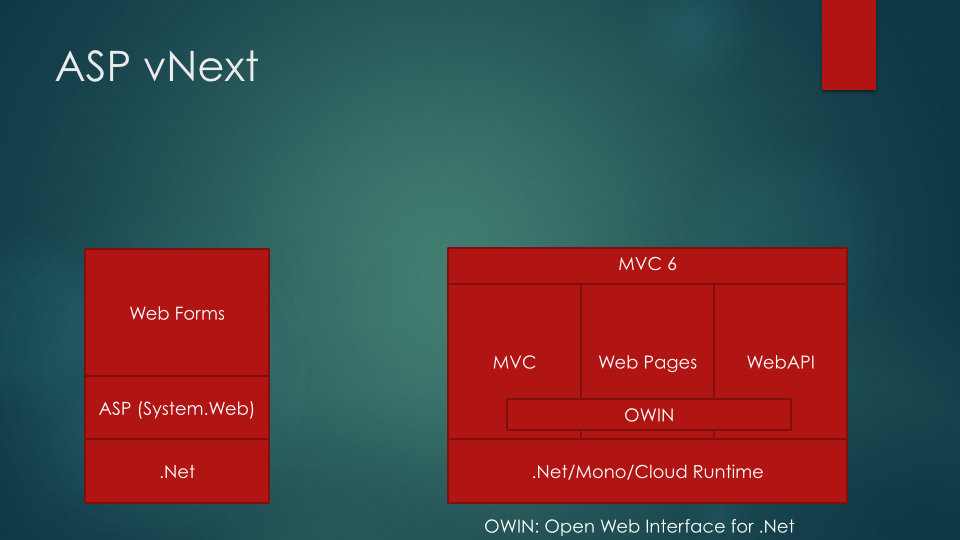
ASP.Net
- With .Net Core 5, you no longer need a system-level pre-installed .Net runtime.
- Basically you get a version of .Net deployed with your app, stripped of all APIs your app doesn't use.
- OWIN middleware is now used for everything
- This allows you to self-host, host outside of IIS, or host inside IIS
ASP.Net
- On ALL platforms
- You use Nuget to install dependencies.
- You use a command line tool to build the app.
- You use a command line tool to run/host the app.
ASP.Net
- dnvm - Dot Net Version Manager - download, update and change the runtime.
- dnu - Dot Net Development Utility - Nuget package manager.
- dnx - Dot Net Execution Environment - Basically like running node.exe for node apps.
- Even Visual Studio on Windows will just invoke these tools for those operations.
ASP.Net
- Web.config is no longer required for hosting config.
- But you can still use it if you want
- You can also use JSON, INI files, or just environment variables.
- Config reader middleware will transparently handle reading config options from any of those.
ASP.Net
- Like Core 5, all ASP.Net development is happening out in the open on Github.
- https://github.com/aspnet/home
- The weekly standup are public, and hosted via Google Hangouts.
Visual Studio
(Aka The Moneymaker)
Tooling
- Multiplatform runtime and hosting doesn't get you anywhere if your tooling is platform-bound.
- Most non-MS devs do not use MS tooling and are not GUI-only users
- Making Visual Studio multiplatform would be an insane effort.
- Also project configs are tightly coupled with Visual Studio
- Non-MS devs would rather continue to use or at least interoperate with proven tooling.
Tooling
- Microsoft is reworking the project file format.
- Unsurprisingly, the new project files look exactly like they do in the Javascript/nodeJS world.
- .csproj's are no more
- Not MSBuild based.
- A JSON file that lists stuff like dependencies and build targets.
- No more huge lists of referenced files.
- Folder-based includes, wildcard excludes.
- Much trimmer and less fragile format.
Tooling
- You can manage and build/host with command line tools.
- Project files are no longer opaque wads of XML.
- Built-in support for 3rd-party task runners.
- All of this means you can use any text editor you want to develop ASP.Net apps.
Tooling
- But of course Microsoft wants a piece of this action.
- Visual Studio Code
- VS Code is basically Microsoft's response to the popular crop of visually clean, powerful multiplatform text editors like Sublime Text, Atom, etc.
- VS Code is multiplatform.
- It's either VS Lite or a heavy text editor, depending on your viewpoint.
Tooling
- VS Code
- Intellisense
- All the new .Net command line operations
- Nuget
- Run
- Debug
- Gulp task runner
- Code lens
- Native Git support
Tooling
- Debugging
- Right now, there is no good C# debugging story outside of using the real Visual Studio.
- This may change eventually.
Summary
Embrace, Extend, Monetize
- The .Net framework is fundamentally changing.
- ASP.Net is fundamentally changing.
- The tooling story is fundamentally changing.
Embrace, Extend, Monetize
- All of this is undeniably a response to the success of the non-Microsoft webdev ecosystem.
- Microsoft needs to win hearts and minds so it can sell them software licenses and Azure.
- All of this makes .Net development better.
Demo!
A Look At The New Multiplatform ASP.NET
By Ben Leggett