












Chengcheng Xiao
PhD student @ Imperial College London
Electride materials are defined* as:
Ionic compounds in which electrons are localized at interstitial sites and act as anions.
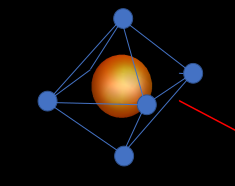
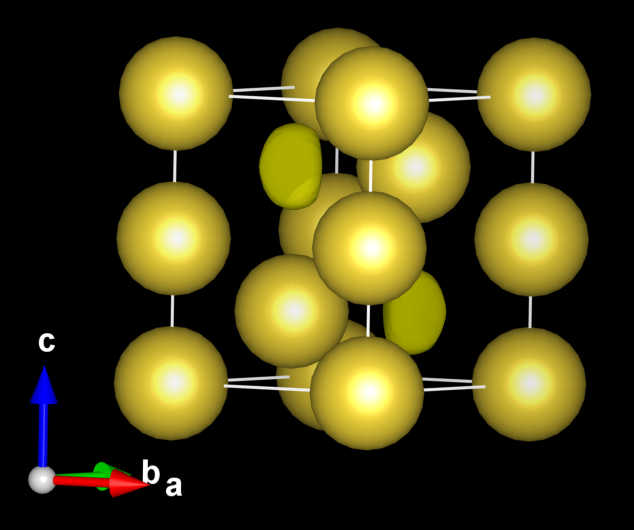
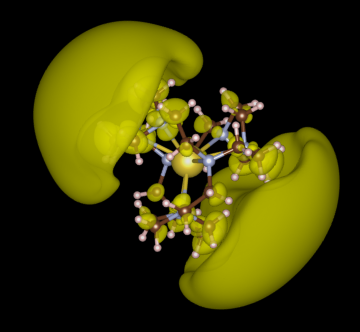
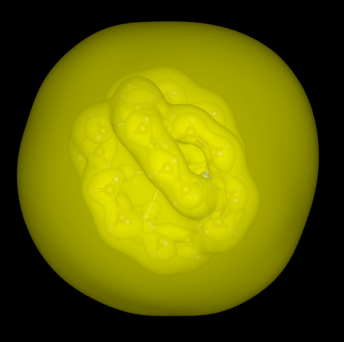
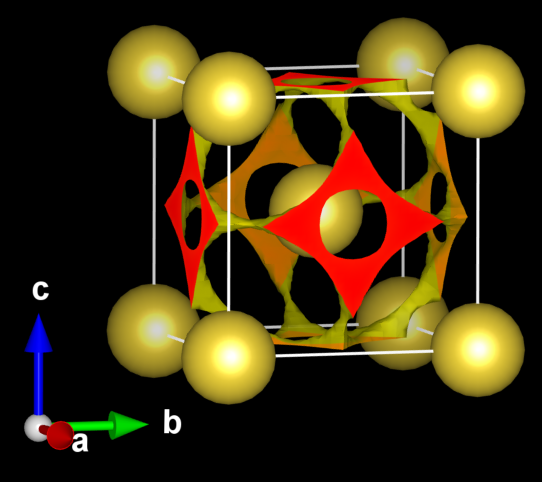
Electron (density) in an octahedral interstitial site
Applications:
Electron emitters: R. H. Huang and J. L. Dye,Chem. Phys. Lett., 1990,166,133–136
Superconductors: Zenner S. Pereira, et al. J. Phys. Chem. C 2021, 125, 8899-8906
Battery anodes: J. Hu, et al ,ACS Appl. Mater. Interfaces, 2015,7, 24016–24022
Catalysts: Michikazu Hara, et al. ACS Catal. 2017, 7, 4, 2313–2324
*Ref: Dye, J. L. Acc. Chem. Res. 2009, 42, 1564−1572.
There are no theory that can explain the origin of all identified electrides. So our goal is to figure out a theory that can be used to understand the origin of these interstitial electrons. (why they gather at the interstitial region)
No practical descriptor has been developed that's powerful enough to be able to identify all known electrides out of a database. We want to develop a routine that can do this with a snap of a finger.
Based on functions
Based on constitutions
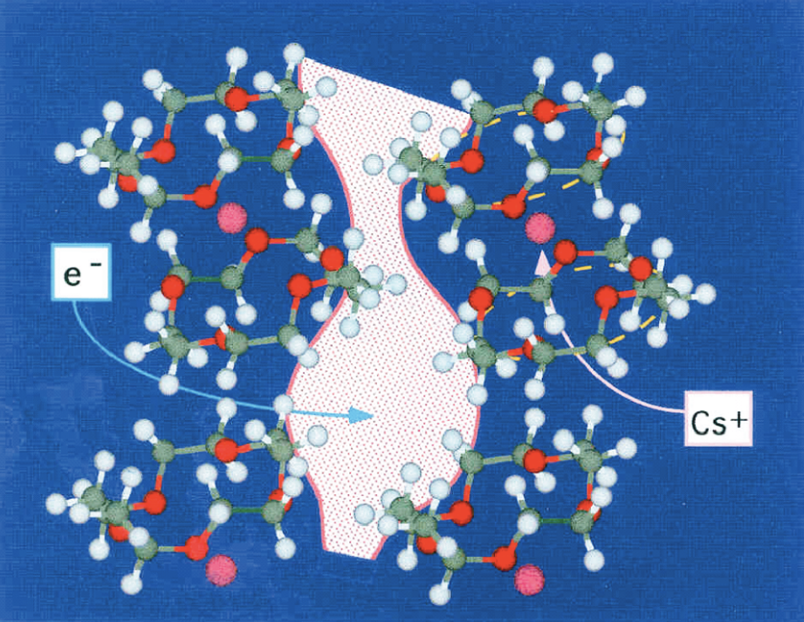
Crown ethers
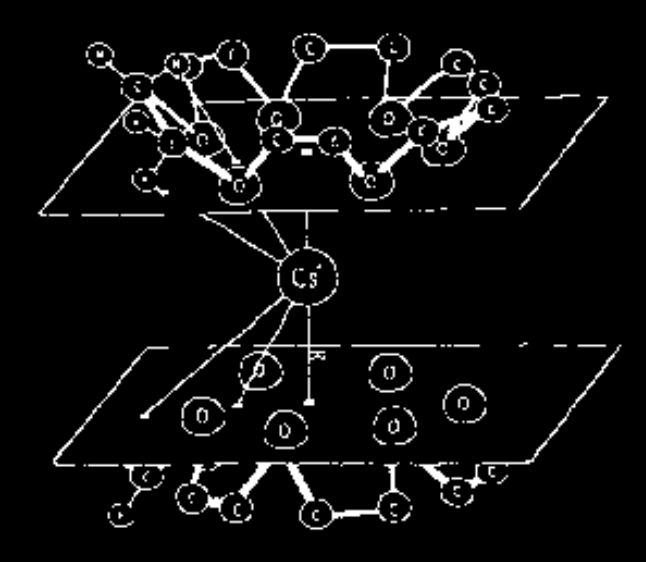
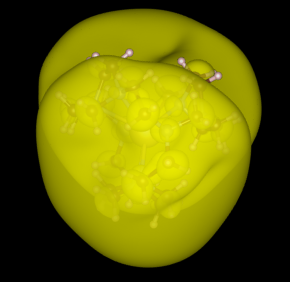
Molecular crystal of Cs⁺(15C5)₂e⁻
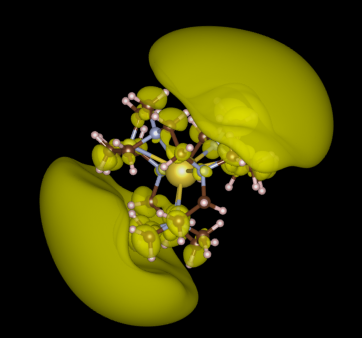
Sinlge unit of metal-organic compound
Cs
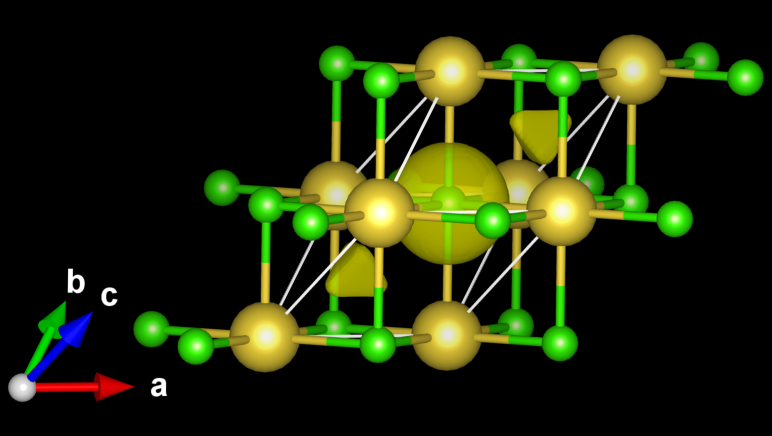
In organic electride, electron occupy interstitial sites surrounded by organic-metal complexes.
Ref: James L. Dye, Acc. Chem. Res. 2009, 42, 10, 1564–1572
Strontium
Bismuth
Sr₅Bi₃
Ref: Lee A. Burton, et.al. Chem.Mater.2018, 30, 7521−7526
Yttrium
Carbon
Ref: Zhang Xiao, et.al. Chem.Mater.2014, 26, 6638−6643
Y₂C
Sodium - hP4
Ref: Yanming Ma, et.al. Nature, (2009), 182-185, 458(7235)
There are a plethora of electrides out there, and they can have very different properties (that's why someone try to categorize them using their properties)
However, to be able to identify them in the wild, we need to find the common feature linking all of these materials together...
Obviously that's "electron @ interstitial site" but that's actually vague and hard to apply to real materials. And it doesn't provide us a theory to understand why they behave like that.
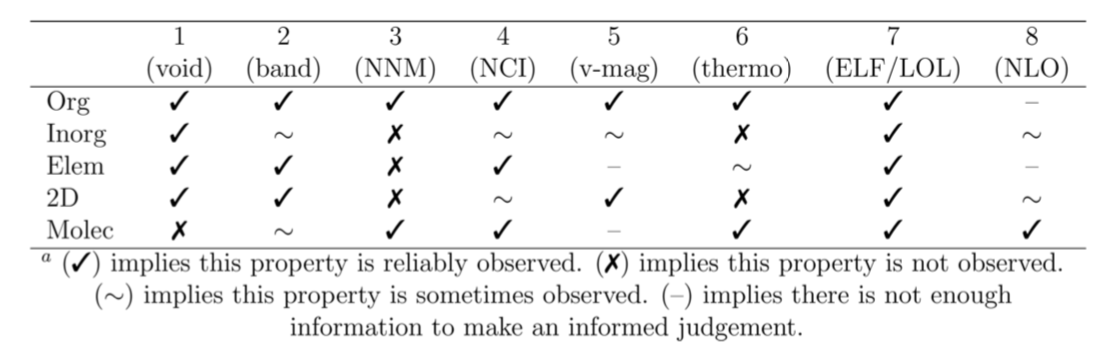
1. Void spaces must be present within an electride crystal.
2. The “electride state” is a high-lying, partially occupied valence state in the band structure of an electride, the density of which is localized within the crystal void.
3. The magnetic properties of the electride crystals originate from the unpaired, interstitial electrons.
4. To form an electride, an alkali metal complex must have a low ionization potential and the resulting cation must have a high metal−ligand binding energy.
5. Electrides possess large nonlinear optical properties.
Ref: Stephen G. Dale and Erin R. Johnson, J. Phys. Chem. A 2018, 122, 9371−9391
1. Procrystal density: looking for void space.
2. Non Nuclear Maximum (NNM): looking for local max in charge density.
3. Magnetic moments: looking for magnetic electrides
4. Electron localization function (ELF): looking for the localization information
5. nonlinear optical (NLO): looking for electride with nonliearn optical properties.
The ELF is defined as:
where,
and,
The ELF is an appriximation of the conditional pair probability of fixing an electron at one point and finding a second like-spin electron near the first one.
In laymen's term:
The ELF is a good descriptor as it has pockets (blob) around the interstitial center.
However, it also have pockets around the interstitial space in metal system which obviously cannot be identified as electride.
Moreover, it has lots of noise around the atoms (due toatom centered orbitals) and it has maximas at the two atom bonding center.
For a two electron system, if they have the same spin, we can write the slater determinant as:
where \(\chi_1 = \psi_1*\beta_1\). \(\psi\) is the spacial orbital and \(\beta\) is the spin orbital (\(\int \alpha(w) \beta(w) dw = 0\); \(\int \beta(w) \beta(w) dw = 1\)). Expanding the determinant:
Integrating over \(\omega_1\) and \(\omega_2\): we have the probability of finding electron 1 at \(r_1\) and electron 2 at \(r_2\):
Using the following relation:
If a electron (with spin \(\sigma\)) is located with certainty at position \(r_{1}\), then the conditional probability of finding a second electron (also with spin \(\sigma\)) at position \(r_{2}\) is obtained by dividing the above pair probability by the total density at \(r_{1}\):
We can rewrite \(P(r_1,r_2) dr_1 dr_2\) as:
Consider the region where \(r_2\) is very close to\(r_1\), we can assume \(P^{\sigma\sigma}_{\text {cond }}(r_{1},r_{2})\) does not depend on the direction but only the difference between \(r_{1}\) and \(r_{2}\). Taylor expansion of \(P^{\sigma \sigma}_\text{cond}\left(r_{1}, r_{2}\right)\) yield:
where \(\tau\) is the positive-definite kinetic energy density defined by:
Hence, electron localization is related to the smallness of the expression:
Finally, to normalize the probability, we need to reference it with the same thing calculated by free electron:
where,
and,
Theory: Interstitial sites originate from overlapping occupied orbitals. i.e. multicentered bonding between "s"-orbitals.
It explains:
Caveat: occupation of real space orbital is an ill defined object and we'll see later how this affects our descriptor.
Other attempt: Miao M, Hoffmann R, J. Am. Chem. Soc. 2015, 137, 3631−3637
HOMO
LUMO-1
LUMO-2
LUMO-3
More stories can be found on the origin of these orbitals. In our view they should be categorized as SAMOs (Super Atomic Molecular Orbitals). But other argue they are metal atoms' extended s-orbitals.
Na-Tripip222
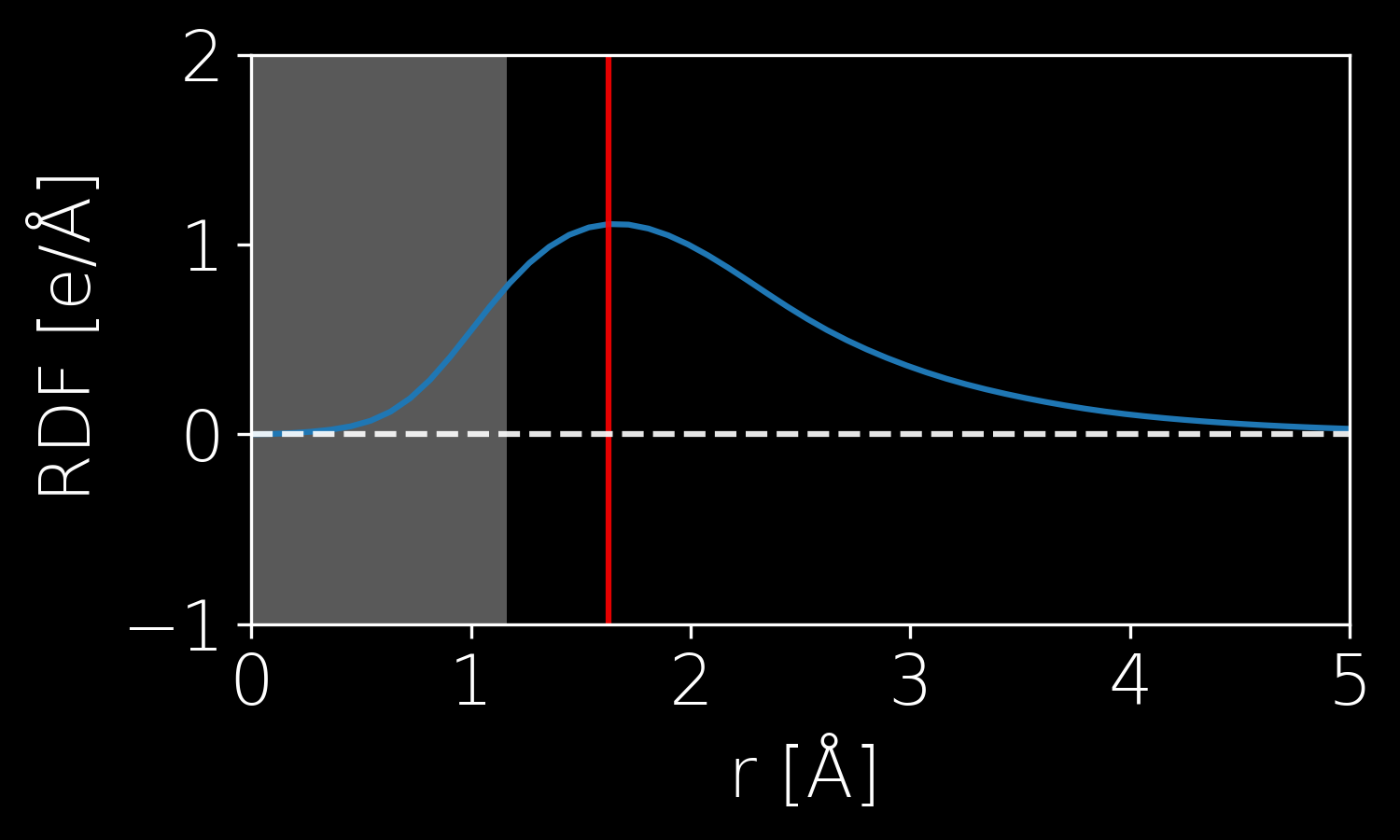
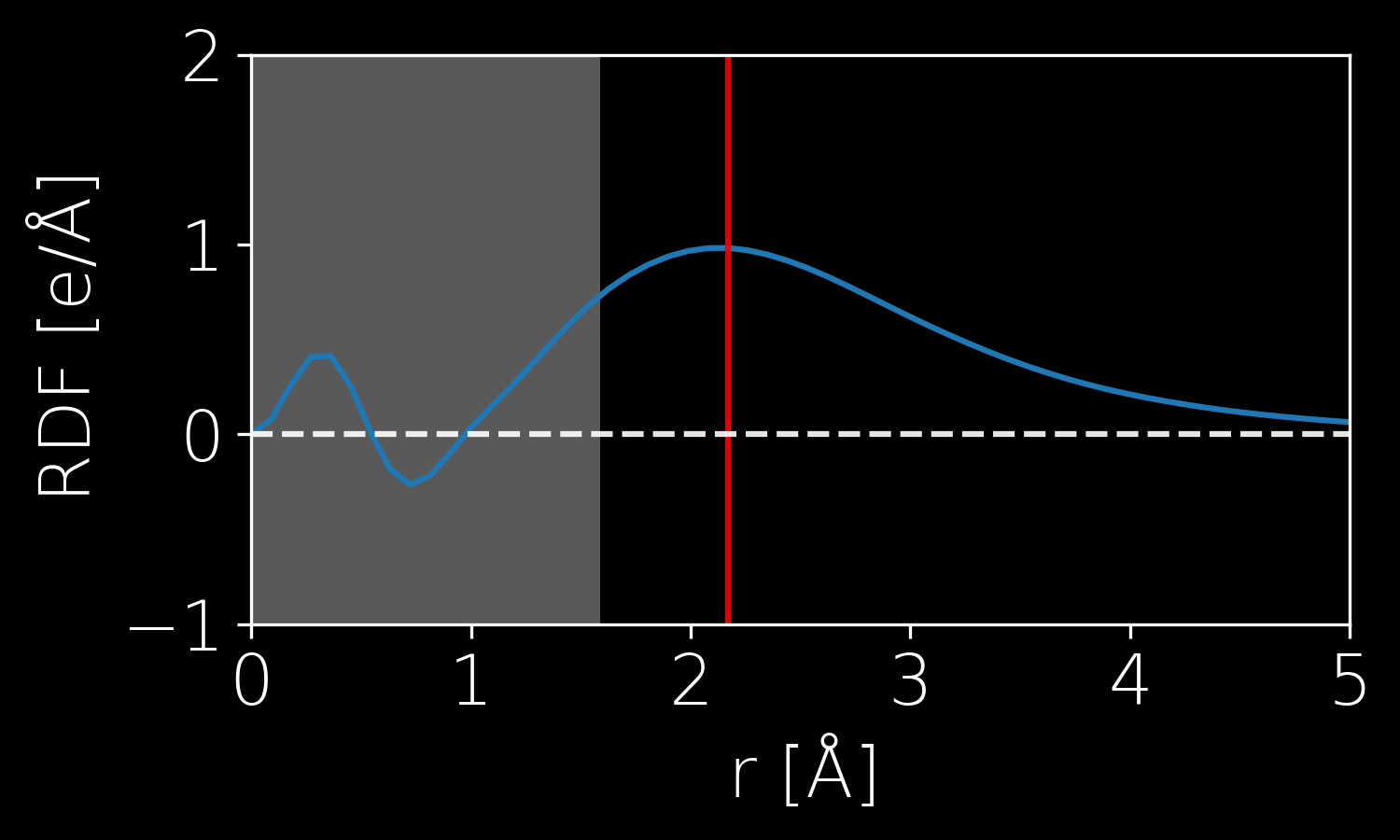
Most interstitial electrons in inorganic electride are caused by frontier s-orbitals for they are very disperse: The maximum point in their RDF is around 2 Å.
K
Na
There are electrides that have interstitial orbital constructed by orbital other then s, but the cage surrounding them are also smaller and they are less easy to identify.
Based on the theory we just proposed, we can manually construct some electride. (MAGIC TIME!) First thing we do is to change the number of interstitial sites so that the occupation can satisfy the criteria.
BCC
Tetragonal
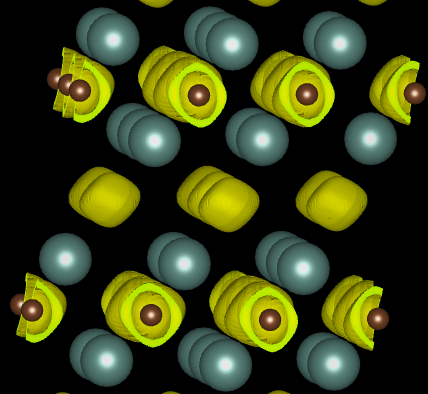
Then, by fixing the structure, we dope the system so that some potential electride site is occupied. For NaCl, aka table salt 🧂where Na's s-orbital is unoccupied (just above the Fermi energy), after doping, it automatically become an electride!
ELF
interstitial electrons!
Theory: Interstitial sites originate from overlapping occupied orbitals. i.e. multicentered bonding between "s"-orbitals.
ELF (local maximas) seems to be a very good descriptor since it provides both the occupation and localization information.
However, like said before, it can be hard to use it to identify electrides due to:
Q: Have a lot of maxima around atomic center.
A: Starting from an ELF maxima, construct a shell with finite thickness, if there are more than three atoms inside the shell, then we have a potential elelctride site.
ELF maxima
Atom
Electride site
Non-electride site
Q: Cannot differentiate metal and electrides.
A: Partition the space using Bader analysis of the ELF and then based on the partition space integrate charge dentisity and assign charge to ELF maximas.
BCC
Tetragonal
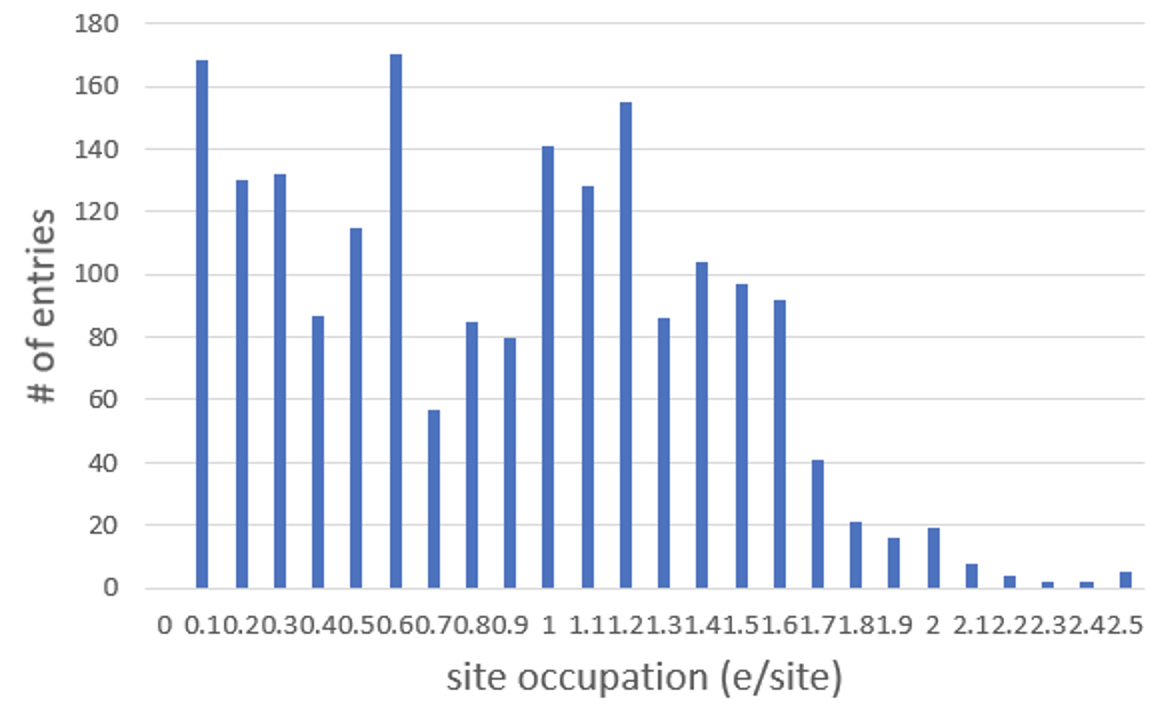
Again, taking Na as an example, the difference in occupation is not 0-1, instead it depends on how many sites are sharing electrons.
Since the transition from electride to metallic bonding is a smooth one that depends on the occupation of the interstitial site, we need to identify electrides by cutting this smoothe transition in half:
I've screened 51000 entries in the Materials project database using my descriptor. All the positive hits can be found in the ELECTRIDE DATABASE.
DATA PLOTS HERE!
Find these slides:
By Chengcheng Xiao


