

Flat band magnetism in LaBr

Chengcheng Xiao, Nicholas Bristowe, Arash Mostofi

E-mail: cx219@ic.ac.uk

Main Takeaways

  • LaBr monolayer is a magnetic 2D material.


  •  


  •  

There is an electronic flat band in the system and can be described using a simple tight binding model - The Dice model.

The flat band and magnetism can be controlled by external strain.

Methods

  • First-principles calculations were performed under the density functional theory (DFT) formalism, as implemented in the pseudopotential VASP, QuantumEspresso, and all-electron ELK code.
  • Exchange-correlation treatment:
    • GGA-PBE
    • Hybrid functional (HSE06)
    • PBE+U (with Hubbard corrections)
  • Self-consistent Hubbard calculation performed using in-house developed code based on pythTB.

structure

Bulk experimentally synthesized*

E_{\text{bind}} =\frac{(E_{\text{full layer}} - 2 \times E_{\text{half layer}})}{A_{\text{contacting}}}

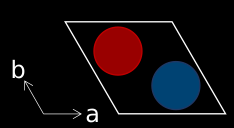
FM

AFM

  • Spacegroup:

  • ​Binding energy:  

0.11 \mathrm{eV/ Å^{2}}
\mathrm{P\bar{3}m1}

bulk Structure

  • Bulk structure [White]

    • Spacegroup: R-3m

  • Monolayer [Yellow]

    • ​Spacegroup: P-3m1

  • ​Exfoliation energy:


Monolayer could be easily exfoliated from bulk.

Stability

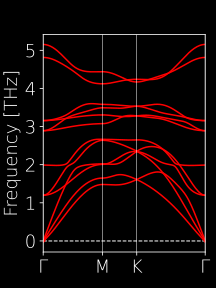
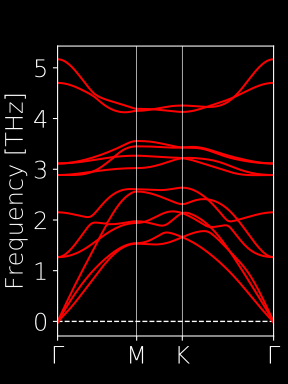
  • Phonon dispersion - Dynamical stability
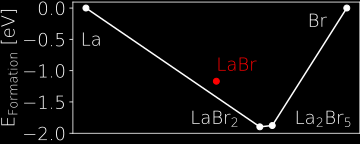
  • Formation energy - Chemical stability

Chemically metastable, but experiementally synthesized*

Flat band

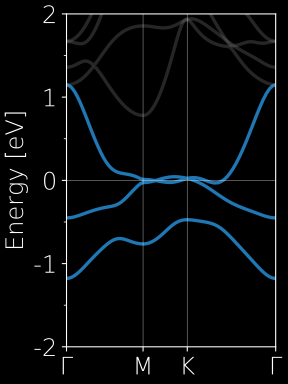
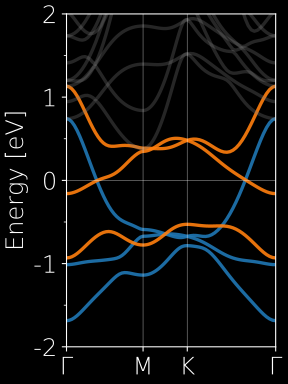
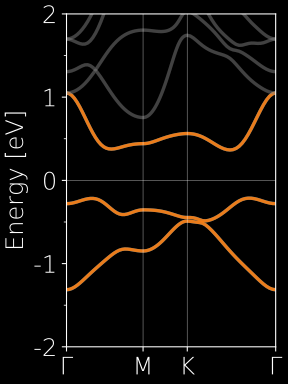
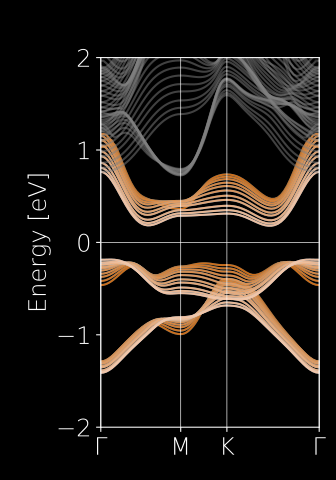
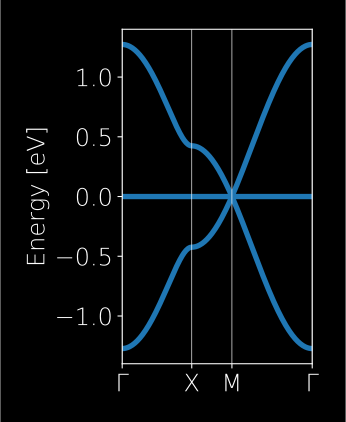
  • We turn our focus to the bands near the Fermi level.
  • Middle band is fairly flat comparing to other bands and it induces magnetism due to Stoner instability.

AFM

FM

PM

Ground state

Controlling Flat band

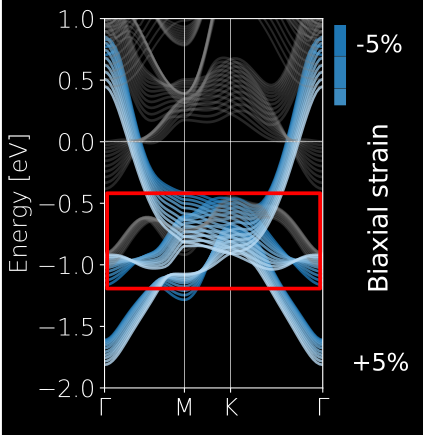
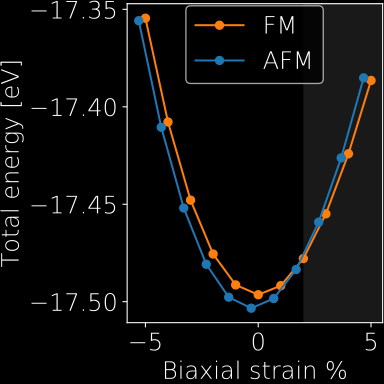
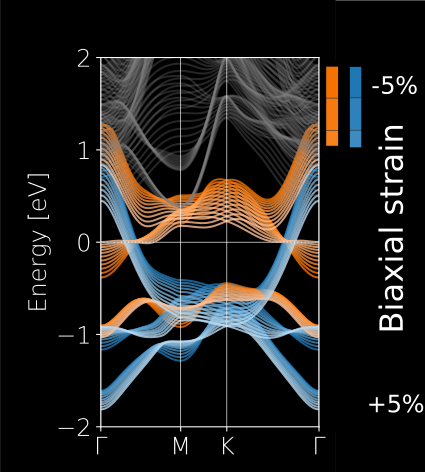
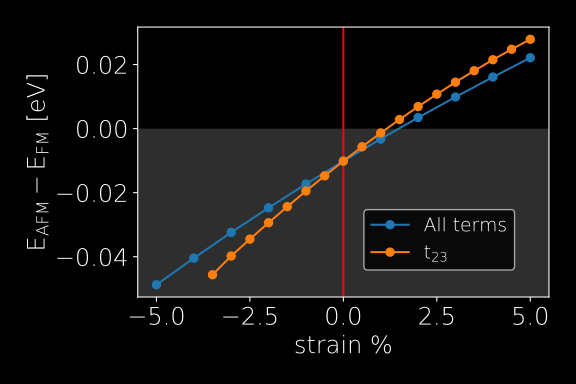
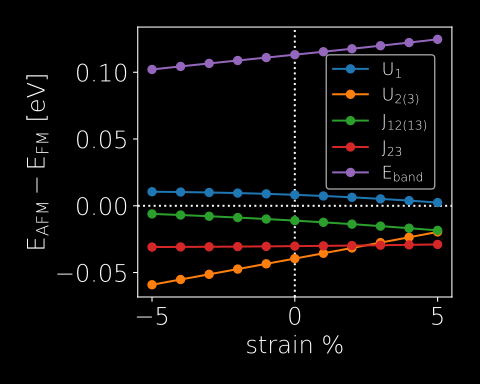
  • Strain can be used to control the shape of the flat band, and magnetic ground states.

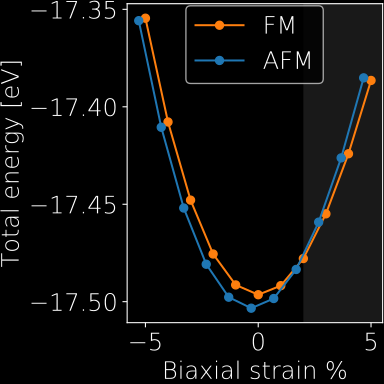
2% biaxial tensile strain:

AFM to FM phase transition

Band width of the middle band change with strain.

Controlling Flat band

  • Strain can be used to control the shape of the flat band, and magnetic states.

At around 2% biaxial tensile strain, system undergoes phase transition from AFM to FM.

AFM

FM

MagnetiC site

Spin density (                  )

\rho_{\uparrow} - \rho_{\downarrow}

FM

Off atom electrons contributes the most!

AFM

  • Monolayer LaBr is an 2D magnetic material with a magnetic moment of
1.7 \mu_B .

Interstitial sites

  • Spin density shows two interstitial sites. ELF gives us another doubly occupied site.

FM

AFM

ELECTRIDES!

Electride materials:

ionic compounds in which electrons are localized at interstitial sites.

  • Some 3D Electrides:
    • Na2He [under high pressure]
    • C12A7:e- (12CaO·7Al2O3)
    • LaCoSi
    • Na [under high pressure]
  • Applications:
    • ​Electron emitters
    • Superconductors
    • Battery anodes
    • Catalysts

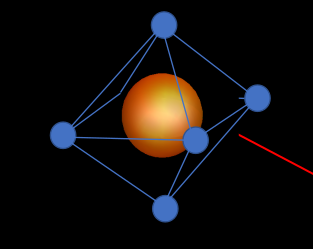
Electron in an octahedral interstitial site

Bader analysis

  • Bader analysis: the overall space is partitioned by the so-called zero flux plane where the charge density is at a minimum with zero flux.

Monolayer LaBr system is indeed an electride system with three interstitial sites.

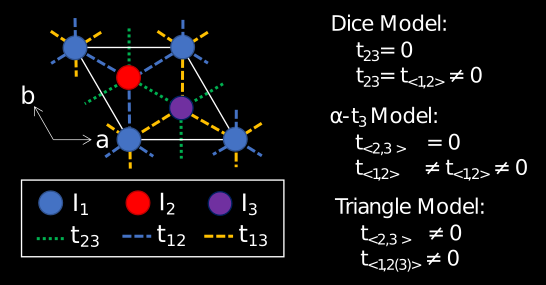
Dice Model

  • The Dice model: 
    • Sites arranged in a triangle lattice.
    • One possible hopping quenched (here, \( t_{23} \)).
    • The remaining hoppings cause destructive interference.

Wavefunction plot for the middle band @ Gamma

Flat band!

Extended Hubbard Model

  • To understand the underlying mechanism of magnetism relating to the flat band, we employed extended Hubbard model.
  • The electron-electron interaction is taken into consideration in a mean-field self-consistent fashion.
\begin{aligned} \mathcal{H}=&-t \sum_{\langle ij\rangle} \sum_{\sigma}\left(c_{i \sigma}^{\dagger} c_{j \sigma}+c_{j \sigma}^{\dagger} c_{i \sigma}\right) \\ \end{aligned}
\begin{aligned} &+U \sum_{i} n_{i \uparrow} n_{i \downarrow}+X \sum_{\langle ij \rangle} \sum_{\sigma}\left(c_{i \sigma}^{\dagger} c_{j \sigma}+c_{j \sigma}^{\dagger} c_{i \sigma}\right)\left(n_{i,-\sigma}+n_{j,-\sigma}\right) \\ &+J \sum_{\langle ij \rangle} \left(\frac{1}{2}\sum_{\alpha,\beta} c_{i\alpha}^{\dagger} \sigma_{\alpha\beta} c_{i\beta}\right) \left(\frac{1}{2}\sum_{\alpha,\beta} c_{j\alpha}^{\dagger} \sigma_{\alpha\beta} c_{j\beta}\right) \end{aligned}

results

  • Model parameters were obtained using hopping parameters from Wannier transforming the DFT Hamiltonian for both the AFM and FM case.
  • Linear interpolating the strained parameters: AFM to FM phase transition indeed happens at around 2% tensile strain.

Summary

  • LaBr monolayer is a magnetic 2D electride.


  •  


  •  

There is an electronic flat band in the system and can be described using a simple tight binding model - The Dice model

The flat band and magnetism can be controlled by strain via tunning the flat band.

thank you 🤟

Powered by:

Find these slides:

APS March 2021

By Chengcheng Xiao

APS March 2021

Slides for APS March meeting 2021

  • 247