COMP2511
25T3 Week 5
Tuesday 10AM - 1PM (T10C)
Slides by Christian Tolentino (z5420628)
This week
- Streams and Lambdas
- Strategy pattern
- Observer pattern
Assignment 2 specification is out! Please put in time to read it and get started. The finalised groups have been posted on the Microsoft Teams. Let me know if you have any issues with it.
Streams
Streams
Streams abstract away the details of data structures and allows you to access all the values in the data structure through a common interface
List<String> strings = new ArrayList<String>(Arrays.asList(new String[] {"1", "2", "3", "4", "5"}));
for (String string : strings) {
   System.out.println(string);
}
List<String> strings = new ArrayList<String>(Arrays.asList(new String[] {"1", "2", "3", "4", "5"}));
strings.stream().forEach(x -> System.out.println(x));
Map<String, Integer> map = new HashMap<>();
map.put("One", 1);
map.put("Two", 2);
map.put("Three", 3);
map.entrySet().stream().forEach(x -> System.out.printf("%s, %s\n", x.getKey(), x.getValue()));Streams
Common uses of streams are:
- forEach
- filter
- map
- reduce
Sort of similar to the Array prototypes/methods in JavaScript
Code Demo
Streams
Code Demo
Convert the following to use streams
package stream;

import java.util.ArrayList;
import java.util.Arrays;
import java.util.List;
import java.util.stream.Collectors;

public class App {
    public static void main(String[] args) {
        List<String> strings = new ArrayList<String>(Arrays.asList(new String[] { "1", "2", "3", "4", "5" }));
        for (String string : strings) {
            System.out.println(string);
        }

        List<String> strings2 = new ArrayList<String>(Arrays.asList(new String[] { "1", "2", "3", "4", "5" }));
        List<Integer> ints = new ArrayList<Integer>();
        for (String string : strings2) {
            ints.add(Integer.parseInt(string));
        }
        System.out.println(ints);
    }

}
package stream;
import java.util.ArrayList;
import java.util.Arrays;
import java.util.List;
import java.util.stream.Collectors;
public class App {
public static void main(String[] args) {
List<String> strings = new ArrayList<String>(Arrays.asList(new String[] { "1", "2", "3", "4", "5" }));
// Same thing
strings.stream().forEach(x -> System.out.println(x));
// Use if there is more than one line of code needed in lambda
strings.stream().forEach(x -> {
System.out.println(x);
});
List<String> strings2 = new ArrayList<String>(Arrays.asList(new String[] { "1", "2", "3", "4", "5" }));
List<Integer> parsedStrings = strings2.stream().map(x -> Integer.parseInt(x)).collect(Collectors.toList());
strings2.stream().map(x -> Integer.parseInt(x)).forEach(x -> System.out.println(x));
}
}Strategy Pattern
Strategy Pattern
Problem: Only some of the children of a parent class implement an abstract method the same way.
Question: How would you implement this without duplicating code?
Note: Behaviours are only shared downwards in inheritance
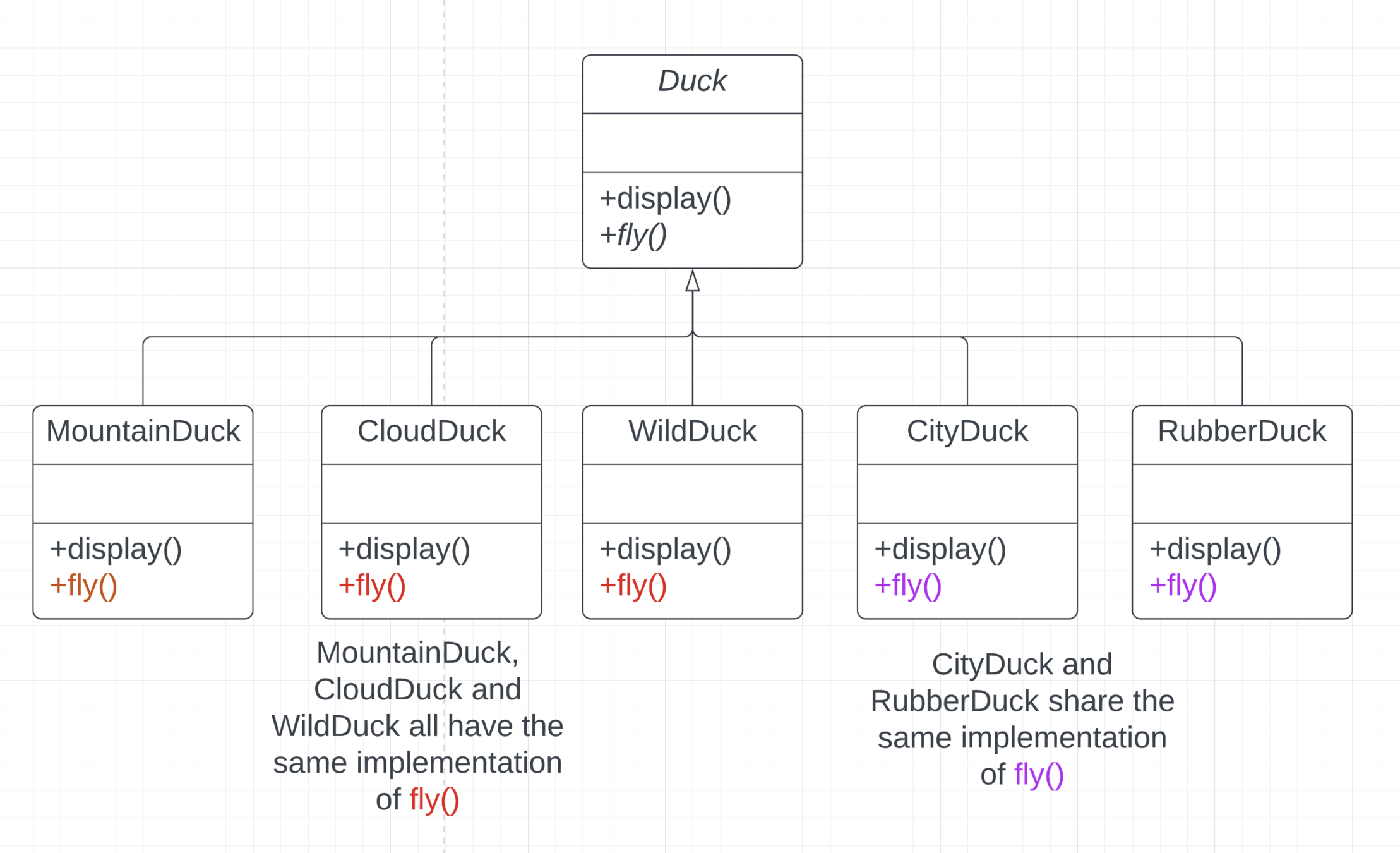
Strategy Pattern
Problem: Only some of the children of a parent class implement an abstract method the same way.
We could introduce a new class in-between the parent and child class.
Strategy Pattern
We could introduce a new class in-between the parent and child class.
However, this becomes problematic when the Ducks have other methods that share the same implementation.
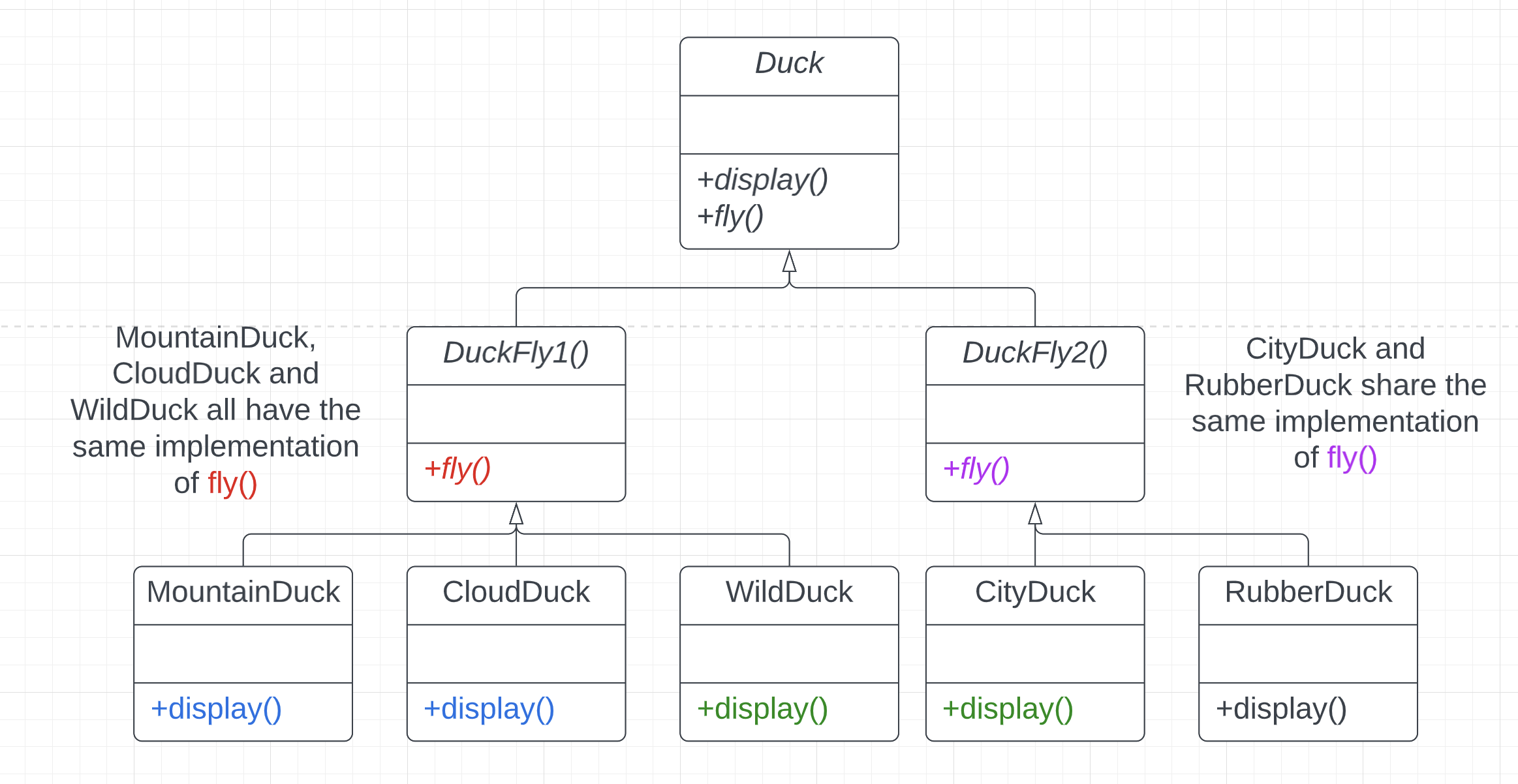
Strategy Pattern
A solution is to move this behaviour into another class and compose this class inside Duck
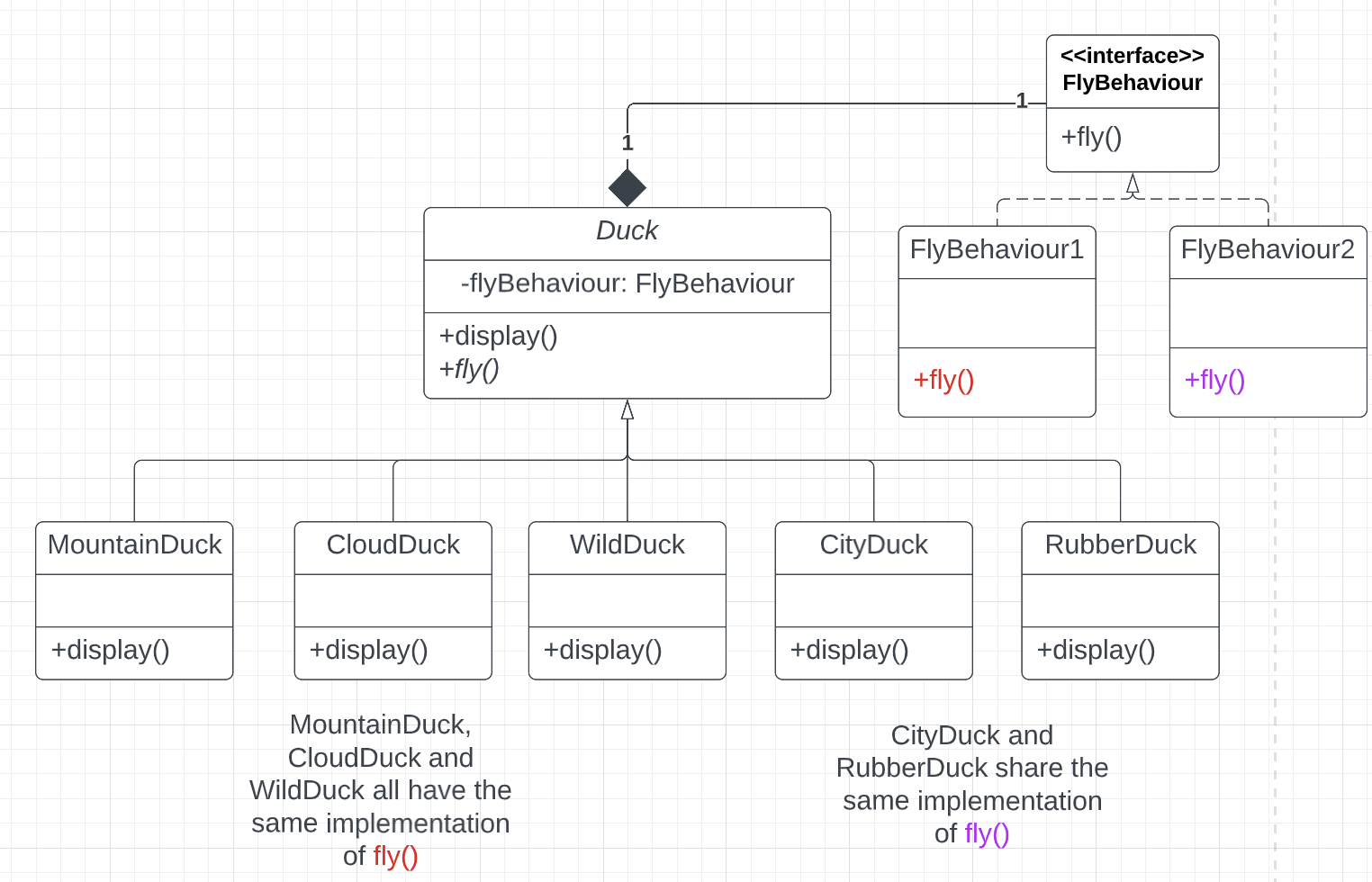
This is one of the main benefits of the strategy pattern, sharing behaviour across an inheritance tree
Strategy Pattern
What type of design pattern is strategy?
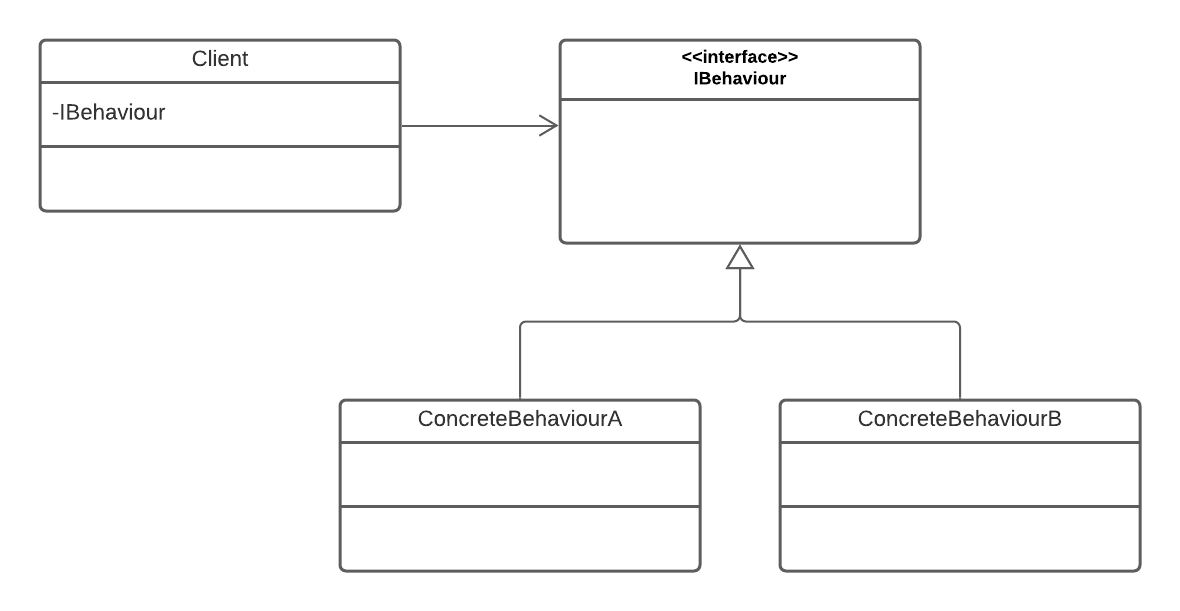
Behavioural Pattern
Behavioural patterns are patterns concerned with algorithms and the assignment of responsibility between object
- Uses composition instead of inheritance
- Allows for dependency injection (Selects and adapts an algorithm at run time). Change the behaviour at runtime.
- Encapsulates interchangeable behaviours and uses delegation to decide which one to use
- Useful when you want to share behaviour across an inheritance tree
Strategy Pattern
Code Demo
Strategy Pattern
Restaurant payment system with the following requirements:
- The restaurant has a menu, stored in a JSON file. Each meal on the menu has a name and price
- The system displays all of the standard meal names and their prices to the user so they can make their order
- The user can enter their order as a series of meals, and the system returns their cost
- The prices on meals often vary in different circumstances. The restaurant has four different price settings:
-
Standard - normal rates
- Holiday - 15% surcharge on all items for all customers
- Happy Hour - where registered members get a 40% discount, while standard customers get 30%
- Discount - where registered members get a 15% discount and standard customers pay normal prices
The prices displayed on the menu are the ones for standard customers in all settings
public class Restaurant {
    ...
    public double cost(List<Meal> order, String payee) {
        switch (chargingStrategy) {
        case "standard":
            return order.stream().mapToDouble(meal -> meal.getCost()).sum();
        case "holiday":
            return order.stream().mapToDouble(meal -> meal.getCost() * 1.15).sum();
        case "happyHour":
            if (members.contains(payee)) {
                return order.stream().mapToDouble(meal -> meal.getCost() * 0.6).sum();
            } else {
                return order.stream().mapToDouble(meal -> meal.getCost() * 0.7).sum();
            }
        case "discount":
            if (members.contains(payee)) {
                return order.stream().mapToDouble(meal -> meal.getCost() * 0.85).sum();
            } else {
                return order.stream().mapToDouble(meal -> meal.getCost()).sum();
            }
        default:
            return 0;
        }
    }
    ...
}- How does the code violate the open/closed principle?
- How does this make the code brittle?
Not closed for modification, open for extension. If more cases need to be added, the switch statement has to be changed.
New requirements may cause the code to break or may be difficult to implement
public class Restaurant {
    ...
    public void displayMenu() {
        double modifier = 0;
        switch (chargingStrategy) {
        case "standard":
            modifier = 1;
            break;
        case "holiday":
            modifier = 1.15;
            break;
        case "happyHour":
            modifier = 0.7;
            break;
        case "discount":
            modifier = 1;
            break;
        }

        for (Meal meal : menu) {
            System.out.println(meal.getName() + " - " + meal.getCost() * modifier);
        }
    }
    ...
}
Similar idea here, if new cases need to be added, the class's method itself needs to be changed. Cannot be extended
Code Demo - Strategy
To fix these issues, we can introduce a strategy pattern and move all the individual case logic into their own classes
public interface ChargingStrategy {
    /**
     * The cost of a meal.
     */
    public double cost(List<Meal> order, boolean payeeIsMember);

    /**
     * Modifying factor of charges for standard customers.
     */
    public double standardChargeModifier();

}
The prices on meals often vary in different circumstances. The restaurant has four different price settings:
- Standard - normal rates
- Holiday - 15% surcharge on all items for all customers
- Happy Hour - where registered members get a 40% discount, while standard customers get 30%
- Discount - where registered members get a 15% discount and standard customers pay normal prices
Observer Pattern
Observer Pattern
What type of design pattern is strategy?
Behavioural Pattern
An object (subject) maintains a list of dependents called observers. The subject notifies the observers automatically of any state changes.
- Used to implement event handling systems ("event driven" programming).
- Able to dynamically add and remove observers
- One-to-many dependency such that when the subject changes state, all of its dependents (observers) are notified and updated automatically
- Loosing coupling of objects that interact with each other.
Observer Pattern
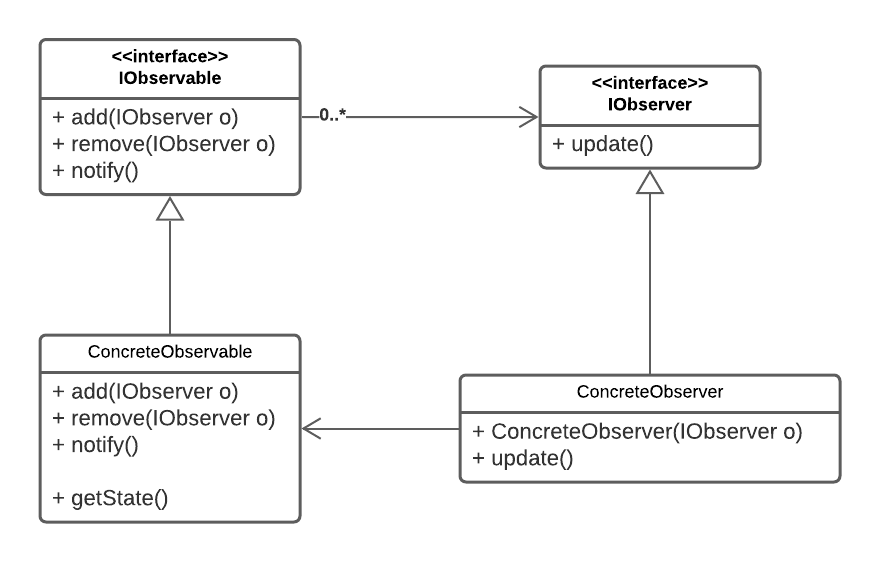
Observer
Subject
Code Demo
Observer Pattern
Code Demo
In src/youtube, create a model for the following requirements of a Youtube-like video creating and watching service using the Observer Pattern:
- A Producer has a name, a series of subscribers and videos
- When a producer posts a new video, all of the subscribers are notified that a new video was posted
- A User has a name, and can subscribe to any Producer
- A video has a name, length and producer
COMP2511 Week 5 25T3
By Christian Tolentino