


Content ITV PRO
This is Itvedant Content department
Learning Outcome
5
Recognize the workflow of provisioning AWS resources using Ansible
4
Understand how Ansible helps in cloud infrastructure provisioning
3
Learn how Ansible can interact with AWS resources
2
Identify the steps required to set up Ansible control node
1
Understand how to configure Ansible for automation
Topic Name-Recall(Slide3)
Previously, we learned about Ansible roles, variables, and templates used for organizing and reusing automation tasks.
Hook/Story/Analogy(Slide 4)
Imagine a remote control system that can set up servers, networks, and storage in the cloud without manually logging into each service.
Transition from Analogy to Technical Concept(Slide 5)
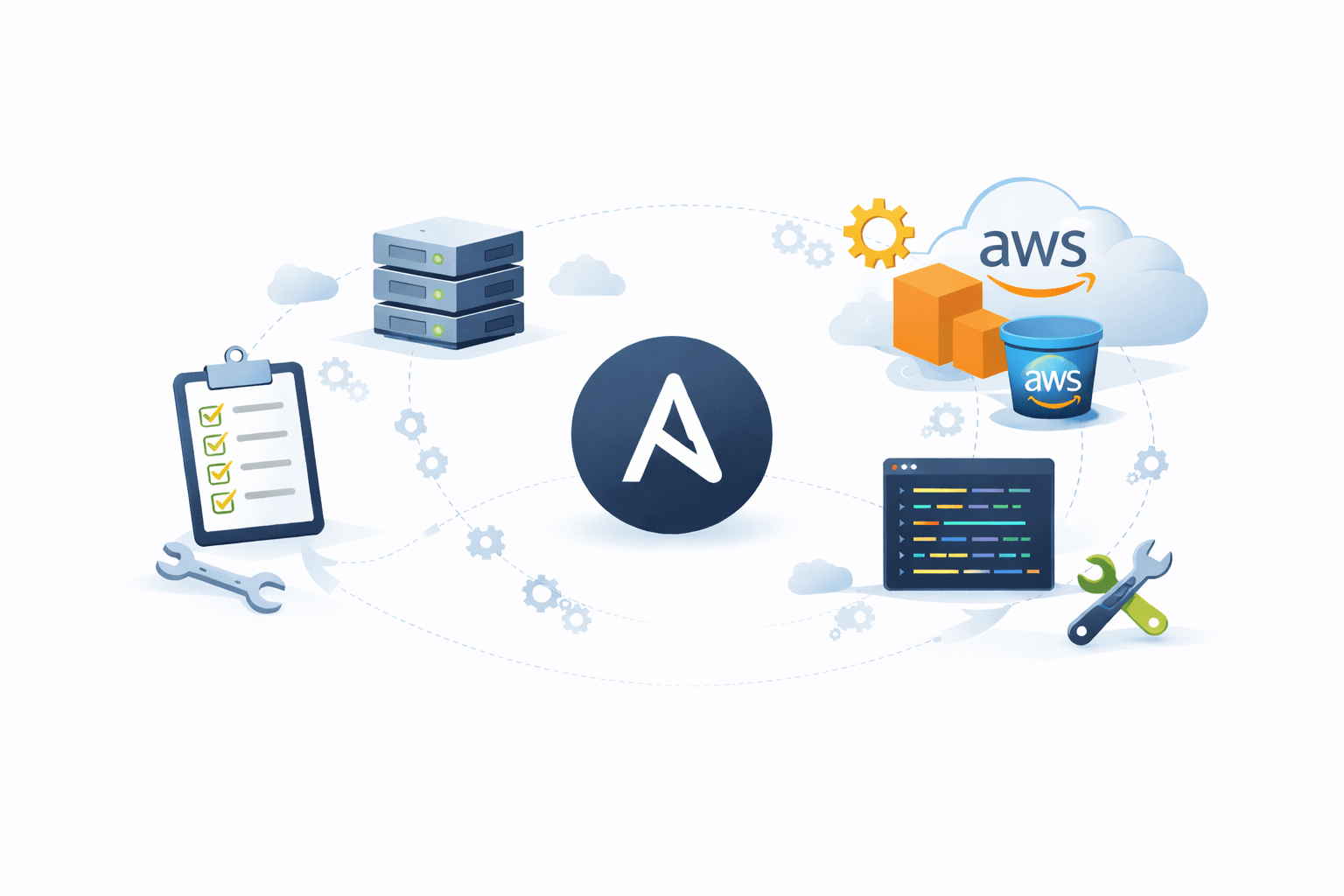
Ansible can be configured to connect with cloud platforms like Amazon Web Services and automatically provision infrastructure resources.
Configuring Ansible
Before using Ansible to manage infrastructure, the control node must be configured properly.
1. Install Ansible
Ansible is installed on the control node, which is the system that manages automation tasks.
Example installation on Ubuntu:
sudo apt update
sudo apt install ansible
2. Verify Ansible Installation
After installation, verify Ansible using:
ansible --version
This confirms that Ansible is installed and ready to use.
3. Configure Inventory
The inventory file contains the list of managed hosts.
Example inventory:
[webservers]
192.168.1.10
192.168.1.11
This tells Ansible which servers should receive automation tasks.
4. Configure SSH Access
Ansible connects to managed nodes using SSH.
The control node must have SSH access to the target servers.
Example:
ssh user@server-ip
This ensures the control node can communicate with managed nodes.
Provisioning AWS Resources Using Ansible
Ansible can also automate cloud infrastructure provisioning.
It can create resources such as:
Virtual machines
Storage buckets
These resources can be provisioned on Amazon Web Services.
Required Configuration for AWS
To interact with AWS, Ansible requires:
AWS credentials
Python libraries for AWS integration
Ansible uses AWS modules to interact with cloud services.
Example: Creating an EC2 Instance
Example Ansible task to create an instance using Amazon EC2:
- name: Launch EC2 instance
hosts: localhost
tasks:
- name: Create EC2 instance
ec2:
key_name: mykey
instance_type: t2.micro
image: ami-123456
region: us-east-1
This task instructs Ansible to create an EC2 instance in AWS
Benefits of Using Ansible for AWS Provisioning
Using Ansible with AWS provides several advantages:
Automates infrastructure creation
Reduces manual cloud configuration
Ensures consistent infrastructure setups
Allows infrastructure management using code
Key Points
Important steps for configuring Ansible:
Install Ansible on the control node
Configure the inventory file
Set up SSH access for managed nodes
Use AWS modules to provision cloud resources
Summary
5
Ansible can automate provisioning of cloud infrastructure resources
4
Ansible modules allow interaction with AWS services
3
Ansible communicates with servers using SSH
2
Inventory files define the list of managed systems
1
Ansible must be configured on a control node before automation
Quiz
Where is Ansible installed in the architecture?
A. Managed node
B. Control node
C. Database server
D. Cloud gateway
Answer
Where is Ansible installed in the architecture?
A. Managed node
B. Control node
C. Database server
D. Cloud gateway
By Content ITV