






Content ITV PRO
This is Itvedant Content department
Learning Outcome
5
Understand their impact on holdings and cash flows.
4
Determine investor eligibility using key dates.
3
Describe important Corporate Action Dates.
2
Explain key Corporate Actions.
1
Define Instrument Attributes and their types.
What Is an Instrument Attribute?
An Instrument Attribute is any data field maintained against a security's identifier in the Security Master to describe its characteristics or record events affecting it.
For example: An equity share with ISIN INE002A01018 (Reliance Industries) carries static attributes such as face value (₹10), asset class (equity), and listing exchange (NSE/BSE), and dynamic attributes such as the type of corporate action declared, along with its Declaration Date, Ex-Date, Record Date, and Payment Date.
Types of Corporate Actions as an Instrument Attribute
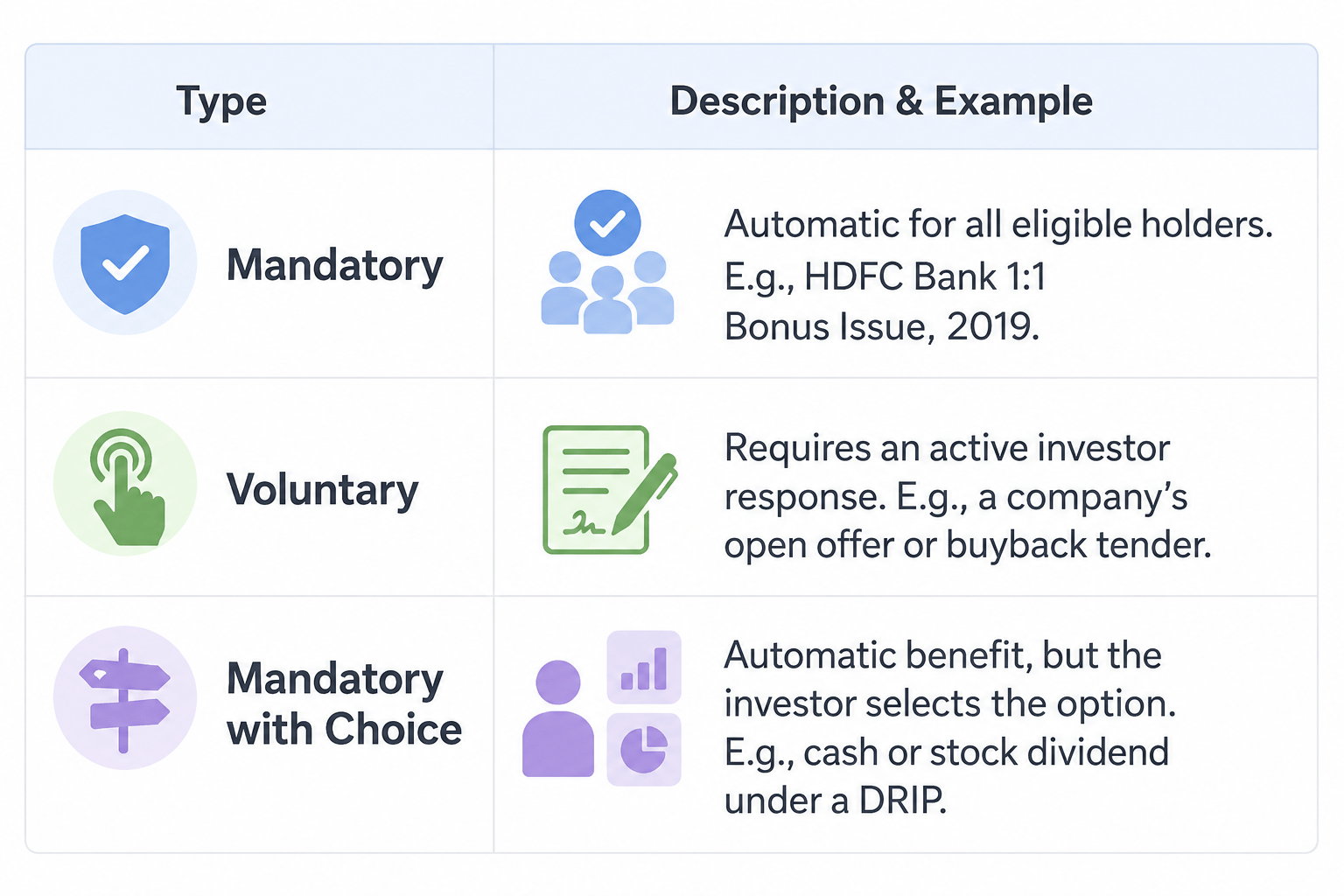
The first attribute recorded against an instrument, once a corporate action is announced, is its type. Corporate actions fall into three categories:
Mandatory:
Applied automatically to every eligible shareholder; no response is needed. Example: Stock Split, Bonus Issue.
Voluntary:
Shareholders must actively elect to participate; non-response means non-participation. Example: Rights Issue, Buyback Tender Offer.
Mandatory with Choice:
The event applies to everyone, but the investor chooses the form of benefit. Example: Dividend Reinvestment Plan (DRIP).
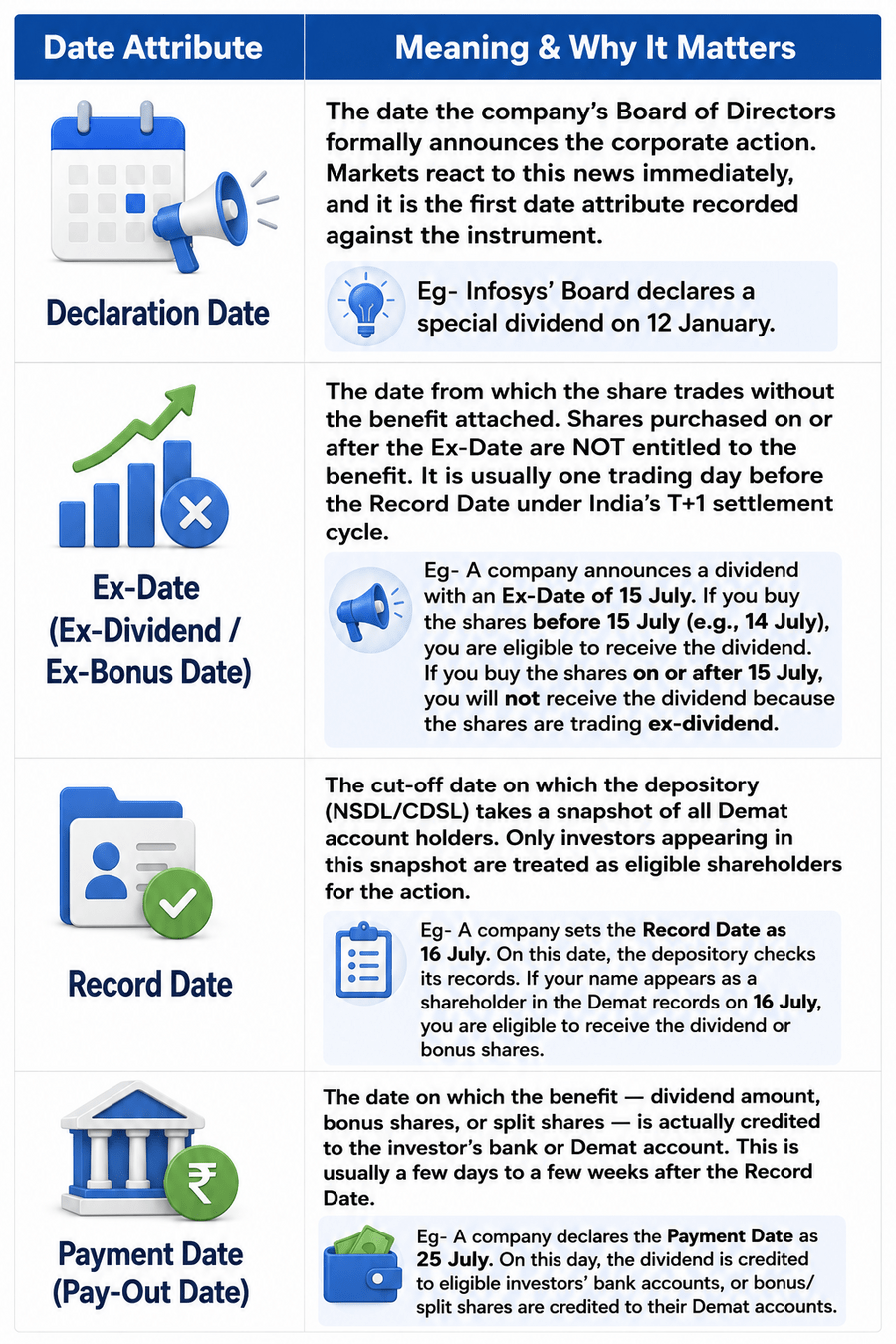
Key Corporate Action Date Attributes
Key Corporate Action Date Attributes
Impact on Investors
2. Share price adjustment:
On the Ex-Date, the share price is adjusted downward to reflect the benefit already given (e.g., a dividend payout or additional bonus shares).
1. Eligibility depends on timing:
You must own the shares before the Ex-Date to receive the benefit. Buying on or after the Ex-Date means you are not eligible.
3. Portfolio valuation changes:
Instrument attribute updates automatically flow into the investor's portfolio statement, changing quantity held, average cost, or cash balance.
Impact on Investors
5. Tax and reporting:
Corporate action attributes (type, dates, and amount) are used by brokers and depositories to generate tax statements such as dividend income or capital gains records.
4. Cash flow timing:
The investor should track the Payment Date attribute to know exactly when the benefit will reflect in their bank or Demat account.
6. Data accuracy risk:
If instrument attributes are updated incorrectly or late in the Security Master, investors may face wrong eligibility determination or delayed credit — making accurate attribute maintenance a key operational control.
Summary
5
Accurate data ensures correct processing.
4
Ex-Date determines eligibility.
3
Key dates guide processing.
2
Corporate actions have three types.
1
Instrument Attributes describe securities.
Quiz
Which document records the commercial details of an individual OTC derivative trade?
A. Schedule
B. Credit Support Annex (CSA)
C. Confirmation
D. Preamble
Quiz-Answer
Which document records the commercial details of an individual OTC derivative trade?
A. Schedule
B. Credit Support Annex (CSA)
C. Confirmation
D. Preamble
By Content ITV