





Content ITV PRO
This is Itvedant Content department
Learning Outcome
5
Apply these concepts across financial markets.
4
Use rates to determine returns and cash flows.
3
Calculate notional value.
2
Understand their role in trade settlement.
1
Define price, rate, quantity, and notional value.
Recall
In earlier modules on Clearing and Settlement, we saw how trades move through confirmation, clearing, and final settlement between buyer and seller, and how the settlement cycle (such as T+1) determines when funds and securities actually change hands.
A trade ticket is the starting point of that entire journey — it is the original record created the moment a trade is executed, and every downstream step of confirmation and settlement relies on the accuracy of the details captured on it.
Trade Ticket Formats
A trade ticket is a standardized record containing all essential details required to process, confirm, and settle a financial trade. Its format is not free-form — exchanges, brokers, and back-office systems follow a consistent structure so that every trade, regardless of who executes it, can be read, matched, and settled without ambiguity. The exact fields on a trade ticket vary slightly by asset class, since an equity trade, a bond trade, or a derivatives trade each carries information specific to that instrument.
Equity Trade Ticket
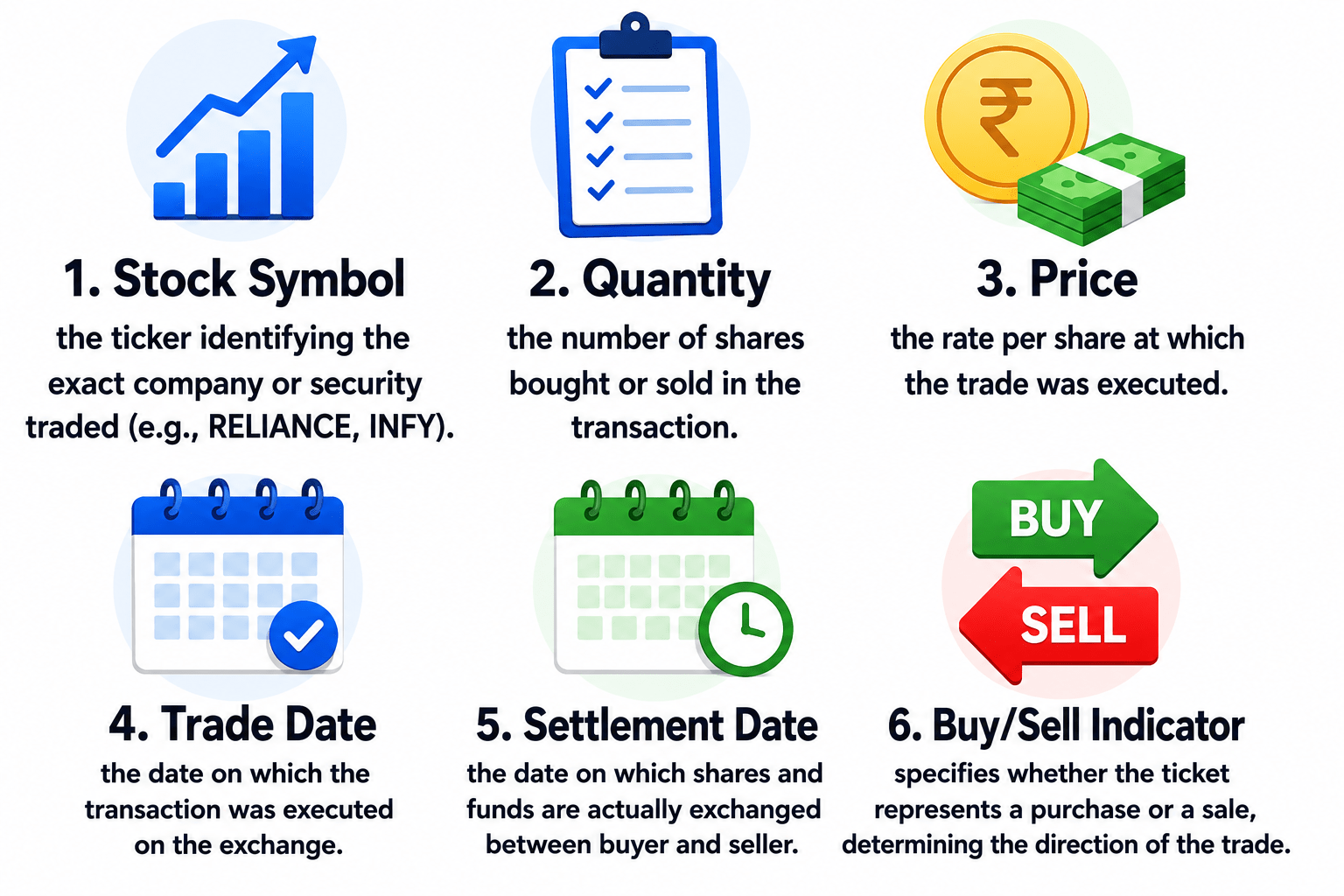
An Equity Trade Ticket captures the details of a buy or sell transaction in shares. It ensures that the broker, the clearing corporation, and the counterparty all have an identical, unambiguous record of what was traded. The key fields typically captured are:
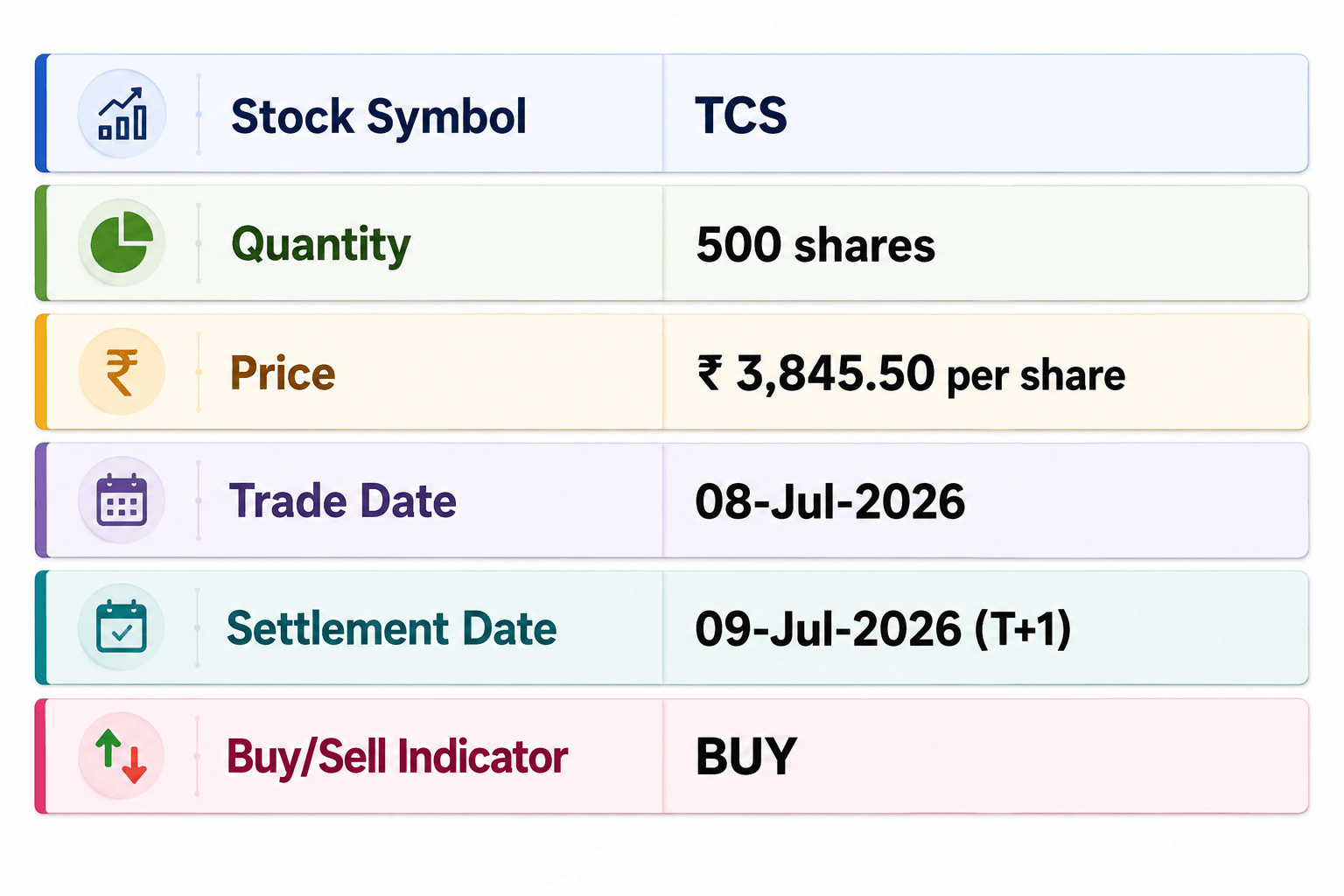
Illustrative Equity Trade Ticket
Why This Matters
A single incorrect field on an equity trade ticket — a wrong symbol, quantity, or settlement date — can cause a trade to fail confirmation or settlement. Accuracy at this first step protects every process that follows.
Summary
5
Buy/Sell indicator shows trade direction.
4
Trade and settlement dates define the timeline.
3
Stock symbol and quantity identify the trade.
2
Equity tickets capture key trade information.
1
Trade tickets record trade details.
Quiz
In a T+1 settlement cycle, if a trade is executed on 8 July 2026, when is the settlement expected to occur?
A. 8 July 2026
B. 9 July 2026
C. 10 July 2026
D. 11 July 2026
Quiz-Answer
In a T+1 settlement cycle, if a trade is executed on 8 July 2026, when is the settlement expected to occur?
A. 8 July 2026
B. 9 July 2026
C. 10 July 2026
D. 11 July 2026
By Content ITV