Shielded CSV 🛡️
Private and Efficient
Client-Side Validation
Jonas Nick
Liam Eagen

Robin Linus


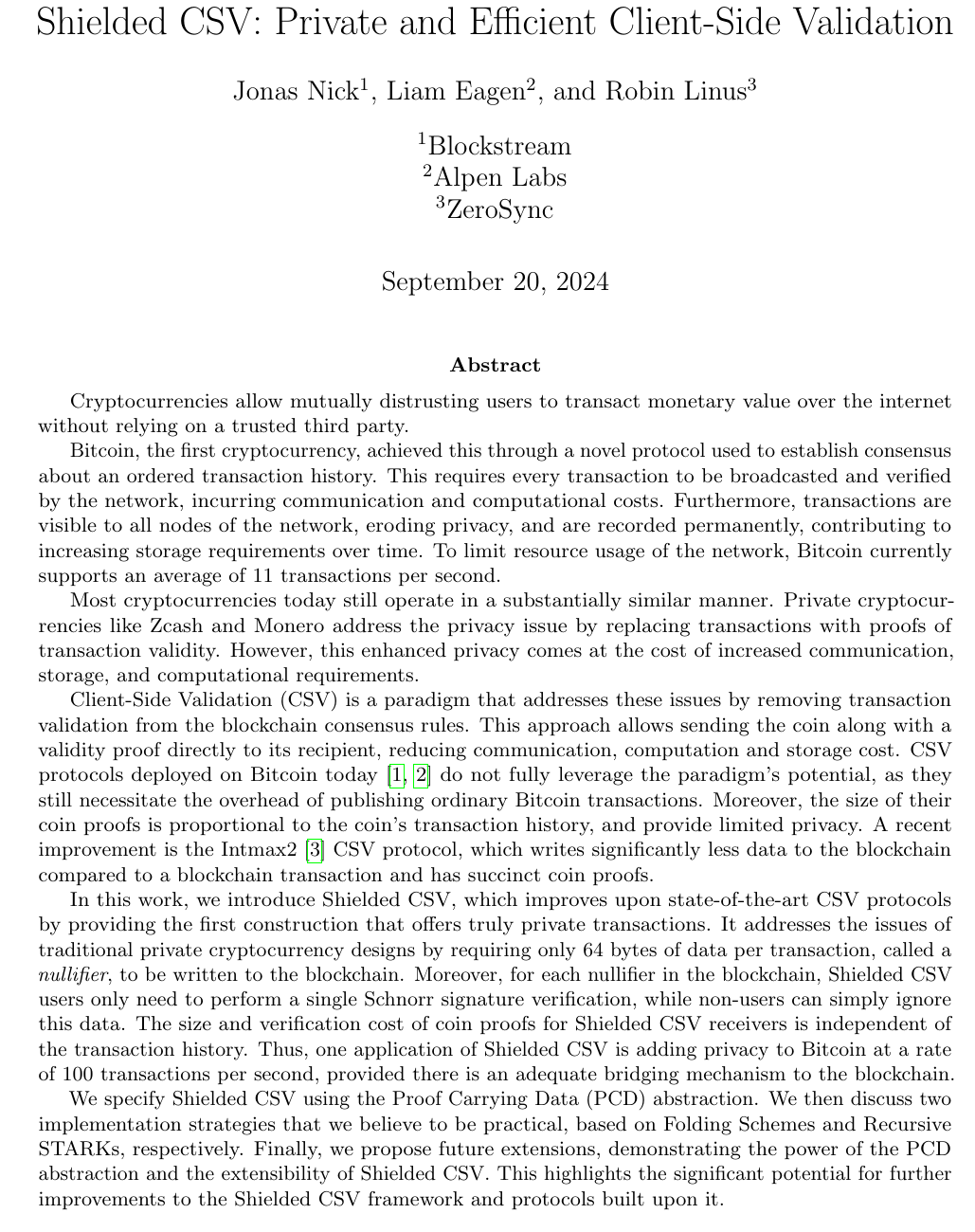
- Shielded CSV is a transaction protocol to create an L1 on top of a blockchain that allows embedding arbitrary data (e.g., Bitcoin).
- It inherits double-spend security from the underlying blockchain.
- The amount of data embedded into the blockchain is 64 bytes.
- Coins and coin proofs are sent directly to the receiver through a private one-way communication channel.
- Coin proofs are succinct.
- Shielded CSV is fully private.
Summary
Blockchain (PoW, ...)
Transaction Validation
"Layer 0.5"
"Layer 1"
🛡️
Motivation
- A more efficient design for private cryptocurrencies
- ZK proofs are not on the blockchain and are not verified by full nodes. Can be built on existing blockchain.
- Improve privacy of Bitcoin.
- Use Bitcoin as the underlying blockchain. Requires bridge (BitVM, one-way peg, federated peg, ...).
Toy CSV: 🐸 Issuance
👩🌾
Ivy: 2 sat
Transaction 1
Ivy
the Issuer
On-Chain
Off-Chain
Ivy: 10 🐸
Transaction 1
Sign("I issue 10 🐸-coins in transaction 1, output 1. Redeemable for physical frogs.")
Toy CSV: Transaction
👩🌾
Ivy: 2 sat
Transaction 1
Ivy
the Issuer
On-Chain
Off-Chain
Ivy: 1 sat
Roy: 1 sat
Transaction 2
Roy
the Receiver
🧑🎤
Ivy: 10 🐸
Transaction 1
Ivy: 3 🐸
Roy: 7 🐸
Transaction 2
"Coin Proof":
Transaction graph connecting Roy's output to an issuance transaction
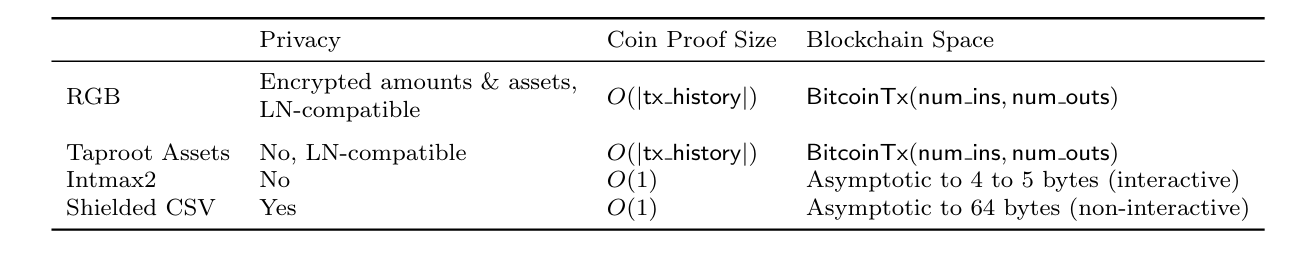
Comparing CSV
What is CSV really?
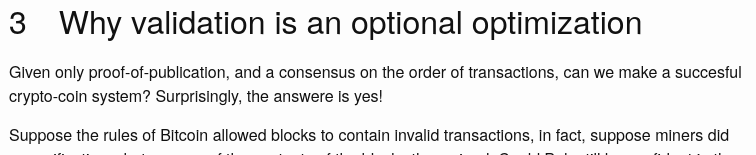
Insight: Transaction validation does not need to be part of the consensus rules.
... then transactions are only validated "client-side" and simply ignored if they are invalid.
- Derive short piece of data ("nullifier") from the CSV transaction.
- Post nullifier to blockchain to prevent double-spending.
Taking CSV seriously
- Toy CSV: nullifier is Bitcoin tx
- Shielded CSV: nullifier is 64-byte blob

Post-quantum
non-interactive publishing
prunable wallet state
PCD
Payment Channels
MEVil
TS-Accumulator
Instantiation
Light clients
Reorgs
Sign-to-Contract Schnorr Half-Aggregation
<REDACTED>
█ █ █ █ █ █ █ █
ᗰᗩᗪᑎᕮᔕᔕ ᗯᗩITᔕ
64-byte nullifier
Private and Efficient CSV
Communication Channels
Client-Side Validation Model
Accounts
mempool
🚢
Shielded CSV: Definitions
- CSV Transaction: similar to Bitcoin transactions. Consist of inputs and outputs.
👩🚀
🧑🎤
Sally the Sender
Roy the Receiver
Coin, Coin Proof
Verify:
All txs in the coin proof
are valid.
Ivy: 3 🐸
Roy: 7 🐸
- Coin: Tx output. Consists of amount & public key.
- CoinID: Tx hash & coin index. Tx inputs contain CoinIDs.
- Coin Proof: History of transactions connecting to issuance transactions.
Preventing Double Spending
Nullifier := (CoinID, TxHash)🧑🎤
👩🚀
Blockchain
| CoinID | TxHash |
|---|---|
| <some CoinID> | <...> |
| <other CoinID> | <...> |
nullifier key-value store
Embed nullifier
Process nullifiers
Process nullifiers:
Ignore nullifiers whose CoinID is already in the KV-store.
(<some CoinID>, <some TxHash>)
IGNORED by Roy
Preventing Double Spending
👩🚀
🧑🎤
Sally the Sender
Roy the Receiver
Coin, Coin Proof
Verify Coin Proof:
- All txs in the coin proof are valid.
-
Every coin spent in the coin proof must be present in the KV-store and the tx hashes must match.
| CoinID | TxHash |
|---|---|
| <some CoinID> | <...> |
| <other CoinID> | <...> |
nullifier key-value store
Preventing Double Spending
This design does prevent double spending with only a small nullifier!
-
Problem: Insecure! Anyone can nullify any coin.
- Solution: Add signature to nullifier.
-
Inefficiency: One nullifier per spent coin.
- Solution: Introduce "accounts", a special type of TXO.
- Result: one nullifier per account state update that can spend an arbitrary number of coins.
-
Problem: Posting nullifiers requires a dedicated on-chain tx.
- Solution: Publishers collect nullifiers and post them all at once with a single on-chain tx. Anyone can become a publisher.
Towards 64-bytes Nullifiers
AggNullifier := (Nullifier_PubKeys, AggSig)Nullifier := (Nullifier_PubKey, Signature)Nullifier := (Nullifier_PubKey, TxHash, Signature) Nullifier := (Nullifier_PubKey, TxHash)Nullifier := (CoinID, TxHash)(insecure, one nullifier per coin)
(insecure, one nullifier per tx)
128 bytes
96 bytes
64 bytes
Accounts
Signature
Sign-To-Contract
Signature Half-Aggregation
👩🚀
🧑🎤
Coin, Coin Proof
👷
Tx := (AcctState, Coins,
       NewAcctState, NewCoins)
Nullifier
AggNullifier
...
Block i + 1
Block i
Block i + 2
aggregates & publishes
reads & verifies aggregate sig
| <...> | <...> |
|---|---|
| <...> | <...> |
- Problem: Coin proof includes all ancestor transactions involved in creating the coin (size?, privacy?)
- Solution: Wrap the protocol in a "Proof-Carrying Data" (PCD) scheme
Succinct & Private Coin Proofs
Proof-Carrying Data (PCD) [2010]
-
πᵢ: proof that the entire preceding computation graph is correct.
- Size and Verification time independent of graph size.
- Zero-Knowledge for incoming inputs and and outputs.
- PCD can be instantiated with recursive SNARKs or Folding schemes.
🖥️
🖥️
🖥️
Local Input
Local Input
Local Input
Output
Output
Output
Output
, π₁
, π₂
, π₃
, π₄
Proof-Carrying Data (PCD) [2010]
🖥️
🖥️
🖥️
Local Input
Local Input
Local Input
Output
Output
Output
Output
, π₁
, π₂
, π₃
, π₄
- 🖥️: Shielded CSV transaction
- Output: Account state or coin
- Local Input: Account update proofs, etc
- πᵢ: Coin proof
Shielded CSV Coin Proofs
👩🚀
Local Input
AcctState
Coin
AcctState
Coin
, π₁
, π₂
, π₃
, π₄
🧑🎤
- Coin proof π₄ proves to Roy that all transactions are correct and have been nullified
- succinct and ZK
- Why PCD? Framework abstracts away some of the complexity.
Shielded CSV is ...
- an instantiation of PCD,
- the definition of correct computation in PCD,
- we specify this in Rust,
- a spec for how the nullifier key-value store is updated.

This was just a tiny glimpse of the paper
- Blockchain reorganizations
- "Trustless" Publishing & Fees
- Security definitions of the primitives (accumulators, etc.)
- t-of-n Shared Accounts
- Atomic Swaps
- Wallet State
- Nullifier Accumulator based on Merkle Tree of Merkle Trees
- ...
Future Work
- More complete specification & test vectors
- Instantiation of primitives
- BitVM (?) Bridging
- Communication channels / UX
- Other drawbacks of CSV paradigm?
- "mempool"
- Efficient timelocks
- Payment channels
- Light clients
- Scriptable spending policies
- ...
Shielded CSV (TAB conf)
By iamjon