PostgreSQL as a broker for offline task processing
/ DjangoPgPubSub

Text
PG
LISTEN virtual;
NOTIFY virtual;
Asynchronous notification "virtual" received
	from server process with PID 8448.
NOTIFY virtual, 'This is the payload';
Asynchronous notification "virtual" with payload
	"This is the payload" received from server process with PID 8448.

LISTEN foo;
SELECT pg_notify('fo' || 'o', 'pay' || 'load');
Asynchronous notification "foo" with payload
	"payload" received from server process with PID 14728.
PUBLISH Hello "Is it me you're looking for"SUBSCRIBE HelloREDIS
Is it me you're looking for@pgpubsub.post_save_listener(MediaTriggerChannel)
def scan_media(old: Media, new: Media):
if not old:
print(f'Perform virus scan on the new media {new}.')
else:
print(f'Media updated; scan {new} all over again.')python manage.py listen@dataclass
class MediaTriggerChannel(TriggerChannel):
model = Media
lock_notifications = TrueUsage

Signals? Not Quite
CREATE TABLE IF NOT EXISTS public.pgpubsub_notification
(
    id integer,
    channel character varying(63),
    payload jsonb NOT NULL,
    created_at timestamp with time zone,
    db_version integer,
	...
)
CREATE OR REPLACE FUNCTION public.pgtrigger_pgpubsub_a83de_cacbb()
...
payload := '{"app": "tests", "model": "Media"}'::jsonb;
payload := jsonb_insert(payload, '{old}', COALESCE(to_jsonb(OLD), 'null'));
payload := jsonb_insert(payload, '{new}', COALESCE(to_jsonb(NEW), 'null'));
SELECT current_setting('pgpubsub.notification_context', True)
INTO notification_context_text;
IF COALESCE(notification_context_text, '') = '' THEN
notification_context_text := '{}';
END IF;
payload := jsonb_insert(payload, '{context}', notification_context_text::jsonb);
INSERT INTO pgpubsub_notification (channel, payload)
VALUES ('pgpubsub_a83de', payload);
perform pg_notify('pgpubsub_a83de', payload::text);
RETURN NEW;
END;
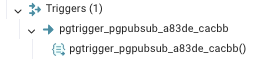
Media Table
Sender
def listen(
    channels: Union[List[BaseChannel], List[str]] = None,
    recover: bool = False,
    autorestart_on_failure: bool = True,
    start_method: str = 'spawn',
):
    connection_wrapper = listen_to_channels(channels)
    logger.info('Listening for notifications... \n')
    while POLL:
		process_notifications(connection_wrapper)
def listen_to_channels(channels: Union[List[BaseChannel], List[str]] = None):
    cursor = connection.cursor()
    with transaction.atomic():
        for channel in channels:
            logger.info(f'Listening on {channel.name()}\n')
            cursor.execute(f'LISTEN {channel.listen_safe_name()};')
    return ConnectionWrapper(connection.connection)
Receiver
You said this replaces Celery?
Media Task
Fixed
What double processing by Multiple Receivers
class LockableNotificationProcessor(NotificationProcessor):
    def process(self):
		...
        notification = (
            Notification.objects.select_for_update(
                skip_locked=True).filter(
                    payload_filter,
                    channel=self.notification.channel,
            ).first()
        )
        if notification is None:
            logger.info(f'Could not obtain a lock on notification '
                        f'{self.notification.pid}\n')
        else:
            logger.info(f'Obtained lock on {notification}')
            self.notification = notification
            self._execute()
            self.notification.delete()
skip_locked is your friend
What if the receiver is down?


Re-queue unprocessed notifications from the DB -> The channel
def process_stored_notifications(channels=None):
	...
    if channels is None:
        channels = registry
    else:
        channels = [locate_channel(channel) for channel in channels]
        channels = {
            channel: callbacks
            for channel, callbacks in registry.items()
            if issubclass(channel, tuple(channels))
        }
    with connection.cursor() as cursor:
        lock_channels = [c for c in channels if c.lock_notifications]
        for channel_cls in lock_channels:
            payload = ''
            logger.info(
                f'Notifying channel {channel_cls.name()} to recover '
                f'previously stored notifications.\n')
            cursor.execute(
                f"select pg_notify('{channel_cls.listen_safe_name()}', '{payload}');")
Pros
- Signals will work with bulk create
- Less machinery / Wont burn a hole in your pocket
Cons
- Will be slower since Redis / RabbitMQ / etc resides in RAM and get their fault tolerance through cluster configs. Should be fine for 99.9% of all cases.
Me
https://au.linkedin.com/pub/iqbal-bhatti/14/63/493


Slides
PostgreSQL as a Broker
By Iqbal Talaat Bhatti


