


















Jeanne Colbois PRO
Physicist @ CNRS. Here you find slides for *some* of my presentations, as well as visual abstracts for recent publications.
Jeanne Colbois | Institut Néel
GDR Physique quantique mésoscopique - Aussois 2025 - 03/12/2025
Jeanne Colbois | Institut Néel
everything commutes
GDR Physique quantique mésoscopique - Aussois 2025 - 03/12/2025
2
Andrew Smerald
KIT | Germany
Frédéric Mila
EPFL | Switzerland
Frank Verstraete
Ghent University | Belgium
Laurens Vanderstraeten
Ghent University | Belgium
Samuel Nyckees
EPFL | Switzerland
Afonso Rufino
EPFL | Switzerland
Bram Vanhecke
University of Vienna | Austria
COLBOIS|TNS FOR CLASSICAL SPIN SYSTEMS | 11.2025
COLBOIS|TNS FOR CLASSICAL SPIN SYSTEMS | 11.2025
3
1. Motivation: classical models
COLBOIS|TNS FOR CLASSICAL SPIN SYSTEMS | 11.2025
3
1. Motivation: classical models
2. Statistical mechanics and tensor networks
COLBOIS|TNS FOR CLASSICAL SPIN SYSTEMS | 11.2025
3
1. Motivation: classical models
2. Statistical mechanics and tensor networks
3. Frustrated magnetism and tensor networks
COLBOIS|TNS FOR CLASSICAL SPIN SYSTEMS | 11.2025
3
1. Motivation: classical models
2. Statistical mechanics and tensor networks
3. Frustrated magnetism and tensor networks
4. Broader perspective: open challenges
COLBOIS|TNS FOR CLASSICAL SPIN SYSTEMS | 11.2025
3
3
Why study them?
Why I study them: frustration, exponential ground state degeneracy
(Why) do we need new techniques?
COLBOIS|TNS FOR CLASSICAL SPIN SYSTEMS | 11.2025
4
COLBOIS|TNS FOR CLASSICAL SPIN SYSTEMS | 11.2025
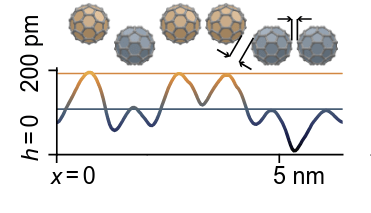
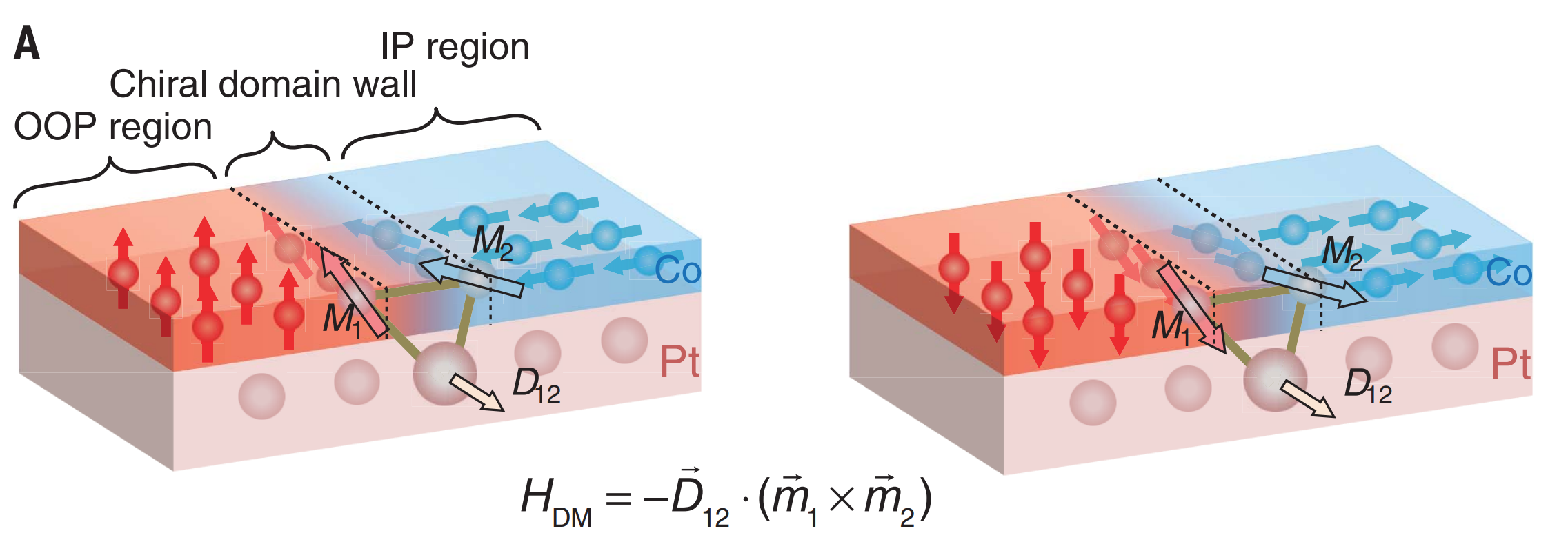
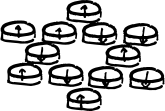
Position of a molecule
I. A. Chioar, et al PRB 93, (2016)
Afonso-Moro et al. (2023)
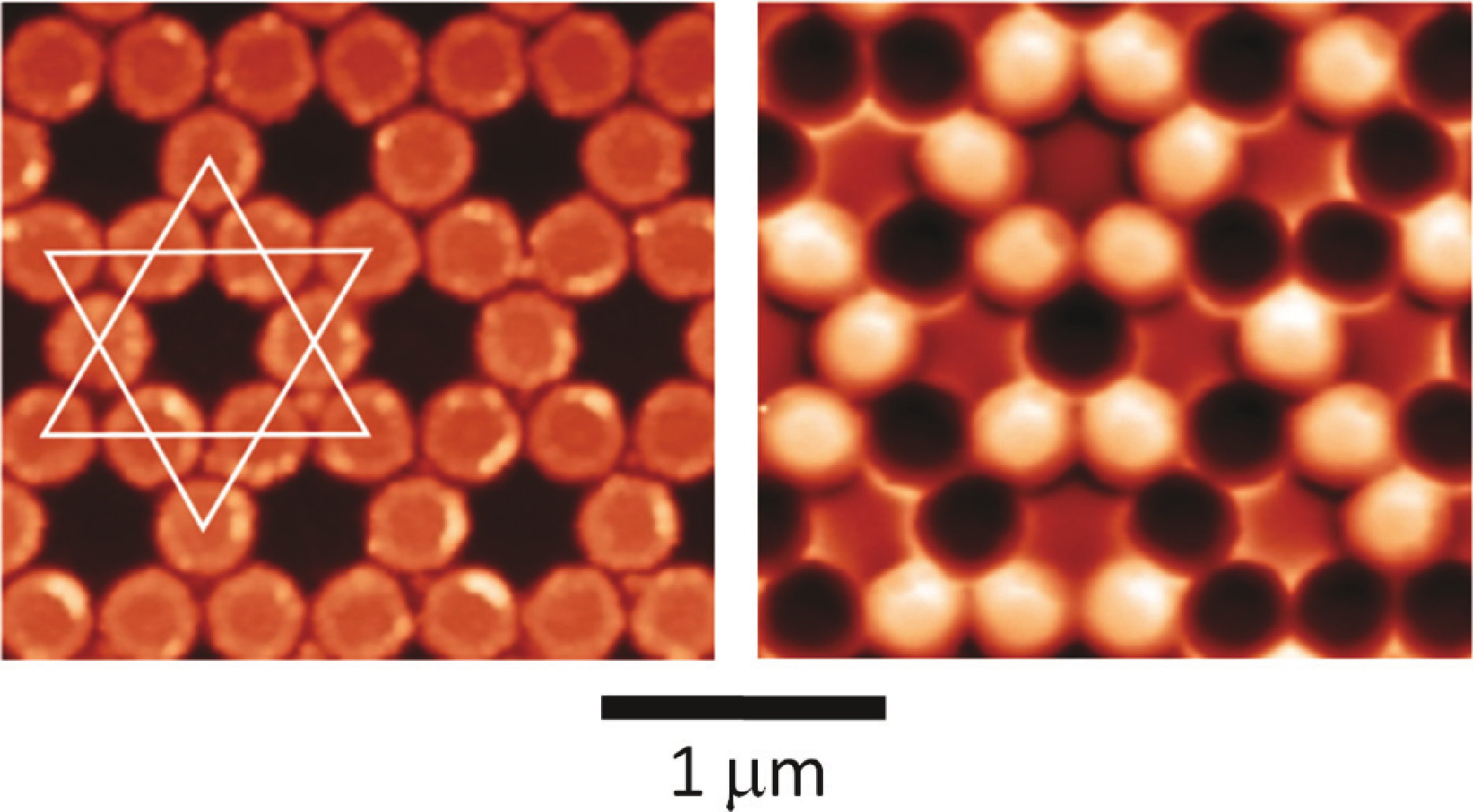
Degree of freedom is captured by a classical variable
Nanomagnet magnetization
4
COLBOIS|TNS FOR CLASSICAL SPIN SYSTEMS | 11.2025
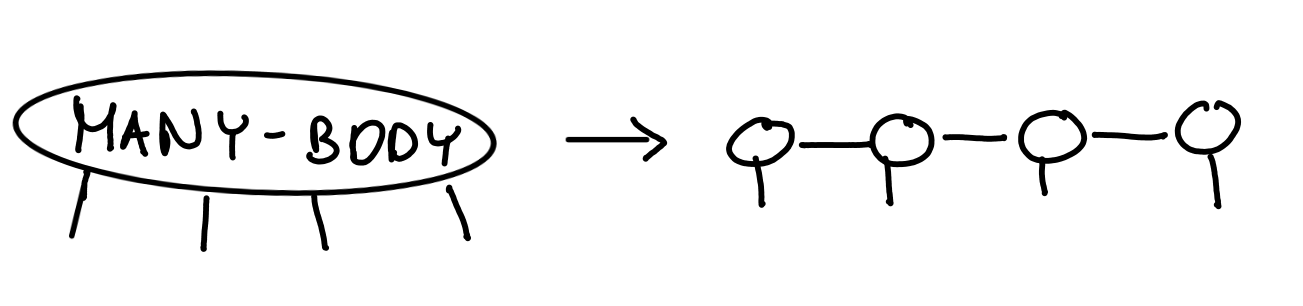
Simplified models of quantum (many-body) systems
Position of a molecule
I. A. Chioar, et al PRB 93, (2016)
Afonso-Moro et al. (2023)
Degree of freedom is captured by a classical variable
Nanomagnet magnetization
4
COLBOIS|TNS FOR CLASSICAL SPIN SYSTEMS | 11.2025
Degree of freedom is captured by a classical variable
Simplified models of quantum (many-body) systems
Quantum models mapped to classical models -- see next talk!
Position of a molecule
I. A. Chioar, et al PRB 93, (2016)
Nanomagnet magnetization
Afonso-Moro et al. (2023)
4
5
COLBOIS|TNS FOR CLASSICAL SPIN SYSTEMS | 11.2025
partition function
6
COLBOIS|TNS FOR CLASSICAL SPIN SYSTEMS | 11.2025
Spin up
Spin down
6
COLBOIS|TNS FOR CLASSICAL SPIN SYSTEMS | 11.2025
T
\(C_v\)
Spin up
Spin down
Thermodynamic properties
6
COLBOIS|TNS FOR CLASSICAL SPIN SYSTEMS | 11.2025
Thermodynamic properties
Magnetic order
\(q_x\)
\(q_x\)
\(\xi = \infty\)
\(\xi = 0\)
\(q_y\)
\(q_y\)
Ideal paramagnet
T
\(C_v\)
Spin up
Spin down
Correlation functions
COLBOIS|TNS FOR CLASSICAL SPIN SYSTEMS | 11.2025
Spin up
Spin down
7
COLBOIS|TNS FOR CLASSICAL SPIN SYSTEMS | 11.2025
Spin up
Spin down
7
\(2100\) sites : \(2^{700} \) ground states!
(vs \(2^{265} \) atoms in the universe)
COLBOIS|TNS FOR CLASSICAL SPIN SYSTEMS | 11.2025
Spin up
Spin down
Kano, Naya (1958)
7
Thermodynamic properties
\(2100\) sites : \(2^{700} \) ground states!
(vs \(2^{265} \) atoms in the universe)
COLBOIS|TNS FOR CLASSICAL SPIN SYSTEMS | 11.2025
\(2100\) sites : \(2^{700} \) ground states!
A. Sütö, Z. Phys. B 44, (1981)
W. Apel, H.-U. Everts, J. Stat. Mech, (2011)
\(q_x\)
\(q_y\)
Spin up
Spin down
Kano, Naya (1958)
7
Correlation functions
Thermodynamic properties
(vs \(2^{265} \) atoms in the universe)
8
COLBOIS|TNS FOR CLASSICAL SPIN SYSTEMS | 11.2025
(From local constraints)
8
COLBOIS|TNS FOR CLASSICAL SPIN SYSTEMS | 11.2025
(From local constraints)
"Mixed-order"
Kasteleyn phase transition
\(T\)
\(C_V\)
Kasteleyn (1960's), Nagle et al(1989), Jaubert et al (2008)
9
I. A. Chioar, N. Rougemaille, B. Canals, PRB 93, (2016)
Z. Luo et al. Science 363, (2019)
JC et al., PRB 104 (2021)
COLBOIS|TNS FOR CLASSICAL SPIN SYSTEMS | 11.2025
9
COLBOIS|TNS FOR CLASSICAL SPIN SYSTEMS | 11.2025
I. A. Chioar, N. Rougemaille, B. Canals, PRB 93, (2016)
Z. Luo et al. Science 363, (2019)
JC et al., PRB 104 (2021)
9
COLBOIS|TNS FOR CLASSICAL SPIN SYSTEMS | 11.2025
I. A. Chioar, N. Rougemaille, B. Canals, PRB 93, (2016)
Z. Luo et al. Science 363, (2019)
JC et al., PRB 104 (2021)
9
COLBOIS|TNS FOR CLASSICAL SPIN SYSTEMS | 11.2025
I. A. Chioar, N. Rougemaille, B. Canals, PRB 93, (2016)
Z. Luo et al. Science 363, (2019)
JC et al., PRB 104 (2021)
COLBOIS|TNS FOR CLASSICAL SPIN SYSTEMS | 11.2025
10
COLBOIS|TNS FOR CLASSICAL SPIN SYSTEMS | 11.2025
10
High-temperature series expansion
COLBOIS|TNS FOR CLASSICAL SPIN SYSTEMS | 11.2025
10
High-temperature series expansion
Monte Carlo methods
COLBOIS|TNS FOR CLASSICAL SPIN SYSTEMS | 11.2025
10
High-temperature series expansion
Renormalization group
Monte Carlo methods
COLBOIS|TNS FOR CLASSICAL SPIN SYSTEMS | 11.2025
10
High-temperature series expansion
Renormalization group
Transfer matrix
Monte Carlo methods
COLBOIS|TNS FOR CLASSICAL SPIN SYSTEMS | 11.2025
10
High-temperature series expansion
Renormalization group
Transfer matrix
Monte Carlo methods
Writing partition functions as tensor networks?
Observables?
COLBOIS|TNS FOR CLASSICAL SPIN SYSTEMS | 11.2025
11
COLBOIS|TNS FOR CLASSICAL SPIN SYSTEMS | 11.2025
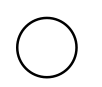
Scalar
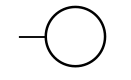
Vector
Matrix
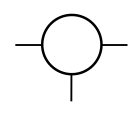
Rank-3 tensor
Tensor notation: R. Penrose, in Combinatorial Mathematics and its applications, (1971)
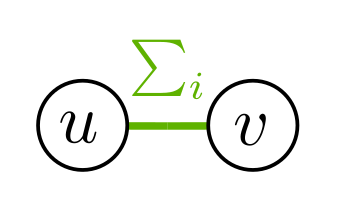
Scalar product
Matrix-vector product
CONTRACTION
Only 2 legs can meet!
11
COLBOIS|TNS FOR CLASSICAL SPIN SYSTEMS | 11.2025
Scalar
Vector
Matrix
Rank-3 tensor
Tensor notation: R. Penrose, in Combinatorial Mathematics and its applications, (1971)
11
Scalar product
Matrix-vector product
CONTRACTION
Only 2 legs can meet!
COLBOIS|TNS FOR CLASSICAL SPIN SYSTEMS | 11.2025
Scalar
Vector
Matrix
Rank-3 tensor
Tensor notation: R. Penrose, in Combinatorial Mathematics and its applications, (1971)
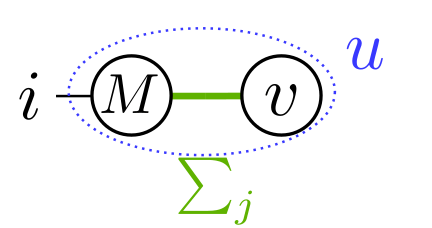
\(M\)
\(U\)
\(S\)
\(V\)
\(=\)
11
Scalar product
Matrix-vector product
CONTRACTION
Only 2 legs can meet!
COLBOIS|TNS FOR CLASSICAL SPIN SYSTEMS | 11.2025
Scalar
Vector
Matrix
Rank-3 tensor
Tensor notation: R. Penrose, in Combinatorial Mathematics and its applications, (1971)
\(M\)
\(U\)
\(S\)
\(V\)
\(=\)
11
Scalar product
Matrix-vector product
CONTRACTION
Only 2 legs can meet!
11
COLBOIS|TNS FOR CLASSICAL SPIN SYSTEMS | 11.2025
Scalar
Vector
Matrix
Rank-3 tensor
Tensor notation: R. Penrose, in Combinatorial Mathematics and its applications, (1971)
\(M\)
\(U\)
\(S\)
\(V\)
\(=\)
Scalar product
Matrix-vector product
CONTRACTION
Only 2 legs can meet!
11
COLBOIS|TNS FOR CLASSICAL SPIN SYSTEMS | 11.2025
Scalar
Vector
Matrix
Rank-3 tensor
Tensor notation: R. Penrose, in Combinatorial Mathematics and its applications, (1971)
\(M\)
\(U\)
\(S\)
\(V\)
\(=\)
Text
Scalar product
Matrix-vector product
CONTRACTION
Only 2 legs can meet!
12
COLBOIS|TNS FOR CLASSICAL SPIN SYSTEMS | 11.2025
Yuriel's talk
(mostly 1D quantum)
This talk
(mostly 2D classical)
12
COLBOIS|TNS FOR CLASSICAL SPIN SYSTEMS | 11.2025
Given:
a complicated function
Yuriel's talk
(mostly 1D quantum)
This talk
(mostly 2D classical)
12
COLBOIS|TNS FOR CLASSICAL SPIN SYSTEMS | 11.2025
Given:
a complicated function
Question:
approximate it as a tensor network?
Yuriel's talk
(mostly 1D quantum)
This talk
(mostly 2D classical)
12
COLBOIS|TNS FOR CLASSICAL SPIN SYSTEMS | 11.2025
Given:
a complicated function
OR
Given:
a Hamiltonian
Question:
approximate it as a tensor network?
Yuriel's talk
(mostly 1D quantum)
This talk
(mostly 2D classical)
12
COLBOIS|TNS FOR CLASSICAL SPIN SYSTEMS | 11.2025
Yuriel's talk
(mostly 1D quantum)
This talk
(mostly 2D classical)
Given:
a complicated function
OR
Given:
a Hamiltonian
Question:
approximate its ground-state wavefunction as a tensor network?
Question:
approximate it as a tensor network?
12
COLBOIS|TNS FOR CLASSICAL SPIN SYSTEMS | 11.2025
Given:
a complicated function
OR
Given:
a Hamiltonian
Question:
approximate its ground-state wavefunction as a tensor network?
Given:
a partition function
exact tensor network
Question:
approximate it as a tensor network?
Yuriel's talk
(mostly 1D quantum)
This talk
(mostly 2D classical)
12
COLBOIS|TNS FOR CLASSICAL SPIN SYSTEMS | 11.2025
Given:
a complicated function
OR
Given:
a Hamiltonian
Question:
Can you evaluate it?
Given:
a partition function
exact tensor network
Question:
approximate its ground-state wavefunction as a tensor network?
Question:
approximate it as a tensor network?
Yuriel's talk
(mostly 1D quantum)
This talk
(mostly 2D classical)
COLBOIS|TNS FOR CLASSICAL SPIN SYSTEMS | 11.2025
13
COLBOIS|TNS FOR CLASSICAL SPIN SYSTEMS | 11.2025
13
Ising (1924)
COLBOIS|TNS FOR CLASSICAL SPIN SYSTEMS | 11.2025
13
Ising (1924)
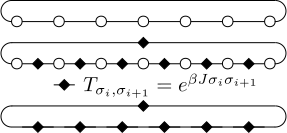
The partition function is just the exponentiation of a 2x2 matrix!
COLBOIS|TNS FOR CLASSICAL SPIN SYSTEMS | 11.2025
13
Ising (1924)
The partition function is just the exponentiation of a 2x2 matrix!
1. Diagonalize
COLBOIS|TNS FOR CLASSICAL SPIN SYSTEMS | 11.2025
13
Ising (1924)
The partition function is just the exponentiation of a 2x2 matrix!
1. Diagonalize
2. Compute
Leading eigenvalue!
13
COLBOIS|TNS FOR CLASSICAL SPIN SYSTEMS | 11.2025
Ising (1924)
COLBOIS|TNS FOR CLASSICAL SPIN SYSTEMS | 11.2025
14
COLBOIS|TNS FOR CLASSICAL SPIN SYSTEMS | 11.2025
14
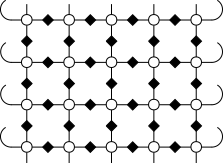
2D Ising model
2D Ising model
COLBOIS|TNS FOR CLASSICAL SPIN SYSTEMS | 11.2025
14
2D Ising model
COLBOIS|TNS FOR CLASSICAL SPIN SYSTEMS | 11.2025
14
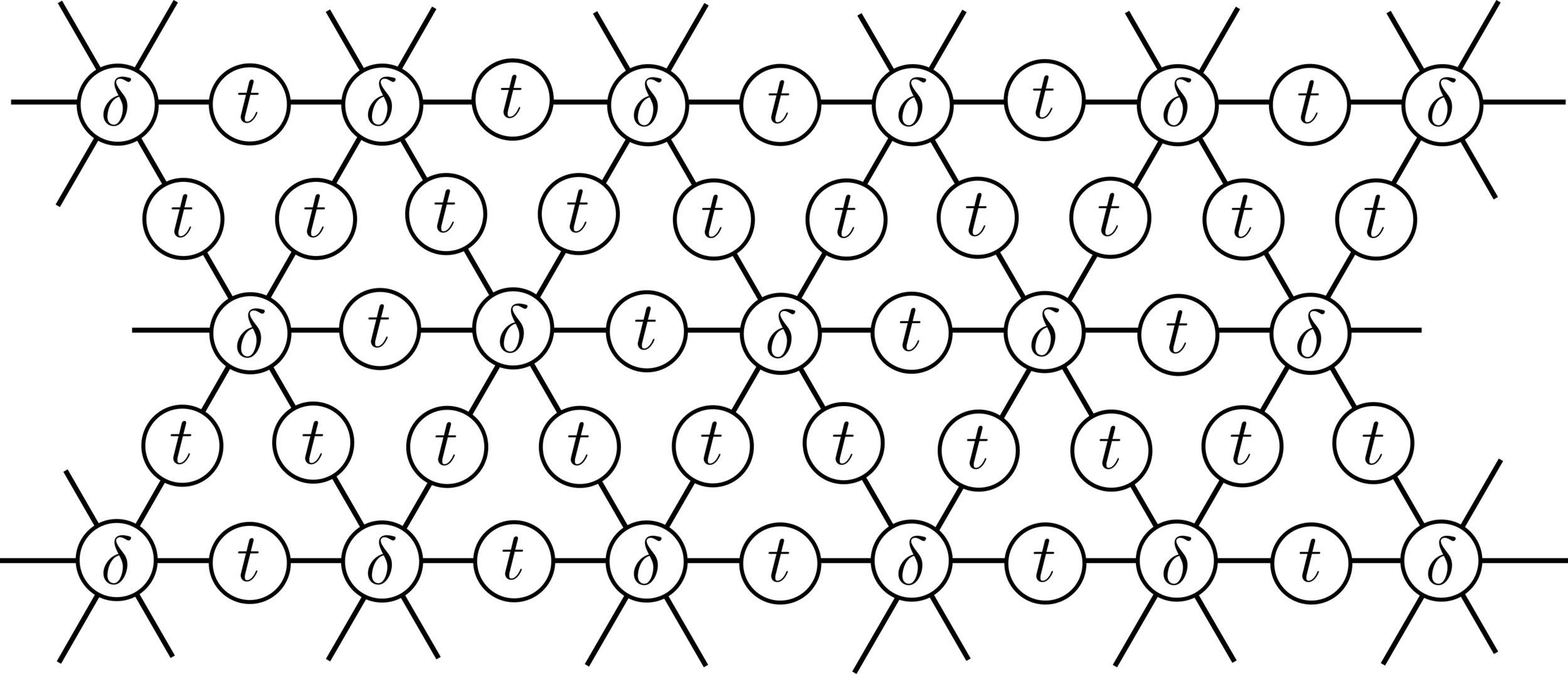
Generalized kronecker \(\delta\) tensor
Generalized kronecker \(\delta\) tensor
2D Ising model
COLBOIS|TNS FOR CLASSICAL SPIN SYSTEMS | 11.2025
14
Dimer counting
# of ways to put dimers on the edges of a square lattice?
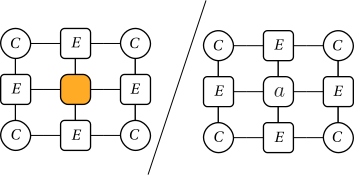
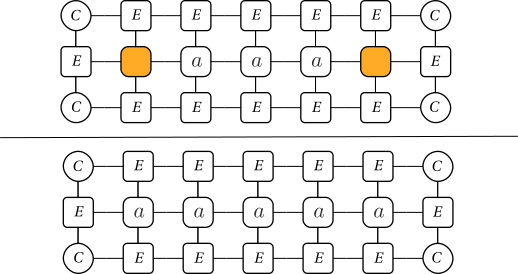
Baxter 1968 : First "tensor network" equations to solve this problem.
Generalized kronecker \(\delta\) tensor
2D Ising model
COLBOIS|TNS FOR CLASSICAL SPIN SYSTEMS | 11.2025
14
Dimer counting
# of ways to put dimers on the edges of a square lattice?
Baxter 1968 : First "tensor network" equations to solve this problem.
\(\Omega \approx 1,3385^ N\)
Generalized kronecker \(\delta\) tensor
2D Ising model
COLBOIS|TNS FOR CLASSICAL SPIN SYSTEMS | 11.2025
14
Dimer counting
# of ways to put dimers on the edges of a square lattice?
\(2 \times 2 \times 2 \times 2\)
Baxter 1968 : First "tensor network" equations to solve this problem.
\(\Omega \approx 1,3385^ N\)
Generalized kronecker \(\delta\) tensor
2D Ising model
COLBOIS|TNS FOR CLASSICAL SPIN SYSTEMS | 11.2025
14
Dimer counting
\(\Omega \approx 1,3385^ N\)
# of ways to put dimers on the edges of a square lattice?
\(2 \times 2 \times 2 \times 2\)
=
= ... = 1
=
= ... = 0
Baxter 1968 : First "tensor network" equations to solve this problem.
COLBOIS|TNS FOR CLASSICAL SPIN SYSTEMS | 11.2025
Given by the Hamiltonian
15
1. Boundary-MPS methods
Baxter, 1968; Orús, Vidal, 2008; Zauner-Stauber et. al. 2018; Fishman et. al 2018
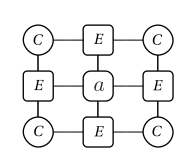
2. Corner transfer matrix renormalization group
3. Tensor network renormalization
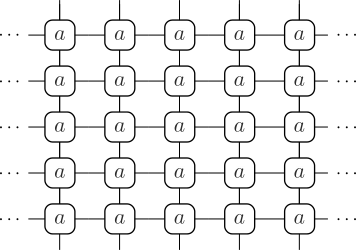
2d classical is like 1d quantum
Approximate the infinite environment
Real-space renormalization
COLBOIS|TNS FOR CLASSICAL SPIN SYSTEMS | 11.2025
Given by the Hamiltonian
R. J. Baxter, J. Math. Phys. 9, 1968;
T. Nishino, K. Okunishi, J. Phys. Soc. Jpn 65, 1996
Levin & Nave, 2007; Gu & Wen (2009); Evenbly & Vidal (2014); Ebel, Kennedy, Rychkov (2025)....
15
1. Boundary-MPS methods
Baxter, 1968; Orús, Vidal, 2008; Zauner-Stauber et. al. 2018; Fishman et. al 2018
2. Corner transfer matrix renormalization group
3. Tensor network renormalization
2d classical is like 1d quantum
Approximate the infinite environment
Real-space renormalization
COLBOIS|TNS FOR CLASSICAL SPIN SYSTEMS | 11.2025
Given by the Hamiltonian
R. J. Baxter, J. Math. Phys. 9, 1968;
T. Nishino, K. Okunishi, J. Phys. Soc. Jpn 65, 1996
Levin & Nave, 2007; Gu & Wen (2009); Evenbly & Vidal (2014); Ebel, Kennedy, Rychkov (2025)....
15
COLBOIS|TNS FOR CLASSICAL SPIN SYSTEMS | 11.2025
16
Baxter, 1968; Orús, Vidal, 2008; Zauner-Stauber et. al. 2018; Fishman et. al 2018
COLBOIS|TNS FOR CLASSICAL SPIN SYSTEMS | 11.2025
16
Baxter, 1968; Orús, Vidal, 2008; Zauner-Stauber et. al. 2018; Fishman et. al 2018
Baxter, 1968; Orús, Vidal, 2008; Zauner-Stauber et. al. 2018; Fishman et. al 2018
COLBOIS|TNS FOR CLASSICAL SPIN SYSTEMS | 11.2025
16
Baxter, 1968; Orús, Vidal, 2008; Zauner-Stauber et. al. 2018; Fishman et. al 2018
COLBOIS|TNS FOR CLASSICAL SPIN SYSTEMS | 11.2025
16
Free energy per site
COLBOIS|TNS FOR CLASSICAL SPIN SYSTEMS | 11.2025
R. J. Baxter, J. Math. Phys. 9, 1968
T. Nishino, K. Okunishi, J. Phys. Soc. Jpn 65, 1996
Fishman et al. PRB 98, 2018
Corboz et al (2014)
17
COLBOIS|TNS FOR CLASSICAL SPIN SYSTEMS | 11.2025
Approximate the infinite-size environment with a few tensors of finite bond dimension
17
R. J. Baxter, J. Math. Phys. 9, 1968
T. Nishino, K. Okunishi, J. Phys. Soc. Jpn 65, 1996
Fishman et al. PRB 98, 2018
Corboz et al (2014)
COLBOIS|TNS FOR CLASSICAL SPIN SYSTEMS | 11.2025
Approximate the infinite-size environment with a few tensors of finite bond dimension
17
R. J. Baxter, J. Math. Phys. 9, 1968
T. Nishino, K. Okunishi, J. Phys. Soc. Jpn 65, 1996
Fishman et al. PRB 98, 2018
Corboz et al (2014)
COLBOIS|TNS FOR CLASSICAL SPIN SYSTEMS | 11.2025
Approximate the infinite-size environment with a few tensors of finite bond dimension
17
R. J. Baxter, J. Math. Phys. 9, 1968
T. Nishino, K. Okunishi, J. Phys. Soc. Jpn 65, 1996
Fishman et al. PRB 98, 2018
Corboz et al (2014)
COLBOIS|TNS FOR CLASSICAL SPIN SYSTEMS | 11.2025
Approximate the infinite-size environment with a few tensors of finite bond dimension
Building block for quantum problems : algorithms are already optimized
17
R. J. Baxter, J. Math. Phys. 9, 1968
T. Nishino, K. Okunishi, J. Phys. Soc. Jpn 65, 1996
Fishman et al. PRB 98, 2018
Corboz et al (2014)
18
COLBOIS|TNS FOR CLASSICAL SPIN SYSTEMS | 11.2025
18
\(\langle O \rangle= \frac{1}{\mathcal{Z}} \sum_{\vec{\sigma}} O(\mathrm{\vec{\sigma}}) e^{-\beta H}\) =
1. Local observable:
COLBOIS|TNS FOR CLASSICAL SPIN SYSTEMS | 11.2025
18
\(\langle O \rangle= \frac{1}{\mathcal{Z}} \sum_{\vec{\sigma}} O(\mathrm{\vec{\sigma}}) e^{-\beta H}\) =
1. Local observable:
2. Correlation function
\(\langle O_i O_j \rangle =\)
COLBOIS|TNS FOR CLASSICAL SPIN SYSTEMS | 11.2025
18
\(\langle O \rangle= \frac{1}{\mathcal{Z}} \sum_{\vec{\sigma}} O(\mathrm{\vec{\sigma}}) e^{-\beta H}\) =
1. Local observable:
2. Correlation function
Correlation length:
\(\langle O_i O_j \rangle =\)
COLBOIS|TNS FOR CLASSICAL SPIN SYSTEMS | 11.2025
19
COLBOIS|TNS FOR CLASSICAL SPIN SYSTEMS | 11.2025
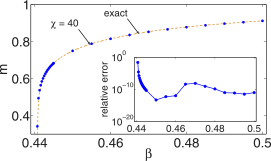
Orús, Vidal, PRB 78, 2008
19
COLBOIS|TNS FOR CLASSICAL SPIN SYSTEMS | 11.2025
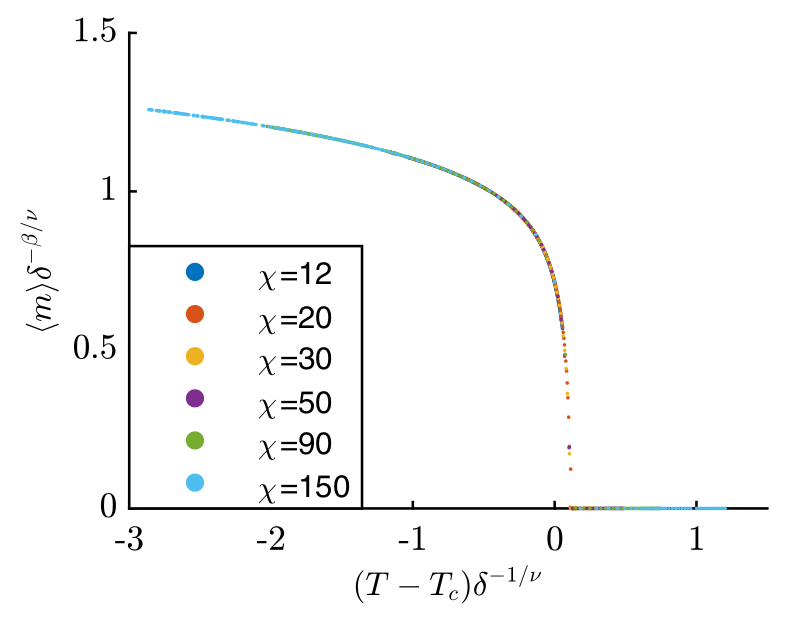
Critical point
\(\rightarrow\) finite-bond dimension scaling
\(T \in [2.2666, 2.2698]\)
Orús, Vidal, PRB 78, 2008
Vanhecke et al. PRL (2019)
COLBOIS|TNS FOR CLASSICAL SPIN SYSTEMS | 11.2025
Partition functions of short-range models as exact, infinite-size tensor networks
Capture correlation functions, critical exponents, etc.
Nyckees, JC, Mila, NPB (2021)
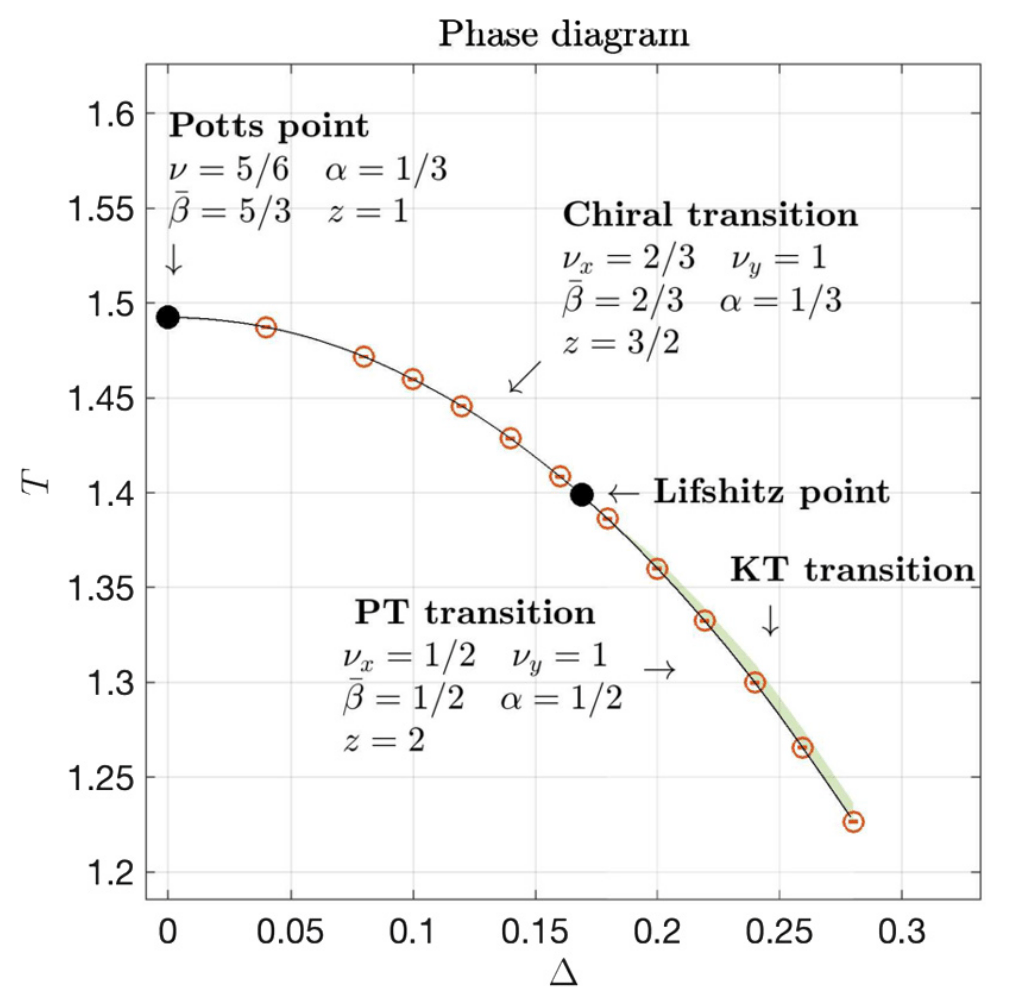
2D chiral Potts model
Ground-state local rules
Example of results
Vanhecke, JC et al (2021)
20
COLBOIS|TNS FOR CLASSICAL SPIN SYSTEMS | 11.2025
Vanhecke, JC et al (2021)
20
COLBOIS|TNS FOR CLASSICAL SPIN SYSTEMS | 11.2025
Vanhecke, JC et al (2021)
20
COLBOIS|TNS FOR CLASSICAL SPIN SYSTEMS | 11.2025
Vanhecke, JC et al (2021)
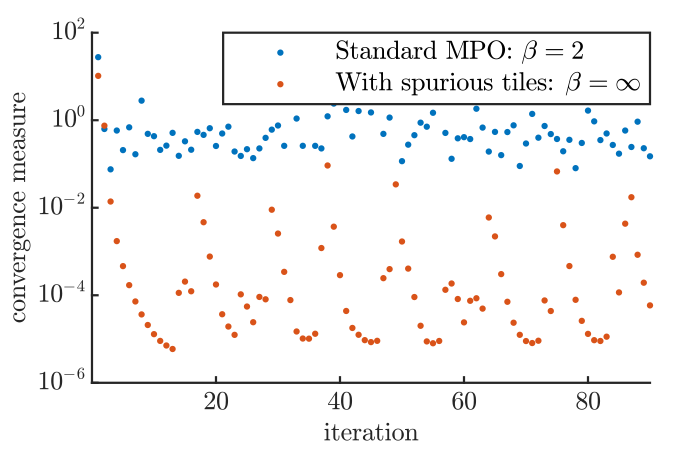
Numerical problem
Cancellation of small and large factors
C. Wang, S.-M. Qin, H.-J. Zhou, PRB 90, (2014)
Z. Zhu, H. G. Katzgraber, arXiv:1903.07721 (2019)
J. G. Liu, L. Wang, P. Zhan, PRL 126, (2021)
20
COLBOIS|TNS FOR CLASSICAL SPIN SYSTEMS | 11.2025
Vanhecke, JC et al (2021)
Numerical problem
Cancellation of small and large factors
Bad gauge
The transfer matrix is badly conditioned
(e.g. not hermitian, ...)
C. Wang, S.-M. Qin, H.-J. Zhou, PRB 90, (2014)
Z. Zhu, H. G. Katzgraber, arXiv:1903.07721 (2019)
J. G. Liu, L. Wang, P. Zhan, PRL 126, (2021)
W. Tang et al, (2024, 2025)
20
COLBOIS|TNS FOR CLASSICAL SPIN SYSTEMS | 11.2025
Vanhecke, JC et al (2021)
Numerical problem
Ground-state rule
Cancellation of small and large factors
Failure to minimize simultaneously all local Hamiltonians.
Bad gauge
The transfer matrix is badly conditioned
(e.g. not hermitian, ...)
C. Wang, S.-M. Qin, H.-J. Zhou, PRB 90, (2014)
Z. Zhu, H. G. Katzgraber, arXiv:1903.07721 (2019)
J. G. Liu, L. Wang, P. Zhan, PRL 126, (2021)
W. Tang et al, (2024, 2025)
B. Vanhecke, JC, et al. PRR 3, (2021)
F.F. Song, T.-Y. Lin, G. M. Zhang, PRB (2023)
20
COLBOIS|TNS FOR CLASSICAL SPIN SYSTEMS | 11.2025
Ground state:
Kasteleyn, (1961), Fisher (1966)
21
COLBOIS|TNS FOR CLASSICAL SPIN SYSTEMS | 11.2025
Ground state:
Dimer coverings!
Kasteleyn, (1961), Fisher (1966)
COLBOIS|TNS FOR CLASSICAL SPIN SYSTEMS | 11.2025
21
Ground state:
Dimer coverings!
\(2 \times 2 \times 2\)
\(=0\)
Kasteleyn, (1961), Fisher (1966)
COLBOIS|TNS FOR CLASSICAL SPIN SYSTEMS | 11.2025
21
Ground state:
Dimer coverings!
\(2 \times 2 \times 2\)
\(=0\)
Kasteleyn, (1961), Fisher (1966)
Vanhecke, JC et al (2021)
COLBOIS|TNS FOR CLASSICAL SPIN SYSTEMS | 11.2025
21
Ground state:
Kasteleyn, (1961), Fisher (1966)
Dimer coverings!
\(2 \times 2 \times 2\)
\(=0\)
Vanhecke, JC et al (2021)
COLBOIS|TNS FOR CLASSICAL SPIN SYSTEMS | 11.2025
21
22
Vanhecke, JC et al (2021)
COLBOIS|TNS FOR CLASSICAL SPIN SYSTEMS | 11.2025
22
Vanhecke, JC et al (2021)
COLBOIS|TNS FOR CLASSICAL SPIN SYSTEMS | 11.2025
\(2 \times 2 \times 2\)
\(=e^{-\beta J}\)
Same structure and size
Different entries
Vanhecke, JC et al (2021)
22
COLBOIS|TNS FOR CLASSICAL SPIN SYSTEMS | 11.2025
\(2 \times 2 \times 2\)
Vanhecke, JC et al (2021)
22
COLBOIS|TNS FOR CLASSICAL SPIN SYSTEMS | 11.2025
\(2 \times 2 \times 2\)
\(=e^{-\beta J}\)
Same structure and size
Different entries
23
COLBOIS|TNS FOR CLASSICAL SPIN SYSTEMS | 11.2025
23
COLBOIS|TNS FOR CLASSICAL SPIN SYSTEMS | 11.2025
Systematic linear program
Finite-range models
Exact ground state energy
Vanhecke, JC et al (2021)
JC et al (2022)
C. K. Majumdar and D. K. Ghosh, J. Math. Phys. 10, (1969); M. Kaburagi, J. Kanamori, Prog. Theor. Phys. 54 , (1975);
B. Sriram Shastry and B. Sutherland, Physica 108 B+C, (1981); W. Huang, D. A. Kitchaev, et. al. , Phys. Rev. B 94, (2016);
B. Vanhecke, JC, L. Vanderstraeten, F. Verstraete, F. Mila, PRR 3, (2021)
Nagy et al; PRE 109 (2024)
24
COLBOIS|TNS FOR CLASSICAL SPIN SYSTEMS | 11.2025
I. A. Chioar, N. Rougemaille, B. Canals, PRB 93, (2016)
J. Hamp, C. Castelnovo, R. Moessner, PRB 98, (2018)
24
COLBOIS|TNS FOR CLASSICAL SPIN SYSTEMS | 11.2025
I. A. Chioar, N. Rougemaille, B. Canals, PRB 93, (2016)
J. Hamp, C. Castelnovo, R. Moessner, PRB 98, (2018)
24
COLBOIS|TNS FOR CLASSICAL SPIN SYSTEMS | 11.2025
JC et. al., PRB 106 (2022)
I. A. Chioar, N. Rougemaille, B. Canals, PRB 93, (2016)
J. Hamp, C. Castelnovo, R. Moessner, PRB 98, (2018)
JC et. al., PRB 106 (2022)
Exact ground-state energy
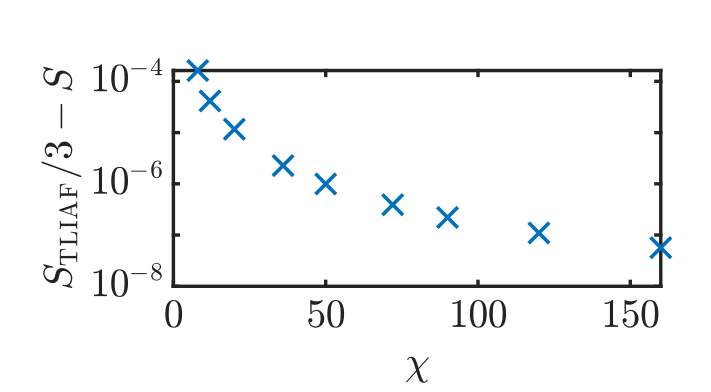
\(10^{-5}\) precision on the entropy
24
COLBOIS|TNS FOR CLASSICAL SPIN SYSTEMS | 11.2025
I. A. Chioar, N. Rougemaille, B. Canals, PRB 93, (2016)
J. Hamp, C. Castelnovo, R. Moessner, PRB 98, (2018)
JC et. al., PRB 106 (2022)
Exact ground-state energy
\(10^{-5}\) precision on the entropy
24
COLBOIS|TNS FOR CLASSICAL SPIN SYSTEMS | 11.2025
25
A. Rufino, S. Nyckees, JC, F. Mila, arXiv:2505.05889 (2025)
COLBOIS|TNS FOR CLASSICAL SPIN SYSTEMS | 11.2025
25
A. Rufino, S. Nyckees, JC, F. Mila, arXiv:2505.05889 (2025)
COLBOIS|TNS FOR CLASSICAL SPIN SYSTEMS | 11.2025
25
A. Rufino, S. Nyckees, JC, F. Mila, arXiv:2505.05889 (2025)
COLBOIS|TNS FOR CLASSICAL SPIN SYSTEMS | 11.2025
25
A. Rufino, S. Nyckees, JC, F. Mila, arXiv:2505.05889 (2025)
COLBOIS|TNS FOR CLASSICAL SPIN SYSTEMS | 11.2025
25
A. Rufino, S. Nyckees, JC, F. Mila, arXiv:2505.05889 (2025)
COLBOIS|TNS FOR CLASSICAL SPIN SYSTEMS | 11.2025
Sampling in real space
25
A. Rufino, S. Nyckees, JC, F. Mila, arXiv:2505.05889 (2025)
COLBOIS|TNS FOR CLASSICAL SPIN SYSTEMS | 11.2025
Sampling in real space
Correlation functions
25
A. Rufino, S. Nyckees, JC, F. Mila, arXiv:2505.05889 (2025)
COLBOIS|TNS FOR CLASSICAL SPIN SYSTEMS | 11.2025
Sampling in real space
Correlation functions
An infinite series of phases not fixed by commensurability
Plateaus in the ratios of densities of 2 types of system-spanning strings
2D systems & 3D systems
Promising directions
26
COLBOIS|TNS FOR CLASSICAL SPIN SYSTEMS | 11.2025
2D
26
COLBOIS|TNS FOR CLASSICAL SPIN SYSTEMS | 11.2025
Ising
XY
Heisenberg
NN
NN frustrated
Farther Neighbours
Farther-N. frustrated
Vanhecke et al.
Colbois et al.
Vanderstraeten et al.
Song et al.
Ueda et al.
Schmoll et al.
Ueda et al.
2D
26
COLBOIS|TNS FOR CLASSICAL SPIN SYSTEMS | 11.2025
Ising
XY
Heisenberg
NN
NN frustrated
Farther Neighbours
Farther-N. frustrated
Vanhecke et al.
Colbois et al.
Vanderstraeten et al.
Song et al.
Ueda et al.
Schmoll et al.
Ueda et al.
2D
26
COLBOIS|TNS FOR CLASSICAL SPIN SYSTEMS | 11.2025
Ising
XY
Heisenberg
NN
NN frustrated
Farther Neighbours
Farther-N. frustrated
?
?
Vanhecke et al.
Colbois et al.
Vanderstraeten et al.
Song et al.
Ueda et al.
Schmoll et al.
Ueda et al.
2D
26
COLBOIS|TNS FOR CLASSICAL SPIN SYSTEMS | 11.2025
Ising
XY
Heisenberg
NN
NN frustrated
Farther Neighbours
Farther-N. frustrated
?
?
Vanhecke et al.
Colbois et al.
Vanderstraeten et al.
Song et al.
Ueda et al.
Schmoll et al.
Ueda et al.
2D
1. Large system limits for disordered systems
2. Long-range interactions
3. Dealing with non-local constraints
Wishlist
Liu et al. (2021)
1D: Nunez-Fernandez et al. (2025)
26
COLBOIS|TNS FOR CLASSICAL SPIN SYSTEMS | 11.2025
SOTA : 3D Ising, 3D Ice : bond dimension 2
Ising
XY
Heisenberg
NN
NN frustrated
Farther Neighbours
1. Large system limits for disordered systems
2. Long-range interactions
Farther-N. frustrated
3. Dealing with non-local constraints
?
?
Vanhecke et al.
Colbois et al.
Vanderstraeten et al.
Song et al.
Ueda et al.
Schmoll et al.
Wishlist
Liu et al. (2021)
1D: Nunez-Fernandez et al. (2025)
Ueda et al.
2D
3D
COLBOIS|TNS FOR CLASSICAL SPIN SYSTEMS | 11.2025
27
Conformal field theory
Renormalization group
Contracting 2D and 3D tensor networks
COLBOIS|TNS FOR CLASSICAL SPIN SYSTEMS | 11.2025
Properties of the fixed-point tensor / RG
Grasping 3D CFTs using original regularization of the sphere
27
Läuchli et al (2025), Rey et al (2025)
Ueda et al. (2023), Kennedy & Rychkov (2024), Ebel et al (2024,2025)
Conformal field theory
Renormalization group
Contracting 2D and 3D tensor networks
COLBOIS|TNS FOR CLASSICAL SPIN SYSTEMS | 11.2025
Properties of the fixed-point tensor / RG
Grasping 3D CFTs using original regularization of the sphere
Taking advantage of lattice symmetries
27
Läuchli et al (2025), Rey et al (2025)
Lukin et al (2023), Nyckees et al (JC) (2023),
Yang & Corboz (2025), Naumann et al (2025)
Ueda et al. (2023), Kennedy & Rychkov (2024), Ebel et al (2024,2025)
Conformal field theory
Renormalization group
Contracting 2D and 3D tensor networks
COLBOIS|TNS FOR CLASSICAL SPIN SYSTEMS | 11.2025
Properties of the fixed-point tensor / RG
Contraction in 3D:
1. Advanced CTMRG and tensor-RG schemes
2. taking advantage of the normality of the transfer operator
Grasping 3D CFTs using original regularization of the sphere
Taking advantage of lattice symmetries
27
Läuchli et al (2025), Rey et al (2025)
Lukin et al (2023), Nyckees et al (JC) (2023),
Yang & Corboz (2025), Naumann et al (2025)
Ueda et al. (2023), Kennedy & Rychkov (2024), Ebel et al (2024,2025)
Nishino et al (2000), [many more],
Vanderstraeten et al (2018),
Ebel (2025), Xu,Lin,Zhang(2025), Tang et al (2025)
Conformal field theory
Renormalization group
Contracting 2D and 3D tensor networks
COLBOIS|TNS FOR CLASSICAL SPIN SYSTEMS | 11.2025
Properties of the fixed-point tensor / RG
Combining with classical Monte Carlo
Contraction in 3D:
1. Advanced CTMRG and tensor-RG schemes
2. taking advantage of the normality of the transfer operator
Frias-Perez et al (2023)
Nishino et al (2000), [many more],
Vanderstraeten et al (2018),
Ebel (2025), Xu,Lin,Zhang(2025), Tang et al (2025)
Grasping 3D CFTs using original regularization of the sphere
Läuchli et al (2025), Rey et al (2025)
Taking advantage of lattice symmetries
Lukin et al (2023), Nyckees et al (JC) (2023),
Yang & Corboz (2025), Naumann et al (2025)
27
Ueda et al. (2023), Kennedy & Rychkov (2024), Ebel et al (2024,2025)
Conformal field theory
Renormalization group
Contracting 2D and 3D tensor networks
COLBOIS|TNS FOR CLASSICAL SPIN SYSTEMS | 11.2025
Tensor networks:
a way to capture complex behavior in statistical mechanics
COLBOIS|TNS FOR CLASSICAL SPIN SYSTEMS | 11.2025
Tensor networks:
a way to capture complex behavior in statistical mechanics
COLBOIS|TNS FOR CLASSICAL SPIN SYSTEMS | 11.2025
Constrained models shine light
on tensor network methods
Tensor networks:
a way to capture complex behavior in statistical mechanics
COLBOIS|TNS FOR CLASSICAL SPIN SYSTEMS | 11.2025
P.S. I also work on quantum many-body disordered systems -
come talk if you are curious!
Constrained models shine light
on tensor network methods
C. K. Majumdar and D. K. Ghosh, J. Math. Phys. 10, (1969); M. Kaburagi, J. Kanamori, Prog. Theor. Phys. 54 , (1975);
B. Sriram Shastry and B. Sutherland, Physica 108 B+C, (1981); W. Huang, D. A. Kitchaev, et. al. , Phys. Rev. B 94, (2016);
B. Vanhecke, JC, L. Vanderstraeten, F. Verstraete, F. Mila, PRR 3, (2021)
Nagy et al; PRE 109 (2024)
Essential idea : Anderson bounds
C. K. Majumdar and D. K. Ghosh, J. Math. Phys. 10, (1969); M. Kaburagi, J. Kanamori, Prog. Theor. Phys. 54 , (1975);
B. Sriram Shastry and B. Sutherland, Physica 108 B+C, (1981); W. Huang, D. A. Kitchaev, et. al. , Phys. Rev. B 94, (2016);
B. Vanhecke, JC, L. Vanderstraeten, F. Verstraete, F. Mila, PRR 3, (2021)
Nagy et al; PRE 109 (2024)
Essential idea : Anderson bounds
LINEAR PROGRAM:
C. K. Majumdar and D. K. Ghosh, J. Math. Phys. 10, (1969); M. Kaburagi, J. Kanamori, Prog. Theor. Phys. 54 , (1975);
B. Sriram Shastry and B. Sutherland, Physica 108 B+C, (1981); W. Huang, D. A. Kitchaev, et. al. , Phys. Rev. B 94, (2016);
B. Vanhecke, JC, L. Vanderstraeten, F. Verstraete, F. Mila, PRR 3, (2021)
Nagy et al; PRE 109 (2024)
Essential idea : Anderson bounds
LINEAR PROGRAM:
1. Split with clusters that overlap
C. K. Majumdar and D. K. Ghosh, J. Math. Phys. 10, (1969); M. Kaburagi, J. Kanamori, Prog. Theor. Phys. 54 , (1975);
B. Sriram Shastry and B. Sutherland, Physica 108 B+C, (1981); W. Huang, D. A. Kitchaev, et. al. , Phys. Rev. B 94, (2016);
B. Vanhecke, JC, L. Vanderstraeten, F. Verstraete, F. Mila, PRR 3, (2021)
Nagy et al; PRE 109 (2024)
Essential idea : Anderson bounds
LINEAR PROGRAM:
1. Split with clusters that overlap
2. Minimize : G.S. lower-bound
C. K. Majumdar and D. K. Ghosh, J. Math. Phys. 10, (1969); M. Kaburagi, J. Kanamori, Prog. Theor. Phys. 54 , (1975);
B. Sriram Shastry and B. Sutherland, Physica 108 B+C, (1981); W. Huang, D. A. Kitchaev, et. al. , Phys. Rev. B 94, (2016);
B. Vanhecke, JC, L. Vanderstraeten, F. Verstraete, F. Mila, PRR 3, (2021)
Nagy et al; PRE 109 (2024)
Essential idea : Anderson bounds
LINEAR PROGRAM:
3. Maximize w.r.t the weights:
1. Split with clusters that overlap
2. Minimize : G.S. lower-bound
C. K. Majumdar and D. K. Ghosh, J. Math. Phys. 10, (1969); M. Kaburagi, J. Kanamori, Prog. Theor. Phys. 54 , (1975);
B. Sriram Shastry and B. Sutherland, Physica 108 B+C, (1981); W. Huang, D. A. Kitchaev, et. al. , Phys. Rev. B 94, (2016);
B. Vanhecke, JC, L. Vanderstraeten, F. Verstraete, F. Mila, PRR 3, (2021)
Nagy et al; PRE 109 (2024)
Essential idea : Anderson bounds
LINEAR PROGRAM:
3. Maximize w.r.t the weights:
1. Split with clusters that overlap
2. Minimize : G.S. lower-bound
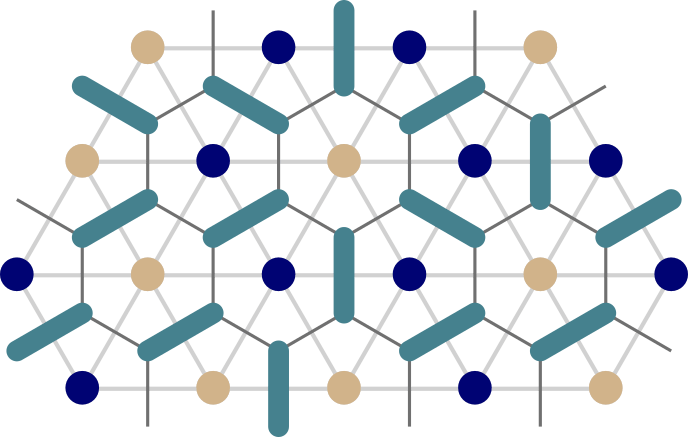
Obtain the ground states by tiling
C. K. Majumdar and D. K. Ghosh, J. Math. Phys. 10, (1969); M. Kaburagi, J. Kanamori, Prog. Theor. Phys. 54 , (1975);
B. Sriram Shastry and B. Sutherland, Physica 108 B+C, (1981); W. Huang, D. A. Kitchaev, et. al. , Phys. Rev. B 94, (2016);
B. Vanhecke, JC, L. Vanderstraeten, F. Verstraete, F. Mila, PRR 3, (2021)
Nagy et al; PRE 109 (2024)
Wikipedia, CC BY license
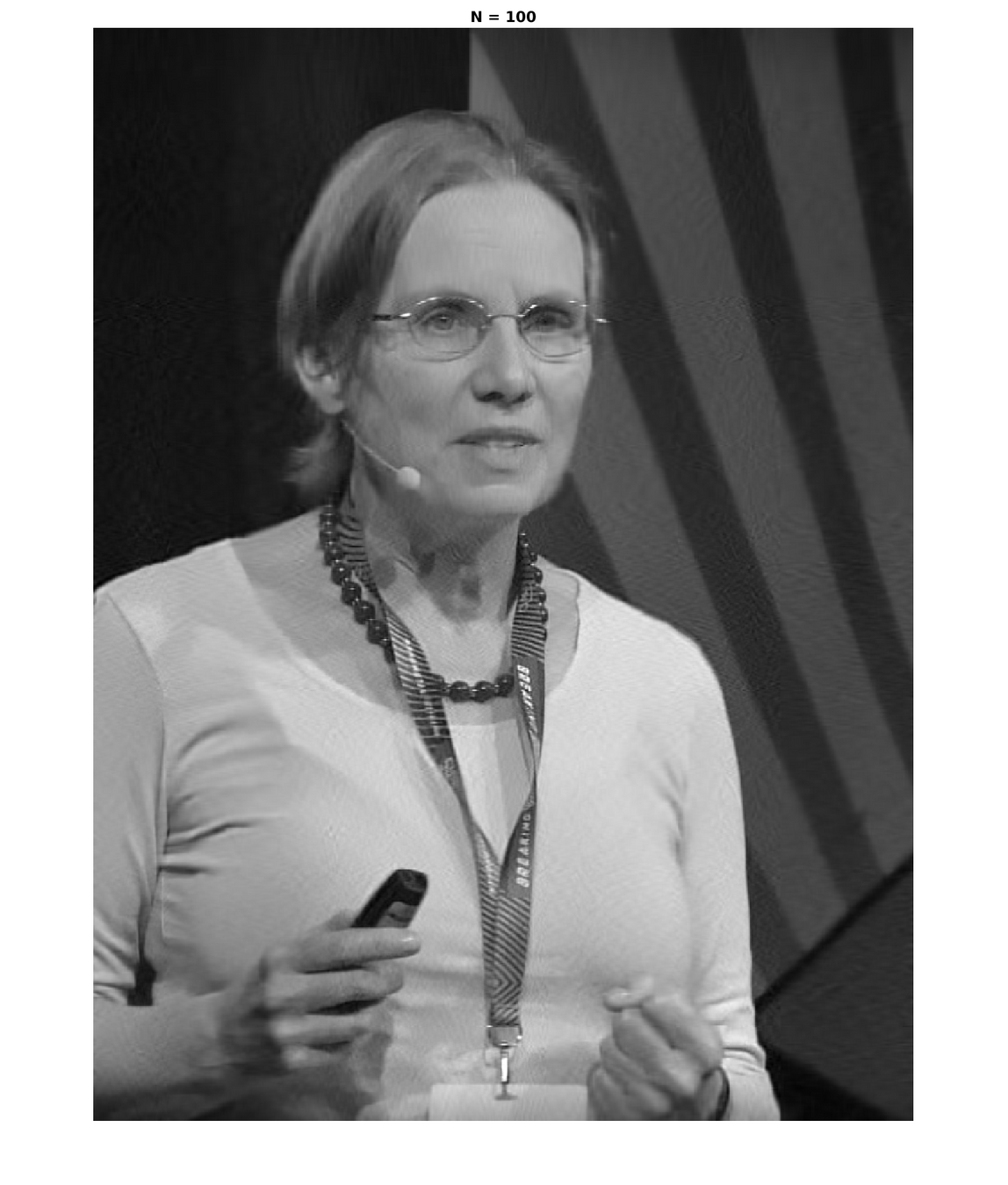
Julia Yeomans
\(M\)
\(U\)
\(S\)
\(V\)
\(=\)
Wikipedia, CC BY license
\(M\)
\(U\)
\(S\)
\(V\)
\(=\)
Wikipedia, CC BY license
\(M\)
\(U\)
\(S\)
\(V\)
\(=\)
Wikipedia, CC BY license
\(M\)
\(U\)
\(S\)
\(V\)
\(=\)
Wikipedia, CC BY license
\(M\)
\(U\)
\(S\)
\(V\)
\(=\)
Wikipedia, CC BY license
\(M\)
\(U\)
\(S\)
\(V\)
\(=\)
Wikipedia, CC BY license
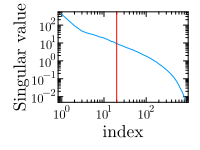
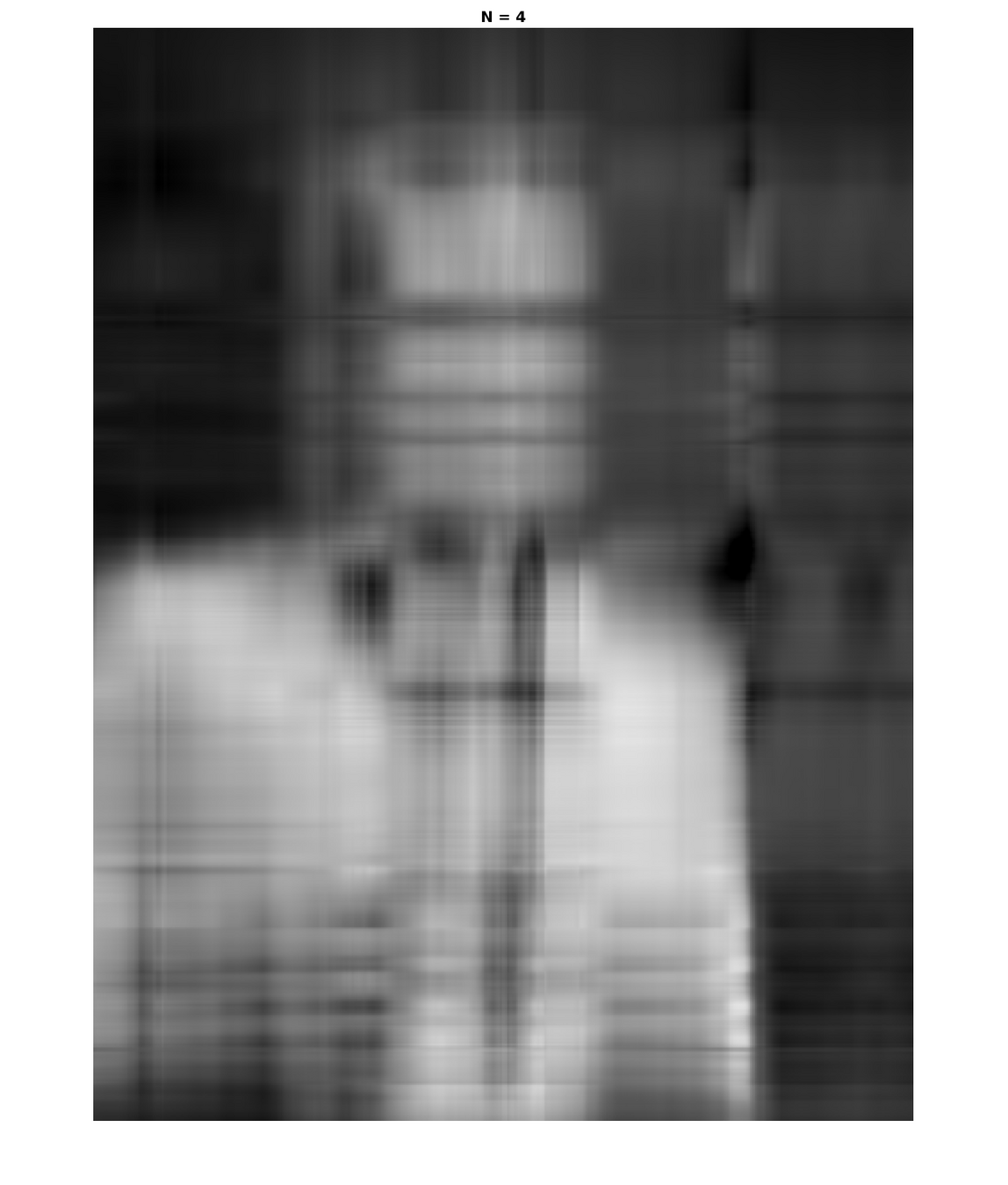
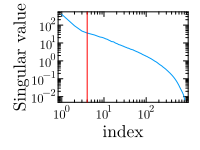
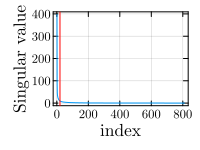
\(\chi = 4\)
\(M\)
\(U\)
\(S\)
\(V\)
\(=\)
Wikipedia, CC BY license
\(\chi = 4\)
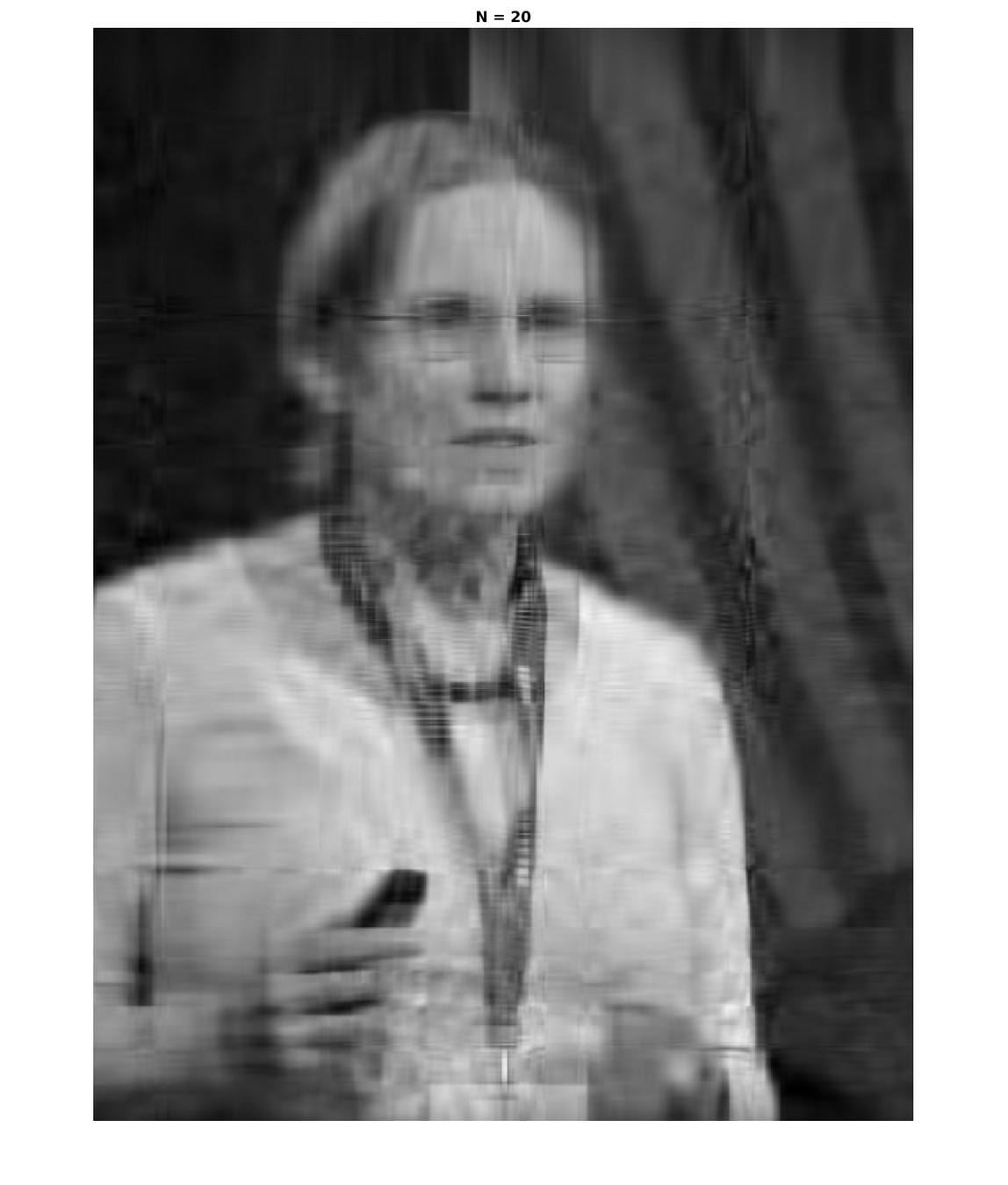
\(\chi = 20\)
\(M\)
\(U\)
\(S\)
\(V\)
\(=\)
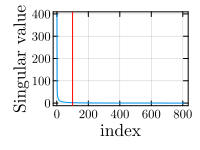
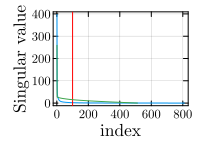
Wikipedia, CC BY license
\(\chi = 4\)
\(\chi = 20\)
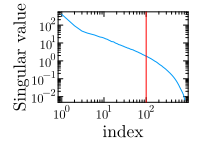
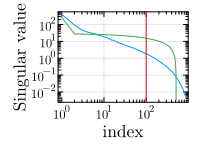
\(\chi = 100\)
\(M\)
\(U\)
\(S\)
\(V\)
\(=\)
Wikipedia, CC BY license
\(\chi = 4\)
\(\chi = 20\)
\(\chi = 100\)
\(M\)
\(U\)
\(S\)
\(V\)
\(=\)
Wikipedia, CC BY license
\(\chi = 4\)
\(\chi = 20\)
\(\chi = 100\)
Tensor notation: R. Penrose, in Combinatorial Mathematics and its applications, (1971)
8
COLBOIS|TNS FOR CLASSICAL FRUSTRATED MAGNETISM | 10.2025
Type
Notation
Visualization
Scalar
Vector
Matrix
Rank-3 tensor
"Legs"
Tensor notation: R. Penrose, in Combinatorial Mathematics and its applications, (1971)
8
COLBOIS|TNS FOR CLASSICAL FRUSTRATED MAGNETISM | 10.2025
Type
Notation
Visualization
Scalar
Vector
Matrix
Rank-3 tensor
"Legs"
Tensor notation: R. Penrose, in Combinatorial Mathematics and its applications, (1971)
8
COLBOIS|TNS FOR CLASSICAL FRUSTRATED MAGNETISM | 10.2025
Type
Notation
Visualization
Scalar
Vector
Matrix
Rank = # indices = # legs =#dimensions
Rank-3 tensor
"Legs"
Tensor notation: R. Penrose, in Combinatorial Mathematics and its applications, (1971)
8
COLBOIS|TNS FOR CLASSICAL FRUSTRATED MAGNETISM | 10.2025
Type
Notation
Visualization
Scalar
Vector
Type
Notation
Visualization
Matrix
Rank = # indices = # legs =#dimensions
Rank-3 tensor
"Legs"
Size of the index = bond dimension = \(\chi\) or \(D\)
Tensor notation: R. Penrose, in Combinatorial Mathematics and its applications, (1971)
COLBOIS|TNS FOR CLASSICAL FRUSTRATED MAGNETISM | 10.2025
8
Scalar
Vector
Type
Notation
Visualization
Matrix
Rank = # indices = # legs =#dimensions
Rank-3 tensor
Connecting legs = make the product
"CONTRACTION"
"Legs"
Size of the index = bond dimension = \(\chi\) or \(D\)
Tensor notation: R. Penrose, in Combinatorial Mathematics and its applications, (1971)
COLBOIS|TNS FOR CLASSICAL FRUSTRATED MAGNETISM | 10.2025
8
Scalar
Vector
Type
Notation
Visualization
Matrix
Rank = # indices = # legs =#dimensions
Rank-3 tensor
Scalar product
Connecting legs = make the product
"CONTRACTION"
"Legs"
Size of the index = bond dimension = \(\chi\) or \(D\)
Tensor notation: R. Penrose, in Combinatorial Mathematics and its applications, (1971)
COLBOIS|TNS FOR CLASSICAL FRUSTRATED MAGNETISM | 10.2025
8
Scalar
Vector
Type
Notation
Visualization
Matrix
Rank = # indices = # legs =#dimensions
Rank-3 tensor
Scalar product
Matrix-vector product
Connecting legs = make the product
"CONTRACTION"
"Legs"
Size of the index = bond dimension = \(\chi\) or \(D\)
Tensor notation: R. Penrose, in Combinatorial Mathematics and its applications, (1971)
COLBOIS|TNS FOR CLASSICAL FRUSTRATED MAGNETISM | 10.2025
8
Scalar
Vector
Type
Notation
Visualization
Matrix
Rank = # indices = # legs =#dimensions
Rank-3 tensor
Scalar product
Matrix-vector product
Connecting legs = make the product
"CONTRACTION"
"Legs"
Size of the index = bond dimension = \(\chi\) or \(D\)
You can group indices:
\(\chi \times\chi \times \chi \times \chi\)
tensor
Tensor notation: R. Penrose, in Combinatorial Mathematics and its applications, (1971)
COLBOIS|TNS FOR CLASSICAL FRUSTRATED MAGNETISM | 10.2025
8
Scalar
Vector
Type
Notation
Visualization
Matrix
Rank = # indices = # legs =#dimensions
Rank-3 tensor
Scalar product
Matrix-vector product
Connecting legs = make the product
"CONTRACTION"
"Legs"
Size of the index = bond dimension = \(\chi\) or \(D\)
You can group indices:
\(\chi \times\chi \times \chi \times \chi\)
tensor
\(\chi^2 \times\chi^2\)
matrix
Tensor notation: R. Penrose, in Combinatorial Mathematics and its applications, (1971)
COLBOIS|TNS FOR CLASSICAL FRUSTRATED MAGNETISM | 10.2025
8
Many-body wavefunction =huge tensor:
High number of parameters
Much smaller number
We want to "factorize" or compress it:
9
COLBOIS|TNS FOR CLASSICAL FRUSTRATED MAGNETISM | 10.2025
Many-body wavefunction =huge tensor:
High number of parameters
Much smaller number
ENTANGLEMENT (area law)
We want to "factorize" or compress it:
9
COLBOIS|TNS FOR CLASSICAL FRUSTRATED MAGNETISM | 10.2025
Many-body wavefunction =huge tensor:
ENTANGLEMENT (area law)
High number of parameters
Much smaller number
Many-body Hilbert space
We want to "factorize" or compress it:
9
COLBOIS|TNS FOR CLASSICAL FRUSTRATED MAGNETISM | 10.2025
Many-body wavefunction =huge tensor:
ENTANGLEMENT (area law)
High number of parameters
Much smaller number
Many-body Hilbert space
We want to "factorize" or compress it:
9
COLBOIS|TNS FOR CLASSICAL FRUSTRATED MAGNETISM | 10.2025
Many-body wavefunction =huge tensor:
Many-body Hilbert space
ENTANGLEMENT (area law)
High number of parameters
Much smaller number
We want to "factorize" or compress it:
9
COLBOIS|TNS FOR CLASSICAL FRUSTRATED MAGNETISM | 10.2025
Many-body wavefunction =huge tensor:
Many-body Hilbert space
Ground states of gapped, local Hamiltonians
ENTANGLEMENT (area law)
High number of parameters
Much smaller number
We want to "factorize" or compress it:
9
COLBOIS|TNS FOR CLASSICAL FRUSTRATED MAGNETISM | 10.2025
Many-body wavefunction =huge tensor:
Many-body Hilbert space
Ground states of gapped, local Hamiltonians
ENTANGLEMENT (area law)
High number of parameters
Much smaller number
We want to "factorize" or compress it:
9
COLBOIS|TNS FOR CLASSICAL FRUSTRATED MAGNETISM | 10.2025
Many-body wavefunction =huge tensor:
Many-body Hilbert space
Ground states of gapped, local Hamiltonians
ENTANGLEMENT (area law)
High number of parameters
Much smaller number
9
We want to "factorize" or compress it:
COLBOIS|TNS FOR CLASSICAL FRUSTRATED MAGNETISM | 10.2025
2D square lattice Ising model
Vanhecke et al. PRL (2019)
19
COLBOIS|TNS FOR CLASSICAL SPIN SYSTEMS | 11.2025
Critical point
\(\rightarrow\) finite-bond dimension scaling
2D chiral Potts model (1d Rydberg arrays)
\(T \in [2.2666, 2.2698]\)
Anisotropy
3-states
Highly anisotropic, not conformal critical point
Nyckees, JC, Mila, NPB (2021) and refs. therein
2D square lattice Ising model
Vanhecke et al. PRL (2019)
19
COLBOIS|TNS FOR CLASSICAL SPIN SYSTEMS | 11.2025
Critical point
\(\rightarrow\) finite-bond dimension scaling
2D chiral Potts model (1d Rydberg arrays)
\(T \in [2.2666, 2.2698]\)
Anisotropy
3-states
Highly anisotropic, not conformal critical point
Nyckees, JC, Mila, NPB (2021) and refs. therein
2D square lattice Ising model
Vanhecke et al. PRL (2019)
19
COLBOIS|TNS FOR CLASSICAL SPIN SYSTEMS | 11.2025
Critical point
\(\rightarrow\) finite-bond dimension scaling
2D chiral Potts model (1d Rydberg arrays)
\(T \in [2.2666, 2.2698]\)
Anisotropy
3-states
Highly anisotropic, not conformal critical point
Nyckees, JC, Mila, NPB (2021) and refs. therein
2D square lattice Ising model
Vanhecke et al. PRL (2019)
19
COLBOIS|TNS FOR CLASSICAL SPIN SYSTEMS | 11.2025
Critical point
\(\rightarrow\) finite-bond dimension scaling
2D chiral Potts model (1d Rydberg arrays)
\(T \in [2.2666, 2.2698]\)
Anisotropy
?
3-states
Highly anisotropic, not conformal critical point
Nyckees, JC, Mila, NPB (2021) and refs. therein
2D square lattice Ising model
Vanhecke et al. PRL (2019)
19
COLBOIS|TNS FOR CLASSICAL SPIN SYSTEMS | 11.2025
Critical point
\(\rightarrow\) finite-bond dimension scaling
2D chiral Potts model (1d Rydberg arrays)
Anisotropy
\(T \in [2.2666, 2.2698]\)
Nyckees, JC, Mila, NPB (2021) and refs. therein
By Jeanne Colbois
Invited talk at GDR quantum meso