















Jeanne Colbois PRO
Physicist @ CNRS. Here you find slides for *some* of my presentations, as well as visual abstracts for recent publications.
Jeanne Colbois | Institut Néel CNRS | Grenoble, France
Tensor networks
Statistical mechanics
Tensor networks
Frustrated magnetism
Fixnet | UZH | 14-16 January 2026, Zurich, Switzerland
Jeanne Colbois | Institut Néel CNRS | Grenoble, France
Contracting the TN
partition function
of a
frustrated model
Fixnet | UZH | 14-16 January 2026, Zurich, Switzerland
Jeanne Colbois | Institut Néel CNRS | Grenoble, France
Contracting the TN
partition function
of a
frustrated model
Numerical problem
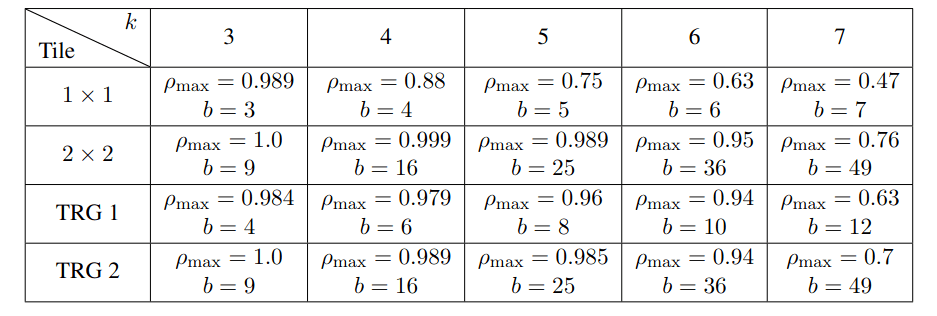
MPO properties
Emergent d.o.fs
Fixnet | UZH | 14-16 January 2026, Zurich, Switzerland
COLBOIS | FRUSTRATED TNS | 01.2026
1
1. Motivation
2. The case of frustrated spin systems
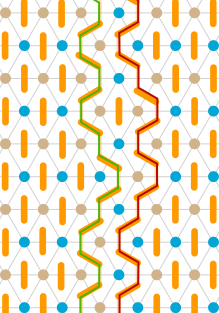
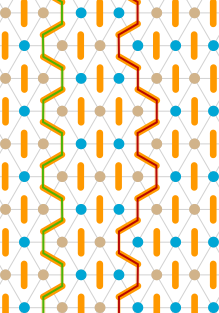
3. Range of constraints
4. Conclusions
COLBOIS | FRUSTRATED TNS | 01.2026
2
Samuel Nyckees
Afonso Rufino
Andrew Smerald
Frédéric Mila
Frank Verstraete
Laurens Vanderstraeten
Bram Vanhecke
TN contraction problem instances:
C. Wang, S.-M. Qin, H.-J. Zhou, PRB 90, (2014)
Vanderstraeten et al., PRE 98 (2018)
Z. Zhu, H. G. Katzgraber, arXiv:1903.07721, (2019)
J. G. Liu, L. Wang, P. Zhang, PRL 126, (2021)
B. Vanhecke, JC, et al. PRR 3, (2021)
FF Song, GM Zhang, PRB 105, (2022)
G. Giudice, F. Surace, H. Pichler, G. Giudici, PRB 106, (2022)
F.F. Song, T.-Y. Lin, G. M. Zhang, PRB 108, (2023)
F.F. Song, H. Numoin, N. Kawashima, PRB 111, (2025)
W. Tang, F. Verstraete, J. Haegeman, PRB 111, (2025)
Homma et al., PRB 111, (2025)
Our applications:
JC, B. Vanhecke, et al, PRB 106, (2022)
Nyckees et al, PRE 108, (2023)
A. Rufino, et al., arXiv:2505.05889 (to appear in PRL)
A. Rufino et al., in prep
Nathan Perruchoud
Frustrated magnetism and constrained models: why?
How? (a priori?)
3
COLBOIS | FRUSTRATED TNS | 01.2026
3
Incompatible constraints
COLBOIS | FRUSTRATED TNS | 01.2026
Cannot simultaneously minimize all terms
3
Incompatible constraints
Macroscopic ground-state degeneracy
COLBOIS | FRUSTRATED TNS | 01.2026
Cannot simultaneously minimize all terms
3
Incompatible constraints
Macroscopic ground-state degeneracy
Spin liquid with algebraic or exponential correlations; Partial order
COLBOIS | FRUSTRATED TNS | 01.2026
Cannot simultaneously minimize all terms
3
Incompatible constraints
Macroscopic ground-state degeneracy
Spin liquid with algebraic or exponential correlations; Partial order
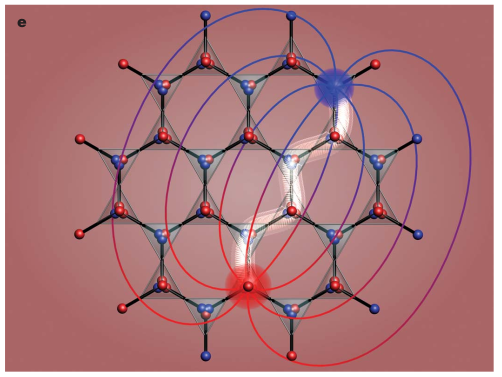
Emergent degrees-of-freedom
C. Castlenovo, R. Moessner, S. L. Sondhi, Nature 451 (2008)
COLBOIS | FRUSTRATED TNS | 01.2026
Cannot simultaneously minimize all terms
4
COLBOIS | FRUSTRATED TNS | 01.2026
4
COLBOIS | FRUSTRATED TNS | 01.2026
Exotic classical phenomena / directly relevant for classical degrees-of-freedom
4
COLBOIS | FRUSTRATED TNS | 01.2026
Exotic classical phenomena / directly relevant for classical degrees-of-freedom
"Simple" limits of quantum many-body systems
Fig. from Giudice etal.
PRB 106, (2022)
(Generalized-)RK type wavefunctions
Classical limit of the dof.
Effective models
...
4
COLBOIS | FRUSTRATED TNS | 01.2026
Partition functions as exact* tensor networks
- particularly hard to contract?
* when the dofs are discrete
Exotic classical phenomena / directly relevant for classical degrees-of-freedom
"Simple" limits of quantum many-body systems
Fig. from Giudice etal.
PRB 106, (2022)
(Generalized-)RK type wavefunctions
Classical limit of the dof.
Effective models
...
4
COLBOIS | FRUSTRATED TNS | 01.2026
* when the dofs are discrete
Partition functions as exact* tensor networks
- particularly hard to contract?
Exotic classical phenomena / directly relevant for classical degrees-of-freedom
"Simple" limits of quantum many-body systems
Fig. from Giudice etal.
PRB 106, (2022)
(Generalized-)RK type wavefunctions
Classical limit of the dof.
Effective models
...
5
COLBOIS | FRUSTRATED TNS | 01.2026
5
COLBOIS | FRUSTRATED TNS | 01.2026
No sign problem!
Monte Carlo:
5
COLBOIS | FRUSTRATED TNS | 01.2026
No sign problem!
Monte Carlo:
Finite-size scaling
5
COLBOIS | FRUSTRATED TNS | 01.2026
No sign problem!
Monte Carlo:
Finite-size scaling
Ergodicity issues
5
COLBOIS | FRUSTRATED TNS | 01.2026
No sign problem!
Monte Carlo:
Finite-size scaling
Tensor networks:
Finite-entanglement scaling / RG
Ergodicity issues
5
COLBOIS | FRUSTRATED TNS | 01.2026
No sign problem!
Monte Carlo:
Finite-size scaling
Tensor networks:
Finite-entanglement scaling / RG
Entropy as the first outcome (free energy per site)
Ergodicity issues
5
COLBOIS | FRUSTRATED TNS | 01.2026
No sign problem!
Monte Carlo:
Finite-size scaling
Tensor networks:
Finite-entanglement scaling / RG
A priori:
Entropy as the first outcome (free energy per site)
Ergodicity issues
5
COLBOIS | FRUSTRATED TNS | 01.2026
No sign problem!
Monte Carlo:
Finite-size scaling
Tensor networks:
Finite-entanglement scaling / RG
A priori:
Entropy as the first outcome (free energy per site)
Ergodicity issues
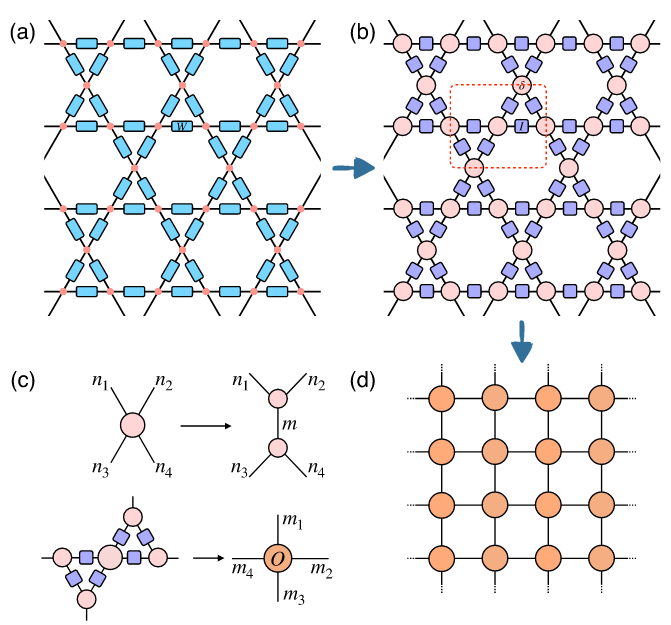
1. Associate a Boltzmann weight with each interaction
5
COLBOIS | FRUSTRATED TNS | 01.2026
No sign problem!
Monte Carlo:
Finite-size scaling
Tensor networks:
Finite-entanglement scaling / RG
A priori:
Entropy as the first outcome (free energy per site)
Ergodicity issues
1. Associate a Boltzmann weight with each interaction
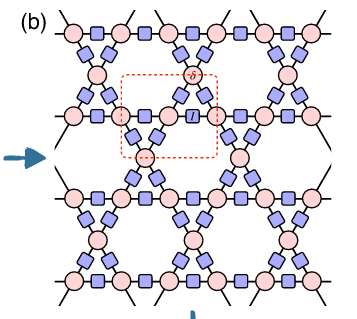
2. split
5
COLBOIS | FRUSTRATED TNS | 01.2026
No sign problem!
Monte Carlo:
Finite-size scaling
Tensor networks:
Finite-entanglement scaling / RG
A priori:
1. Associate a Boltzmann weight with each interaction
2. split
3. group and reshape
Entropy as the first outcome (free energy per site)
Ergodicity issues
5
COLBOIS | FRUSTRATED TNS | 01.2026
No sign problem!
Monte Carlo:
Finite-size scaling
Tensor networks:
Finite-entanglement scaling / RG
A priori:
1. Associate a Boltzmann weight with each interaction
2. split
3. group and reshape
4. contract the 2D TN with your favourite tool
Entropy as the first outcome (free energy per site)
Ergodicity issues
Understanding the triangular lattice Ising antiferromagnet
How to go beyond
Current limitations
Ground state:
6
COLBOIS | FRUSTRATED TNS | 01.2026
Ground state:
6
COLBOIS | FRUSTRATED TNS | 01.2026
Ground state:
G.H. Wannier, PR 79, (1950, 1973)
6
COLBOIS | FRUSTRATED TNS | 01.2026
Ground state:
G.H. Wannier, PR 79, (1950, 1973)
6
COLBOIS | FRUSTRATED TNS | 01.2026
Ground state:
G.H. Wannier, PR 79, (1950, 1973)
Boltzmann Weight
6
COLBOIS | FRUSTRATED TNS | 01.2026
Ground state:
G.H. Wannier, PR 79, (1950, 1973)
Boltzmann Weight
6
COLBOIS | FRUSTRATED TNS | 01.2026
6
Ground state:
G.H. Wannier, PR 79, (1950, 1973)
Boltzmann Weight
COLBOIS | FRUSTRATED TNS | 01.2026
7
Vanhecke, JC et al (2021)
COLBOIS | FRUSTRATED TNS | 01.2026
7
Vanhecke, JC et al (2021)
COLBOIS | FRUSTRATED TNS | 01.2026
7
Vanhecke, JC et al (2021)
1. Cancellation of big / small factors
Z. Zhu, H. G. Katzgraber, arXiv:1903.07721 (2019)
\(\rightarrow\) precision?
COLBOIS | FRUSTRATED TNS | 01.2026
J. G. Liu, L. Wang, P. Zhan, PRL 126, (2021)
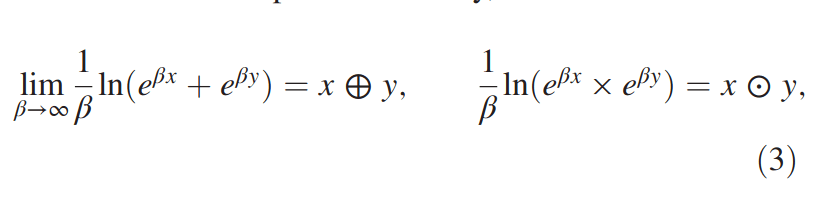
\(\rightarrow\) log / tropical algebra
C. Wang, S.-M. Qin, H.-J. Zhou, PRB 90, (2014)
Rams et al, PRE 104, (2021)
Note: no approximate contraction scheme
7
Vanhecke, JC et al (2021)
COLBOIS | FRUSTRATED TNS | 01.2026
Local tensor:
1. Cancellation of big / small factors
Z. Zhu, H. G. Katzgraber, arXiv:1903.07721 (2019)
\(\rightarrow\) precision?
J. G. Liu, L. Wang, P. Zhan, PRL 126, (2021)
\(\rightarrow\) log / tropical algebra
C. Wang, S.-M. Qin, H.-J. Zhou, PRB 90, (2014)
Rams et al, PRE 104, (2021)
7
Vanhecke, JC et al (2021)
COLBOIS | FRUSTRATED TNS | 01.2026
2. Low-temperature limit / emergent dofs
Vanderstraeten et al., PRE 98 (2018)
B. Vanhecke, JC, et al. PRR 3, (2021)
F.F. Song, T.-Y. Lin, G. M. Zhang, PRB 108, (2023)
1. Cancellation of big / small factors
Z. Zhu, H. G. Katzgraber, arXiv:1903.07721 (2019)
\(\rightarrow\) precision?
J. G. Liu, L. Wang, P. Zhan, PRL 126, (2021)
\(\rightarrow\) log / tropical algebra
C. Wang, S.-M. Qin, H.-J. Zhou, PRB 90, (2014)
Rams et al, PRE 104, (2021)
7
Vanhecke, JC et al (2021)
3. MPO properties
W. Tang, F. Verstraete, J. Haegeman, PRB 111, (2025)
COLBOIS | FRUSTRATED TNS | 01.2026
Vanderstraeten et al., PRE 98 (2018)
B. Vanhecke, JC, et al. PRR 3, (2021)
F.F. Song, T.-Y. Lin, G. M. Zhang, PRB 108, (2023)
2. Low-temperature limit / emergent dofs
1. Cancellation of big / small factors
Z. Zhu, H. G. Katzgraber, arXiv:1903.07721 (2019)
\(\rightarrow\) precision?
J. G. Liu, L. Wang, P. Zhan, PRL 126, (2021)
\(\rightarrow\) log / tropical algebra
C. Wang, S.-M. Qin, H.-J. Zhou, PRB 90, (2014)
Rams et al, PRE 104, (2021)
7
Vanhecke, JC et al (2021)
3. MPO properties
2. Low-temperature limit / emergent dofs
Vanderstraeten et al., PRE 98 (2018)
B. Vanhecke, JC, et al. PRR 3, (2021)
F.F. Song, T.-Y. Lin, G. M. Zhang, PRB 108, (2023)
W. Tang, F. Verstraete, J. Haegeman, PRB 111, (2025)
COLBOIS | FRUSTRATED TNS | 01.2026
1. Cancellation of big / small factors
Z. Zhu, H. G. Katzgraber, arXiv:1903.07721 (2019)
\(\rightarrow\) precision?
J. G. Liu, L. Wang, P. Zhan, PRL 126, (2021)
\(\rightarrow\) log / tropical algebra
C. Wang, S.-M. Qin, H.-J. Zhou, PRB 90, (2014)
Rams et al, PRE 104, (2021)
9
COLBOIS | FRUSTRATED TNS | 01.2026
with all entries smaller or equal to 1?
9
COLBOIS | FRUSTRATED TNS | 01.2026
with all entries smaller or equal to 1?
Dimer counting problem on a honeycomb lattice!
see e.g. Vanderstraeten et al, PRE 98 (2018)
9
COLBOIS | FRUSTRATED TNS | 01.2026
Dimer counting problem on a honeycomb lattice!
Wannier, PR 79 1950;
Kasteleyn, 1960;
Levin, Nave, PRL 99, 2007
with all entries smaller or equal to 1?
see e.g. Vanderstraeten et al, PRE 98 (2018)
9
COLBOIS | FRUSTRATED TNS | 01.2026
Dimer counting problem on a honeycomb lattice!
with all entries smaller or equal to 1?
see e.g. Vanderstraeten et al, PRE 98 (2018)
Wannier, PR 79 1950;
Kasteleyn, 1960;
Levin, Nave, PRL 99, 2007
Xie et al, Phys. Rev. X 4 (2014)
10
COLBOIS | FRUSTRATED TNS | 01.2026
Text
\(\omega\) on all triangles
Vanhecke, JC et al (2021)
\(E_{\mathrm{GS}}/N_{\triangle}\) = \(\min_{\vec{\sigma }}H_{\triangle}(\vec{\sigma})\)
COLBOIS | FRUSTRATED TNS | 01.2026
Text
Vanhecke, JC et al (2021)
10
\(\omega\) on all triangles
\(E_{\mathrm{GS}}/N_{\triangle}\) = \(\min_{\vec{\sigma }}H_{\triangle}(\vec{\sigma})\)
all entries smaller or equal to 1
COLBOIS | FRUSTRATED TNS | 01.2026
Text
Vanhecke, JC et al (2021)
10
\(\omega\) on all triangles
\(E_{\mathrm{GS}}/N_{\triangle}\) = \(\min_{\vec{\sigma }}H_{\triangle}(\vec{\sigma})\)
all entries smaller or equal to 1
COLBOIS | FRUSTRATED TNS | 01.2026
Text
Vanhecke, JC et al (2021)
10
\(\omega\) on all triangles
\(E_{\mathrm{GS}}/N_{\triangle}\) = \(\min_{\vec{\sigma }}H_{\triangle}(\vec{\sigma})\)
all entries smaller or equal to 1
COLBOIS | FRUSTRATED TNS | 01.2026
Text
Vanhecke, JC et al (2021)
JC, PhD Thesis
10
\(\omega\) on all triangles
\(E_{\mathrm{GS}}/N_{\triangle}\) = \(\min_{\vec{\sigma }}H_{\triangle}(\vec{\sigma})\)
all entries smaller or equal to 1
11
COLBOIS | FRUSTRATED TNS | 01.2026
Text
Vanhecke, JC et al (2021)
11
COLBOIS | FRUSTRATED TNS | 01.2026
Text
Same Hamiltonian in PBC
Vanhecke, JC et al (2021)
11
COLBOIS | FRUSTRATED TNS | 01.2026
Text
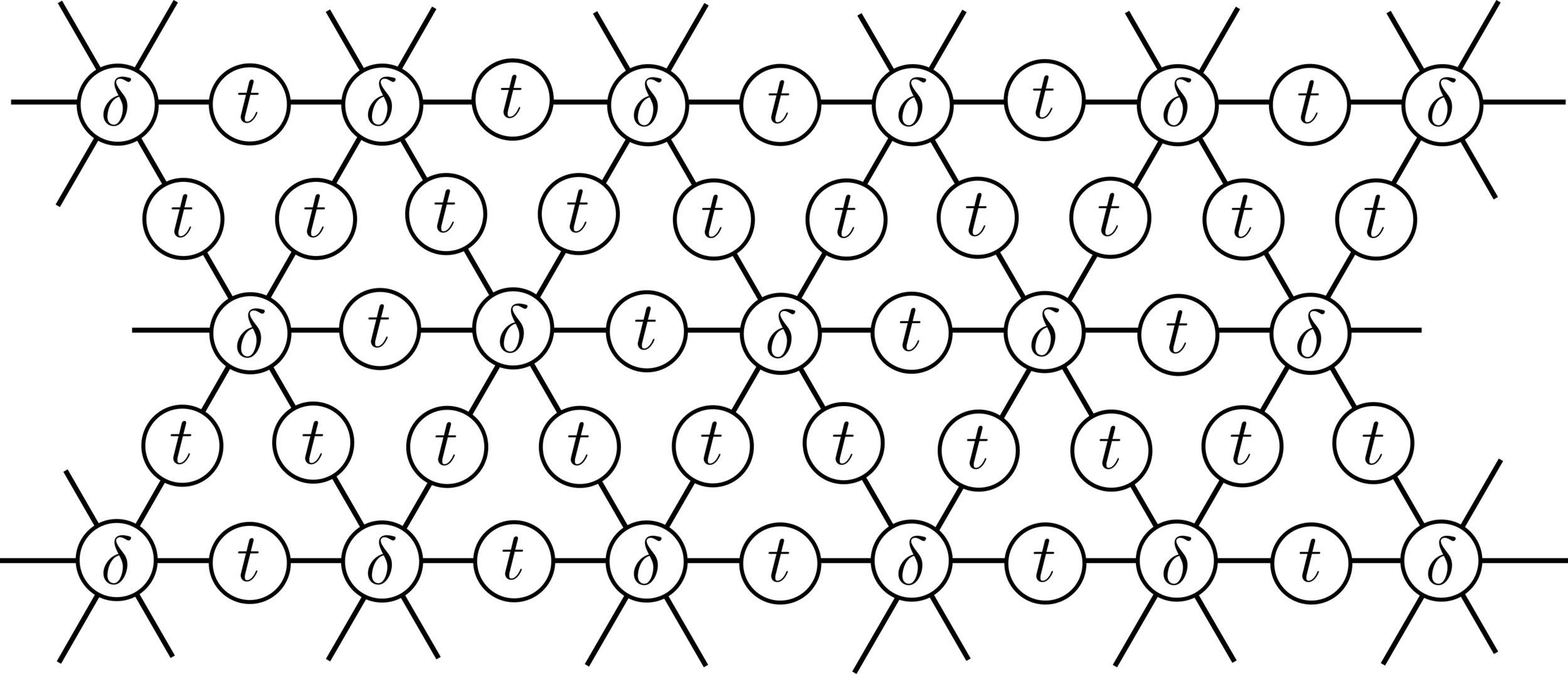
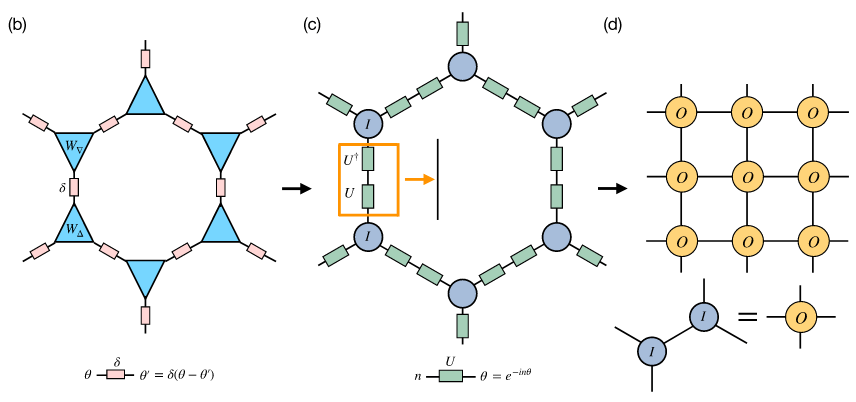
Boltzmann weight
(half for each bond)
Boltzmann weight
(half for each bond)
Kronecker Delta
Boltzmann weight
Vanhecke, JC et al (2021)
Same Hamiltonian in PBC
COLBOIS | FRUSTRATED TNS | 01.2026
Text
11
Vanhecke, JC et al (2021)
Same Hamiltonian in PBC
COLBOIS | FRUSTRATED TNS | 01.2026
See e.g. Kasteleyn 1960
12
\(U(1)\)
COLBOIS | FRUSTRATED TNS | 01.2026
See e.g. Kasteleyn 1960
12
\(U(1)\)
COLBOIS | FRUSTRATED TNS | 01.2026
See e.g. Kasteleyn 1960
12
\(U(1)\)
COLBOIS | FRUSTRATED TNS | 01.2026
See e.g. Kasteleyn 1960
12
\(U(1)\)
COLBOIS | FRUSTRATED TNS | 01.2026
See e.g. Kasteleyn 1960
12
\(U(1)\)
COLBOIS | FRUSTRATED TNS | 01.2026
See e.g. Kasteleyn 1960
12
\(U(1)\)
COLBOIS | FRUSTRATED TNS | 01.2026
See e.g. Kasteleyn 1960
12
\(U(1)\)
COLBOIS | FRUSTRATED TNS | 01.2026
See e.g. Kasteleyn 1960
See also, Nourhani et al, PRE 98 (2018)
Tang, Vestraete, Haegeman, PRB 111, (2025)
12
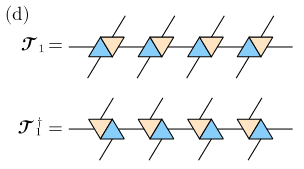
1. Transfer matrix \(\mathcal{T}_1\)
\(U(1)\)
COLBOIS | FRUSTRATED TNS | 01.2026
See e.g. Kasteleyn 1960
See also, Nourhani et al, PRE 98 (2018)
Tang, Vestraete, Haegeman, PRB 111, (2025)
12
1. Transfer matrix \(\mathcal{T}_1\)
- is normal : \(\mathcal{T}_1^{\dagger} \mathcal{T}_1 = \mathcal{T}_1 \mathcal{T}_1^{\dagger}\)
- conserves U(1) (conserves the sector)
\(U(1)\)
COLBOIS | FRUSTRATED TNS | 01.2026
See e.g. Kasteleyn 1960
1. Transfer matrix \(\mathcal{T}_1\)
- is normal : \(\mathcal{T}_1^{\dagger} \mathcal{T}_1 = \mathcal{T}_1 \mathcal{T}_1^{\dagger}\)
- conserves U(1) (conserves the sector)
See also, Nourhani et al, PRE 98 (2018)
1. Transfer matrix \(\mathcal{T}_2 = \mathcal{T}_1 + \Delta \mathcal{T}\)
- non-normal
- related to \(\mathcal{T}_1\) by a bond-dimension 2 MPO \(\mathcal{P}\) that allows to interpolate between them
- affects scaling of the entanglement entropy
Tang, Vestraete, Haegeman, PRB 111, (2025)
12
\(U(1)\)
13
COLBOIS | FRUSTRATED TNS | 01.2026
Numerical problem
Tropical algebra: approximate contraction?
COLBOIS | FRUSTRATED TNS | 01.2026
13
Numerical problem
MPO properties
Tropical algebra: approximate contraction?
COLBOIS | FRUSTRATED TNS | 01.2026
Given the (badly conditioned) MPO \(\rightarrow\) how to find the (non-local) gauge?
13
Numerical problem
MPO properties
Tropical algebra: approximate contraction?
Finding the ground-state local rule / emergent dof?
Given the (badly conditioned) MPO \(\rightarrow\) how to find the (non-local) gauge?
COLBOIS | FRUSTRATED TNS | 01.2026
13
Emergent d.o.fs: dual construction?
Numerical problem
MPO properties
Tropical algebra: approximate contraction?
Finding the ground-state local rule / emergent dof?
1. Beyond nearest-neighbor couplings
Given the (badly conditioned) MPO \(\rightarrow\) how to find the (non-local) gauge?
COLBOIS | FRUSTRATED TNS | 01.2026
13
Emergent d.o.fs: dual construction?
Numerical problem
MPO properties
Tropical algebra: approximate contraction?
Finding the ground-state local rule / emergent dof?
1. Beyond nearest-neighbor couplings
2. Beyond discrete spins: XY models
Given the (badly conditioned) MPO \(\rightarrow\) how to find the (non-local) gauge?
COLBOIS | FRUSTRATED TNS | 01.2026
13
Emergent d.o.fs: dual construction?
Numerical problem
MPO properties
Emergent d.o.fs: dual construction?
Tropical algebra: approximate contraction?
Finding the ground-state local rule / emergent dof?
1. Beyond nearest-neighbor couplings
2. Beyond discrete spins: XY models
Given the (badly conditioned) MPO \(\rightarrow\) how to find the (non-local) gauge?
COLBOIS | FRUSTRATED TNS | 01.2026
13
Numerical problem
MPO properties
Tropical algebra: approximate contraction?
Finding the ground-state local rule / emergent dof?
1. Beyond nearest-neighbor couplings
2. Beyond discrete spins: XY models
Given the (badly conditioned) MPO \(\rightarrow\) how to find the (non-local) gauge?
COLBOIS | FRUSTRATED TNS | 01.2026
13
Emergent d.o.fs: dual construction?
COLBOIS | FRUSTRATED TNS | 01.2026
C. K. Majumdar and D. K. Ghosh, J. Math. Phys. 10, (1969); M. Kaburagi, J. Kanamori, Prog. Theor. Phys. 54 , (1975); B. Sriram Shastry and B. Sutherland, Physica 108 B+C, (1981); W. Huang, D. A. Kitchaev, et. al. , Phys. Rev. B 94, (2016);
B. Vanhecke, JC, L. Vanderstraeten, F. Verstraete, F. Mila, PRR 3, (2021); Nagy et al; PRE 109 (2024)
Essential idea : Anderson bounds
14
COLBOIS | FRUSTRATED TNS | 01.2026
C. K. Majumdar and D. K. Ghosh, J. Math. Phys. 10, (1969); M. Kaburagi, J. Kanamori, Prog. Theor. Phys. 54 , (1975); B. Sriram Shastry and B. Sutherland, Physica 108 B+C, (1981); W. Huang, D. A. Kitchaev, et. al. , Phys. Rev. B 94, (2016);
B. Vanhecke, JC, L. Vanderstraeten, F. Verstraete, F. Mila, PRR 3, (2021); Nagy et al; PRE 109 (2024)
Essential idea : Anderson bounds
14
LINEAR PROGRAM:
COLBOIS | FRUSTRATED TNS | 01.2026
C. K. Majumdar and D. K. Ghosh, J. Math. Phys. 10, (1969); M. Kaburagi, J. Kanamori, Prog. Theor. Phys. 54 , (1975); B. Sriram Shastry and B. Sutherland, Physica 108 B+C, (1981); W. Huang, D. A. Kitchaev, et. al. , Phys. Rev. B 94, (2016);
B. Vanhecke, JC, L. Vanderstraeten, F. Verstraete, F. Mila, PRR 3, (2021); Nagy et al; PRE 109 (2024)
Essential idea : Anderson bounds
LINEAR PROGRAM:
1. Split with clusters that overlap
14
COLBOIS | FRUSTRATED TNS | 01.2026
C. K. Majumdar and D. K. Ghosh, J. Math. Phys. 10, (1969); M. Kaburagi, J. Kanamori, Prog. Theor. Phys. 54 , (1975); B. Sriram Shastry and B. Sutherland, Physica 108 B+C, (1981); W. Huang, D. A. Kitchaev, et. al. , Phys. Rev. B 94, (2016);
B. Vanhecke, JC, L. Vanderstraeten, F. Verstraete, F. Mila, PRR 3, (2021); Nagy et al; PRE 109 (2024)
Essential idea : Anderson bounds
LINEAR PROGRAM:
1. Split with clusters that overlap
2. Minimize : G.S. lower-bound
14
COLBOIS | FRUSTRATED TNS | 01.2026
C. K. Majumdar and D. K. Ghosh, J. Math. Phys. 10, (1969); M. Kaburagi, J. Kanamori, Prog. Theor. Phys. 54 , (1975); B. Sriram Shastry and B. Sutherland, Physica 108 B+C, (1981); W. Huang, D. A. Kitchaev, et. al. , Phys. Rev. B 94, (2016);
B. Vanhecke, JC, L. Vanderstraeten, F. Verstraete, F. Mila, PRR 3, (2021); Nagy et al; PRE 109 (2024)
Essential idea : Anderson bounds
LINEAR PROGRAM:
3. Maximize w.r.t the weights:
1. Split with clusters that overlap
2. Minimize : G.S. lower-bound
14
COLBOIS | FRUSTRATED TNS | 01.2026
C. K. Majumdar and D. K. Ghosh, J. Math. Phys. 10, (1969); M. Kaburagi, J. Kanamori, Prog. Theor. Phys. 54 , (1975); B. Sriram Shastry and B. Sutherland, Physica 108 B+C, (1981); W. Huang, D. A. Kitchaev, et. al. , Phys. Rev. B 94, (2016);
B. Vanhecke, JC, L. Vanderstraeten, F. Verstraete, F. Mila, PRR 3, (2021); Nagy et al; PRE 109 (2024)
Essential idea : Anderson bounds
LINEAR PROGRAM:
3. Maximize w.r.t the weights:
1. Split with clusters that overlap
2. Minimize : G.S. lower-bound
Obtain the ground states by tiling!
14
COLBOIS | FRUSTRATED TNS | 01.2026
C. K. Majumdar and D. K. Ghosh, J. Math. Phys. 10, (1969); M. Kaburagi, J. Kanamori, Prog. Theor. Phys. 54 , (1975); B. Sriram Shastry and B. Sutherland, Physica 108 B+C, (1981); W. Huang, D. A. Kitchaev, et. al. , Phys. Rev. B 94, (2016);
B. Vanhecke, JC, L. Vanderstraeten, F. Verstraete, F. Mila, PRR 3, (2021); Nagy et al; PRE 109 (2024)
Essential idea : Anderson bounds
LINEAR PROGRAM:
3. Maximize w.r.t the weights:
1. Split with clusters that overlap
2. Minimize : G.S. lower-bound
Obtain the ground states by tiling!
And more generally :
14
COLBOIS | FRUSTRATED TNS | 01.2026
C. K. Majumdar and D. K. Ghosh, J. Math. Phys. 10, (1969); M. Kaburagi, J. Kanamori, Prog. Theor. Phys. 54 , (1975); B. Sriram Shastry and B. Sutherland, Physica 108 B+C, (1981); W. Huang, D. A. Kitchaev, et. al. , Phys. Rev. B 94, (2016);
B. Vanhecke, JC, L. Vanderstraeten, F. Verstraete, F. Mila, PRR 3, (2021); Nagy et al; PRE 109 (2024)
Essential idea : Anderson bounds
LINEAR PROGRAM:
3. Maximize w.r.t the weights:
1. Split with clusters that overlap
2. Minimize : G.S. lower-bound
Obtain the ground states by tiling!
And more generally :
"Interactions round a face"
14
R. J. Baxter, J. Stat. Phys. 19, (1978), T. Nishino, J. Phys. Soc. Jpn. 64, (1995), T. Nishino and K. Okunishi, J. Phys. Soc. Jpn. 66, (1997)
Xie et al, Phys. Rev. X 4 (2014)
15
COLBOIS | FRUSTRATED TNS | 01.2026
The linear program is invariant under the cluster symmetry group \(G\)
15
COLBOIS | FRUSTRATED TNS | 01.2026
The linear program is invariant under the cluster symmetry group \(G\)
1. We can look for optimal solutions in the subspace of \(G\)-invariant solutions.
2. We can keep only one configuration per orbit when solving the linear program
COLBOIS | FRUSTRATED TNS | 01.2026
F.F. Song, G. M. Zhang, PRB 108, 014424 (2023)
F.F. Song, T.-Y. Lin, G. M. Zhang, PRB 108, 224404 (2023)
(see also FF Song, H Nuomin, N Kawashima PRB 111 (2025))
16
COLBOIS | FRUSTRATED TNS | 01.2026
F.F. Song, G. M. Zhang, PRB 108, 014424 (2023)
F.F. Song, T.-Y. Lin, G. M. Zhang, PRB 108, 224404 (2023)
(see also FF Song, H Nuomin, N Kawashima PRB 111 (2025))
16
COLBOIS | FRUSTRATED TNS | 01.2026
F.F. Song, G. M. Zhang, PRB 108, 014424 (2023)
F.F. Song, T.-Y. Lin, G. M. Zhang, PRB 108, 224404 (2023)
(see also FF Song, H Nuomin, N Kawashima PRB 111 (2025))
What happens when your partition function cannot be exactly expressed as a TN?
16
COLBOIS | FRUSTRATED TNS | 01.2026
F.F. Song, G. M. Zhang, PRB 108, 014424 (2023)
F.F. Song, T.-Y. Lin, G. M. Zhang, PRB 108, 224404 (2023)
(see also FF Song, H Nuomin, N Kawashima PRB 111 (2025))
What happens when your partition function cannot be exactly expressed as a TN?
1. Similar issue as TIAFM (on square XY)
16
COLBOIS | FRUSTRATED TNS | 01.2026
F.F. Song, G. M. Zhang, PRB 108, 014424 (2023)
F.F. Song, T.-Y. Lin, G. M. Zhang, PRB 108, 224404 (2023)
(see also FF Song, H Nuomin, N Kawashima PRB 111 (2025))
What happens when your partition function cannot be exactly expressed as a TN?
1. Similar issue as TIAFM (on square XY)
2. A slightly different issue on the kagome: truncation leads to wrong results
16
COLBOIS | FRUSTRATED TNS | 01.2026
F.F. Song, G. M. Zhang, PRB 108, 014424 (2023)
F.F. Song, T.-Y. Lin, G. M. Zhang, PRB 108, 224404 (2023)
(1) decomposition onto cylindrical harmonics
(2) split and group
\(t = \exp(-\beta J \cos(\theta_i - \theta_j)\)
17
COLBOIS | FRUSTRATED TNS | 01.2026
F.F. Song, G. M. Zhang, PRB 108, 014424 (2023)
F.F. Song, T.-Y. Lin, G. M. Zhang, PRB 108, 224404 (2023)
(2) split and group
\(t = \exp(-\beta J \cos(\theta_i - \theta_j)\)
(1) Fourier transform or decomposition onto Bessel functions
(2) split and group
17
(1) decomposition onto cylindrical harmonics
COLBOIS | FRUSTRATED TNS | 01.2026
F.F. Song, G. M. Zhang, PRB 108, 014424 (2023)
see also FF. Song; GM Zhang, Ch. Phys. Letters (2025)
18
COLBOIS | FRUSTRATED TNS | 01.2026
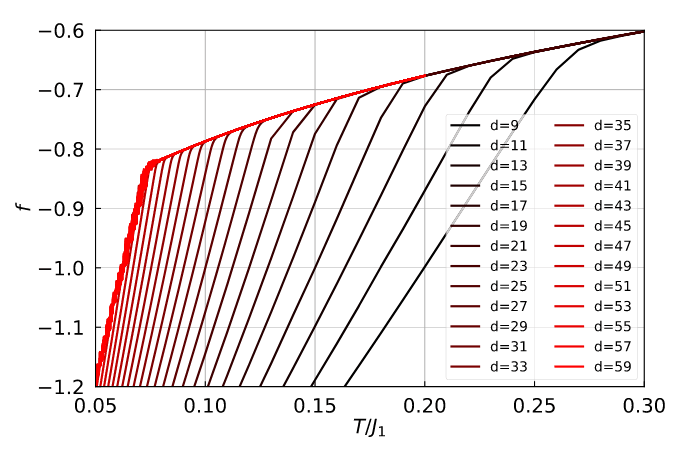
First-order phase transition?
F.F. Song, G. M. Zhang, PRB 108, 014424 (2023)
see also FF. Song; GM Zhang, Ch. Phys. Letters (2025)
18
COLBOIS | FRUSTRATED TNS | 01.2026
First-order phase transition?
F.F. Song, G. M. Zhang, PRB 108, 014424 (2023)
see also FF. Song; GM Zhang, Ch. Phys. Letters (2025)
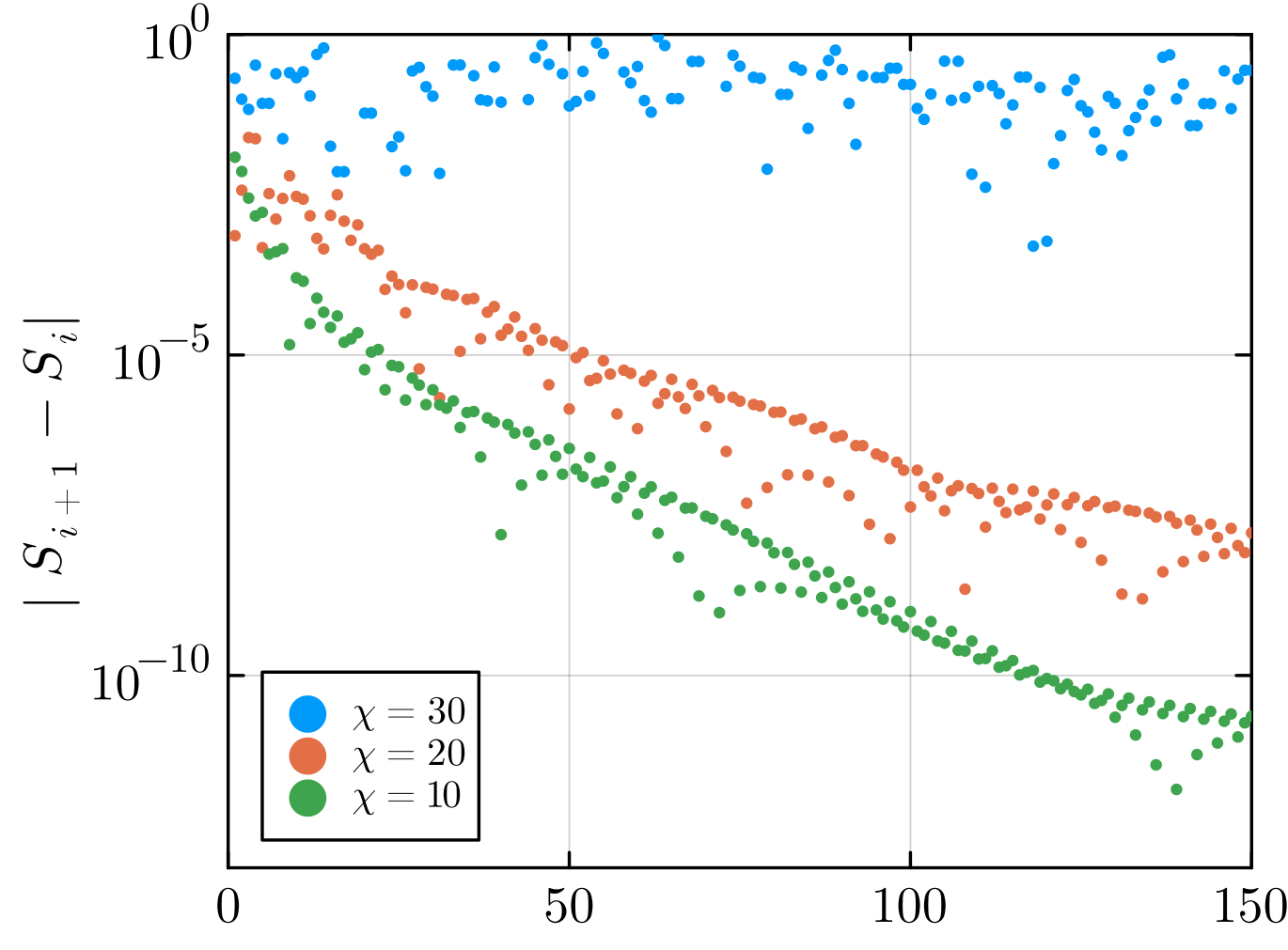
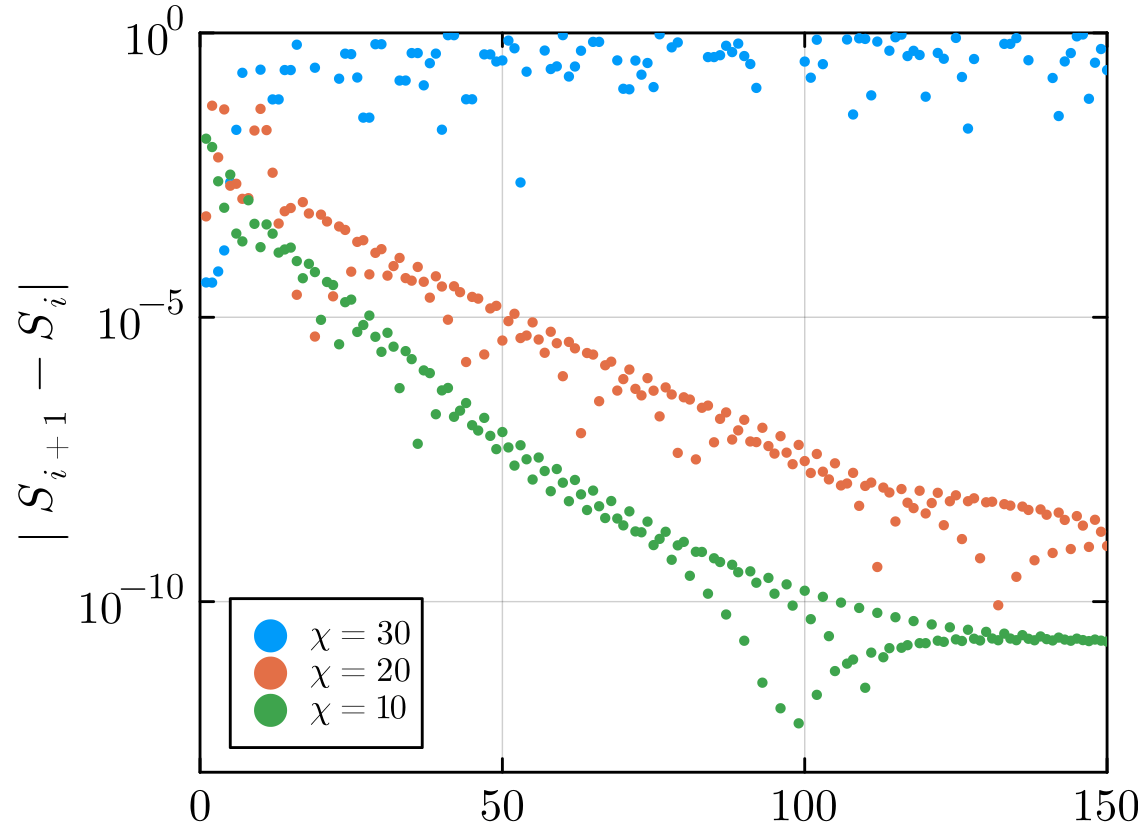
Converges
but not reliably
18
COLBOIS | FRUSTRATED TNS | 01.2026
First-order phase transition?
F.F. Song, G. M. Zhang, PRB 108, 014424 (2023)
see also FF. Song; GM Zhang, Ch. Phys. Letters (2025)
Converges
but not reliably
18
COLBOIS | FRUSTRATED TNS | 01.2026
First-order phase transition?
F.F. Song, G. M. Zhang, PRB 108, 014424 (2023)
see also FF. Song; GM Zhang, Ch. Phys. Letters (2025)
Converges
but not reliably
BKT
18
19
COLBOIS | FRUSTRATED TNS | 01.2026
19
COLBOIS | FRUSTRATED TNS | 01.2026
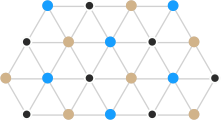
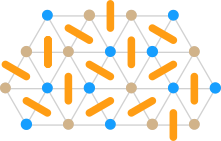
1. Finding the ground state rule / emergent dof: range of frustration?
Ronceray & Le Floch (2020)
19
COLBOIS | FRUSTRATED TNS | 01.2026
1. Finding the ground state rule / emergent dof: range of frustration?
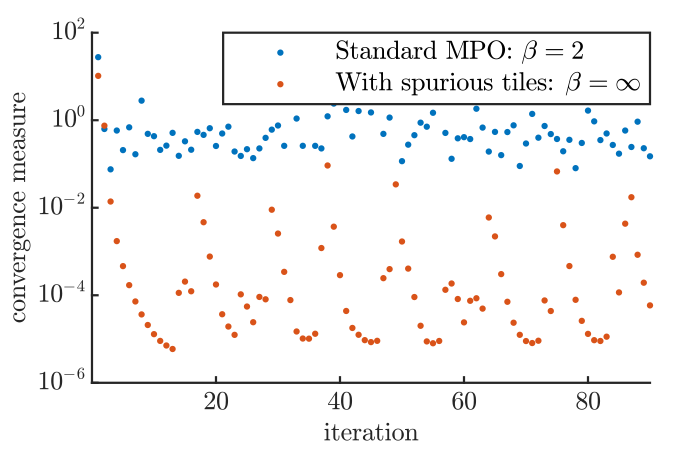
2. Making sure that no "spurious tile" spoils the convergence?
Ronceray & Le Floch (2020)
19
COLBOIS | FRUSTRATED TNS | 01.2026
1. Finding the ground state rule / emergent dof: range of frustration?
Ronceray & Le Floch (2020)
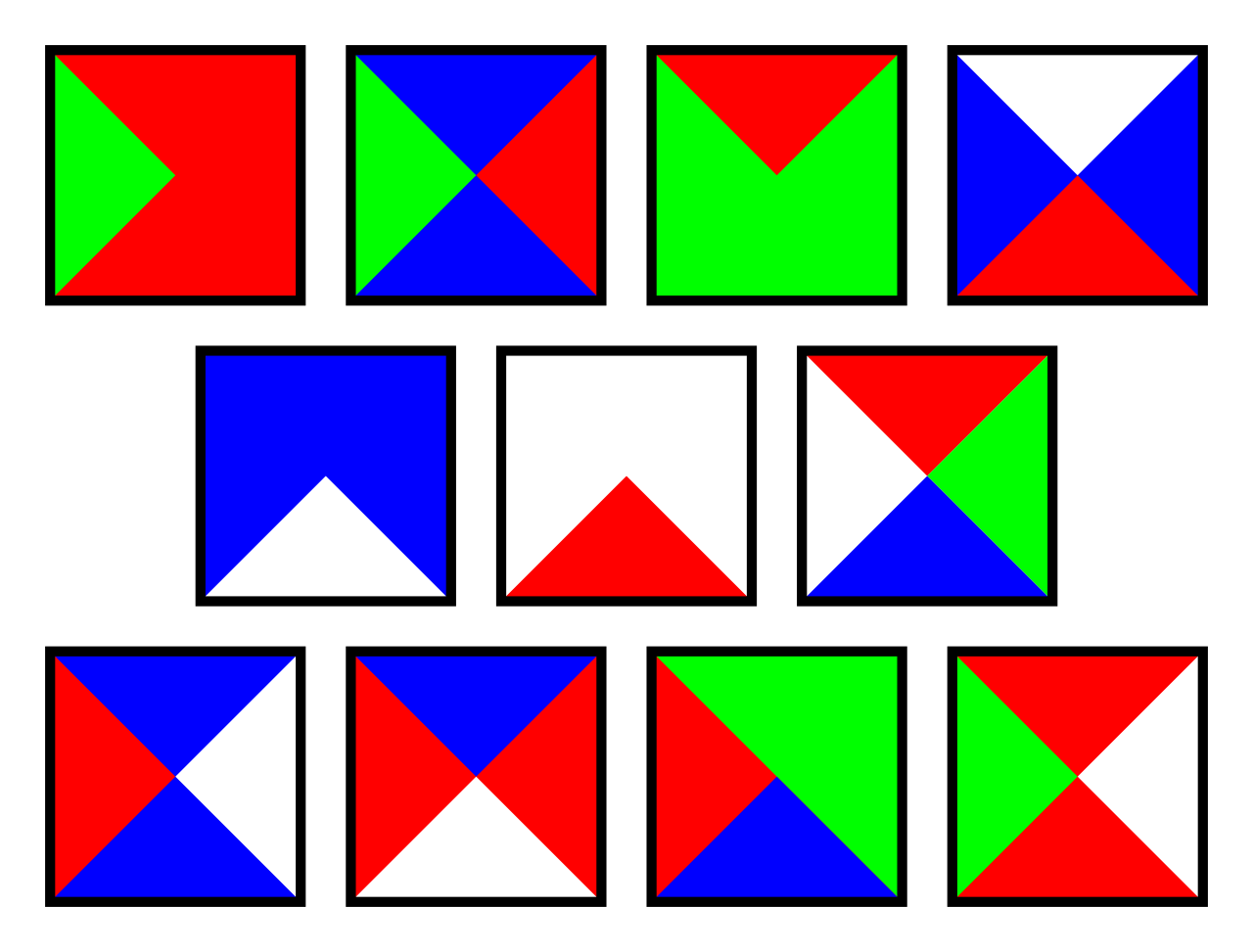
3. More fundamentally: tiling problems
2. Making sure that no "spurious tile" spoils the convergence?
19
COLBOIS | FRUSTRATED TNS | 01.2026
1. Finding the ground state rule / emergent dof: range of frustration?
3. More fundamentally: tiling problems
\(\rightarrow\) undecidability in general
Ronceray & Le Floch (2020)
2. Making sure that no "spurious tile" spoils the convergence?
19
COLBOIS | FRUSTRATED TNS | 01.2026
1. Finding the ground state rule / emergent dof: range of frustration?
3. More fundamentally: tiling problems
\(\rightarrow\) practical cases?
\(\rightarrow\) undecidability in general
Ronceray & Le Floch (2020)
2. Making sure that no "spurious tile" spoils the convergence?
Nathan Perruchoud
Afonso Rufino
20
COLBOIS | FRUSTRATED TNS | 01.2026
Fig. from N. Perruchoud's Master thesis
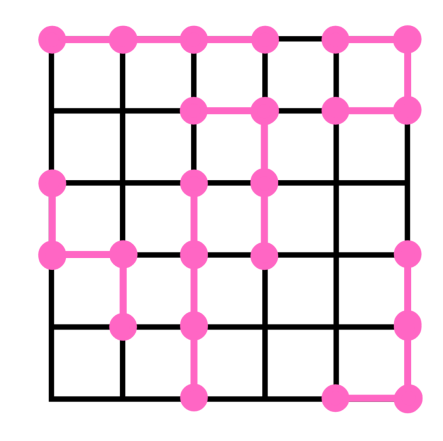
Given a lattice : packing polymers of length \(k\)
20
COLBOIS | FRUSTRATED TNS | 01.2026
Fig. from N. Perruchoud's Master thesis
Given a lattice : packing polymers of length \(k\)
20
COLBOIS | FRUSTRATED TNS | 01.2026
Fig. from N. Perruchoud's Master thesis
RVB state properties?
Given a lattice : packing polymers of length \(k\)
See eg. Giudice et al, PRB 106 (2022),
Zhang et al, Commun. Mat. 6 (2025)
20
COLBOIS | FRUSTRATED TNS | 01.2026
Fig. from N. Perruchoud's Master thesis
RVB state properties?
Statistical mechanics ?
Given a lattice : packing polymers of length \(k\)
See eg. Giudice et al, PRB 106 (2022),
Zhang et al, Commun. Mat. 6 (2025)
See next slide
21
COLBOIS | FRUSTRATED TNS | 01.2026
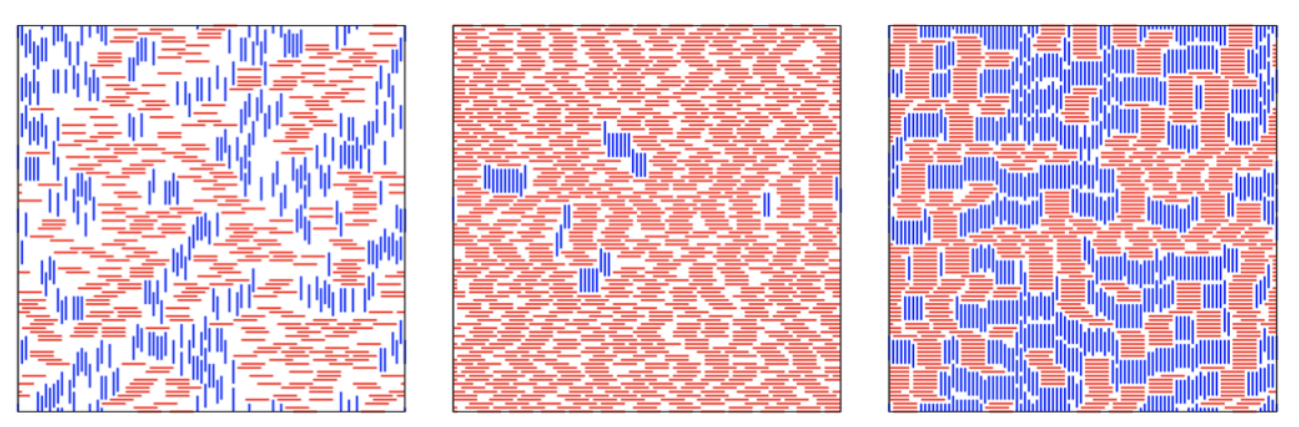
Fig: Shah et al, PRE 105 (2022)
Nice review: Shah et al, PRE 105 (2022)
COLBOIS | FRUSTRATED TNS | 01.2026
Fig: Shah et al, PRE 105 (2022)
Nice review: Shah et al, PRE 105 (2022)
Low-density disordered
21
COLBOIS | FRUSTRATED TNS | 01.2026
Fig: Shah et al, PRE 105 (2022)
Nice review: Shah et al, PRE 105 (2022)
Low-density disordered
Intermediate density nematic
21
COLBOIS | FRUSTRATED TNS | 01.2026
Fig: Shah et al, PRE 105 (2022)
Nice review: Shah et al, PRE 105 (2022)
Low-density disordered
Intermediate density nematic
High density disordered
21
COLBOIS | FRUSTRATED TNS | 01.2026
Low-density disordered
Intermediate density nematic
High density disordered
Fig: Shah et al, PRE 105 (2022)
Nice review: Shah et al, PRE 105 (2022)
A. Ghosh and D. Dhar. Euro. Letters, 78 (2007).
21
COLBOIS | FRUSTRATED TNS | 01.2026
Low-density disordered
Intermediate density nematic
High density disordered
Fig: Shah et al, PRE 105 (2022)
Nice review: Shah et al, PRE 105 (2022)
Disertori and Giuliani.,Comm. Math.Phys, 323, (2013).
A. Ghosh and D. Dhar. Euro. Letters, 78 (2007).
21
COLBOIS | FRUSTRATED TNS | 01.2026
Low-density disordered
Intermediate density nematic
High density disordered
Fig: Shah et al, PRE 105 (2022)
Nice review: Shah et al, PRE 105 (2022)
Disertori and Giuliani.,Comm. Math.Phys, 323, (2013).
A. Ghosh and D. Dhar. Euro. Letters, 78 (2007).
Matoz-Fernandez, et al, Europhys. Letters, 82 (2008).
21
COLBOIS | FRUSTRATED TNS | 01.2026
Low-density disordered
Intermediate density nematic
High density disordered
Fig: Shah et al, PRE 105 (2022)
Nice review: Shah et al, PRE 105 (2022)
Disertori and Giuliani.,Comm. Math.Phys, 323, (2013).
A. Ghosh and D. Dhar. Euro. Letters, 78 (2007).
Matoz-Fernandez, et al, Europhys. Letters, 82 (2008).
21
COLBOIS | FRUSTRATED TNS | 01.2026
22
COLBOIS | FRUSTRATED TNS | 01.2026
22
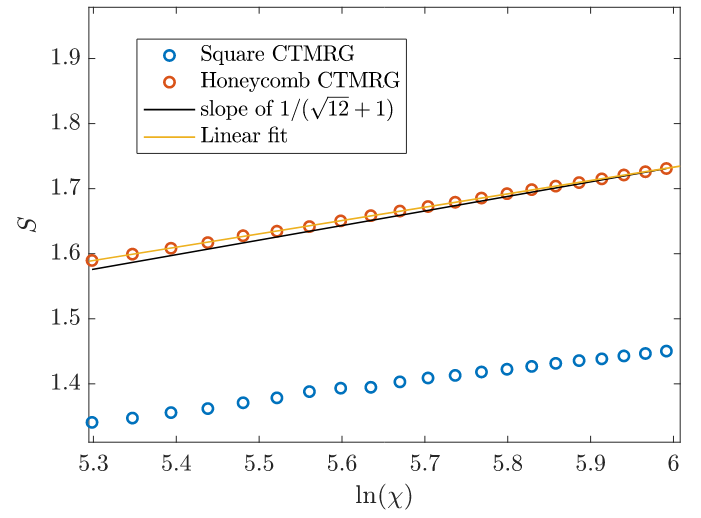
Contraction with CTMRG :
N. Perruchoud Master's thesis
Giudice etal. PRB 106, (2022)
22
COLBOIS | FRUSTRATED TNS | 01.2026
Contraction with CTMRG :
N. Perruchoud Master's thesis
Giudice etal. PRB 106, (2022)
CTMRG (extraplation): 0.158496(14)
TM with extapolation: 0.158539(37); 0.158520(15)
Serra et al, (2023)
Ghosh et al, (2023)
23
COLBOIS | FRUSTRATED TNS | 01.2026
Afonso Rufino
A. Rufino, et al., arXiv:2505.05889 (to appear in PRL)
COLBOIS | FRUSTRATED TNS | 01.2026
Afonso Rufino
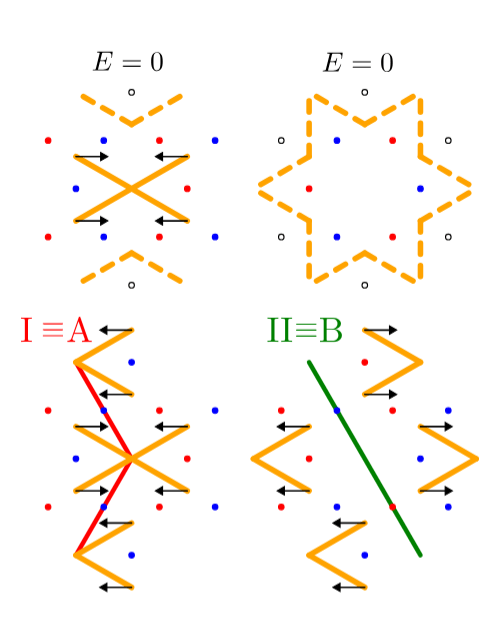
\(J_1, J_3 \rightarrow \infty\)
some of the constraints
A. Rufino, et al., arXiv:2505.05889 (to appear in PRL)
23
COLBOIS | FRUSTRATED TNS | 01.2026
Afonso Rufino
\(J_1, J_3 \rightarrow \infty\)
some of the constraints
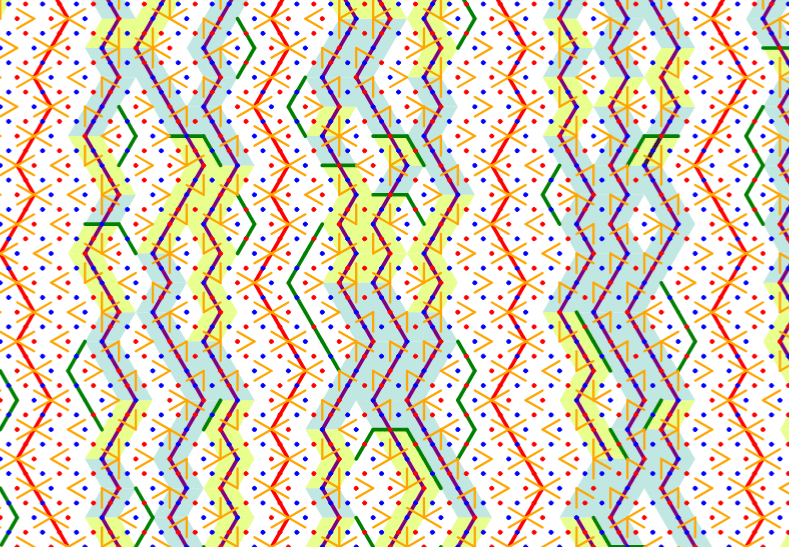
emergent string degrees of freedom
leading to a topological staircase
A. Rufino, et al., arXiv:2505.05889 (to appear in PRL)
23
24
COLBOIS | FRUSTRATED TNS | 01.2026
COLBOIS | FRUSTRATED TNS | 01.2026
1. Simple stat mech models written as exact TNs can lead to contraction failure
24
COLBOIS | FRUSTRATED TNS | 01.2026
1. Simple stat mech models written as exact TNs can lead to contraction failure
2. Strategies: tropical algebra; gauging; finding the frustration-free cluster
Rules-of-thumb:
- normal MPO
- lattice symmetries
- emergent dofs : interactions-round-a-face
24
COLBOIS | FRUSTRATED TNS | 01.2026
1. Simple stat mech models written as exact TNs can lead to contraction failure
3. Families of frustrated spin systems where we have a well-behaved formulation
Learn strategies to fix the gauge?
Topological devil's staircase:
non-local emergent dofs.
2. Strategies: tropical algebra; gauging; finding the frustration-free cluster
Rules-of-thumb:
- normal MPO
- lattice symmetries
- emergent dofs : interactions-round-a-face
24
COLBOIS | FRUSTRATED TNS | 01.2026
1. Simple stat mech models written as exact TNs can lead to contraction failure
3. Families of frustrated spin systems where we have a well-behaved formulation
Learn strategies to fix the gauge?
Thank you!
Topological devil's staircase:
non-local emergent dofs.
2. Strategies: tropical algebra; gauging; finding the frustration-free cluster
Rules-of-thumb:
- normal MPO
- lattice symmetries
- emergent dofs : interactions-round-a-face
24
COLBOIS | FRUSTRATED TNS | 01.2026
Giudice etal. PRB 106, (2022)
Remark by Juraj Hasik:
F. Pollmann, et al. PRL 102 (2009)
L. Tagliacozzoet al. PRB 78 (2008)
S. Nyckees et al. PRE 108 (2023)
F. Pollmann, et al. PRL 102 (2009)
L. Tagliacozzoet al. PRB 78 (2008)
COLBOIS | FRUSTRATED TNS | 01.2026
3x3
Afonso Rufino
3x3
2x2
COLBOIS | FRUSTRATED TNS | 01.2026
\(E \propto L \)
Nearest-neighbor anisotropic
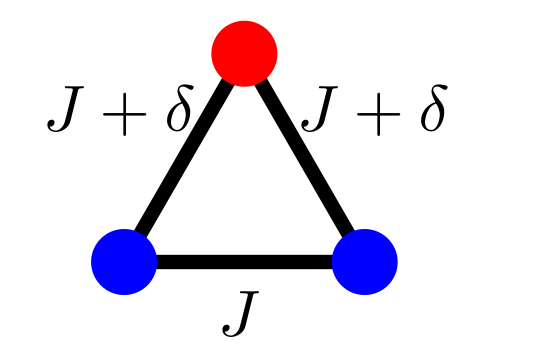
Smerald & Mila, Scipost (2019)
Constrained limit \(J \gg T, \delta \)
COLBOIS | FRUSTRATED TNS | 01.2026
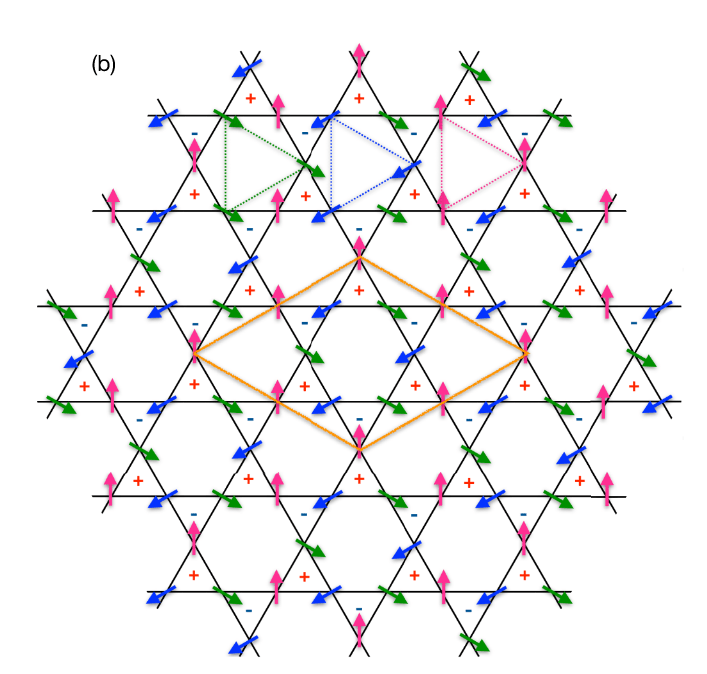
Ground-states: U(1) + 3-states clock
Huse, Rosenfeld, PRB 45, (1992)
F.F. Song, G. M. Zhang, PRB 108, 014424 (2023)
F.F. Song, T.-Y. Lin, G. M. Zhang, PRB 108, 224404 (2023)
(see also FF Song, H Nuomin, N Kawashima PRB 111 (2025))
COLBOIS | FRUSTRATED TNS | 01.2026
Ground-states: U(1) + 3-states clock
Residual entropy due to 3-states: \(S = 0.126...\)
Huse, Rosenfeld, PRB 45, (1992)
R. J. Baxter, J. Math. Phys. 11, (1970)
F.F. Song, G. M. Zhang, PRB 108, 014424 (2023)
F.F. Song, T.-Y. Lin, G. M. Zhang, PRB 108, 224404 (2023)
(see also FF Song, H Nuomin, N Kawashima PRB 111 (2025))
COLBOIS | FRUSTRATED TNS | 01.2026
Ground-states: U(1) + 3-states clock
Residual entropy due to 3-states: \(S = 0.126...\)
Huse, Rosenfeld, PRB 45, (1992)
R. J. Baxter, J. Math. Phys. 11, (1970)
F.F. Song, G. M. Zhang, PRB 108, 014424 (2023)
F.F. Song, T.-Y. Lin, G. M. Zhang, PRB 108, 224404 (2023)
(see also FF Song, H Nuomin, N Kawashima PRB 111 (2025))
Question:
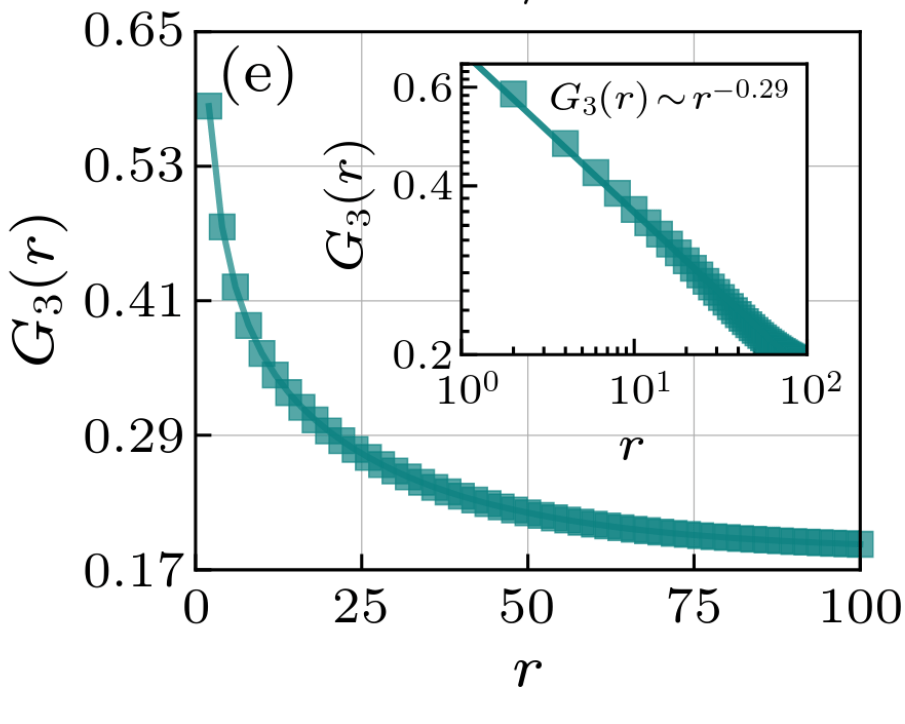
- BKT transition, or
- pre-empted by a first-order or 2nd order transition in the chiralities?
R. J. Baxter, J. Math. Phys. 11, (1970)
COLBOIS | FRUSTRATED TNS | 01.2026
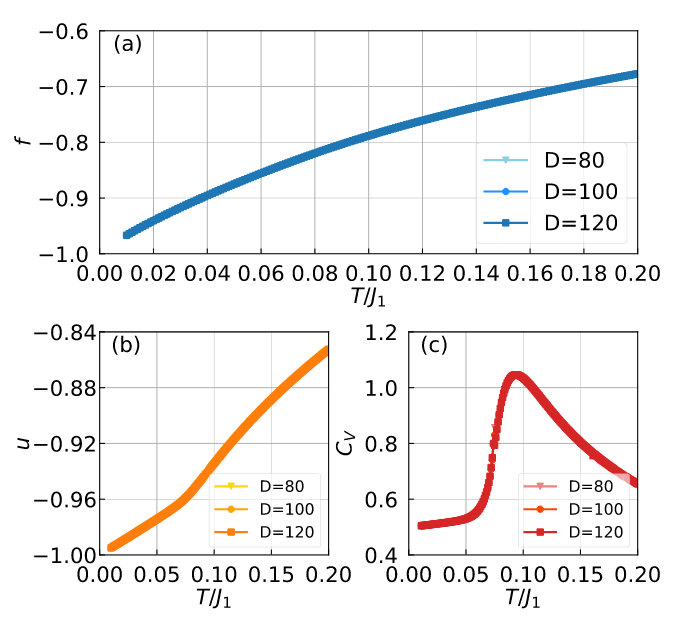
\(10^{-8}\) precision on the partition function per site
CTMRG (extraplation): 0.158496(14)
TM with extapolation: 0.158539(37); 0.158520(15)
Serra et al, (2023)
N. Perruchoud Master's thesis
Ghosh et al, (2023)
By Jeanne Colbois
Contributed talk at the FIXNET workshop