Burn, Baby! Burn!
Weber employs ideal types to construct a theoretical explanation for the rise of modern capitalism.
An ideal type (Idealtypus) stresses certain but not all dominant attributes of a subject.
This facilitates comparison and explanation but does not assume exhaustive accounting.
Weber uses ideal types of, among others, religion and capitalism to set up his theory.
Protestant Work Ethic
How intense is it?
Writing emails, doing homework, texting, searching Facebook, daydreaming, complaining, leaving, etc., during class may be a sign you are not one of the elect.
As J. Edwards said, "the way is uphill."
The Protestant work ethic means constant striving to be better, to perfect oneself, to achieve without ceasing, without leisure, without complaint.
It means not asking, "What can I do for me?" But, "What can I do for God?"
AND
How can I do it better than I did the last time? Because my best will never be sufficient enough to the point that I can stop striving. After all, Christ suffered the cross.
Beruf in Calvinism and Lutheranism 1: Individuals are called to be productive in living out their faith.
- Religious connotation: a (consuming) task (profession) set by God
- To glorify God, individuals should not "dissipate" the fruits of their productive activities in worldly pleasures.
This ceaseless toil, which is unnatural to us, has become a prominent characteristic of the modern Capitalist system.
- It's not an evolutionary by-product of any "survival of the fittest."
- It is a consequence of human belief in a monotheistic "God," who judges beyond human reason.
Weber reacted initially to theorists such as Adam Smith, who argued that the market provided motivation, via competition, to purse profit as a benefit to self-interest.
But doesn't that presuppose the existence of the market? Weber thought so.
Calvin Capitalized on Monotheism
How Could the Reformers' Voices Be So Influential?
The defining ideological contours of monotheism coupled with the political and economic influence of human agents loyal to early Protestant ideologies opened the door.
In other words, Protestant thinking provided a new sense of order, purpose, and stability amidst growing dissatisfaction under the Catholic Church and its loyal political and economic agents.
What Calvin tapped into was the anxiety that lies at the heart of monotheism: the loss of collective identity and the group's ability to shape the normative of the social-political world (whether in this reality or the next).
But "the profane world" seduces the believer away from preserving the impact of the believing community.
Sometimes, indeed, convinced by their own experience, [philosophers] do not deny how difficult it is for man to establish the supremacy of reason in himself, inasmuch as he is at one time enticed by the allurements of pleasure; at another, deluded by a false semblance of good; and, at another, impelled by unruly passions ... (Calvin, Institutes)
Left to our own desires, we pursue pleasure and laziness.
We need a kick in the pants...
-
Luther (
beardless and not handsome
) understood profession (
Beruf
) and vocation (
Berufung
) as religious obligations.
-
He based this on 1 Cor 7:20: "Let each of you remain in the condition (τη κλήσει = calling, role) in which you were called."
A similar sense is shared by Calvin,
For whence is it that one is more excellent than another, but that in a common nature the grace of God is specially displayed in passing by many and thus proclaiming that it is under obligation to none. We may add, that each individual is brought under particular influences according to his calling . (Calvin, Institutes)
Protestant Ethic (PE): we should work in order to preserve the community and its function as a symbolic representation of God's authority and sovereignty within this world.
Consequently, the Protestant Ethic, for Weber, provides a plausible explanation for cultural change toward,
- Rigorous organization
- Methodical labor
- Systematic pursuit of profit
The Specter of Weber, or Calvin, or Luther
PE in the Modern Context
Though notice how this is a more "secularized" version (than that of the early Protestants) of the PE.
Positive and negative responses to the capitalist work ethic in the US may affirm the impact of Protestantism upon the cultural ethos. Both react to it as a cultural drive.
The emphasis upon the U.S. Christian community (often within Protestant circles) as the symbolic representation of divine authority shapes attitudes toward Israel.
We work hard!

God blesses the U.S. because of our work ethic.
Western Christians more clearly reflect what a "good Christian" ought to look like...
When we enter into relations with our cultures, we tend to do so with presuppositions about "right" responses and attitudes.
- Religion provides the façade of universal legitimation for own cultural assumptions and expectations.
- In Western, capitalist cultures, these assumptions are framed within a general Christian worldview.
- In some cases, the overt religious nuances have become secularized. In other cases, religious reasoning has been foisted to the foreground (perhaps in direct response to the threat of secularization).
While Weber may not be entirely correct in all aspects of his theory, he has clearly identified some of the main areas of struggle in Western, capitalist societies.
Some have a more "rational" (and capitalist) explanation for US support for Israel.
Weber's Rationalization Thesis
Consequences
The historical drive toward a world in which one can master all things through rational calculation would eventually lead to one of two possibilities:
- Iron Cage ("cogs in the machine")
- Value fragmentation (values beyond capitalism limited to communities)
The overwhelming drive for rational calculability in capitalist institutions will result in,
- The commodification1 of the individual
- The worker as nothing more than a number in the accounting books
1 The inappropriate treatment of something as if it can be acquired or marketed like other commodities.
"Institutional rationalization" = predicated upon a new, rational type of personality: "person of vocation" (Thank you very much, Luther! [Beruf, Berufung])
Or, "My calling and vocation define my identity."
Bureaucratic "iron cage":
No one knows who will live in this cage (Gehäuse) in the future, or whether at the end of this tremendous development entirely new prophets will arise, or there will be a great rebirth of old ideas and ideals, or, if neither, mechanized petrification, embellished with a sort of convulsive self-importance. For the “last man” (letzten Menschen) of this cultural development, it might well be truly said: “Specialist without spirit, sensualists without heart; this nullity imagines that it has attained a level of humanity (Menschentums) never before achieved. (Weber)
Martin Luther
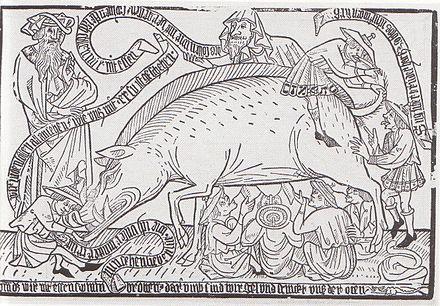
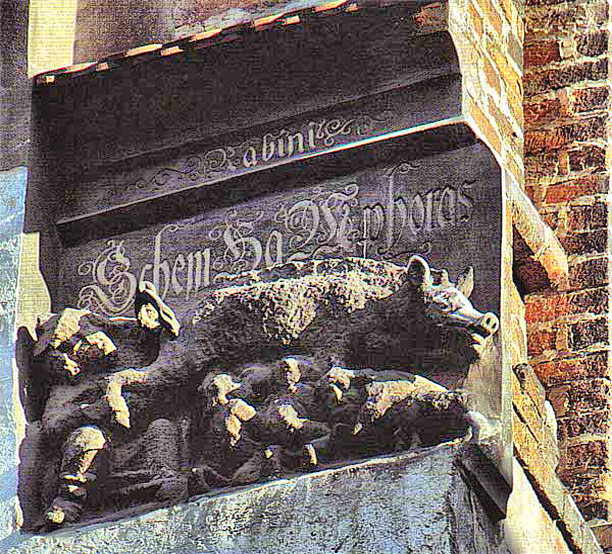
Judensau

Wittenberg
shem ha-meforash = possibly a tannaitic term for tetragrammatron
Here on our church in Wittenberg a sow is sculpted in stone. Young pigs and Jews lie suckling under her. Behind the sow a rabbi is bent over the sow, lifting up her right leg, holding her tail high and looking intensely under her tail and into her Talmud, as though he were reading something acute or extraordinary, which is certainly where they get their Shemhamphoras.
Luther in Wittenberg
Weber, Calvin, Luther
By Jeremiah Cataldo
Weber, Calvin, Luther
- 1,332