Ancient Judaism
http://biblia.com/books/nrsv/Ne13.1
- What are the dominant attributes of the subject community? (That is, how would you describe it in colloquial terms?)
- Does the text tell us anything about social relations?
- Does it tell us anything about economic relations?
- What are some foreseeable problems with using this passage as a guide for modern living?
Background History on Israelite History and Religion
Political Background: Confederacy
- It is quite possible that different tribes worshiped difference deities.
- Max Weber proposed that Yahweh was the god of the confederacy of Canaanite tribes against the Philistines.
- Yahweh symbolized order and solidarity in the face of an imminent threat.
- "Israel" = multivalent term:
- Denotes northern kingdom in contrast to the southern kingdom of Judah
- Adopted by southern authors to refer to Judah
- Adopted by returning exiles as the identification of a restored nation/kingdom
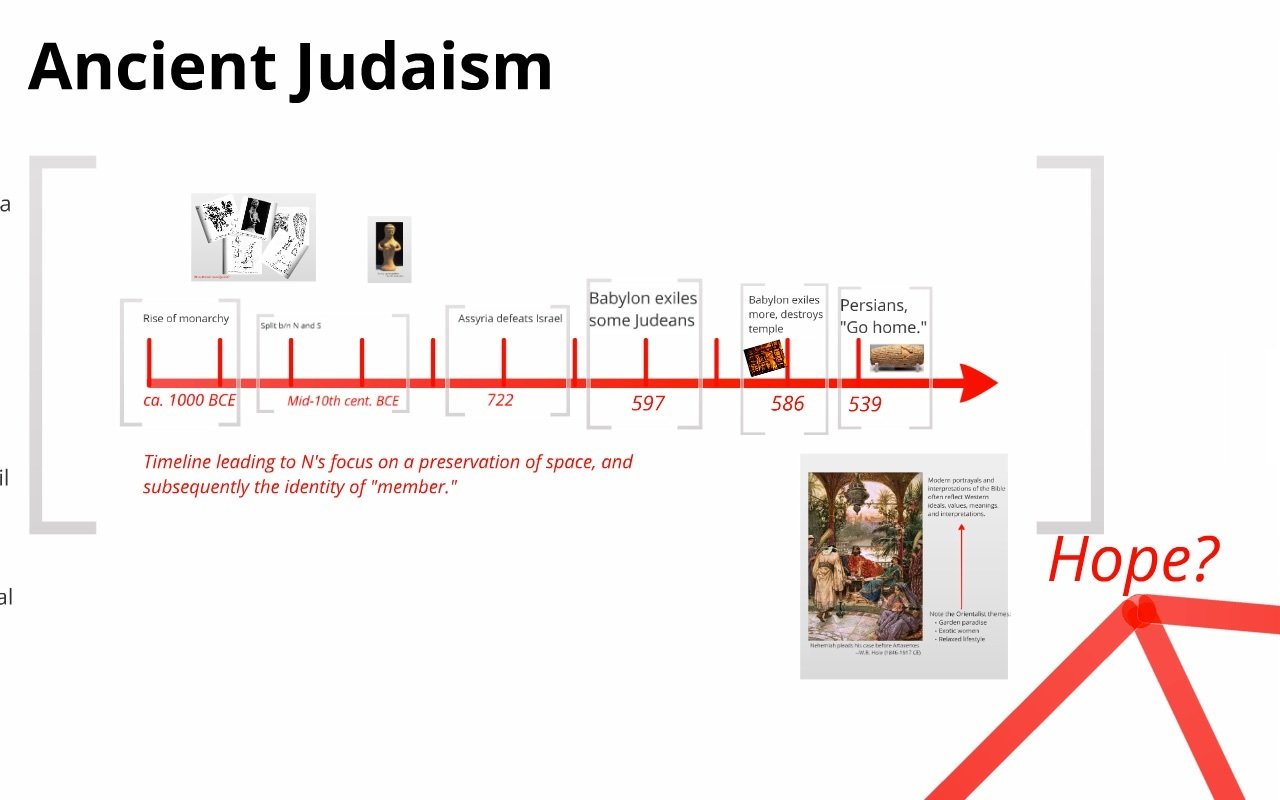
Chronology

Religious Background
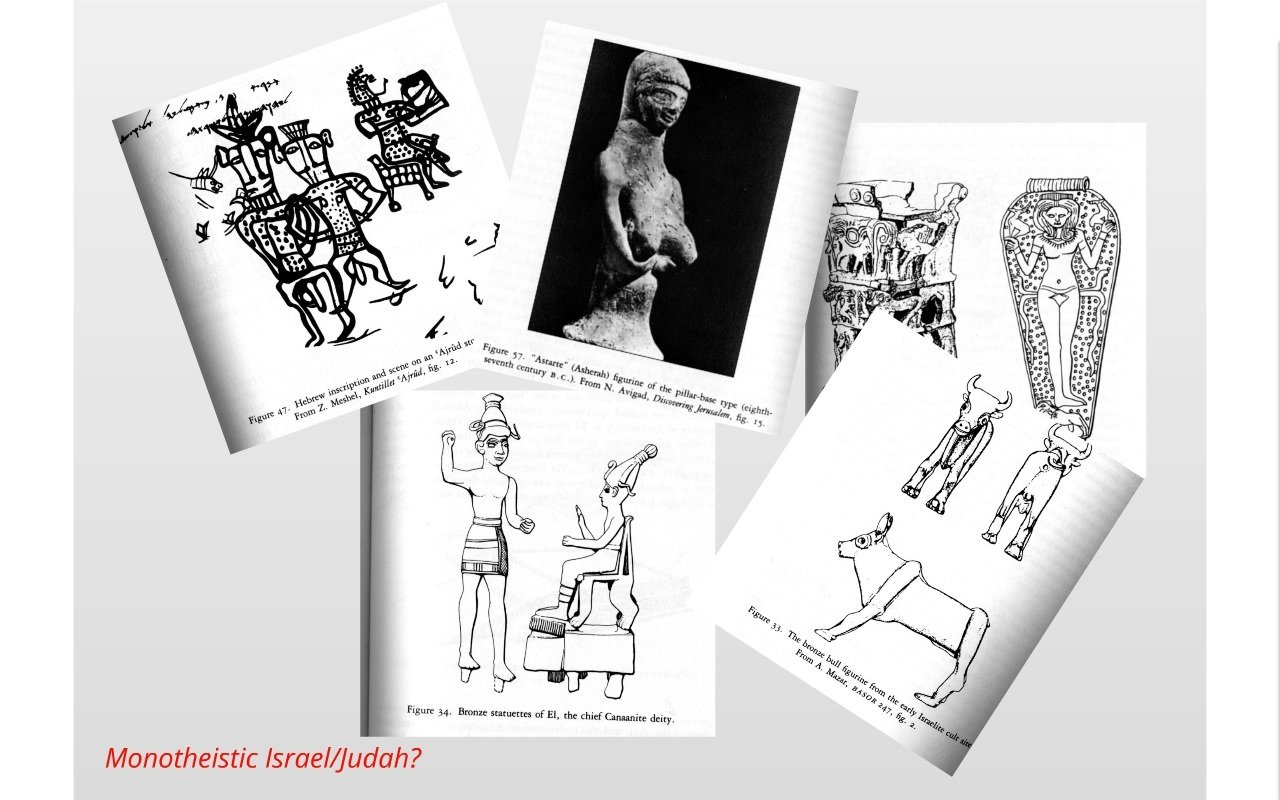
- Despite popular perception, Israel was not always monotheistic.
- Strict monotheism doesn't emerge until during the 6th century B.C.E. and later.
- Most of the biblical authors pre-6th century accepted the existence of other deities (tended to be henotheistic).

Interpreting the Exile
Deuteronomistic Historian (Dtr.)
- Dtr. maintained that the exiles were punishments from God for disobedience.
- The prophets (for which we have record) largely supported this view.
Ezra-Nehemiah
- Ezra-Nehemiah reinforces boundaries to distinguish between insider and outsider.
- EN interprets the "disobedience of Israel" as a consequence of assimilation.
- EN centralizes the "law" as a shared symbol around which the community should organize itself.
- Obedience to religious law is equated with ethical social-political norm.
- Intermarriage is strictly forbidden (= rewriting the social-political identity of the "citizen").
Golah vs. Am Ha'aretz
- Projected social categories (from golah perspective ... Did the am ha'aretz consider itself as such?)
- Conflict over control of the land resides at the core of this conflict over identity.
Emergence of Monotheism
- Monotheism did not "evolve" in Israel. Israel was heno-/polytheistic until after the exiles.
- Archaeological evidence supports a decline in deities worshipped.
- "Yahweh" became the symbol of collective desire. Yahweh was exclusive because that desire was exclusive. Our desire is symbolized in our deity.
- The early monotheistic community was less concerned about religion for the sake of religion and more about establishing a stabilized world.
Ezra-Nehemiah's prohibition on intermarriage reflected a deep concern for establishing and regulating community boundaries (cf. Neh. 13:23-27).
The "law" in Ezra-Nehemiah was intended to fashion (note constructivist and not descriptive) the social-political order into one consistent with golah collective desire for land and authority.
Modern Relevance of Neh. 13?
Can Neh. 13 be used to support a position such as that advocated in the following?
Fundamentals of Monotheism
Three pillars of monotheism:
- Revelation
- Law
- Restoration
Concepts of an exclusive God did not produce a monotheistic religion. The desire for exclusive authority and control over the land produced the idea of an exclusive God.
- God symbolized collective identity and desire for land and authority (and stability/nomos)
- The actions and and attributes of God reflect those of the community (note for instance, the Mosaic Covenant, the Exodus tradition, Passover, etc.)
Ancient Judaism
By Jeremiah Cataldo
Ancient Judaism
- 1,189