Everettian chance in no uncertain terms
Jer Steeger and James Read


Supporters agree chance should be derived with uncertain belief, but not on how.
- Deutsch (1999) and Wallace (2012) use decision theory
- Sebens and Carroll (2018) use self-locating uncertainty
- McQueen and Vaidman (2019) disagree with Sebens and Carroll's metaphysics of branching
Critics argue these approaches are viciously circular.
- Dawid and Thébault (2025) argue Everettians need a partial interpretation of QM formalism to derive a chance measure, but they don't give a clear one
Supporters agree chance should be derived with uncertain belief, but not on how.
Critics argue these approaches are viciously circular.
We suggest a shift in focus to what Everettians take to be certain.
- They tacitly hold a functional link between chance and certainty, and they agree when we're certain about a branch's isolation.
- We give a partial interpretation defining trivial (0 or 1) chance values, from which we derive the others.
Everettian chance in no uncertain terms
1. 'Chance' tacitly invokes certainty
2. Certainty of isolation helps (sometimes)
3. But 'isolation' is ambiguous
4. Probing Everettian 'isolation' with theory sectors
5. Sectors unite and strengthen Born rule derivations
Everettian chance in no uncertain terms
1. 'Chance' tacitly invokes certainty
2. Certainty of isolation helps (sometimes)
3. But 'isolation' is ambiguous
4. Probing Everettian 'isolation' with theory sectors
5. Sectors unite and strengthen Born rule derivations
1. 'Chance' tacitly invokes certainty
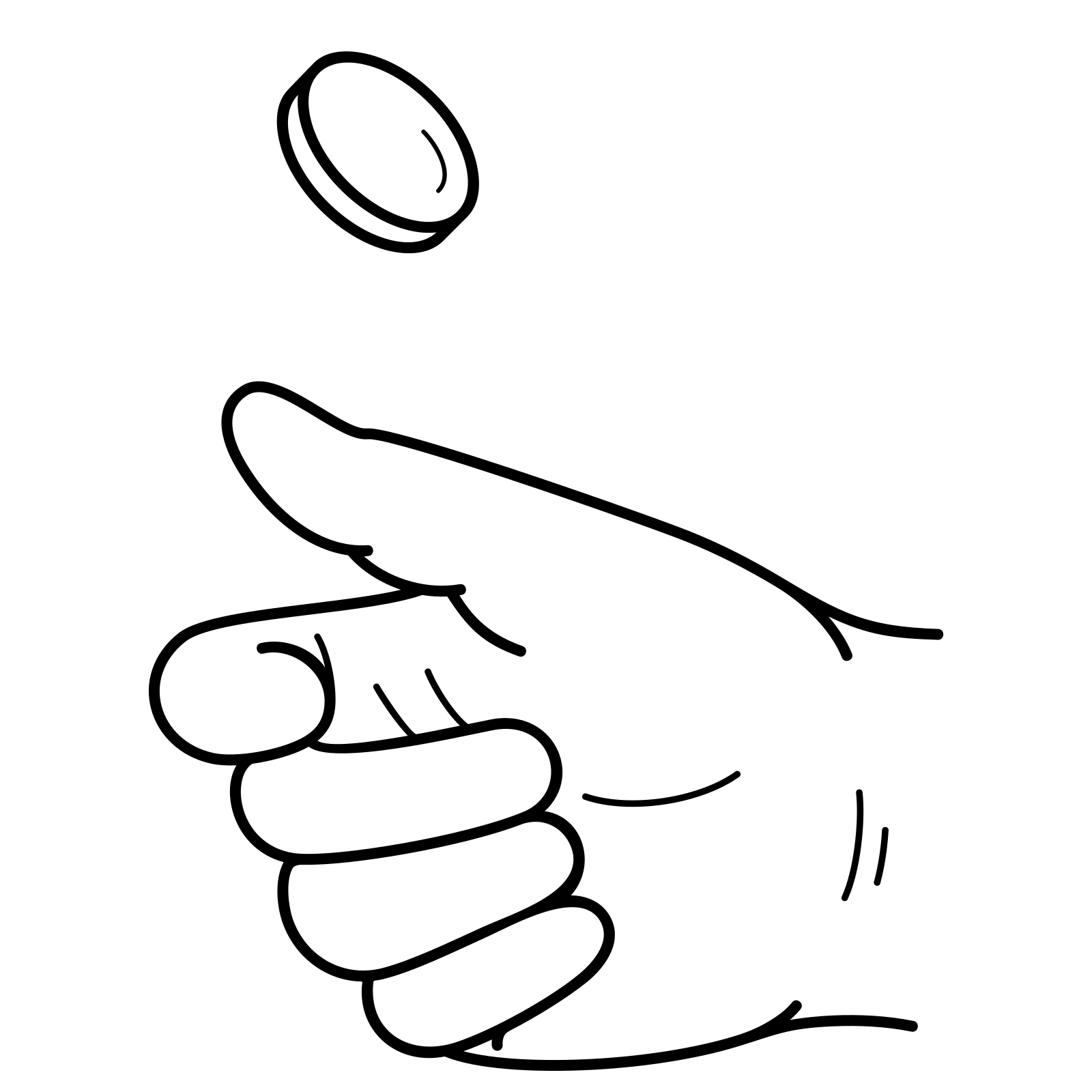


Our approach: functionalism.
- What are the essential functions 'chance' plays in Everettian discourse?
1. 'Chance' tacitly invokes certainty
The main Everettian links (Saunders, 2010):
- (C1) Inference: frequencies measure chance
- (C2) Credence: credence should equal chance
- (C3) Uncertainty: chance events are uncertain
- Do we need this?
- If all outcomes are actual, maybe we don't want it. (Greaves, 2007)
- Still, we can make sense of 'not knowing what branch we're on'
- Even so: does that tell us about a specific measure of chance?
- One way it might: the principle of indifference.
- Alas: this principle struggles to give consistent recommendations!
1. 'Chance' tacitly invokes certainty
Full wordings of the chance links:
- (C1) The inferential link. The chance of an event is measured
(roughly) by (actual) relative frequencies of that event. - (C2) The credential link. All else being equal, one’s subjective
degree of belief or credence in an event ought to equal the
chance of that event. - (C3) The uncertainty link. Chance events, prior to their
occurrence, are uncertain. - (C4) The certainty link. Chance values supervene on the
totality of physical information that is relevant to the
(actual) relative frequencies of the event.
1. 'Chance' tacitly invokes certainty
E.g., van Fraassen's (1989) box factory.


smallest side length:
$$4\text{cm}$$
largest side length:
$$5\text{cm}$$
What are your estimates for side length and face area?
1. 'Chance' tacitly invokes certainty
smallest side length:
$$4\text{cm}$$
largest side length:
$$5\text{cm}$$
- Indifference over length? Estimate for face area: \( 4.5 \times 4.5 = 20.25 \text{cm}^2 \)
- Indifference over face area? New estimate: \( (16 + 25) /2 = 20.5 \text{cm}^2 \)
- Which do we choose?
1. 'Chance' tacitly invokes certainty
smallest side length:
$$4\text{cm}$$
largest side length:
$$5\text{cm}$$
Ideally, we'd like more information about the box factory.
1. 'Chance' tacitly invokes certainty
Motivates a fourth link:
- (C1) Inference: frequencies measure chance
- (C2) Credence: credence equals chance
- (C3) Uncertainty: chance events are uncertain
- (C4) Certainty: chances supervene on physical info we're certain of
Everettian chance in no uncertain terms
1. 'Chance' tacitly invokes certainty
2. Certainty of isolation helps (sometimes)
3. But 'isolation' is ambiguous
4. Probing Everettian 'isolation' with theory sectors
5. Sectors unite and strengthen Born rule derivations
2. Certainty of isolation helps (sometimes)
Maybe information about when a system is isolated will help.
Does indifference over side length yield chance values?
(C1) inference:
relative frequencies might not track these values even roughly!

2. Certainty of isolation helps with reference class
What goes wrong in the box factory? Maybe it's the reference class problem.
- I.e., we don't know whether the right reference class varies lengths or varies areas.
- Most Everettians follow subjectivists by analyzing chance in terms of credence. Isn't this only a problem frequentists?
2. Certainty of isolation helps with reference class
Doesn't the reference class problem apply only to frequentists?
- For us, physical theory trumps all else.
- We view this as a consistency constraint: if we think QM is authoritative enough to describe the totality of relevant empirical info, it had better also give us our expert credence function!
- First, let's see if we can pin down a 'reference class' (or: unique expert credence function) for the box factory.
2. Certainty of isolation helps with reference class
Doesn't the reference class problem apply only to frequentists?
- Hájek (2007) argues not: subjectivists fill in the credential link, (C2), by asking us to set our credence according to some expert's: $$\textit{cr} (X \mid \textit{cr}_\text{expert}(X) = x) = x,$$ where \(\textit{cr}_\text{expert}(X)\) could be a Lewisian chance function, a function given by a physical theory, a logical probability, etc.
- And these plausibly give different answers: ‘You can’t serve all your masters at once, so you have to play favorites. But who trumps whom, and which trumps which?’ (2007, p. 597).
2. Certainty of isolation helps (sometimes)
Maybe isolation and symmetries will help.

angled cutters
drop at time \(t\)
$$x$$
$$ \textit{ch}_t (s) = \textit{ch}_{t+t'} (s + t'\, \text{mod} \,1) $$
\(1\text{cm}/\text{s}\)
\(s=\) length past \(4\text{cm}\)
Rods' distribution described by (unknown) \(\textit{ch}_t(x) = \textit{ch}_t(s)\)

Does this pin down a chance measure?
$$ \textit{ch}_t (s) $$
2. Certainty of isolation helps (sometimes)
Maybe isolation and symmetries will help.
angled cutters
drop at time \(t\)
$$x$$
\(1\text{cm}/\text{s}\)
\(s=\) length past \(4\text{cm}\)
Does this pin down a chance measure?
$$ \textit{ch}_t (s) = \textit{ch}_{t+t'} (s + t'\, \text{mod} \,1) $$
Rods' distribution described by (unknown) \(\textit{ch}_t(x) = \textit{ch}_t(s)\)
$$ \textit{ch}_{t+.5} (s + .5\, \text{mod} \,1) $$
2. Certainty of isolation helps (sometimes)
Isolation and symmetries will help, sometimes.
angled cutters
drop at time \(t\)
$$x$$
\(1\text{cm}/\text{s}\)
\(s=\) length past \(4\text{cm}\)
Rods' distribution described by (unknown) \(\textit{ch}_t(x) = \textit{ch}_t(s)\)
changing \(t\) does not change frequencies of \(s\)
2. Certainty of isolation helps (sometimes)
Isolation and symmetries will help, sometimes.
angled cutters
drop at time \(t\)
$$x$$
\(1\text{cm}/\text{s}\)
\(s=\) length past \(4\text{cm}\)
changing \(t\) does not change frequencies of \(s\):
$$ \textit{ch}_t (s) = \textit{ch}_{t+t'} (s + t'\, \text{mod} \,1) = \textit{ch}_{t'} (s)$$
Rods' distribution described by (unknown) \(\textit{ch}_t(x) = \textit{ch}_t(s)\)
$$ \textit{ch}_t (s) $$
2. Certainty of isolation helps (sometimes)
Isolation and symmetries will help, sometimes.
- Find a subsystem that is isolated. For \(U\) the factory and \(S\) the cutter dropping at \(t=0\),$$\textit{ch}(s\mid U) = \textit{ch}(s\mid S)$$
- Find a symmetry of that subsystem. For \(S'\) the cutter dropping at \(t\) and \(s' = s + t \, \text{mod}\, 1\),$$\textit{ch}(s\mid S) = \textit{ch}(s' \mid S')$$
- Find states identified by that symmetry. If \(t\) doesn't change the outcomes, then we should set \(S=S'\), and $$ \textit{ch}(s\mid S) = \textit{ch}(s' \mid S') = \textit{ch}(s'\mid S)$$
2. Certainty of isolation helps (sometimes)
Isolation and symmetries will help, sometimes.
- Find a subsystem that is isolated. For \(U\) the factory and \(S\) the cutter dropping at \(t=0\),$$\textit{ch}(s\mid U) = \textit{ch}(s\mid S)$$
- Find a symmetry of that subsystem. For \(S'\) the cutter dropping at \(t\) and \(s' = s + t \, \text{mod}\, 1\),$$\textit{ch}(s\mid S) = \textit{ch}(s' \mid S')$$
- Find states identified by that symmetry. If \(t\) doesn't change the outcomes, then we should set \(S=S'\), and $$ \textit{ch}(s\mid S) = \textit{ch}(s' \mid S') = \textit{ch}(s'\mid S)$$
2. Certainty of isolation helps (sometimes)
Isolation and symmetries will help, sometimes.
- Ontic Separability Principle (OSP) combines steps 1 and 2: $$\textit{ch}(s\mid U) = \textit{ch}(s\mid S) = \textit{ch}(s' \mid S')$$
- Step 3 might uncover some \(S'=S\).
2. Certainty of isolation helps with reference class
Isolation and symmetries will help, sometimes.
- Ontic Separability Principle (OSP). Suppose that a physical theory \(T\) specifies the totality of physical information that is relevant to the (actual) relative frequencies of an event \(X\) in a system \(U\). Moreover, suppose that \(X\) occurs in an isolated subsystem \(S\) of \(U\), and that a map from \(X\) in \(S\) to \(X'\) in \(S'\) preserves its relative frequency. Then \(T\) should assign chance values to \(X\) in \(S\) that are independent of the environment \(U \setminus S\) and preserved by this map: $$\textit{ch}(s\mid U) = \textit{ch}(s\mid S) = \textit{ch}(s' \mid S')$$
- OSP gets steps 1 and 2; step 3 might uncover some \(S'=S\).
2. Certainty of isolation helps with reference class
The isolated system \(S\) in OSP acts as our reference class.
- When OSP gives strong enough constraints to pin down a single measure, it affords a pragmatic resolution of the reference class problem that applies equally well to Lewisians and frequentists (and others besides).
- ...as long as we're clear about that first step of identifying an isolated subsystem...
Everettian chance in no uncertain terms
1. 'Chance' tacitly invokes certainty
2. Certainty of isolation helps (sometimes)
3. But 'isolation' is ambiguous
4. Probing Everettian 'isolation' with theory sectors
5. Sectors unite and strengthen Born rule derivations
3. But 'isolation' is ambiguous
We want a notion of 'isolation' that works for explicitly non-local theories.
Our functional analysis of 'isolation':
- (I1) Recursion: isolated subsystems should have a recursive structure
- (I2) Control: we can study them in a laboratory
3. But 'isolation' is ambiguous
Wallace's (2022a; 2022b) theory sectors help us get a handle on recursion.
- Roughly, a sector of a theory identifies a system where the following can be described without reference to any other system:
- kinematics
- dynamics
- symmetries fixing intrinsic properties
- relations of restriction and extension between subsystems
3. But 'isolation' is ambiguous
Wallace's (2022a; 2022b) theory sectors help us get a handle on recursion.
- Example: a subset \(M\) of \(N\) charged particles very far from the others identifies a sector of Coulombic electrostatics.
- kinematics: charges, masses, and positions of the \(M\) particles
- dynamics: Coulomb's law, \(F = k \frac{|q_1q_2|}{ r^2}\)
- symmetries: translation, rotation, permutation, etc., fixing (e.g.) relative distances as intrinsic properties
- relations of restriction and extension between subsystems (e.g., projection onto a further subset \(L\subset M\))
3. But 'isolation' is ambiguous
Wallace's (2022a; 2022b) theory sectors help us get a handle on recursion.
- Crucially, Wallace doesn't think all sectors are isolated!
- E.g.: Newtonian gravity (NG) defines sectors nearly identical to those of electrostatics.
- The fields (electric or gravitational) vanish at a sector's boundary.
- But then no Earth-bound laboratory is a sector of NG!
- Using different boundary conditions for the gravitational potential field, we get new sectors that include these labs.
- Doing the same for electrostatics gives a less strict (but still useful) notion of isolation!
3. But 'isolation' is ambiguous
The gravitational potential field
$$ \frac{\mathrm{d}^2}{\mathrm{d}t^2} x^i_J = \nabla_i \Phi(x^i_J,t)$$
satisfies the Poisson equation
$$\nabla^2 \Phi(x,t) = -4\pi G \sum_J \delta (x-x_J) m_J.$$
and is linear at the boundary:
$$\lim_{|x|\to \infty} \Phi(x,t) = \Phi_0 (t) + a_i(t) x^i(t)$$
If it is constant at the boundary, this theory recovers Newton's law.
3. But 'isolation' is ambiguous
- So, we flesh out the recursion link with Wallace's (2022a; 2022b) theory sectors, and the case of Newtonian gravity motivates the control link.
- (I1) The recursion link. Roughly, 'isolated subsystems' should instantiate a recursive structure (like Wallace's theory sectors).
- (I2) The control link. We can study them in a laboratory.
- There are plausibly many valid ways of fleshing out these links—just like Lewisians and frequentists differ on how to fill in (C1)–(C4).
- Using theory sectors for (I1) meshes nicely with OSP.
3. But 'isolation' is ambiguous
- Using theory sectors for (I1) meshes nicely with OSP. Recall from OSP:$$\textit{ch}(s\mid U) = \textit{ch}(s\mid S) = \textit{ch}(s' \mid S')$$
- The second equality gives a function of states \(S\) and outcomes \(s\) that is preserved by applying a symmetry map to both.
- In other words, it says the chances are the same up to a re-labeling of outcomes.
- This closely matches what Wallace would call an intrinsic property of a sector.
- Thus, we'll refer to chance's invariance under re-labeling as OSP's intrinsicality condition.
3. But 'isolation' is ambiguous
Defining intrinsic properties requires characterizing all symmetries.
- Thorny!
- Our heuristic: if we know a property is intrinsic, any putative symmetry should preserve it.
- E.g., any putative symmetry of NG should preserve relative distances.
- For QM, any putative symmetry should preserve eigenstates and their orthogonality
Everettian chance in no uncertain terms
1. 'Chance' tacitly invokes certainty
2. Certainty of isolation helps (sometimes)
3. But 'isolation' is ambiguous
4. Probing Everettian 'isolation' with theory sectors
5. Sectors unite and strengthen Born rule derivations
4. Probing Everettian 'isolation' with theory sectors
- Microstates 1 and 2 are isolated iff
- their kinematical states are separable: $$\psi_{12} = \psi_1\otimes \psi_2$$
- and their dynamics are separable: $$U_{12} = U_1\otimes U_2$$
- If macrostates 1 and 2 are isolated,
- their kinematical states are orthogonal: $$\psi_1\bot\psi_2$$
- their dynamics are completely described by their own unitaries
- Orthodoxy adds: either 1 or 2 occurs after a projection
- Everettians add: both 1 and 2 occur but are dynamically isolated
4. Probing Everettian 'isolation' with theory sectors
- According to orthodoxy about quantum mechanics, there are two dynamical rules:
- unitary dynamics describes self-evolution
- projective dynamics describes measurement
- In contrast, a traditional selling point of Everettian
approaches is that they treat all dynamics as unitary. - Thus, one might think that orthodoxy will frustrate attempts
to define a theory sector, while Everettian approaches will
accommodate sectors more straightforwardly.- Both of these impressions are false!
4. Probing Everettian 'isolation' with theory sectors
- Thus, one might think that orthodoxy will frustrate attempts
to define a theory sector, while Everettian approaches will
accommodate sectors more straightforwardly.- Both of these impressions are false!
- On the orthodox approach, one can helpfully use von Neumann’s measurement scheme to relegate projective dynamics to interactions with macroscopic objects.
- Similarly, Everettians rely on projections to specify the sense in which their macrostates—branches—are dynamically isolated.
- Both of these impressions are false!
- Everettian or not, use two sectors: one for microstates and one for macrostates.
4. Probing Everettian 'isolation' with theory sectors
How defensible is the orthodox approach?
- Nice notions of extension and restriction in both 'space' (smaller and larger systems) and 'time' (before and after measurement)
- Two problems:
- Using projections means measurements must be repeatable; no room for noise.
- Too strict: like how Earth-bound labs couldn't test our first pass at Newtonian gravity. (Measurement theory addresses this!)
- It's not clear why some projections are allowed and not others.
- Too liberal: like saying we don't need the electric field to vanish in electrostatics.
- Using projections means measurements must be repeatable; no room for noise.
4. Probing Everettian 'isolation' with theory sectors
How defensible is the orthodox approach?
- It's not clear why some projections are allowed and not others.
- Too liberal: like saying we don't need the electric field to vanish in electrostatics.
- Everettians address this with decoherence (at least in part).
- This gives a dynamical explanation both for which projections define macrostates and how macrostates stay isolated.
- The 'how' is the branching criterion: only one prior branch \(i\) contributes to any future branch \(j\),
$$|\psi_{ij}^{t_1 t_2}|\neq 0, \,|\psi_{i'j}^{t_1 t_2}|\neq 0 \Longleftrightarrow i= i' $$
- The 'how' is the branching criterion: only one prior branch \(i\) contributes to any future branch \(j\),
4. Probing Everettian 'isolation' with theory sectors

\(\oplus\)
\(\oplus\)
- Branching doesn't ensure quasi-classicality, but it's still a useful notion of isolation (like that for generalized electrostatics)
- Realistic systems only branch approximately; appeal to the \(\hbar\to 0\) limit to idealize without chance (Dawid and Thébault, 2025)
4. Probing Everettian 'isolation' with theory sectors

4. Probing Everettian 'isolation' with theory sectors
Branching criterion: only one prior branch \(i\) contributes to any future branch \(j\),
$$|\psi_{ij}^{t_1 t_2}|\neq 0, \,|\psi_{i'j}^{t_1 t_2}|\neq 0 \Longleftrightarrow i= i' $$
Where
$$ \Psi_{ij}^{{t_1}{t_2}} = {\hat{X}_j^{t_2} \hat{U}^{t_2\leftarrow t_1} {\hat{X}_i^{t_1}} \hat{U}^{t_1\leftarrow t_0} \Psi^{t_0}.} $$
\(\hat{X}\) is a macroscopic projection (a coarse-graining of a projection onto a microstate).
4. Probing Everettian 'isolation' with theory sectors
- Microstates' intrinsic properties:
- Any symmetry must preserve eigenstates and their orthogonality
- Uhlhorn's theorem: therefore, any symmetry must preserve Born weights (for \(\mathrm{dim}(\mathcal{H}) \geq 3\))
- Partial interpretation: zero weight = zero chance
- Macrostates' intrinsic properties:
- Any (new) symmetry must preserve macrostate membership and orthogonality
- Repartitionings exhaust these and preserve Born weights
- Partial interpretation: zero weight = zero chance
Everettian chance in no uncertain terms
1. 'Chance' tacitly invokes certainty
2. Certainty of isolation helps (sometimes)
3. But 'isolation' is ambiguous
4. Probing Everettian 'isolation' with theory sectors
5. Sectors unite and strengthen Born rule derivations
5. Sectors unite and strengthen Born rule derivations
The core approach, sketch:
- Chances are a function of Born weights.
- By Uhlhorn's theorem, state-outcome pairs \((X,S)\) and \((X',S')\) are symmetric iff the have the same Born weights.
- Apply OSP, assuming chances are intrinsic.
- This function is increasing. Construct a suitable partition.
- This function is the identity for rational weights. Follows from partial interpretation (0 weight = 0 chance) and suitable partition.
- It is the identify for all real weights. Require that the function is continuous and construct appropriate sequences.
5. Sectors unite and strengthen Born rule derivations
- To illustrate, consider the two-branch case:
$$ (a{\color{orange}|\!\uparrow\rangle} + b {\color{Magenta}|\!\downarrow\rangle})|A\rangle |E\rangle \to a{\color{orange}|\!\uparrow\rangle |A_\uparrow \rangle |E_\uparrow\rangle } + b {\color{Magenta}|\!\downarrow \rangle|A_\downarrow \rangle |E_\downarrow \rangle} $$ The RHS specifies a microstate \(S\) with macrostates \(\color{orange}X_1\) and \(\color{Magenta}X_2\). - Apply a unitary transformation that swaps the two branches:
$$ (a{\color{Magenta}|\!\downarrow\rangle} + b {\color{orange}|\!\uparrow\rangle})|A'\rangle |E'\rangle \to a {\color{Magenta}|\!\downarrow \rangle|A_\downarrow \rangle |E_\downarrow \rangle} + b {\color{orange}|\!\uparrow\rangle |A_\uparrow \rangle |E_\uparrow\rangle} $$ The RHS specifies a microstate \(S'\) with macrostates \(\color{Magenta}X_1'\) and \(\color{orange}X_2'\).- When \(a=b\), \(S'=S\).
- And the macrostates repartition the originals; i.e., there is a repartitioning such that \({\color{Magenta}X_{1}'} = {\color{Magenta}X_{2'}}\) and \({\color{orange}X_{2}'} = {\color{orange}X_{1'}}\).
- Combining with OSP: $$\textit{ch}({\color{orange}X_1}\mid S) = \textit{ch}({\color{Magenta}X_{1}'}\mid S') = \textit{ch}({\color{Magenta}X_{2'}} \mid S) = \textit{ch}({\color{Magenta}X_{2} } \mid S) $$
5. Sectors unite and strengthen Born rule derivations
- Comparisons with existing approaches:
- Wallace (2012) uses erasures to send symmetric branches to the same state
- In tension with subsystem recursivity: erasures can't be performed at the same time (Mandolesi, 2019)
- Sebens and Carroll (2018) use global branching to identify microstates belonging to the same (agent) macrostate
- This only applies a short time before decoherence reaches them (McQueen and Vaidman, 2019)
- McQueen and Vaidman (2019) use symmetry and locality
- We only need the symmetries of NRQM
- Wallace (2012) uses erasures to send symmetric branches to the same state
5. Sectors unite and strengthen Born rule derivations
The core issue in S&C's setup:
$$| \Psi_0 \rangle = | R_0 \rangle_A |R \rangle_{D1} |R \rangle_{D2} |\!\uparrow_x \rangle |E_R \rangle$$
must evolve to
$$| \Psi_1 \rangle = \frac{1}{\sqrt{2}} {\color{orange}| R \rangle_A } |\!\uparrow \rangle_{D1} |\heartsuit \rangle_{D2} |\!\uparrow_z \rangle \left |E_{\uparrow\heartsuit} \right\rangle + \frac{1}{\sqrt{2}} {\color{orange}| R \rangle_A } |\!\downarrow \rangle_{D1} |\diamondsuit \rangle_{D2} |\!\downarrow_z \rangle \left |E_{\downarrow\diamondsuit} \right\rangle$$
but not to
$$ | \Psi_1 ' \rangle = \frac{1}{\sqrt{2}} {\color{Magenta}| R_\uparrow \rangle_A } |\!\uparrow \rangle_{D1} |\heartsuit \rangle_{D2} |\!\uparrow_z \rangle \left |E_{\uparrow\heartsuit} \right\rangle + \frac{1}{\sqrt{2}} {\color{Magenta} | R_\downarrow \rangle_A } |\!\downarrow \rangle_{D1} |\diamondsuit \rangle_{D2} |\!\downarrow_z \rangle \left |E_{\downarrow\diamondsuit} \right\rangle$$
to get identical reduced \(\rho\) for agent \(A\) and detector \(D2\) in the symmetric setup that flips \(\heartsuit\) and \(\diamondsuit\) labels.
5. Sectors unite and strengthen Born rule derivations
S&C's (2018) ESP: Suppose that the universe \(U\) contains within it a set of subsystems \(S\) such that every agent in an internally qualitatively identical state to agent \(A\) is located in some subsystem that is an element of \(S\). The probability that \(A\) ought to assign to being located in a particular subsystem \(X\in S\) given that they are in \(U\) is identical in any possible universe which also contains subsystems \(S\) in the same exact states (and does not contain any copies of the agent in an internally qualitatively identical state that are not located in \(S\)):
$$ c\left( X \mid U\right) = c\left(X\mid S\right). $$
5. Sectors unite and strengthen Born rule derivations
S&C's (2018) ESP-QM: Suppose that an experiment has just measured observable \(\hat{O}\) of system \(S\) and registered some eigenvalue \(O_i\) on each branch of the wavefunction. The probability that agent \(A\) ought to assign to the detector \(D\) having registered \(O_i\) in their branch when the universal wavefunction is \(\Psi\), \(c\left( O_i | \Psi \right)\), only depends on the reduced density matrix of \(A\) and \(D\), \(\hat{\rho}_{AD}\):
$$ c\left( O_i \, | \, \Psi \right) = c \left( O_i \, |\, \hat{\rho}_{AD} \right) .$$
What next?
- Is the need for two sectors anathema to an Everettian approach? Or is it a natural accommodation of lessons from stat mech into an Everettian worldview?
- What other physical theories might yield a chance derivation like the modified box factory?
- What should we do when we can't derive a unique chance measure?
Thank you!
Everettian chance in no uncertain terms (Foundations 2026)
By Jer Steeger
Everettian chance in no uncertain terms (Foundations 2026)
The current landscape of views on the role of chance in the Everett interpretation is rocky. Everettians (Wallace 2012, Sebens and Carroll 2018, McQueen and Vaidman 2019) agree that chance values should be derived using principles governing uncertain or partial belief, but cannot agree on how. Critics (Baker 2007, Dawid and Thébault 2015, Mandolesi 2019) maintain that any such approach is circular. We smooth the landscape by shifting focus from what Everettians take to be uncertain to what they should think is certain: namely, the conditions under which branches are isolated. Our approach to isolation resolves the main tensions among the different Everettian chance derivations while clarifying how they avoid circularity.