Spin 1 physics in molecules and quantum dots
Department of Physics of Complex Systems
Eötvös Loránd University
László Oroszlány
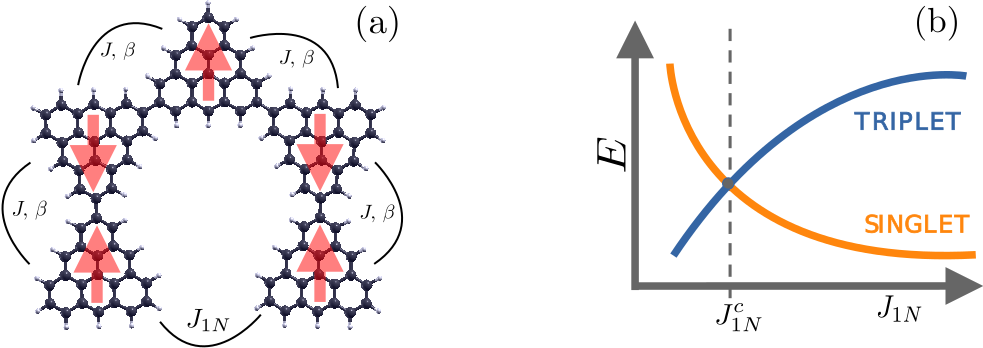



Haldane's conjecture and the AKLT model
\displaystyle \hat H = {\color{red}J} \left (\sum_p \vec{S}_p \cdot \vec{S}_{p+1} + {\color{red}\beta} (\vec{S}_p \cdot \vec{S}_{p+1})^2 \right )
BL-BQ model
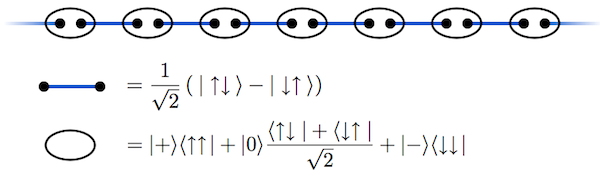
\displaystyle \hat H = \sum_p \vec{S}_p \cdot \vec{S}_{p+1} + \frac{1}{3} (\vec{S}_p \cdot \vec{S}_{p+1})^2
Affleck, Kennedy, Lieb, Tasaki Phys. Rev. Lett. 59, 799 (1987)
\displaystyle H=\sum_p \vec{S}_p\cdot\vec{S}_{p+1}
\(S=\frac{1}{2}\rightarrow\) gapless
\(S=1\rightarrow\) gapped
F. D. M. Haldane Phys. Rev. Lett. 50, 1153 (1983)
How to realize S=1 and the Haldane phase
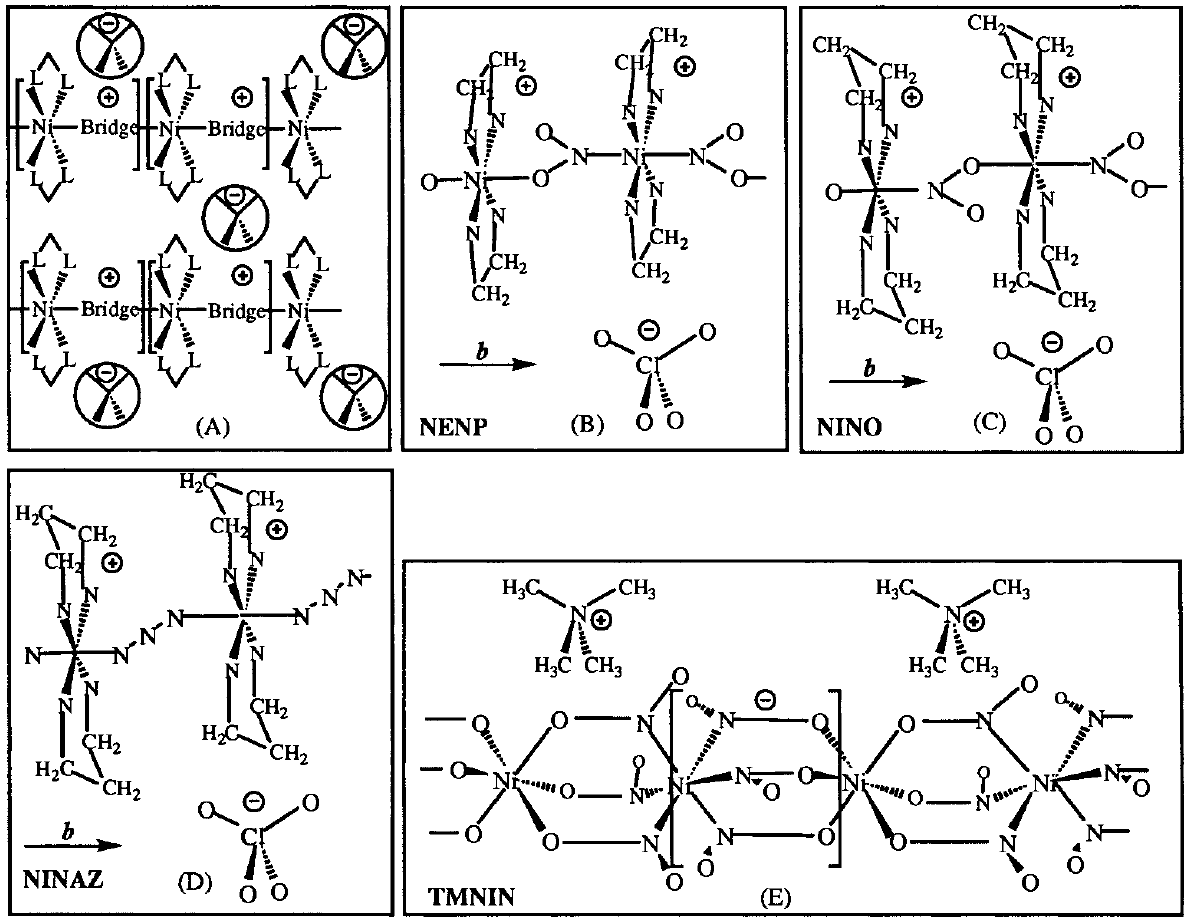
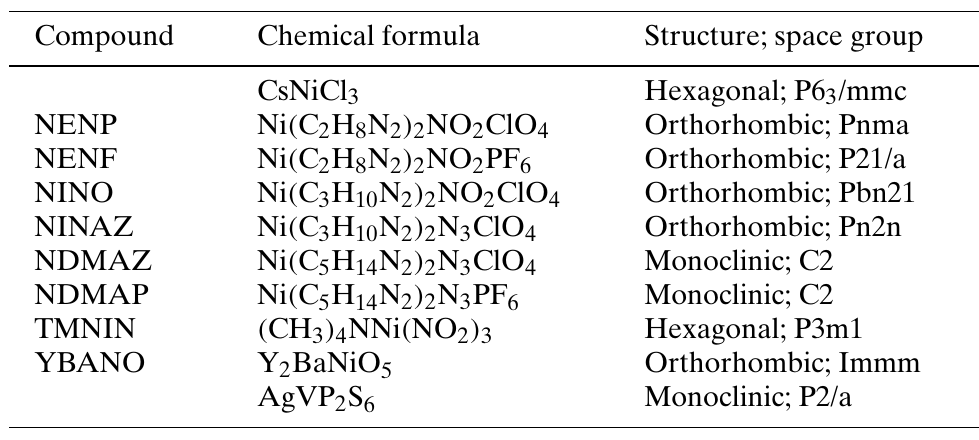
Renard, Regnault, Verdaguer, in
Magnetism: Molecules to Materials I: Models and Experiments
- inelastic neutron-scattering experiments on bulk samples
- interchain interaction
- anisotropy
Can we realize with S=1 with carbon?
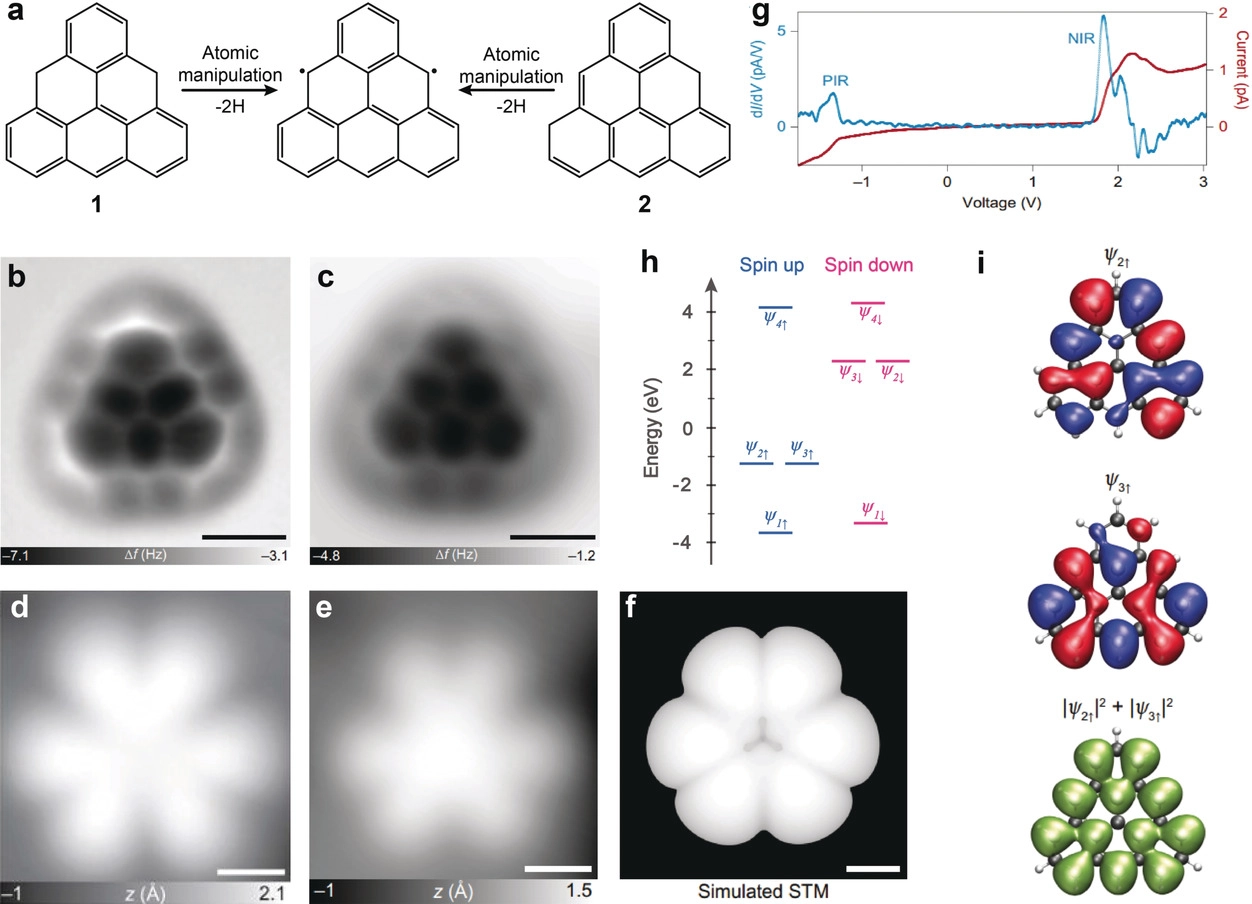
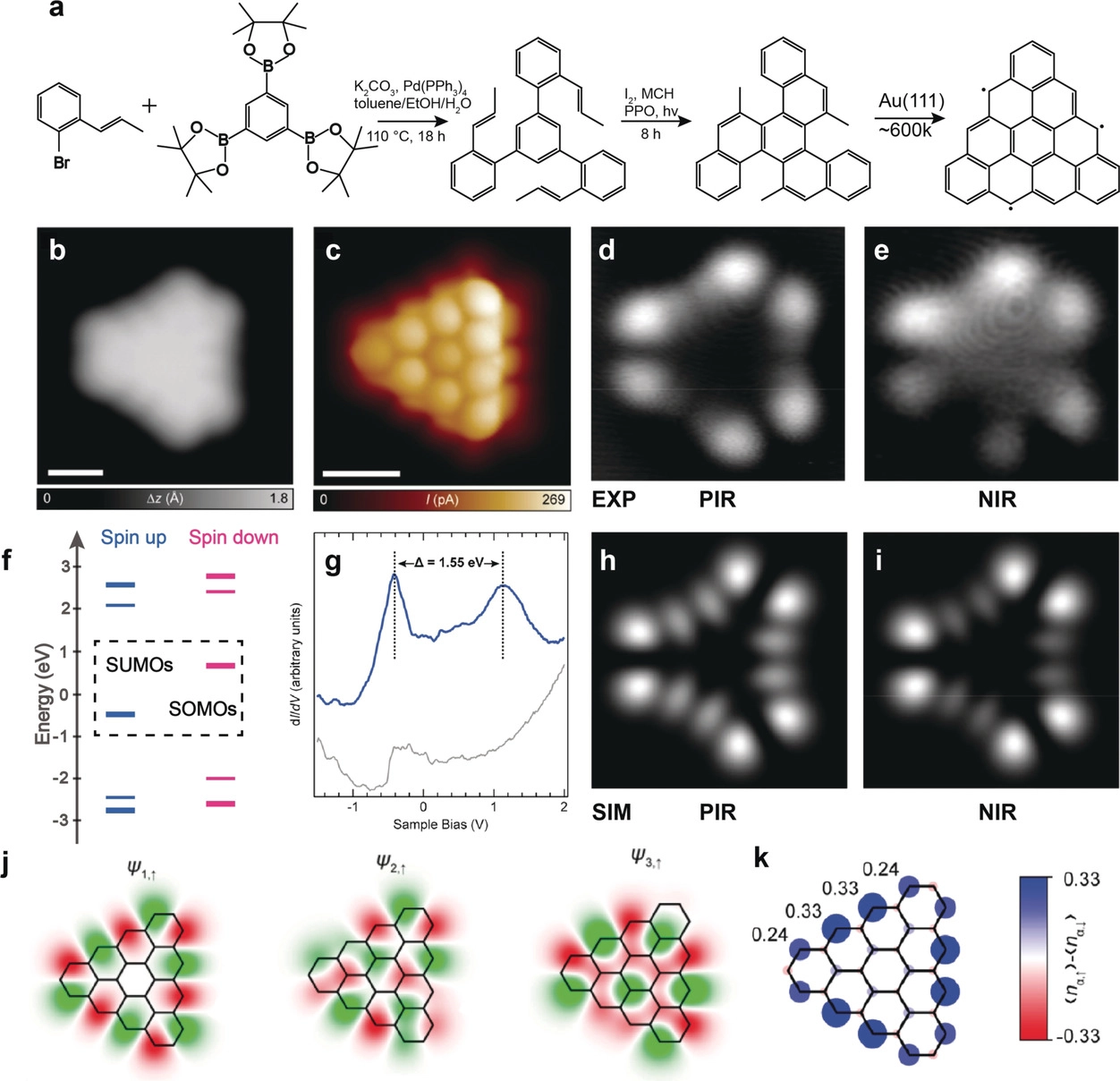
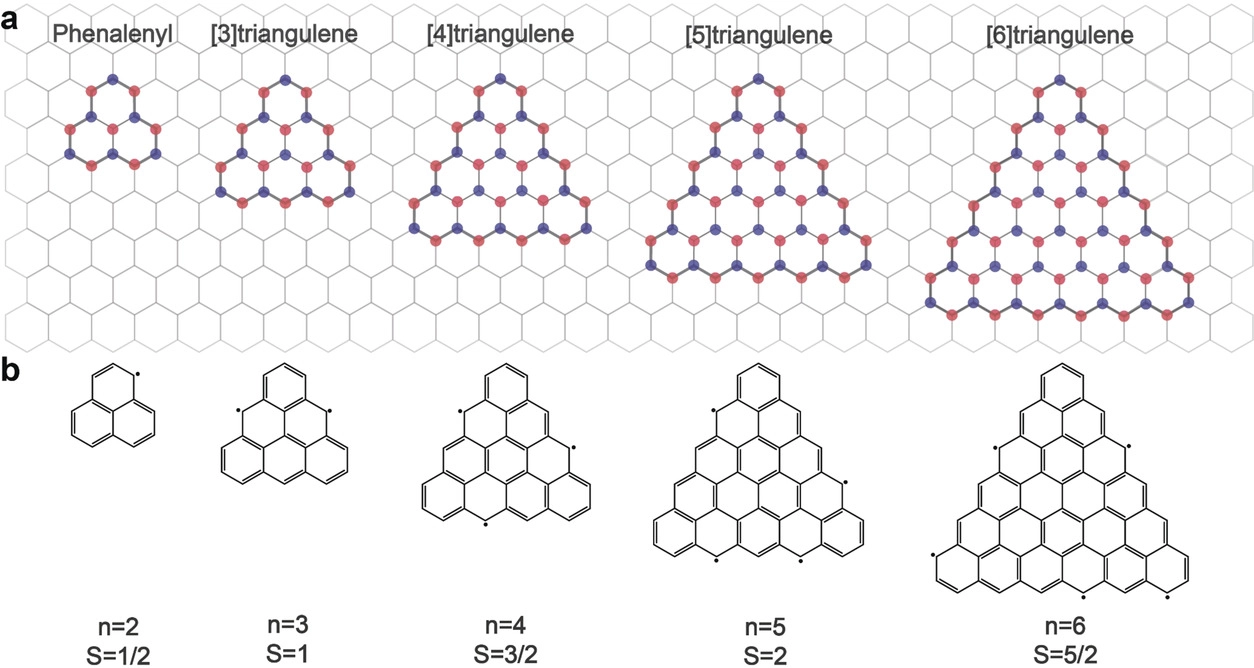
Su, Telychko, Song, Lu Angewandte Chemie 59 7658 (2020)
YES!
E. Lieb,
Phys. Rev. Lett. 62 1201 (1989)
Making a chain!
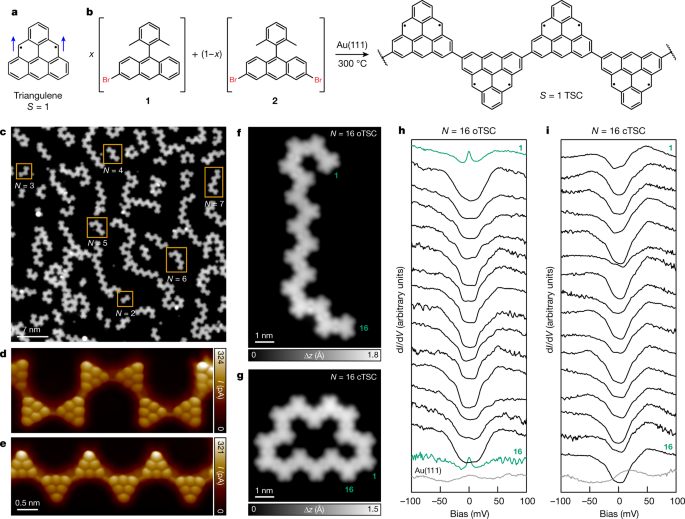
Mishra et al. Nature 598, 287 (2021).
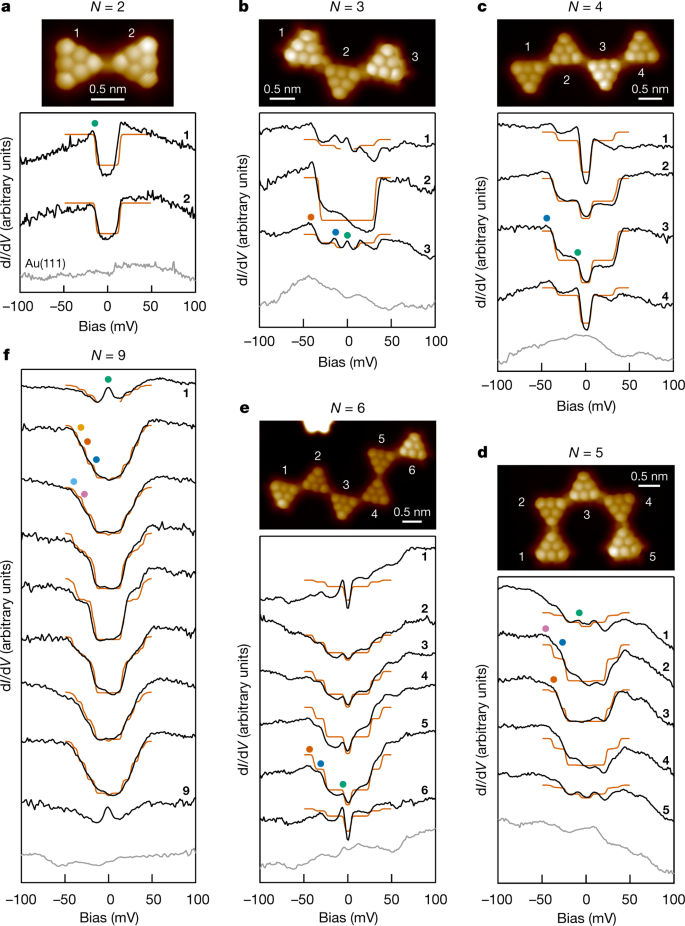
fit to BL-BQ model:
J=18 \mathrm{meV}\, ,\beta=0.09
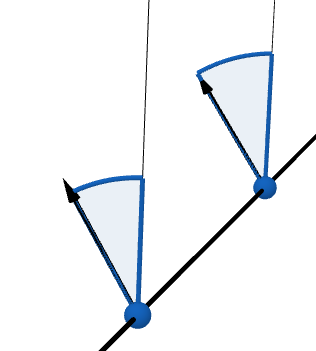
Kicking a black box to learn about its contents
\displaystyle \mathcal{H}=-\frac{1}{2}\sum_{i\ne j}J_{ij}\,\vec{e}_{i}\vec{e}_{j}
J_{ij}=?
\delta E(\vec{e}_{i})=E(\vec{e}_{i})-E_{0}=\left(1-\vec{e}_{i}\vec{e}_{0}\right)\sum\limits _{k\left(\neq i\right)}J_{ik}
\delta E(\vec{e}_{i},\vec{e}_{j})=E(\vec{e}_{i},\vec{e}_{j})-E_{0}=\left(1-\vec{e}_{i}\vec{e}_{j}\right)J_{ij}
+\left(1-\vec{e}_{i}\vec{e}_{0}\right)\sum\limits _{k\left(\neq i,j\right)}J_{ik}+\left(1-\vec{e}_{j}\vec{e}_{0}\right)\sum\limits _{k\left(\neq i,j\right)}J_{jk}\, \\
=\delta E(\vec{e}_{i})+\delta E(\vec{e}_{j})-\left(\vec{e}_{i}-\vec{e}_{0}\right)\left(\vec{e}_{j}-\vec{e}_{0}\right)J_{ij}\,.
\displaystyle E_{0}=-\frac{1}{2}\sum_{i\ne j}J_{ij}
Assume a ferromagnetic arrangement:
E_{ij}^{\mathrm{int}} =\delta E(\vec{e}_{i},\vec{e}_{j})-\delta E(\vec{e}_{i})-\delta E(\vec{e}_{j}) =-J_{ij}\,\delta\vec{e}_{i}\delta\vec{e}_{j}
Ab initio spin model parameters
\displaystyle \delta E^{int}_{nm} = -\frac{1}{\pi} \int \mathrm{Im} \mathrm{Tr} [G\delta V_n G \delta V_m] \mathrm{d}E \rightarrow \mathbb{E}_{nm}\,
\delta\mathbf{S}_n\cdot\delta\mathbf{S}_m
\mathbb{E}_{nm}=J_{nm}\,\left(\,1+2\,\beta_{nm}\left(\mathbf{S}_n\cdot\mathbf{S}_m\right)\,\right)
J_{nm} = \left(\mathbb{E}_{nm}^{FM}+ \mathbb{E}_{nm}^{AFM}\right)/2\\\,\\
\beta_{nm} = \dfrac{1}{2}\,\dfrac{\mathbb{E}_{nm}^{FM}- \mathbb{E}_{nm}^{AFM}}{\mathbb{E}_{nm}^{FM}+\mathbb{E}_{nm}^{AFM}}
\displaystyle \hat H = \sum_{nm} {\color{red}J_{nm}} \left (\vec{S}_n \cdot \vec{S}_{m} + {\color{red}\beta_{nm}} (\vec{S}_n \cdot \vec{S}_{m})^2 \right )

DFT through
| Dimer | Infinite chain | Experiment | |
|---|---|---|---|
| 17.7 meV | 19.75 meV | 18 meV | |
| 0.03 | 0.05 | 0.09 |
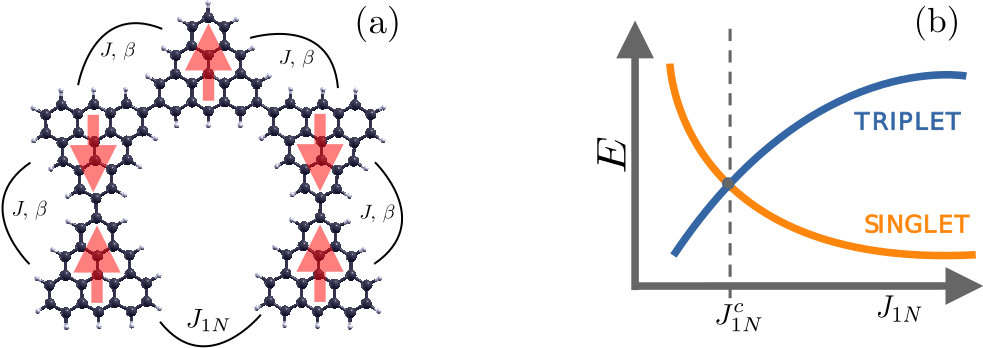
The proof of the pudding
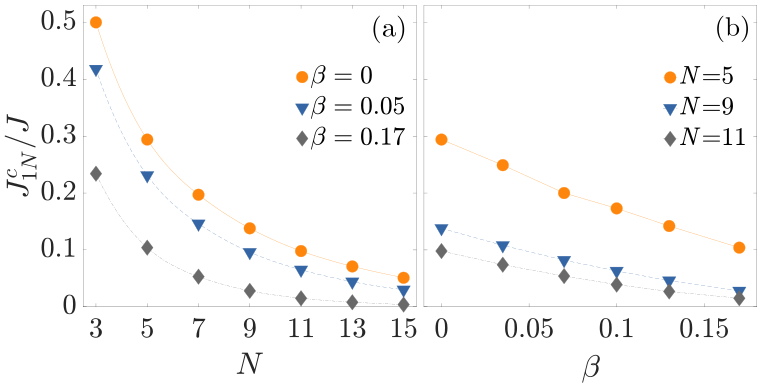
\( \beta \)
\( J \)
Singlet-Triplet transition in odd-length chains
Bridgeing with a sulfur atom \(\Rightarrow\)
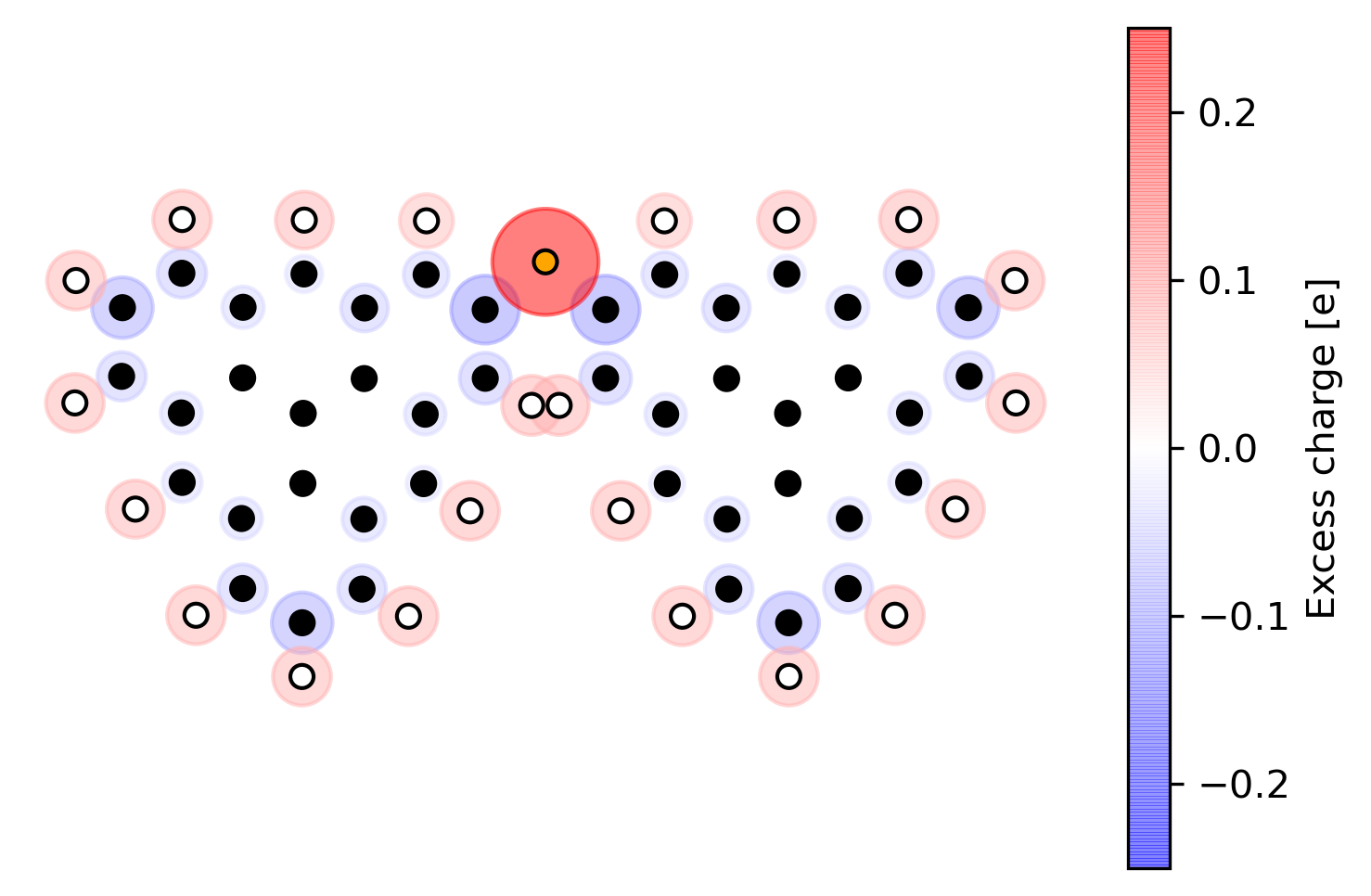
there is a dipole!
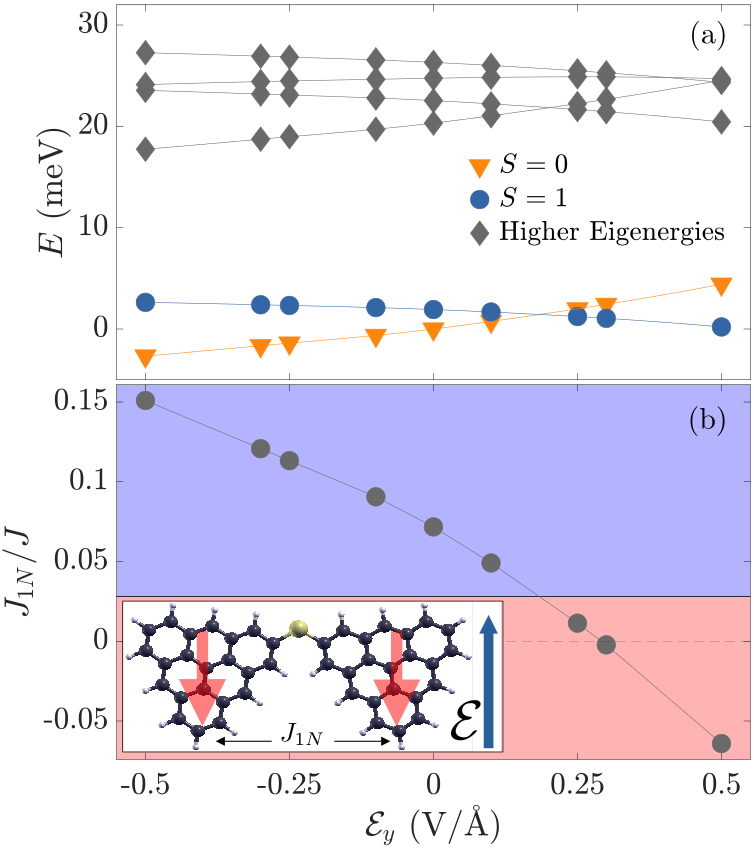
Singlet-Triplet transition through electric field

Get Grogu(py)!
- Very early release !!
- https://github.com/danielpozsar/grogu
- post. proc. for single DFT calculation
- parallel BZ integral with MPI or CUDA
- Generalised Heisenberg model
H(\{\mathbf{S}_i\}) = \frac{1}{2} \sum_{i \neq j} \mathbf{S}_i \mathcal{J}_{ij} \mathbf{S}_j + \sum_i \mathbf{S}_i K_i \mathbf{S}_i

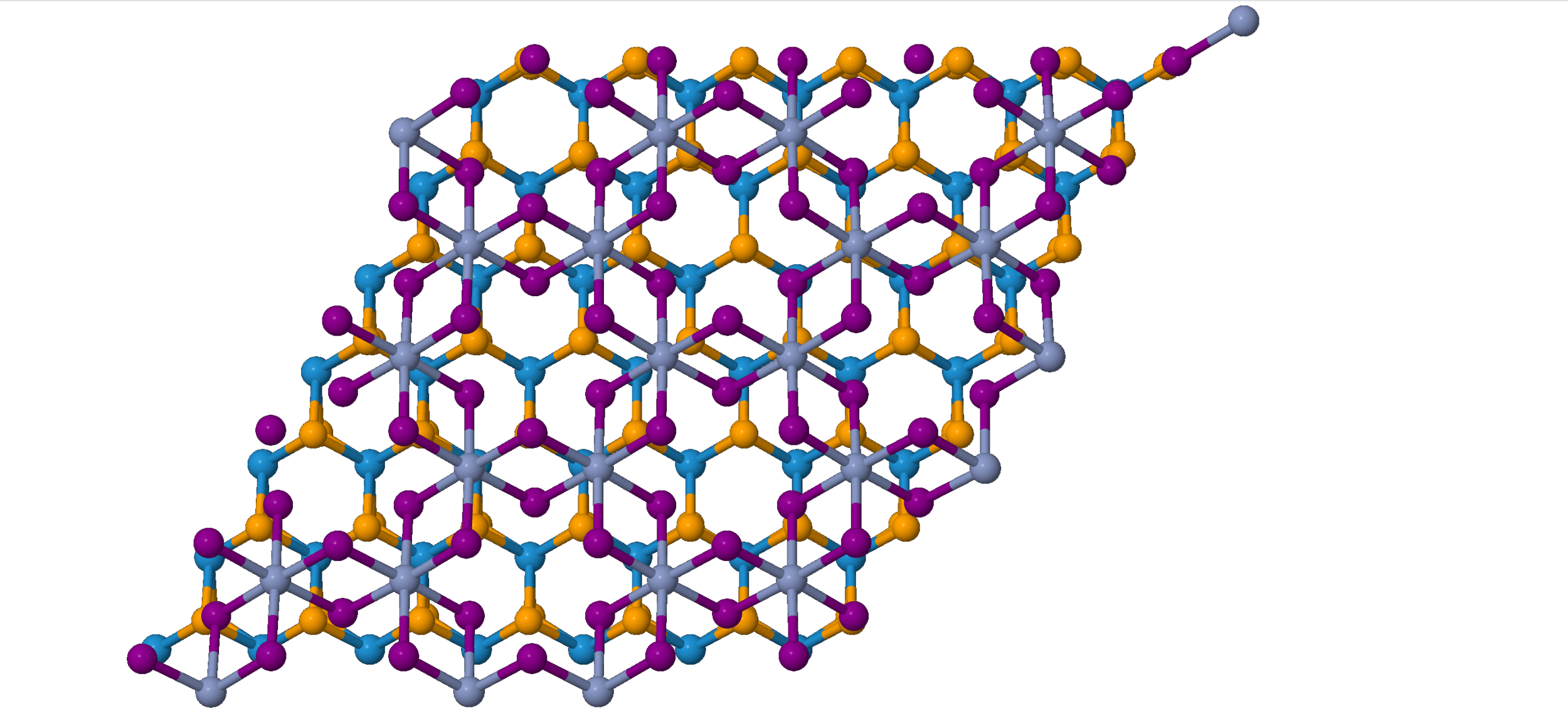
Number of orbitals: 8276
UNDER 1 Hour on 8 GPUs
pip install grogupyMeasurement based quantum computing
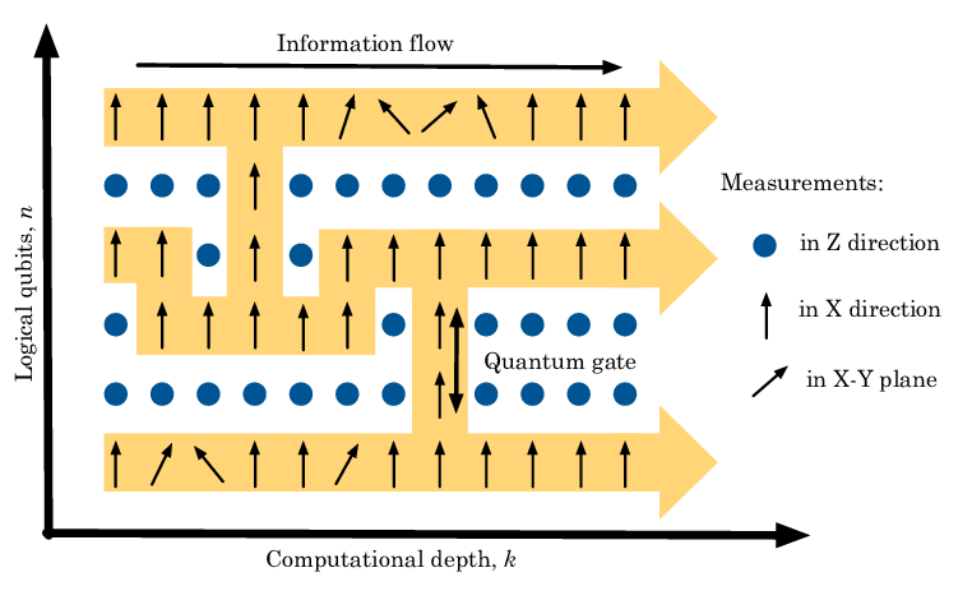


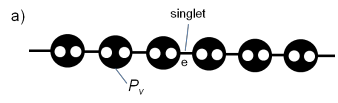
Raussendorf, Briegel Phys. Rev. Lett. 86, 5188 (2001)
Raussendorf
Looking for resource states
Wei, Affleck, Raussendorf Phys. Rev. Lett. 106, 070501 (2011)
Tzu-Chieh Wei
Ian Affleck
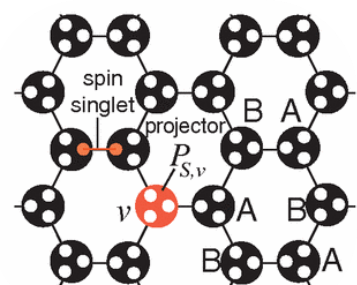
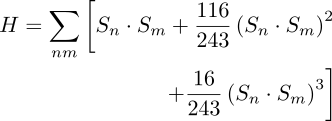

Looking for higher spins

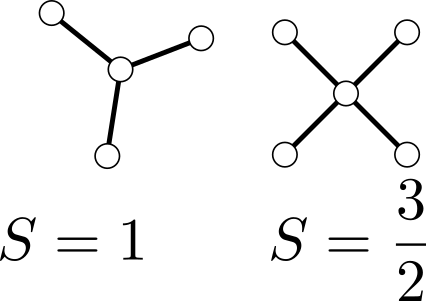
Lieb Phys. Rev. Lett. 62, 1927 (1989)
Elliott Lieb
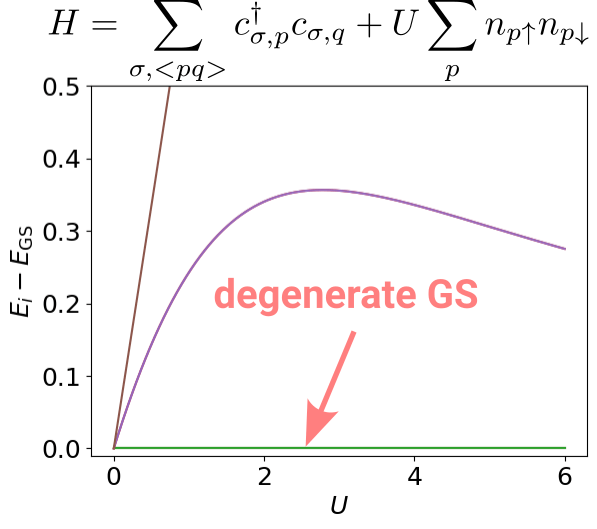
Stars are quite resilient!
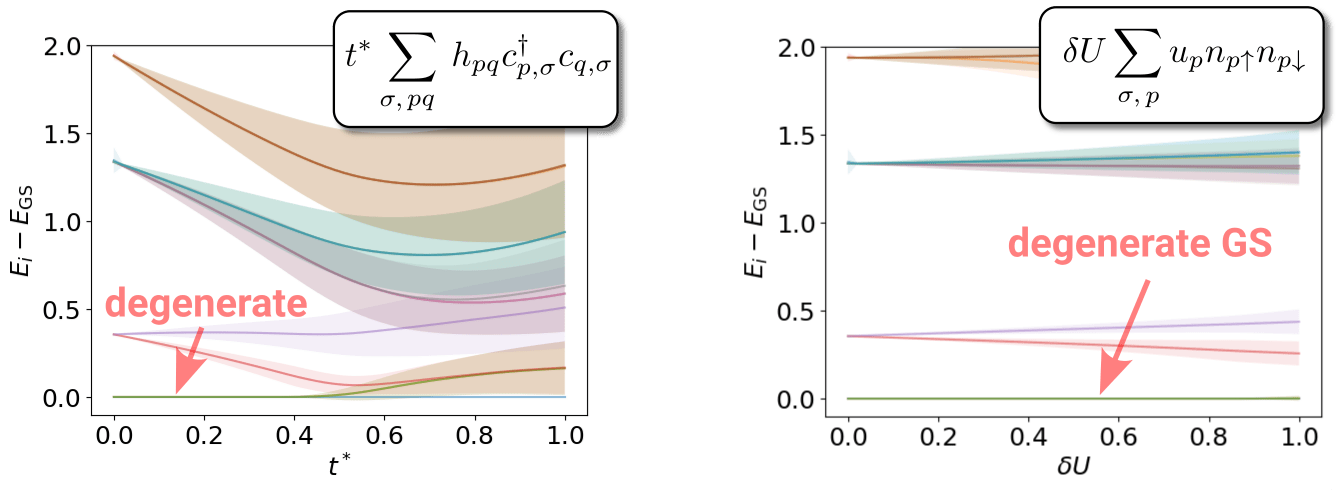
S=1 AKLT: How to couple two stars?
AFM
AFM
FM
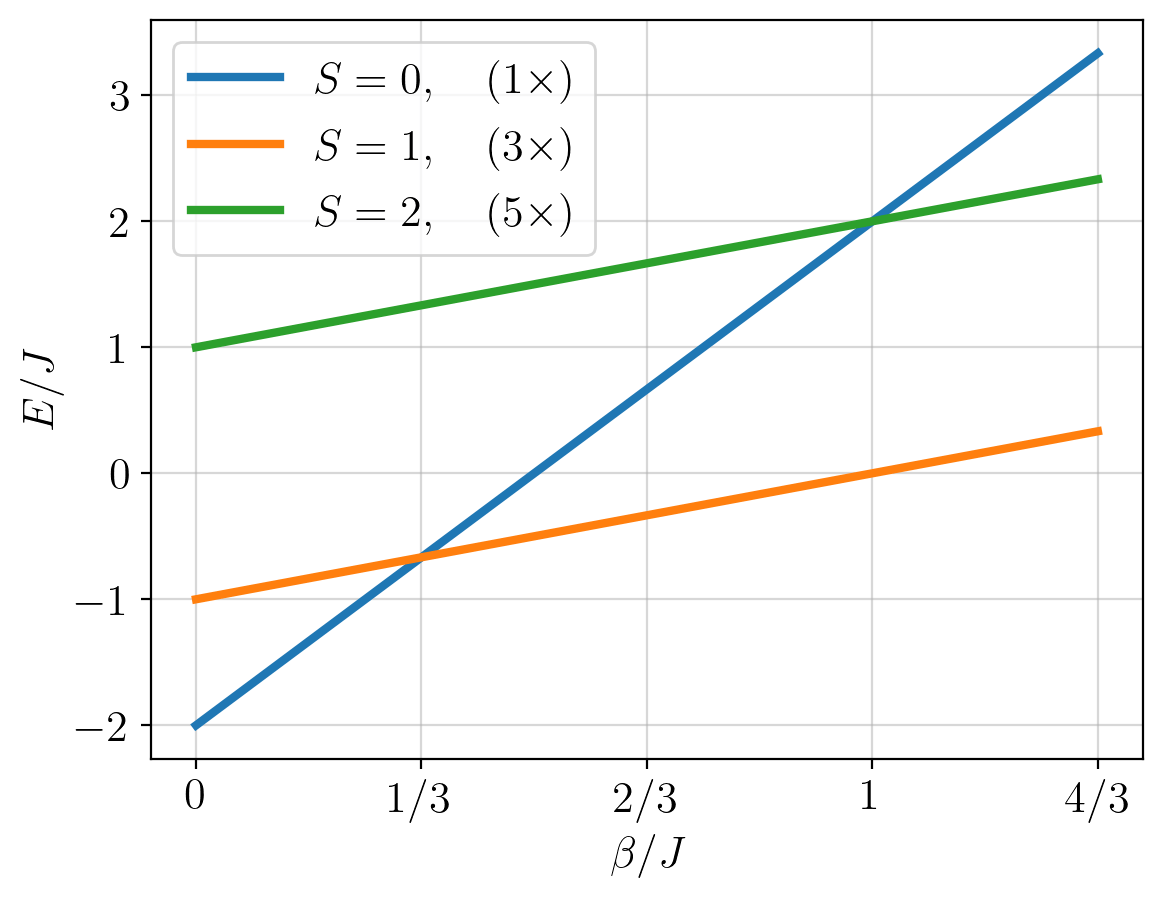
H=J\vec{S}_1\cdot\vec{S}_2+\beta\left ( \vec{S}_1\cdot\vec{S}_2 \right )^2
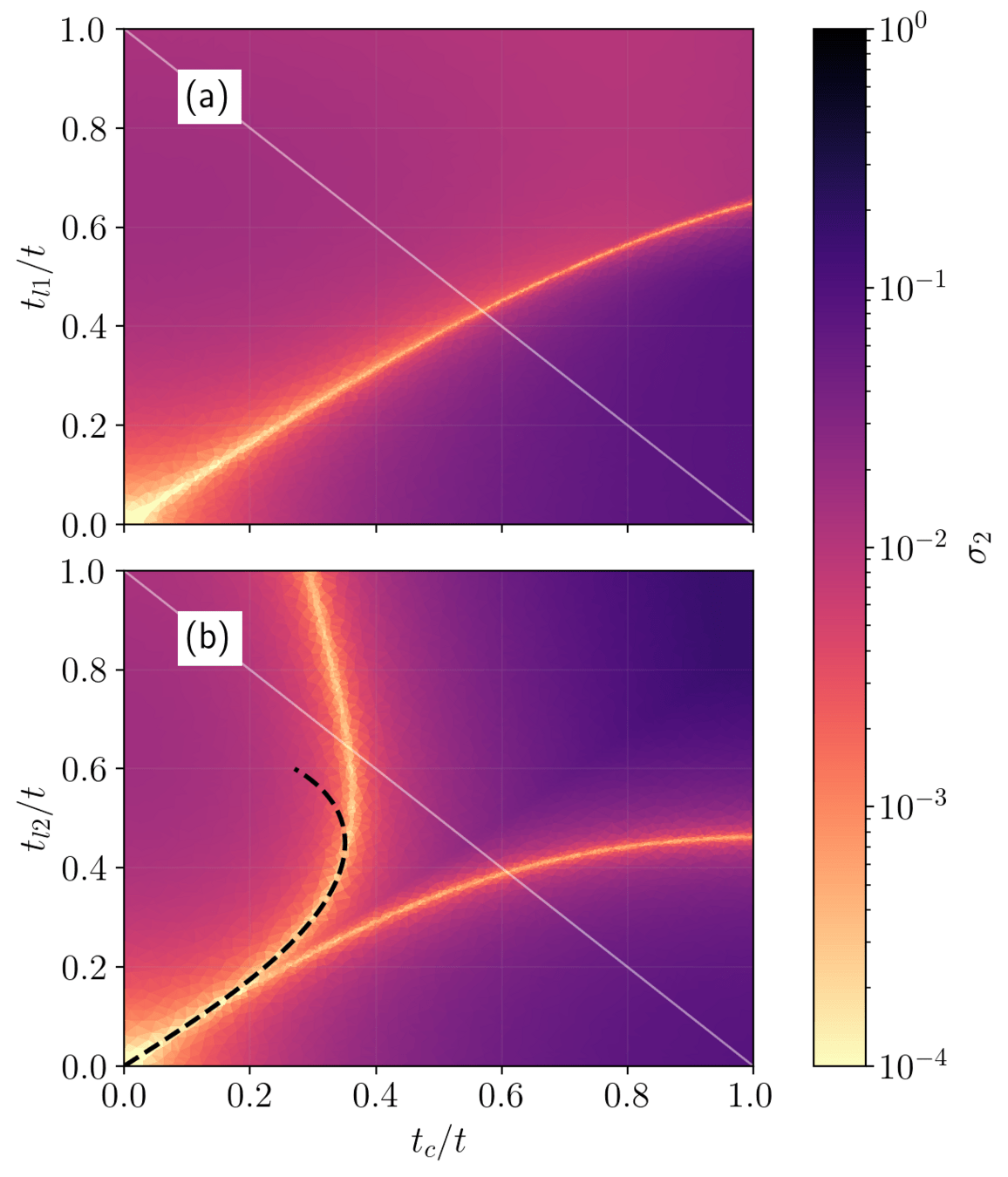
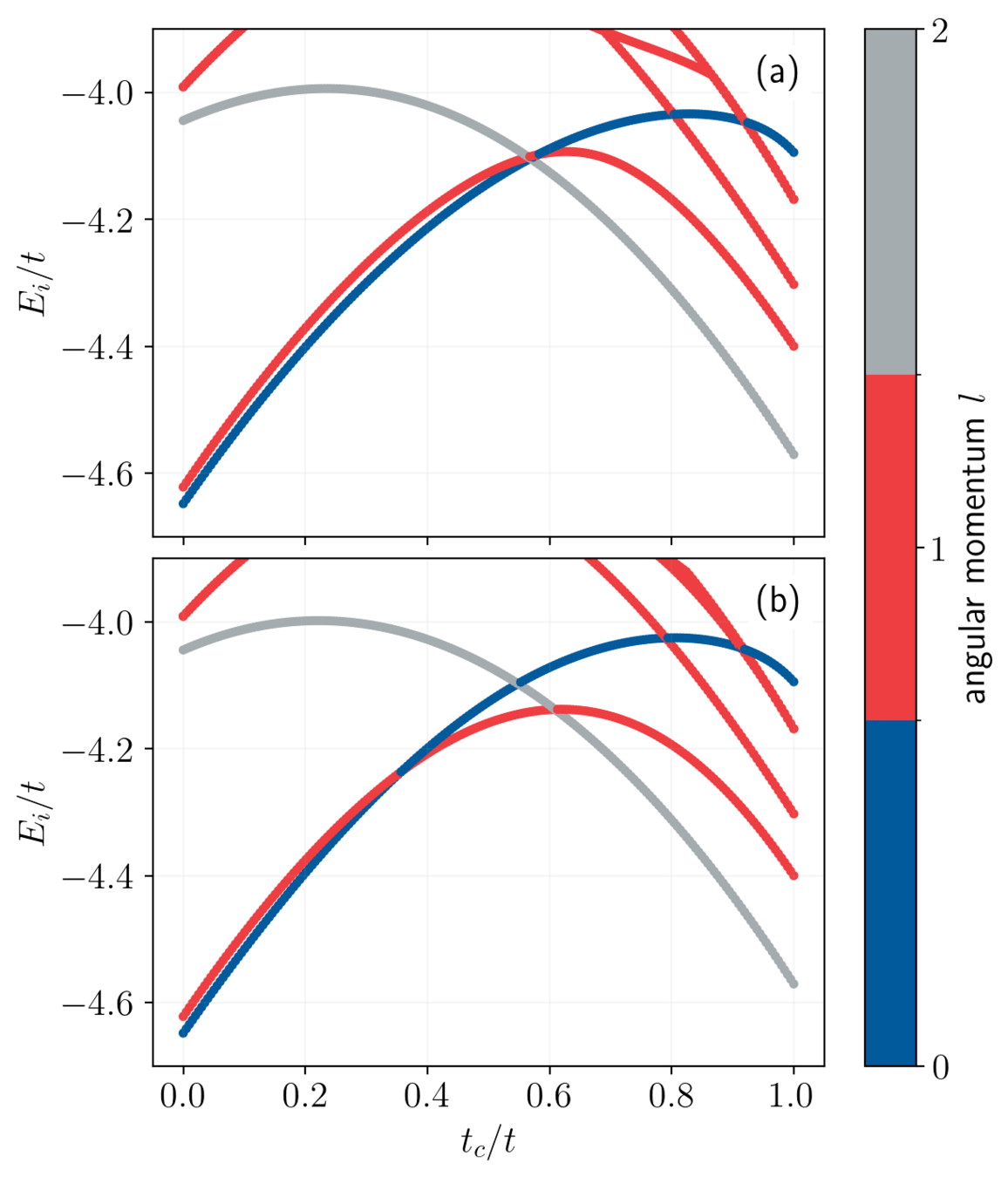
\sigma_2=\frac{|E_0-E_1|}{2t}
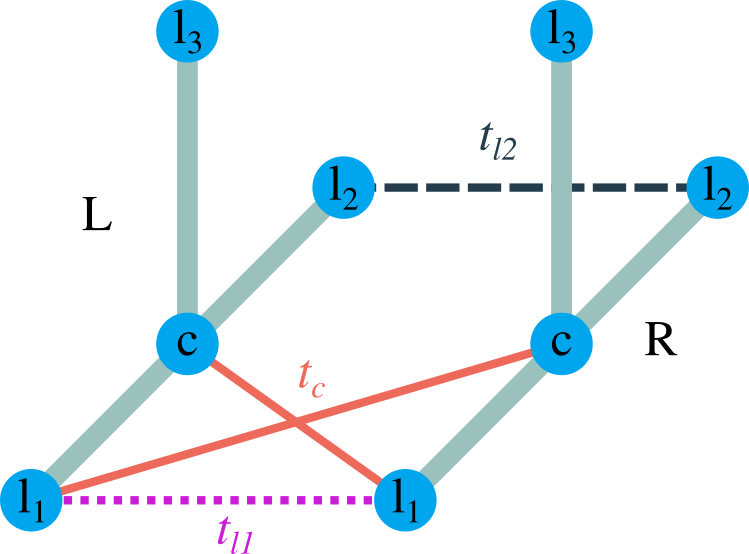
Effective model for spins from QDPT!
Day, et al. Phys. Codebases 50 (2025)
pymablock.readthedocs.io
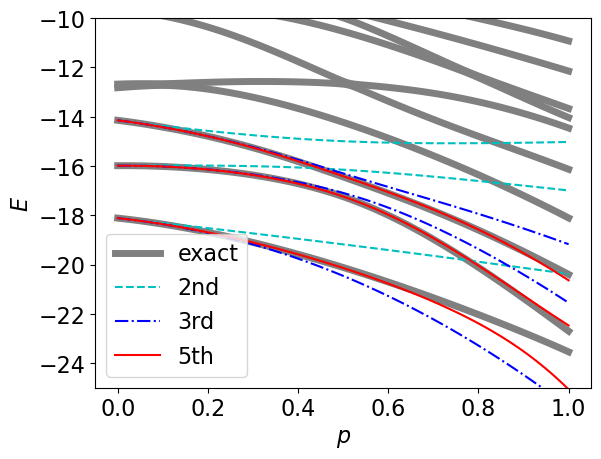
H_0 + p H_1 \Rightarrow \tilde{H}_0+\sum_n p^n \tilde{H}^{(n)}_1
S=1 AKLT: How to couple two stars, PT
\underbrace{H_0 + p H_1}_{c_{n\sigma}} \Rightarrow \underbrace{\tilde{H}_0+\sum_n p^n \tilde{H}^{(n)}_1}_{S_i}
\left(S_i S_j\right)^n=a_nI+b_n\left(S_i S_j\right)+c_n\left(S_i S_j\right)^2
\tilde{H}=A(t)I+f(t)\left(S_1 S_2\right)+g(t)\left(S_1 S_2\right)^2
f(t^*)=3g(t^*)
S=1 AKLT: How to couple many stars?
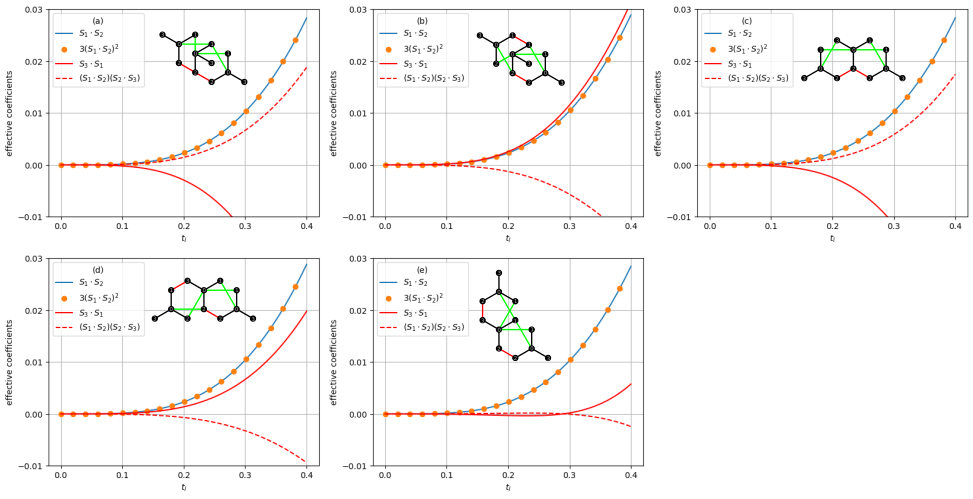
This is
promising!


We do not want:
\( \vec{S}_1\cdot\vec{S}_3 \Rightarrow \) long range
\( (\vec{S}_1\cdot\vec{S}_2) (\vec{S}_2\cdot\vec{S}_3) \) \(\Rightarrow\) multi spin
Experimental realization
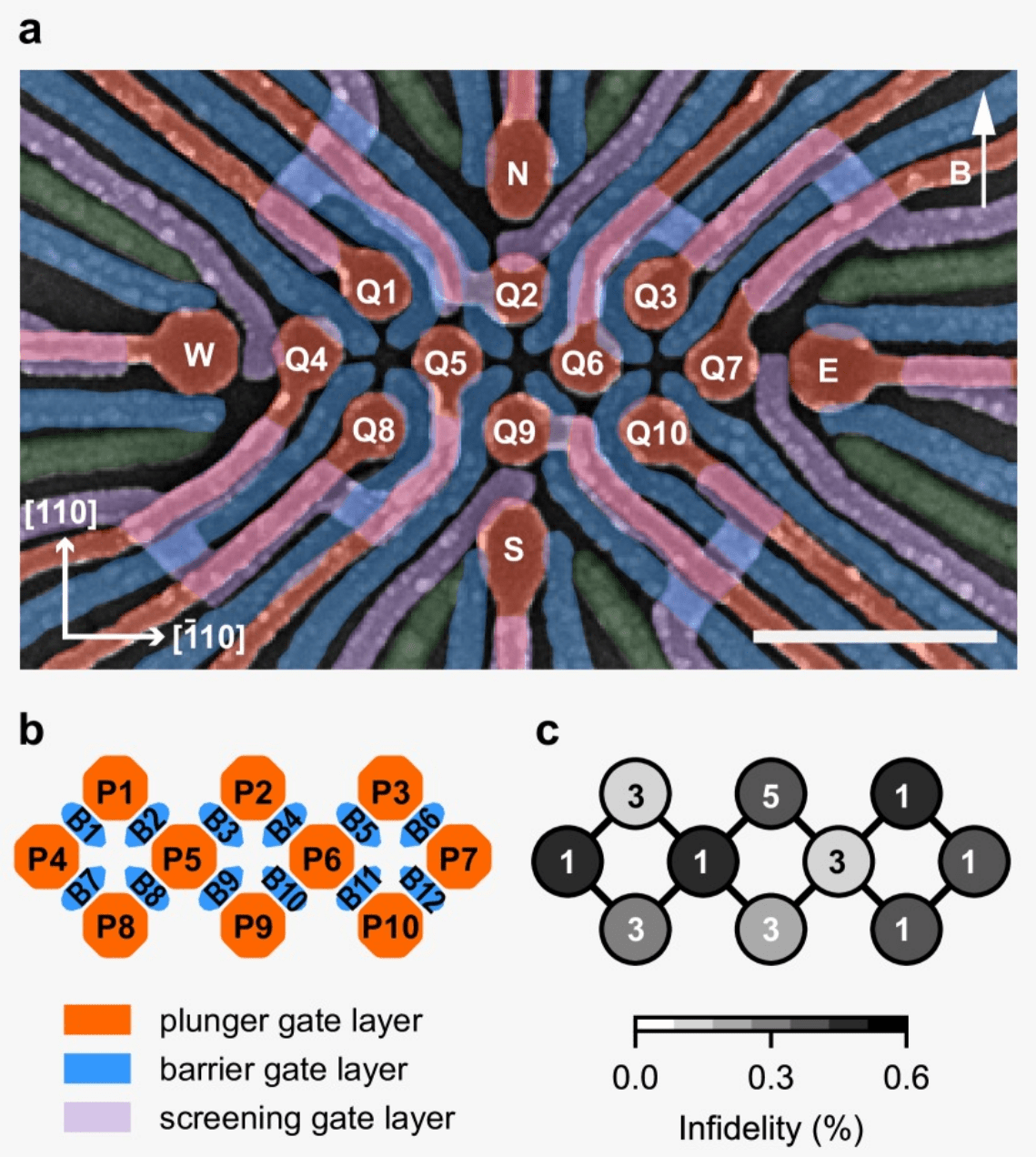
V. John et al. Nat. Commun. 16, 10560 (2025)
Thanks!
C. Benjamin, D. Varjas, G. Széchenyi, J. Romhányi, LO
https://arxiv.org/abs/2603.06455




G. Martínez-Carracedo, LO, A. García-Fuente, L. Szunyogh, J. Ferrer
Phys. Rev. B 107, 035432 (2023)



S=1
By László Oroszlány