electoral volatility
electoral volatility
The modern understanding of democracy distinguishes three models:
- procedural (focused on making the possession of power, especially executive power, dependent on delegating it by society through elections),
- substantive (expanding the previous understanding to include the content of democracy – standards, values, models of behaviour, the implementation of which cannot be guaranteed by only establishing the appropriate procedure ),
- participatory, emphasizing the participation of citizens in the processes of exercising power.
electoral volatility
The last of these models – which seems to be the most fully consistent with current reality – attributes great importance to maintaining relations between such institutions of the political system as political parties and society, and in particular – between parties and their voters. These relations, or their models, have changed in the course of historical social transformations.
electoral volatility
This was noticed already in the 1960s, when attention was drawn to the disintegration of traditional bonds between parties and electorates, resulting in increased variability of the voting decisions of individual voters and social groups. The phenomenon of this variability is referred to as electoral volatlity.
electoral volatility
Electoral volatility is an important element of the dynamics of the party system, thus influencing the functioning of the political system. As a result, it is increasingly becoming an object of interest and research in the social sciences, especially in those researching electoral behavior.
[From elite parties, through mass parties, to electoral parties]
electoral volatility
Traditionally, electoral volatility can be considered in three perspectives: between all parties in the system, between blocs or between families of political parties.
electoral volatility
To examine electoral volatility, we use the Pedersen Index [PI].
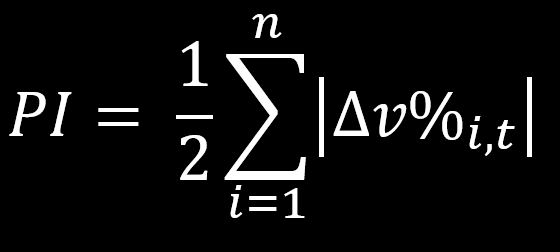
where v%i is the percentage of votes obtained by group i in relation to the set of valid votes, Δv%i,t is the difference between the value of v%i in the next two elections, and n is equal to the number of groups participating in both elections in total.
electoral volatility
The index takes values from 0 to 1, where a higher value of the index indicates higher electoral instability: 0 means identical percentages of votes cast for each of the groups in two subsequent elections, while 1 means that none of the groups that received at least 1 vote in the previous elections received a single vote in the subsequent elections.
electoral volatility
The modified version of PI refers not to the share of parties in the set of valid votes cast but to the share of individual districts (district lists) in the set of votes cast for the chosen party [Electoral Instability/Volatility Index at the district level (PIC)].
electoral volatility
The electoral volatility coefficient understood in this way will take the form:
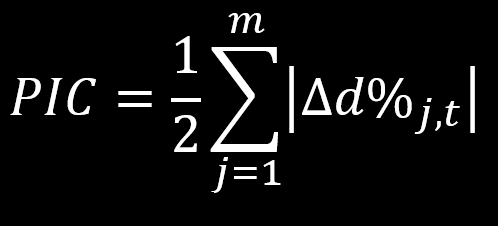
where d%j is the share of votes cast for the list of the group in district j in relation to the set of all votes cast for the lists of this group, Δd%j,t the difference between the value of d%j in the next two elections, and m is equal to the number of districts
electoral volatility
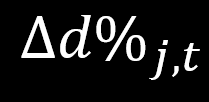
For a more detailed analysis of electoral volatility, the value of delta can also be used separately.
for individual groups, districts and elections
electoral volatility
It is important to note the limitations of this method. The most important are:
PC, PIC and delta are not able to take into account changes in the structure of the entire electorate, in particular natural movement (entry of new voters into the electoral market, e.g. related to obtaining the right to vote, exit of other voters from the electoral market, e.g. as a result of their death). Over the years, the group of those entitled to vote (as well as those using this right) undergoes continuous, natural changes.
electoral volatility
It is important to note the limitations of this method. The most important are:
These coefficients (PIC and delta) are unable to take into account changes in the electoral structure resulting from population migration (both within the country – between constituencies – and related to departures and returns from abroad).
electoral volatility
It is important to note the limitations of this method. The most important are:
The coefficients used provide information on the net value of the change.
electoral volatility
The coefficients used provide information about the net value of the change. For example: if the share of the district in the electorate of party X in year t1 was xi%, after which half of the voters transferred their support to other parties, but it managed to gain new voters in a number that balanced the loss (and the total number of votes obtained by party X nationwide did not change), then the share of this district in the next elections in year t2 will remain unchanged, even though the actual change was xi% (voters who withdrew support + new voters), so it was equal to the value of support in the first elections.
electoral volatility
Unfortunately, without having information about the individual voting decisions of all voters and their variability over time (which would be inconsistent with the principle of secrecy of the ballot), it is impossible to provide the actual value of the change (gross value).
Copy of Chwiejność wyborcza
By Maciej Onasz