Angular
with
Microservices
who am i?

Armagan Amcalar
Co-founder, Chief Software Architect
Startup Kitchen
dashersw

Node.js
We love it.
We develop all kinds of software with it.
We love to daemonize it.
El Problema
Es
Programming model encourages stateful app design
Works great as single process
Works OK as a cluster
what's next?
What if you need more computing power?
How about horizontal scalability?
Current solution
nginx
node-http-proxy
REVERSE PROXY
nginx
Easy to set up if you're familiar with nginx
Hard to maintain
Yet another technology dependency
node-http-proxy
Hard to set up even if you're familiar
Hard to maintain
Very low level
we need a different solution.
Because we have more problems
We're not just building express apps
We were programming the DOM, we need that flexibility
more problems?
Be fast with your API response
Asynchronous processing (e.g., analytics)
You may need to scale very dynamically
Fault tolerance
THE YEAR'S 2014, WHERE ARE THE EVENTS?
Let's take a break.
monolithic apps
vs
service oriented architecture & microservices
monolithic applications
Single code base
One process to rule them all
A bug anywhere crashes the whole system
May consume lots of stale resources
Hard to scale; needs even more stale resources
Request–response flow is one huge piece
Easy to manage
Microservices
Separate code base
Multi processes for each service
A bug in a service crashes only that service
Consumes minimal resources
Scales well, needs minimal additional resources
Supports event-driven architecture
Request–response flow breakdown
Hard to manage
event-driven architecture
pub-sub pattern
observer pattern
pub-sub pattern
Just like DOM events, what we're used to build.
Instead of click events, you have custom events (e.g. in jQuery)
Instead of DOM element interaction, you have daemon interaction
observer pattern
First-of-its-kind event driven pattern
You observe an object property, not an arbitrary event
Like all your click handlers have to have the same name
Limits possibilities
enter redis
Originally a NoSQL database
Key-value pair server with lots of great features like sets, etc.
Pub-sub capability
Supports events based on channels and patterns
Very cool node.js library
a redis pubsub-based architecture
redis
d1
d4
d3
d2
publishes foo
notifies of foo
notifies of foo
notifies of foo
client request
session storage
logs
API
example
var redis = require('redis'),
    client = redis.createClient(6379, '127.0.0.1');

client.publish('request', JSON.stringify({
    body: 'some cool request'
}));
var redis = require('redis'),
logger = redis.createClient(6379, '127.0.0.1');
logger.subscribe('request');
logger.on('message', function(channel, message) {
if (channel == 'request')
console.log(JSON.parse(message));
});Client
Logger
quick demo
enter rabbitmq
A message broker for distributed applications
Like redis pubsub, with heavy focus on additional features
such as very flexible message routing
work queues, topics, etc.
QoS management
round robin load balancing
message acks
rate limiting
unfriendly node.js library
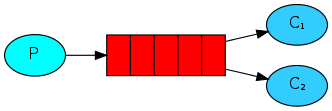
work queues

remote procedure calls
example work queue
var amqp = require('amqp'),
    connection = amqp.createConnection(),
    workId = 0;

connection.on('ready', function() {
    connection.queue('work_queue', {autoDelete: false, durable: true}, function(queue) {
        setInterval(function() {
            connection.publish('work_queue', 'message #' + ++workId, { deliveryMode: 2 });
            console.log('sent message #' + workId);
        }, 1000);
    });
});
var amqp = require('amqp'),
    connection = amqp.createConnection();

connection.on('ready', function () {
    connection.queue('work_queue', {autoDelete: false, durable: true}, function(queue) {
        queue.subscribe({ack: true, prefetchCount: 1}, function(msg) {
            var body = msg.data.toString('utf-8');
            console.log("received", body);
            queue.shift(); // basic_ack equivalent
        });
    });
});
quick demo
enter cote.js
node.js framework for fault tolerant, distributed apps
developed at Startup Kitchen
partially funded by TUBITAK
cote.js features
auto-discovery
mesh network, peer-to-peer communication
pubsub pattern
requester/responder pattern
client-side communication with websockets
load balancing with different strategies
daemon monitor
example architecture

example pub-sub implementation
var Publisher = require('cote').Publisher,
    publisher = new Publisher({
        name: 'publisher',
        broadcasts: ['update']
    }),
    workId = 0;

publisher.on('ready', function() {
    setInterval(function() {
        console.log('emitting', ++workId);
        publisher.publish('update', workId);
    }, 3000);
});
var Subscriber = require('cote').Subscriber,
    subscriber = new Subscriber({
        name: 'subscriber'
    });

subscriber.on('update', function(message) {
    console.log('update', message);
});
quick demo
Conclusion
With Redis, RabbitMQ or cote.js we can;
Apply sophisticated programming paradigms
Scale nearly infinitely
Have fault-tolerant systems
thank you!
contribute to cote.js
Let's keep in touch!
Armagan Amcalar
armagan@amcalar.com
twitter: @aamcalar
github: dashersw
blog: arm.ag
examples at https://github.com/dashersw/node-scale
Angular with Microservices
By maudel