Data structures
On storing data with care
Quick review
-
When to use a loop?
-
How to look into each array element?
-
How to access array element?
- How to get the array size?
Weekly quiz ( 10 min )

Homework
ToDo list

Contents
-
Why data structures
-
Queues
-
Stacks
-
Lists
-
Maps
-
Summary
Why data structures?
Computer programs need
to store data
e.g. keep array of user names
The right data structure might make a program run 10x or more faster
e.g. search for contact in your phone, get or add new item in your shopping list
Queues
Some examples
- When you order in line to pay your electricity bill
- When a police officer stops multiple cars they are processed as a queue
- When you go see your GP and other patients are waiting too
Do you have more?

Queue
- Add new elements at the back (tail)
- Get existing elements from the front (head)
What queues do? (2)
Front
Back
Add
Poll
First In First Out (FIFO)
Example: Waiting in line
Ivancho is in EVN office to pay his bill
and... disaster strikes!
The line is not moving!!!
They need a hero (or a good programmer) to fix that!
In a galaxy far far away....
Operations on queues
ArrayDeque<Integer> queue = new ArrayDeque<>();queue.add(1);why not int?
Add element at the back of the queue
Create empty queue of integers
Operations on queues (2)
Get element from the head of the queue and REMOVE IT
int element = queue.poll();int element = queue.peek();Get element from the head of the queue and DO NOT remove it
Operations on queues (3)
Check if the queue is empty
int elementCount = queue.size();Check how many elements are in the queue
boolean isQueueEmpty = queue.isEmpty();Questions?
Stacks
Some examples
- Pile of dishes you have to wash
- Undo (Ctrl + z) operation in Android Studio
- Company, in a crisis, sometimes fire the most junior member first (last hired)
Do you have more?

Stack
- Add new elements at the top
- Get existing elements from the top
What stacks do? (2)
Top
Bottom
Push
Pop
Last In First Out (LIFO)
Example: Waiting in line
revisited
Ivancho is again in the EVN office to pay his bill
the line is huge!
Can Ivancho skip the line?
Operations on stacks
Stack<Integer> stack = new Stack<>();stack.push(1);Add element at the top of the stack
Create empty stack of integers
Operations on stacks (2)
Get element from the top of the stack and REMOVE IT
int element = stack.pop();int element = stack.peek();Get element from the top of the stack and DO NOT remove it
Operations on stacks (3)
Check if the stack is empty
int elementCount = stack.size();Check how many elements are in the stack
boolean isStackEmpty = stack.empty();Questions?
Break (10 min)

Lists
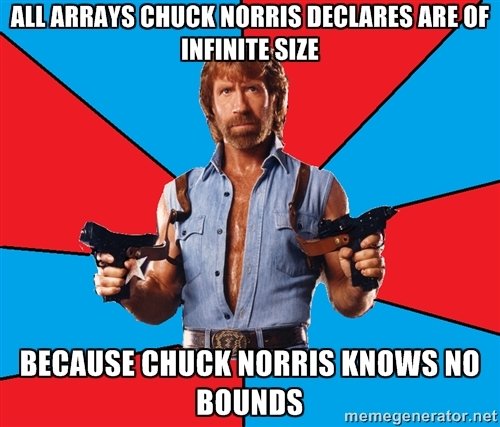
How to decide what size your array should be?
What if you can't hire
Chuck Norris?
Use lists and you won't have to
List
- Do not have to specify size
- All the goodies from the arrays
Example: Shopping list
Ivancho have to buy all the items from the near
grocery shop that his mom ordered him.
if he does, he can spend a night in Galaxy with Mariika
Ivancho has lousy memory but still can do it!
Idea: create a shopping list and store all items in it.
He has no pen and paper. Can he write an app?

Operations on lists
ArrayList<String> list = new ArrayList<>();list.add("Semki");Add element of the back of the list
Create empty list of strings
Operations on lists (2)
list.get(0);list.remove(0);Remove an item at specified index
Get an item at specified index
Operations on lists (3)
list.set(0, "Slaninka");int elementCount = list.size();Get the size of the list
Add item at specific place (index)
Questions?
Maps
Some examples
- Dictionary of words from Bulgarian to English or vice versa
- Look up a student by his ID number
- Associate contact name with his phone number
Do you have more?
Map
- Add a pair of key and element (value)
- Get element by it's key
- Can give you an element in (near) constant time if you know it's key
- Only one element for key (some do)
- Slow when iterating over elements
Example: Shopping list
revisited
His mom asks him to visit the grocery shop again!
This time the task is just a bit (maybe more) harder.
He has to buy some groceries in different quantities.
His reward will be a week in Amsterdam,
close to the Red Light District...
Ivancho is very happy with his experience
with Mariika in Galaxy (hmm?).
Ivancho is very
enthusiastic about it!
He just have to modify his app.
Can you help?

Operations on maps
HashMap<String, Integer> map = new HashMap<>();map.put("Krushi", 3);Add element with a key
Create empty map of strings to integers
Operations on maps (2)
int quantity = map.get("Krushi");map.remove("Krushi");Remove an item with key
Get value for a key
Operations on maps (3)
boolean hashKrushi = map.contains("Krushi");int elementCount = map.size();Get the size of the map
Check if contains value with key
Questions?
Summary
- Queues get elements from the front and add to the back
- Stacks get elements from the top and add to the top
- Lists are like arrays but you can store (almost) unlimited elements in them
- Maps allow association of one element with another
Daily quiz

Questions?
Homework or not
Thank you :)
Lecture 5 - Data structures
By naughtyspirit