



Opetus.tv PRO
Opetus.tv
(Lauri's fight against cognitive laziness)
Lauri Hellsten (lauri.k.hellsten@gmail.com)
Espoon yhteislyseo
In the summer of 2025 Finnish National Agency for Education released guidelines to provide the framework for using AI in the classrooms
AI applications can serve as support, but conclusions related to assessment and the design of teaching are always the teacher’s responsibility.
The teacher/school should establish clear local guidelines for AI use, for example, how students’ use of AI in assignments should be documented.
Inclusion and equality must be ensured. The use of AI must not discriminate against learners.
"Assessment guides studying and learning more than any other factor in a learning situation"
"The purpose of student assessment is to guide and encourage learning and to develop students' self-assessment skills. Students' learning and work should be assessed in a variety of ways."
-High school law 17 §
One effective way to strengthen students' cognitive skills is to focus assessment on the learning process in a variety of ways and, in particular, to guide students in becoming aware of and evaluating their work and thinking.
Halinen et al. 2016 s.276
The teacher guides the student to recognize what the studied topic is about and to compare their own conceptions and views with the overall context of the topic
Make the criteria clear and understandable tools
Design tools (e.g. skill level tables, lists of criteria, guiding question lists). Provide instructions and support for their use.
Give students practice and routines for self-assessment, and provide them with feedback on the quality of their self-assessment.
Teach self-assessment as a central goal that supports their self-regulation and the development of their own learning (Brown & Harris, 2014).
In your feedback, use language that supports students’ self-assessment.
Use self-assessment more for supporting learning than for determining grades.
Using Feedback to Improve Learning (2018), Maria Araceli Ruiz-Primo and Susan M Bookhart
Make the criteria clear and understandable tools
Design tools (e.g. skill level tables, lists of criteria, guiding question lists). Provide instructions and support for their use.
Give students practice and routines for self-assessment, and provide them with feedback on the quality of their self-assessment.
Teach self-assessment as a central goal that supports their self-regulation and the development of their own learning (Brown & Harris, 2014).
In your feedback, use language that supports students’ self-assessment.
Use self-assessment more for supporting learning than for determining grades.
Using Feedback to Improve Learning (2018), Maria Araceli Ruiz-Primo and Susan M Bookhart
Assessment of the course will be agreed upon with the students on the first lesson.
The students will work in small table groups during the course.
The course is divided into six sections, each of which will be worked on for about a week.
individual assignments
group work (peer feedback)
self-assessment
multiple-choice quiz
At the end of the course there is usually an exam, portfolio or an larger group work.
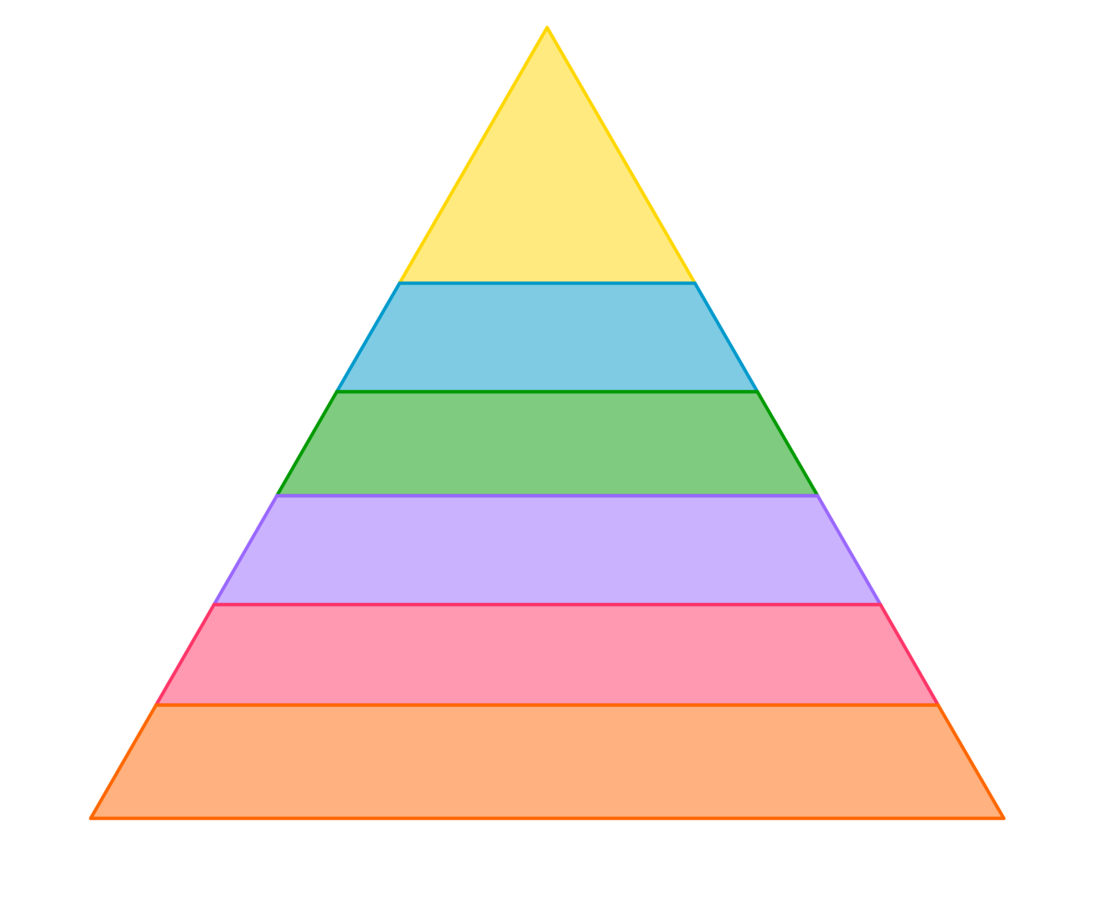
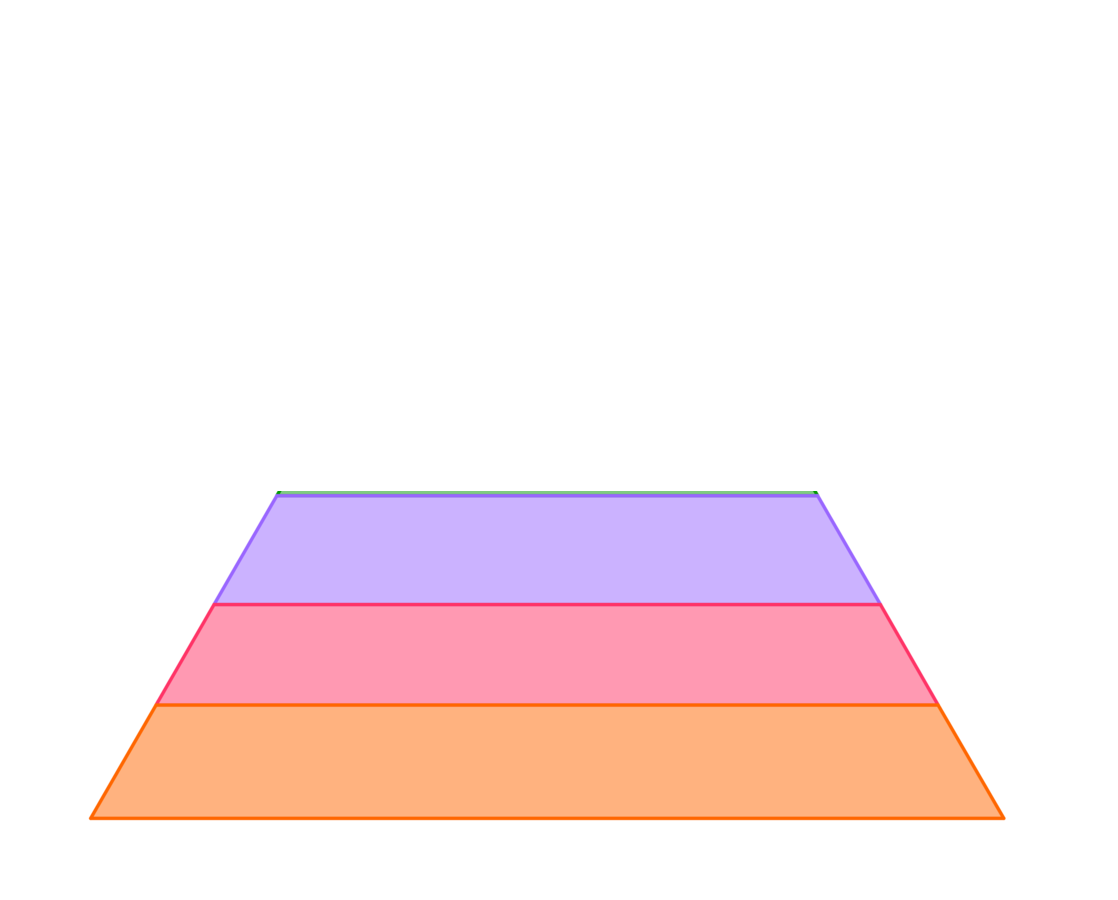
Higher order thinking
Lower order thinking
The teacher guides the student to identify what the studied topic is about and compare their own perceptions and views on the whole.
Unit 1
Self-assessment
1A
passed
Unit 2
Self-assesment
2A
failed
Self-assessment
2A
failed
passed
passed
Students choose their own pace to progress and move on when they have mastered the topic at hand.
I understand this so well I could
teach it to a friend.
I feel I have understood this.
I feel I somehow understand this, but there still is something unclear to me.
I need more practice and time to understand this.
This is not included in my studies.
AI model (e.g GPT-5) → General knowledge, "core brain" but it doesn’t remember what you uploaded to it.
AI agent → Built on top of the "core brain" with extra abilities (memory, goals, tools, etc.).
Curriculum guidelines
Old exam problems
ChatGPT / Gemini
Own material
📓
Remember to take copyrights into account!
You are a secondary teacher and assessment expert. Create a guided self-assessment checklist for students in a flipped learning setting (used after pre-class study, before in-class practice).
Produce 12–15 student-friendly statements that help learners reflect on what they understand (concepts) and what they can do (skills).
Use both stems: “I understand …” (concepts) and “I can …” (skills).
Keep language clear, positive, and supportive; avoid grading/judgmental wording.
Make items concrete and observable so students know what evidence they could show....
role & context
precise task
specification
Structure (progression)
Foundational understanding – core ideas, terms, relationships (recognize what the topic is about).
Application & practice – problem solving/methods/interpretation or creation.
Reflection & transfer – connect new knowledge to prior conceptions, broader contexts, or ethics.
Self-regulation features
Add a one-line student instruction at the top.
For each statement, include a 3-point self-rating: ▢ Not yet ▢ Getting there ▢ Got it.
Structured
progression
(scaffolding)
Self-regulation
Output format (strict)
Return Markdown exactly like this:
H2 title: “Self-Assessment – {Subject}: {Topic}”
Short student instruction (1 sentence).
Three H3 sections with the exact headings: “Foundational understanding”, “Application & practice”, “Reflection & transfer”.
Under each section, 3–5 checkbox items using “- [ ] …”.
Parameters
Output format constraints
Clear input parameters
After your pre-class study, use this to check what you know and what you can do; be honest and pick one or two items to improve next.
I understand what a force is (vector with magnitude and direction) and what “net force” means for an object’s motion. — ▢ Not yet ▢ Getting there ▢ Got it
I understand Newton’s First Law (inertia) and can recognize when velocity stays constant because the net force is zero. — ▢ Not yet ▢ Getting there ▢ Got it
...
I can draw a clear free-body diagram (FBD) for a situation, labeling weight, normal, tension, friction/drag, and choosing sensible axes. — ▢ Not yet ▢ Getting there ▢ Got it
I can resolve forces into components (e.g., on an incline) and compute the net force along chosen axes.
— ▢ Not yet ▢ Getting there ▢ Got it
...
I can explain and correct common misconceptions (e.g., “motion needs a force,” “action and reaction cancel motion”). — ▢ Not yet ▢ Getting there ▢ Got it
I understand how modeling choices (neglecting friction/air resistance, massless rope) affect predictions, and I can state my assumptions. — ▢ Not yet ▢ Getting there ▢ Got it
...
Workshop task
Use AI tools to create a student self-assessment form (e.g., in Google Sheets, Microsoft Forms). Use AI to draft questions, criteria, and instructions, but remember to review the content before use.
Questions:
Is the assessment diagnostic, formative, or summative?
What aspects are emphasized?
What information does the student receive from the form?
How does the student use this information in learning?
Does the form support understanding of learning goals?
How does the form align with curriculum goals (general, subject-specific, course-specific)?
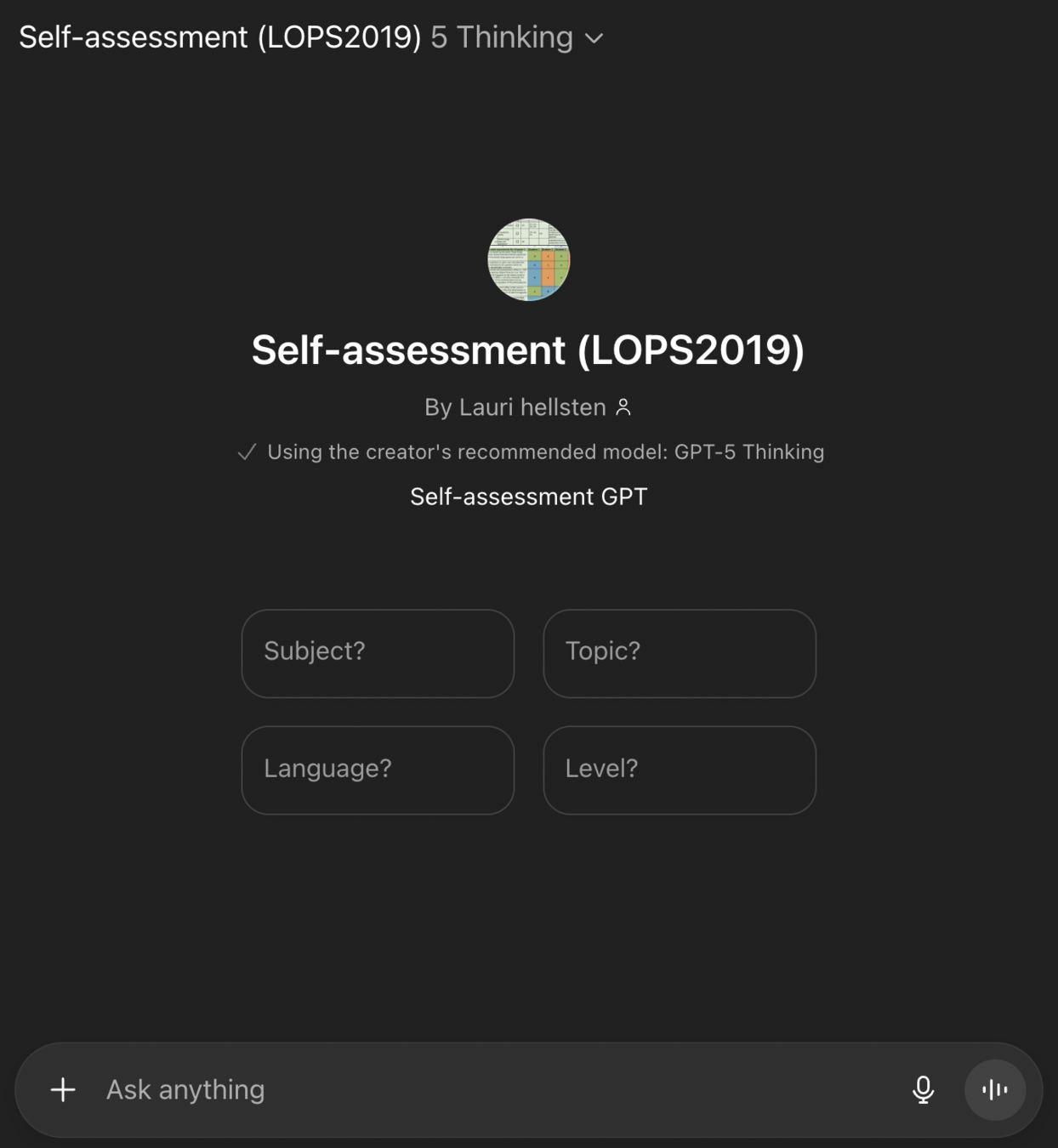
bit.ly/GPTself
bit.ly/GPTselfprompt
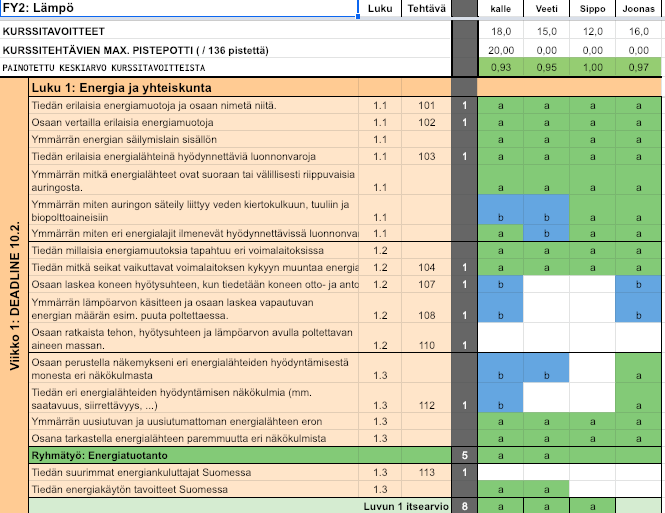
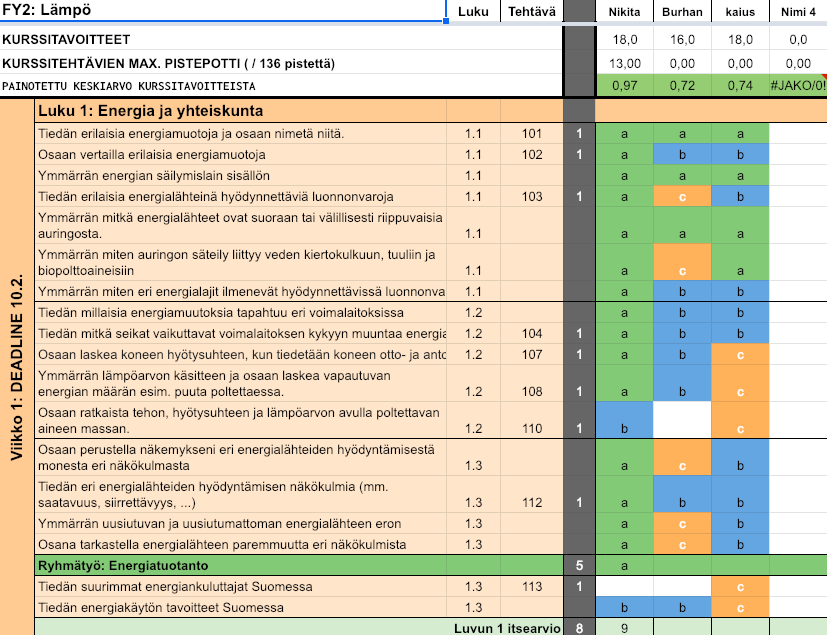
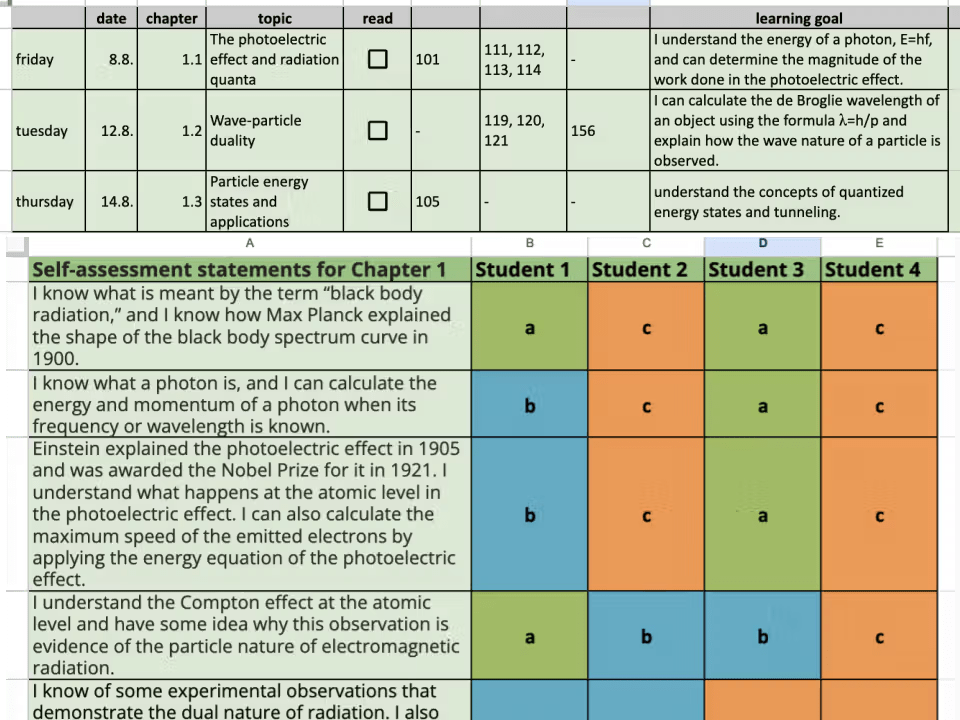
Example Sheet
claude.ai free version
gemini.google.com
To battle cognitive laziness in the AI era, self-assessment empowers learners to take ownership of their learning and active responsibility for what they know—and what they don't know yet.
By Opetus.tv