Steady State Visual Evoked Potential (SSVEP) Based Brain-Computer Interface (BCI) Performance Under Different Perturbations


PLoS ONE 13(1): e0191673

Zafer İşcan

Centre for Cognition and Decision Making, National Research University Higher School of Economics, Moscow, Russian Federation, Cognitive Neuroimaging Unit, CEA DRF/Joliot Institute, INSERM, Université Paris-Sud, Université Paris-Saclay, NeuroSpin center, Gif-sur-Yvette, France


Vadim V. Nikulin

Centre for Cognition and Decision Making, National Research University Higher School of Economics, Moscow, Russian Federation, Department of Neurology, Max Planck Institute for Human Cognitive and Brain Sciences, Leipzig, Germany, Neurophysics Group, Department of Neurology, Charité-University Medicine Berlin, Campus Benjamin Franklin, Berlin, Germany

Introduction

BCIs

  • Brain-computer interfaces (BCIs) have potential to help severely disabled people by translating the intentions of subjects into a number of different commands.
    • Usually tested when environmental and biological
      artifacts are intentionally avoided.

SSVEPs

  • Steady state visual evoked potentials (SSVEPs) are particularly attractive due to high signal to noise ratio (SNR) and robustness.
    • In this study, we deliberately introduced different perturbations in order to test the robustness of a steady state visual evoked potential (SSVEP) based BCI.

About

  • This is the first study that systematically analyses the effects of these perturbations on the online perform-ance of SSVEP based BCI within and across subjects.

Materials & Methods

Participants

  • Recruitied in summer-autumn 2016.
  • Most of them were students at Higher School of Economics.
  • No payment for the participants.
  • 27 healthy subjects between 18 and 41 years of age.
    • 9 males.
    • mean 26 years of age
  • All subjects participated in both offline and online tasks.

Experiment Setup

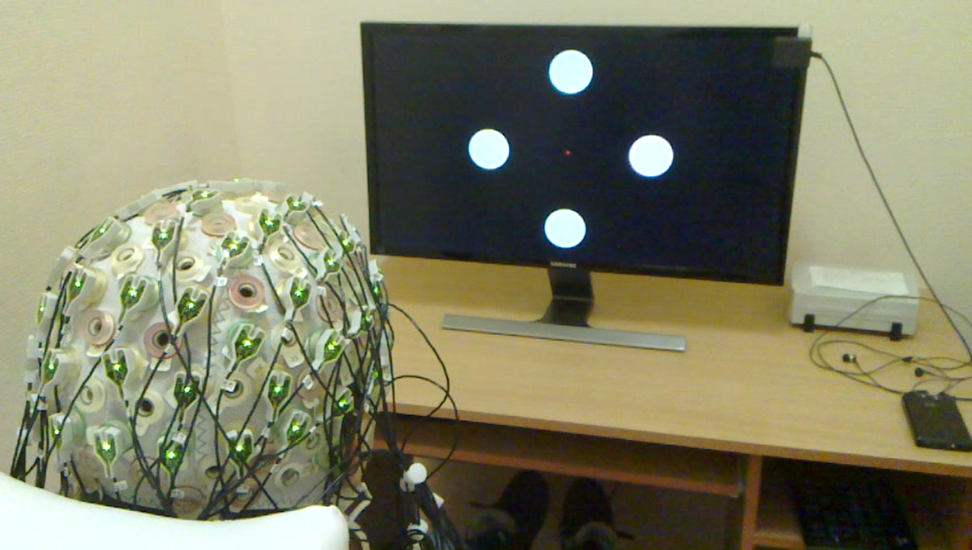
  • EEG were recorded in an electrically shielded dark cabin.
  • Stimulus paradigms were prepared in Matlab
    software using Psychophysics Toolbox Version 3.
  • Participants followed the stimuli presented on a Ultra HD LED Monitor.

Experiment setup

  • The main stimuli are composed of four circles placed in different locations with individual flickering frequencies.
    • Up: 5.45 Hz
    • Down: 8.57 Hz
    • Right: 12 Hz
    • Left: 15 Hz

Offline Task

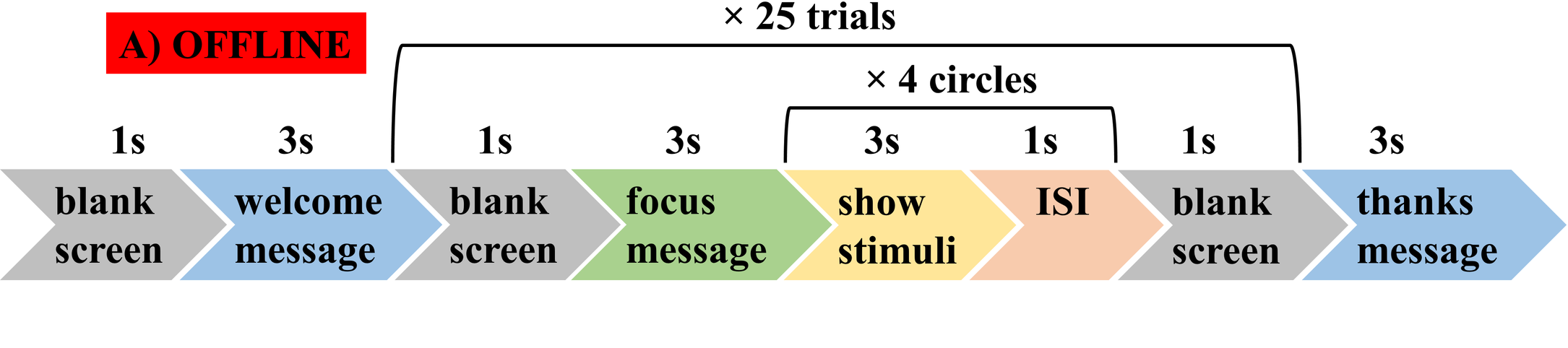
  • For each of 25 trials, there is an instruction on the screen informing a subject to focus on the presented circle.
  • Subjects then focus on each of the four randomly presented flickering circles indicated by a red oval frame for three seconds with an inter-stimulus interval (ISI) of one second.

Online Task

  • Subjects focuses on one of the four flickering white circles for 3 seconds.
  • Classification result is presented on the screen with a red color.
  • Subjects either confirm or reject the location using keyboard.

Online Task

  • The online task was performed under four conditions randomized across subjects:
    • Control
    • Speaking
    • Thinking
    • Listening

Power Spectrum

  • Fast Fourier Transform was used with Hanning window to calculate the power spectrum of the preprocessed EEG for a 3s stimuli length.
    • delta (1±3 Hz)
    • theta (4±7 Hz)
    • alpha (8±13 Hz)
    • beta (14±30 Hz)

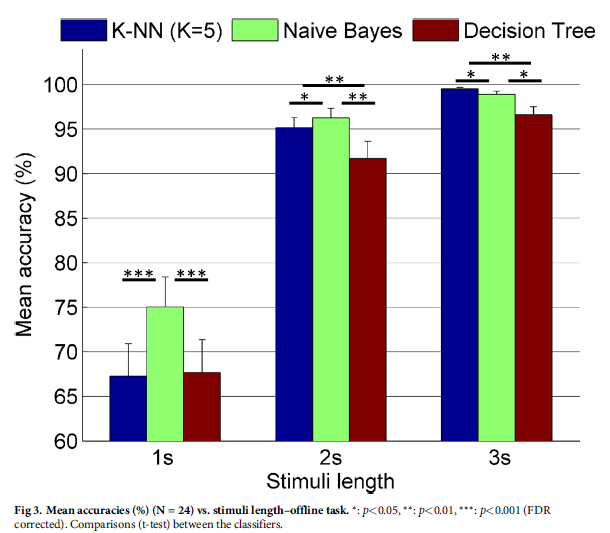
Classification

  • There are 3 classifiers were used to evaluate:
    • Decision tree
    • Naïve Bayes
    • K-Nearest Neighbor

Results

Offline Classification

Power of Spectrum

Online Classification

Conclusions

Conclusions

  • SSVEP-based online BCI under different perturbations is robust.
  • loud or silent counting resulted only in slight decrease in BCI performance.
    • Indicates that SSVEP-based BCI can be used in parallel during the conversations.
  • Some subjects perturbations resulted even in better performance.
    • The different cognitive strategy can be used for improving the accuracy of BCI within individuals.

BSPA Paper Report

By Penut Chen (PenutChen)

BSPA Paper Report

1071 BSPA Midterm Paper Report

  • 28