


The Perceptron

Cornell CS 3/5780 ยท Spring 2026

(down arrow to see handout slides)

0. The Curse of Dimensionality

Dimension (\(d\)) Edge Length (\(\ell\))
2 0.1
10 0.63
100 0.955
1000 0.9954

For \(k=10, n=1000\)

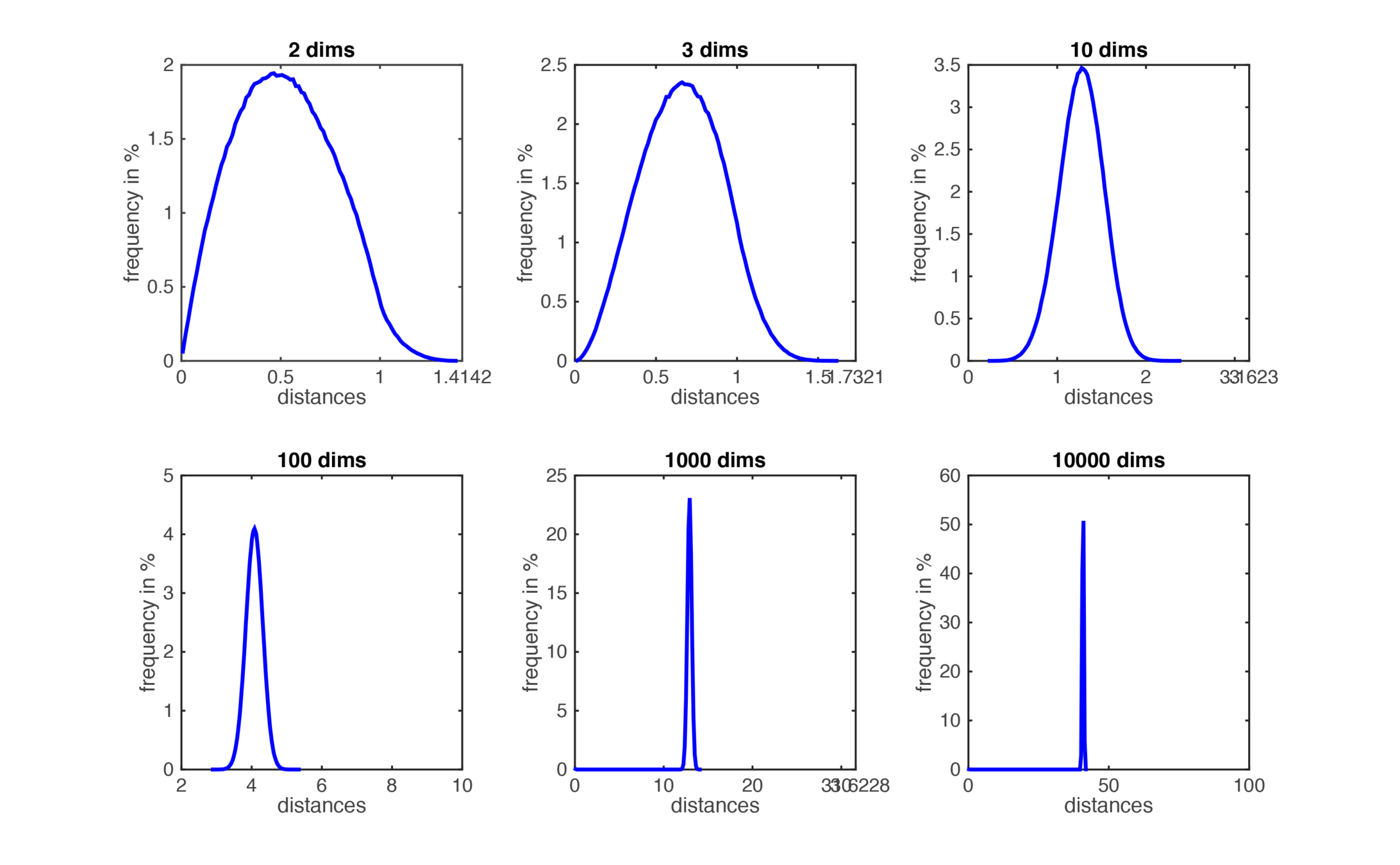
The distributions of all pairwise distances between randomly distributed points within \(d\)-dimensional unit squares.

0. The Curse of Dimensionality

  • Points drawn from a probability distribution tend to never be close together in high dimensions.
  • Volume Analysis: For uniform distribution on features, to capture \(k\) neighbors in a unit cube \([0,1]^d\), the required edge length \(\ell^d \approx k/n\)
  • Question:
    • What happens to \(\ell\) for \(k/n\) fixed and \(d\) getting big?
    • How big does \(n\) need to get to keep \(\ell\) constant?
  • Mitigating the Curse
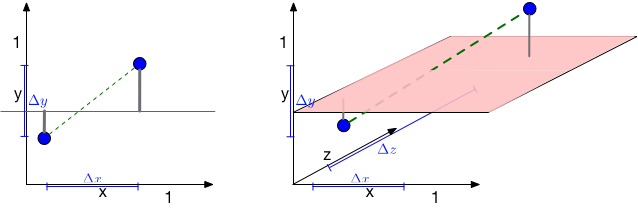
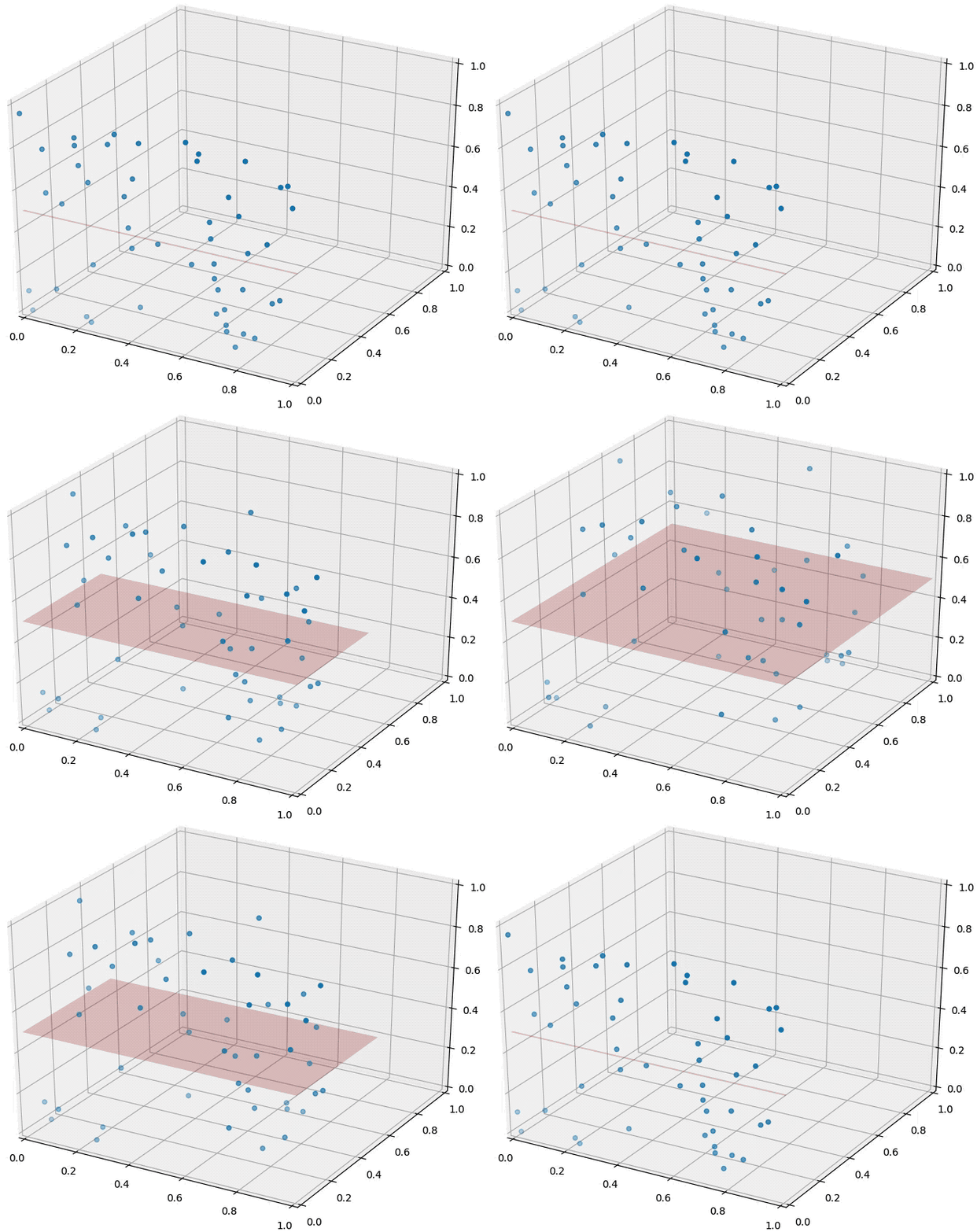
    • Linear Separation: Pairwise distances between points grow with dimensionality, but distances to hyperplanes do not.
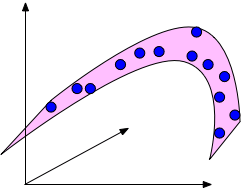
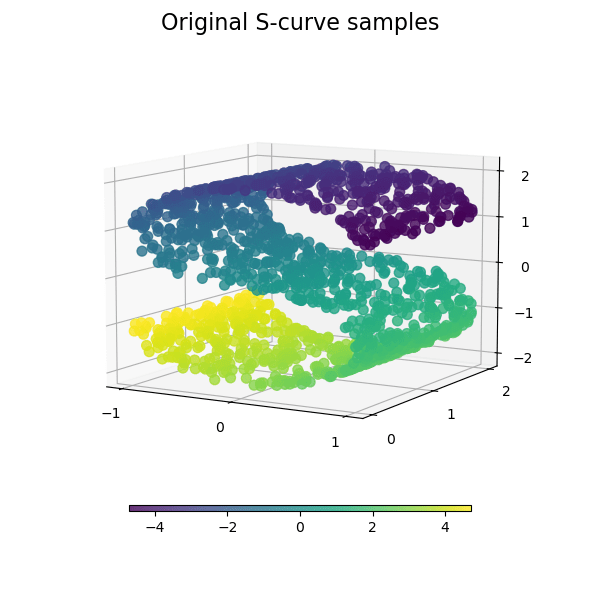
    • Low Dimensional Structure: Data often lies on low-dimensional manifolds despite a high-dimensional \(d\).

1. Perceptron Classifier

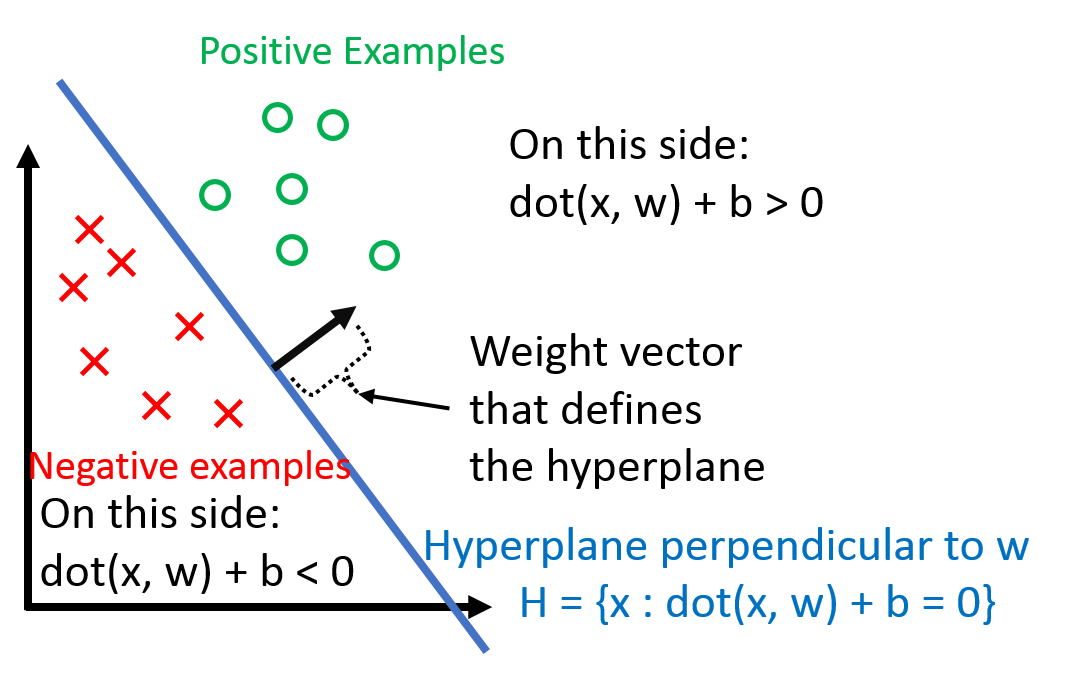
$$ h(\mathbf{x}_i) = \textrm{sign}(\mathbf{w}^\top \mathbf{x}_i + b) $$

hyperplane: \(\mathbf{w}^\top \mathbf{x}_i + b =0\)

\(\bf w\)

\(0\)

\(\underbrace{\qquad\quad}_{-b}\)

\(\bf x\)

1. Perceptron Classifier

  • Core Assumption: Binary classification with \(y_i \in \{-1, +1\}\) and data that is linearly separable
  • Classification Rule: Determined by which side of a hyperplane the input \(\mathbf x\) is on.
  • Formally: given by direction \(\mathbf{w}\) and bias \(b\) $$ h(\mathbf{x}_i) = \textrm{sign}(\mathbf{w}^\top \mathbf{x}_i + b) $$
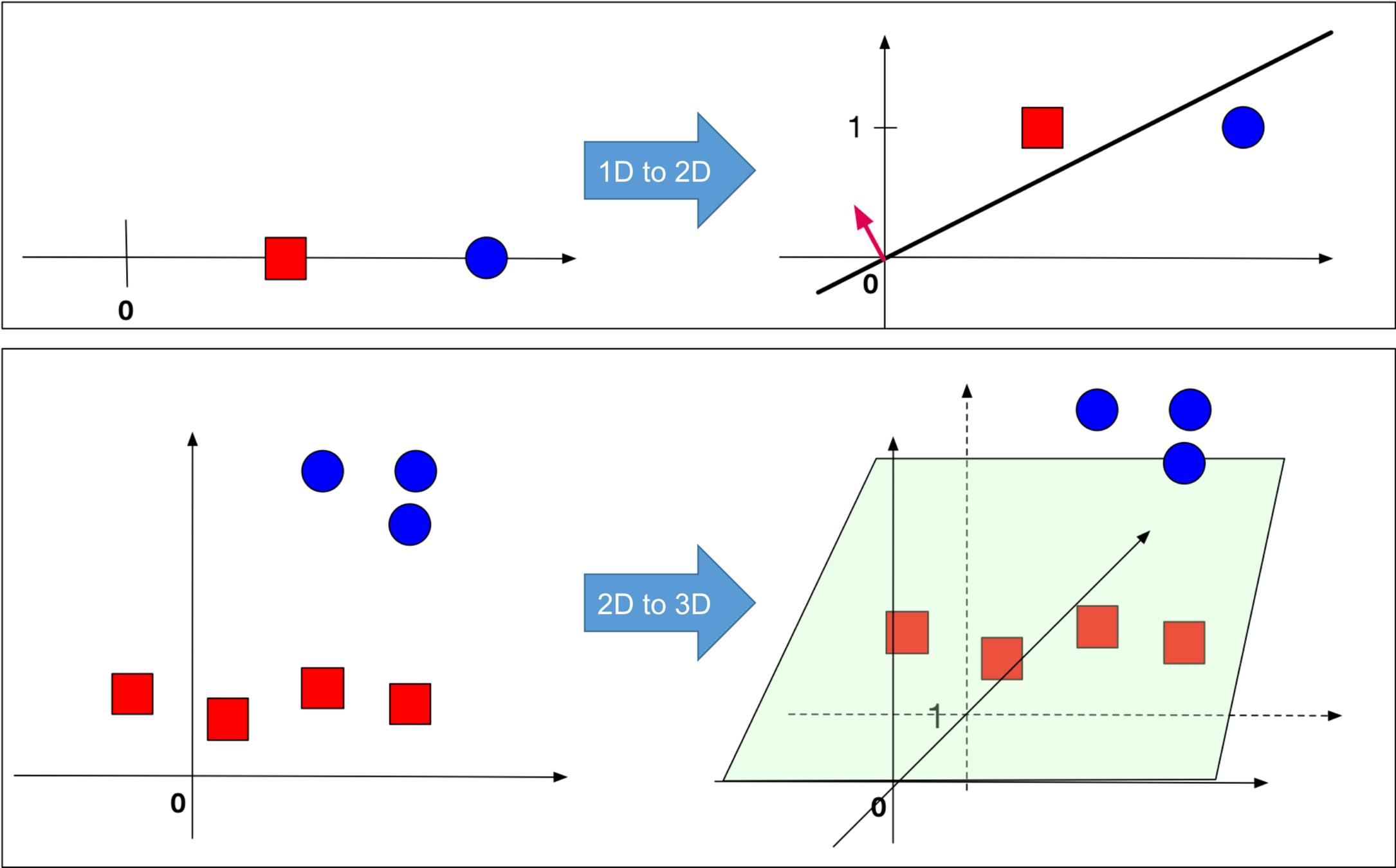
  • Without the bias term, the hyperplane that \(\mathbf{w}\) defines would always have to go through the origin.

2. Simplified Formulation

 $$ \mathbf{x}_i \hspace{0.1in} \rightarrow \hspace{0.1in} \begin{bmatrix} \mathbf{x}_i \\ 1 \end{bmatrix},\qquad \mathbf{w} \hspace{0.1in} \rightarrow \hspace{0.1in} \begin{bmatrix} \mathbf{w} \\ b \end{bmatrix} $$

2. Simplified Formulation

  • Absorbing bias term: add one additional constant dimension $$ \mathbf{x}_i \hspace{0.1in} \text{becomes} \hspace{0.1in} \begin{bmatrix} \mathbf{x}_i \\ 1 \end{bmatrix},\qquad \mathbf{w} \hspace{0.1in} \text{becomes} \hspace{0.1in} \begin{bmatrix} \mathbf{w} \\ b \end{bmatrix} $$
  • New formulation: under the new definition of \(\mathbf x\) and weight \(\mathbf w\), $$ h(\mathbf{x}_i) = \textrm{sign}(\mathbf{w}^\top \mathbf{x}) $$
  • Key Observation: Note that \(\mathbf{x}_i\) is classified correctly (i.e. on the correct side of the hyperplane) if $$ y_i(\mathbf{w}^\top \mathbf{x}_i) > 0 $$

3. Perceptron Algorithm

Initialize: \(\mathbf{w} = \mathbf{0}\)

While TRUE:

  1. set \(m=0\)
  2. for \((\mathbf{x}_i, y_i) \in D\)
    • if \(y_i(\mathbf{w}^\top \mathbf{x}_i) \leq 0\)
      • \(\mathbf{w} = \mathbf{w} + y_i \mathbf{x}_i\)
      • \(m = m+1\)
  3. if \(m=0\): break

1     2    3

4     5    6

7     8    9

1     2    3

4     5    6

7     8    9

1     2    3

4     5    6

7     8    9

1     2    3

4     5    6

7     8    9

1     2    3

4     5    6

7     8    9

Form a group of \(d=9\)

Each group member tracks a weight!

\(\bf x_1=\)

\(\bf x_2=\)

\(y_1=+1\)

\(y_2=-1\)

1     2    3

4     5    6

7     8    9

3. Perceptron Algorithm

Input: Training data \(D = \{(\mathbf{x}_1, y_1), ..., (\mathbf{x}_n, y_n)\}\)

Initialize: \(\mathbf{w} = \mathbf{0}\)

While TRUE:

  1. set \(m=0\)
  2. for \((\mathbf{x}_i, y_i) \in D\)
    • if \(y_i(\mathbf{w}^\top \mathbf{x}_i) \leq 0\)
      • \(\mathbf{w} = \mathbf{w} + y_i \mathbf{x}_i\)
      • \(m = m+1\)
  3. if \(m=0\): break

4. Perceptron Convergence

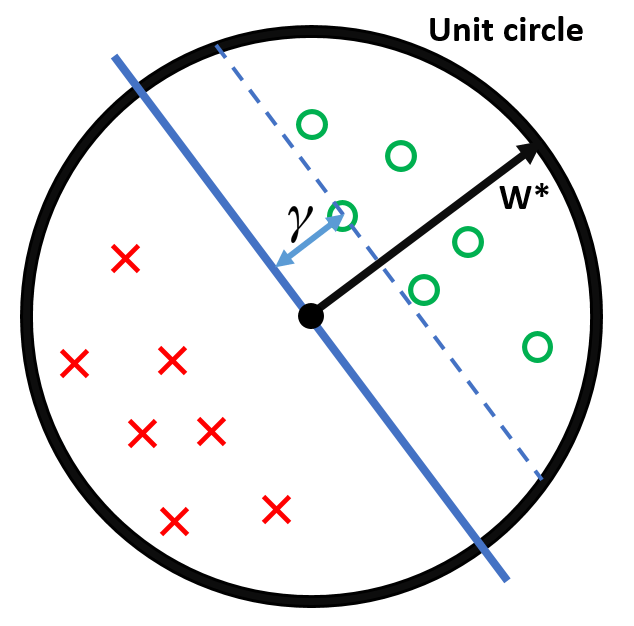
Setup: \(\|\mathbf{w}^*\| = 1\), \(\|\mathbf{x}_i\| \le 1~~\forall~ \mathbf{x}_i \in D\),
margin \( \gamma = \min_{(\mathbf{x}_i, y_i) \in D}|\mathbf{x}_i^\top \mathbf{w}^* | \)

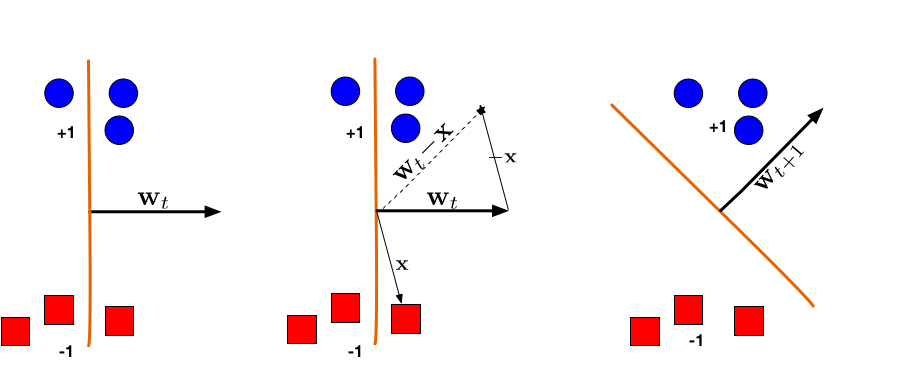
1. hyperplane misclassifies one red (-1) and one blue (+1) point

2. \(\bf x\) is chosen and used for an update.

3. updated hyperplane separates the two classes

4. Perceptron Convergence

  • Guarantee: If a data set is linearly separable, Perceptron finds a separating hyperplane in finite steps.
  • Separability: \(\exists \mathbf{w}^*\) such that \(y_i(\mathbf{x}^\top \mathbf{w}^* ) > 0,\) for all \((\mathbf{x}_i, y_i) \in D\).
  • Rescaling: weights, features such that \(\|\mathbf{w}^*\| = 1\), \(\|\mathbf{x}_i\| \le 1~~\forall~ \mathbf{x}_i \in D\)
  • Margin: the distance \(\gamma\) from the hyperplane to the closest data point: $$ \gamma = \min_{(\mathbf{x}_i, y_i) \in D}|\mathbf{x}_i^\top \mathbf{w}^* | $$
  • Key Observation: For all \(\mathbf{x}\) we must have \(y(\mathbf{x}^\top \mathbf{w}^*)=|\mathbf{x}^\top \mathbf{w}^*|\geq \gamma\).

5. Convergence Theorem

x

x

o

o

\(\bf w\)

\(\bf w\)

5. Convergence Theorem

  • Theorem: For separable data with margin \(\gamma\), the Perceptron algorithm makes at most \(1 / \gamma^2\) mistakes.
  • Question: What is more desirable, a large margin or a small margin? When will the Perceptron converge quickly?
     
  • Fact 1: for misclassified \(\mathbf x\), we have \(y( \mathbf{x}^\top \mathbf{w})\leq 0\)
  • Fact 2: for any \(\mathbf x\), we have \(y( \mathbf{x}^\top \mathbf{w}^*)>\gamma\) due to margin (previous slide)

6. Convergence Proof 

  • Proof idea: show \(\bf w\) becomes close to \(\bf w^\star\)
  • Recall that the cosine dot product formula $$\cos\left(\theta\right) = \frac{\bf w^\star\cdot \bf w }{\|\bf w^\star\| \|\bf w\|}$$

\(1\)

\(\vec v\)

\(\vec u\)

)

\(\theta\)

\(\vec v\)

\(\vec u\)

\(\vec u \cdot \vec v=0\)

\(\vec u \cdot \vec v>0\)

\(\vec u \cdot \vec v<0\)

\(\vec v\)

\(\vec u\)

)

6. Convergence Proof part 1

  • Consider the effect of an update on \(\mathbf{w}^\top \mathbf{w}^*\): $$\begin{align*} (\mathbf{w} + y\mathbf{x})^\top \mathbf{w}^* &= \mathbf{w}^\top \mathbf{w}^* + y(\mathbf{x}^\top \mathbf{w}^*) \\ &\ge \mathbf{w}^\top \mathbf{w}^* + \gamma \end{align*} $$
  • Consider the effect of an update on \(\mathbf{w}^\top \mathbf{w}\): $$ \begin{align*}(\mathbf{w} + y\mathbf{x})^\top (\mathbf{w} + y\mathbf{x}) &= \mathbf{w}^\top \mathbf{w} +2y\mathbf{w}^\top \mathbf{x} +y^2(\mathbf{x}^\top \mathbf{x}) \\&\le \mathbf{w}^\top \mathbf{w} + y^2(\mathbf{x}^\top \mathbf{x})  \\&\le \mathbf{w}^\top \mathbf{w} + 1 \end{align*}$$
  • This means that for each update, \(\mathbf{w}^\top \mathbf{w}^* \) grows by at least \(\gamma\) and \(\mathbf{w}^\top \mathbf{w}\) grows by at most 1.

7. Convergence Proof part 2

  • We initialize \(\mathbf{w}={0}\). Hence, initially \(\mathbf{w}^\top\mathbf{w}=0\) and \(\mathbf{w}^\top\mathbf{w}^*=0\).
  • After \(M\) updates, (1) \(\mathbf{w}^\top\mathbf{w}^*\geq M\gamma\) and (2) \(\mathbf{w}^\top \mathbf{w}\leq M\)

  • Starting with (1) and ending with (2) $$ \begin{align*} M\gamma &\le \mathbf{w}^\top \mathbf{w}^*  \\ &=\|\mathbf{w}\|\|\mathbf{w}^*\|\cos(\theta) \\ &\leq \|\mathbf{w}\|  \\ &= \sqrt{\mathbf{w}^\top \mathbf{w}} \le \sqrt{M} \end{align*} $$

  • Rearranging \(M\gamma \le \sqrt{M}\), we conclude \(M \le {1}/{\gamma^2}\)

7. History

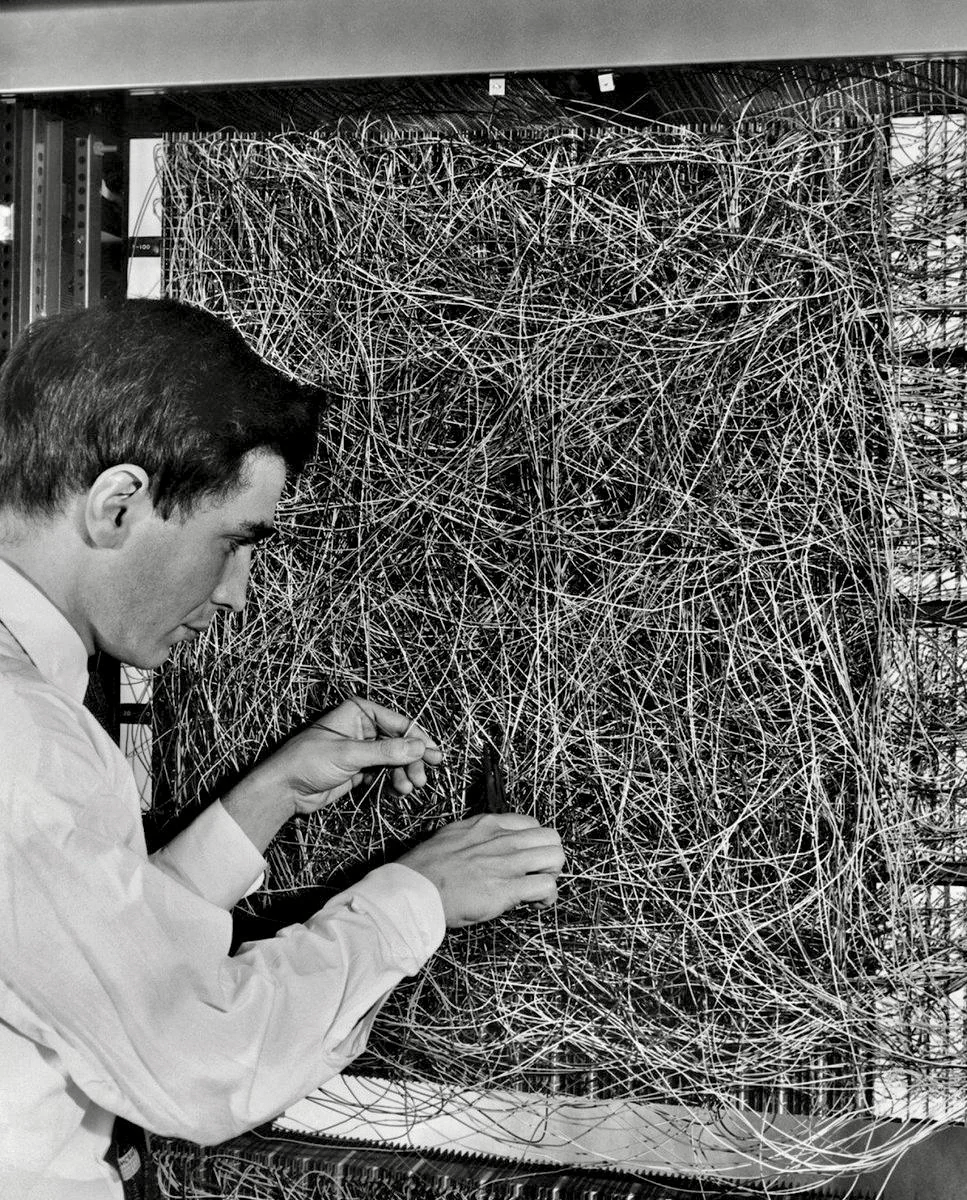
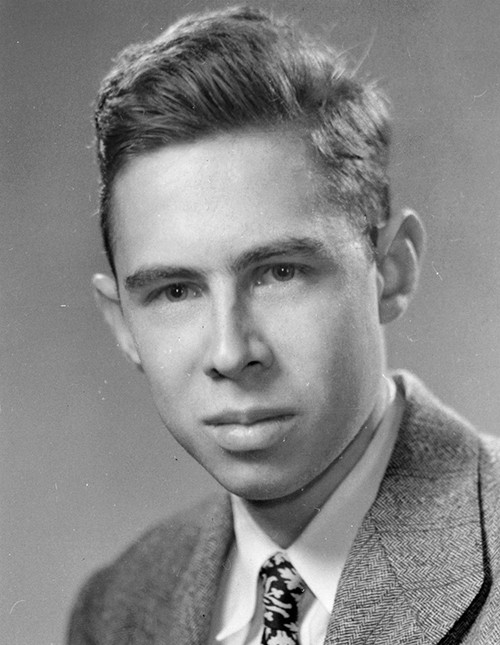
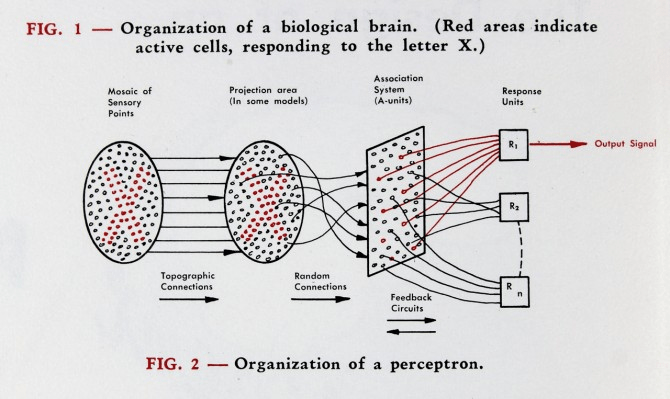
Frank Rosenblatt

New York Times, 1958

IBM 704

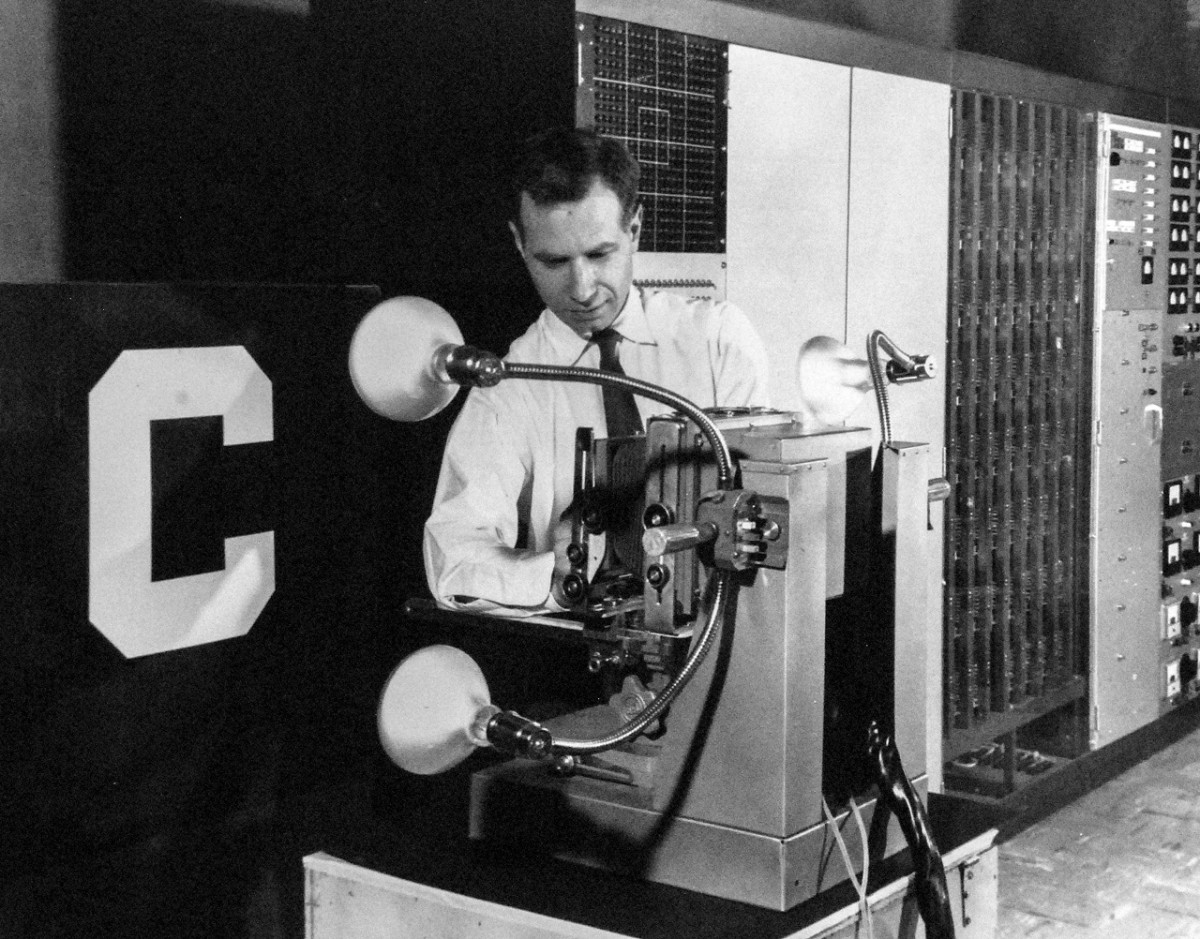
MARK I
Perceptron, 1960

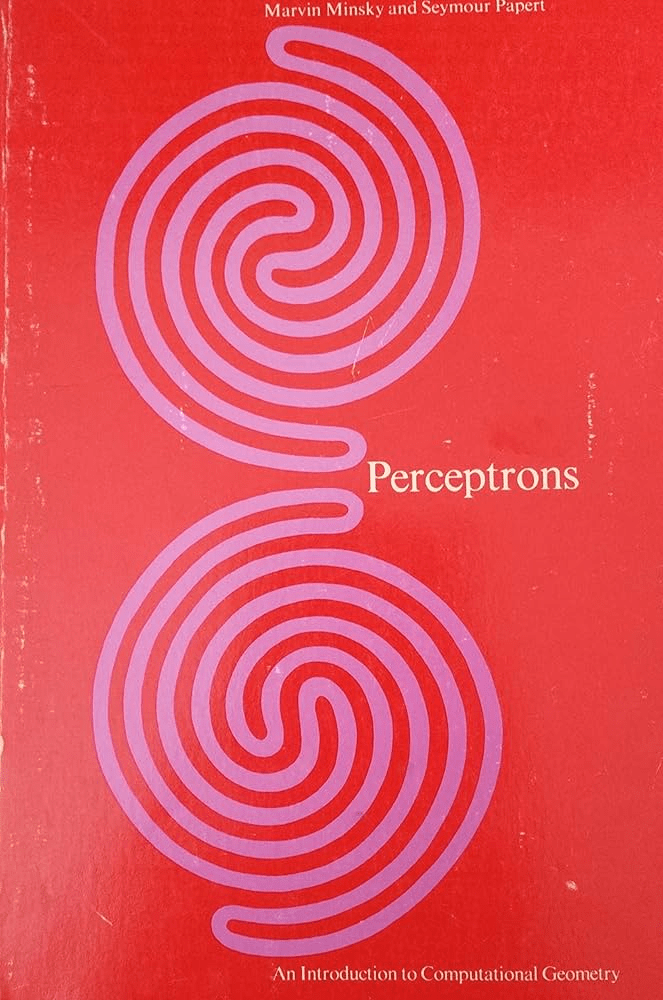
Minsky & Papert

Perceptrons, 1969

\(\underbrace{\quad\qquad\qquad}_{\vec x}\)

\(\underbrace{\qquad}_{h_{\vec w}}\)

\({\vec w}\)

\(\underbrace{\qquad}\)

updates
with \(\vec y\)

\(\underbrace{\qquad}\)

No good algorithm for multiple layers (yet)

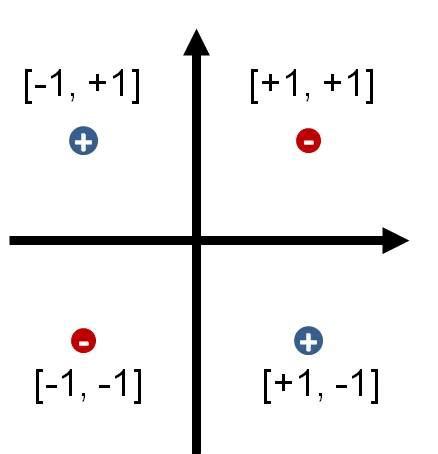
Fundamental limitations of linear classifiers (XOR)

8. Summary

  • The Perceptron is a binary linear classifier
  • We absorb the bias term by adding a constant feature dimension
  • Guaranteed to converge if data is linearly separable
    • Number of mistakes bounded by \(1/\gamma^2\) where \(\gamma\) is the margin
    • Larger margins lead to faster convergence
  • Cannot solve non-linearly separable problems (like XOR)

The Perceptron

By Sarah Dean

Private

The Perceptron