Post-Positivism, Experimental Approaches, and Quasi-Experimental Approaches
Shayan Doroudi
EDUC 222: Research Epistemologies and Methodologies
What paradigm(s) are the authors coming from?
“Consequently experimental results are partly relative to those assumptions and contexts and might well change with new assumptions or contexts. In this sense, all scientists are epistemological constructivists and relativists....Most practicing scientists, including ourselves, would describe themselves as ontological realists but weak epistemological relativists.”
Cook, T. D., Campbell, D. T., & Shadish, W. (2002). Experimental and quasi-experimental designs for generalized causal inference (Vol. 1195). Boston, MA: Houghton Mifflin.
“For example, Campbell and Stanley (1963) described themselves as:
Cook, T. D., Campbell, D. T., & Shadish, W. (2002). Experimental and quasi-experimental designs for generalized causal inference (Vol. 1195). Boston, MA: Houghton Mifflin.
committed to the experiment: as the only means for settling disputes regarding educational practice, as the only way of verifying educational improvements, and as the only way of establishing a cumulative tradition in which improvements can be introduced without the danger of a faddish discard of old wisdom in favor of inferior novelties. (p. 2)”
“This counterfactual reasoning is fundamentally qualitative because causal inference, even in experiments, is fundamentally qualitative.”
What do they mean by this?
Cook, T. D., Campbell, D. T., & Shadish, W. (2002). Experimental and quasi-experimental designs for generalized causal inference (Vol. 1195). Boston, MA: Houghton Mifflin.
How well does Jackson’s (2020) analysis fare in terms of Freedman’s (1991) critique of regression?
“they find that that a 10% increase in per pupil spending each year for all years of public school leads to 0.31 more completed years of education, about 7% higher wages, and a 3.2 percentage-point reduction in the annual incidence of adult poverty.”
“In her preferred estimates, a one-time increase in funding of $96.90 per student improves school-average test scores by about 0.07 student-level standard deviations.”
Jackson, C. K. (2020). Does school spending matter? The new literature on an old question. American Psychological Association.
Education Sciences Reform Act of 2002
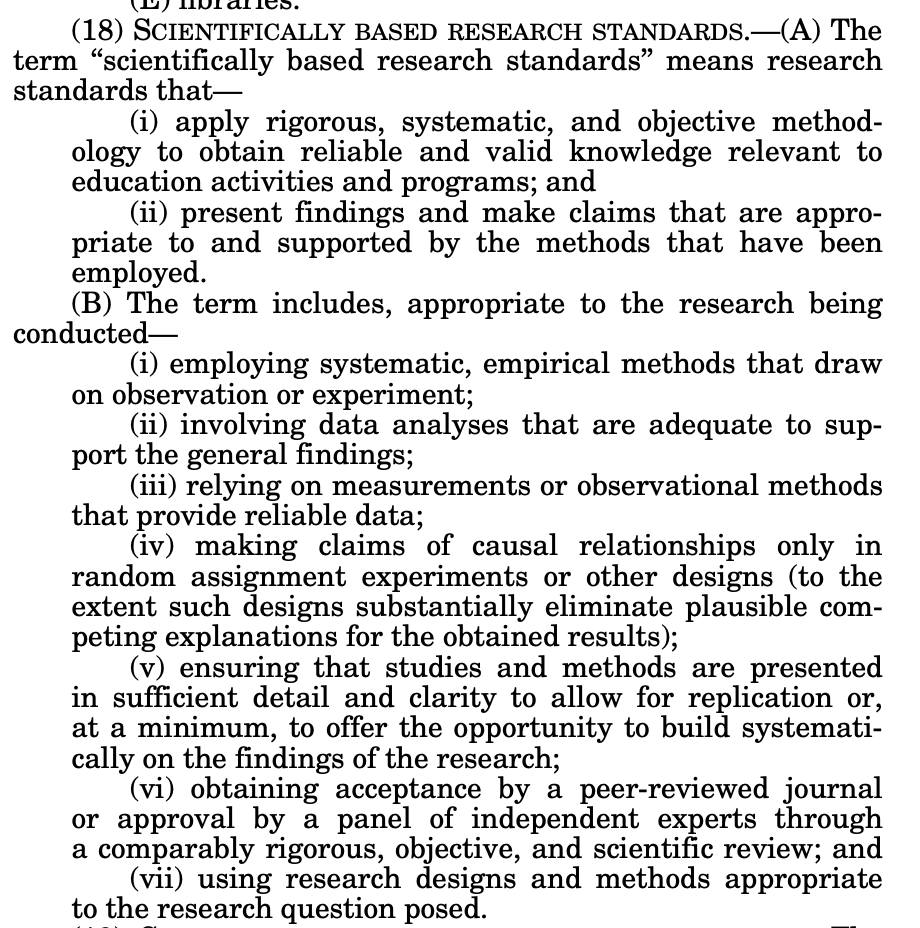
What Works Clearinghouse

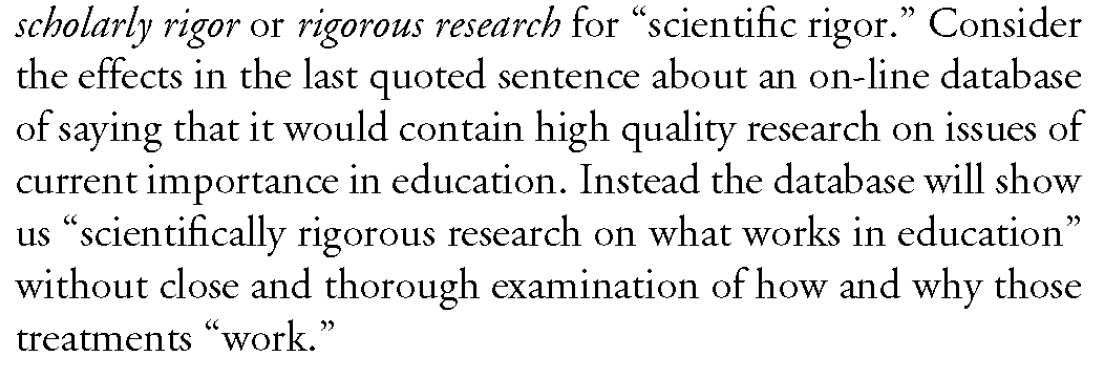
Erickson and Gutierez (2002)
Incommensurability
Science vs. Rigor
What role should the government play in mandating education research?
Do you agree with having a "porous buffer"?
EDUC 222 - Week 3
By Shayan Doroudi