Clayton Shonkwiler PRO
Mathematician and artist
/gs26
this talk!
AMS Special Session on Applications of Knot Theory
March 29, 2026
University of Georgia
BIRS, Japan Science and Technology Agency (CREST JPMJCR19T4), National Science Foundation (DMS–2107700), Deutsche Forschungsgemeinschaft (320021702/GRK2326).
Ochanomizu University
RWTH Aachen University
Kyoto University
Localization Hypothesis
In the asymptotic limit, knots of type \(K\) in SAPs are independent events with a characteristic size and a fixed probability of starting at every edge of the polygon.
Summand Count Conjecture [Kesten/Hammersley 1960s(?)]
Suppose \(K\) is a prime knot type and let
\(m_K^n := \text{number of prime summands of knot type \(K\) in an \(n\)-gon}.\)
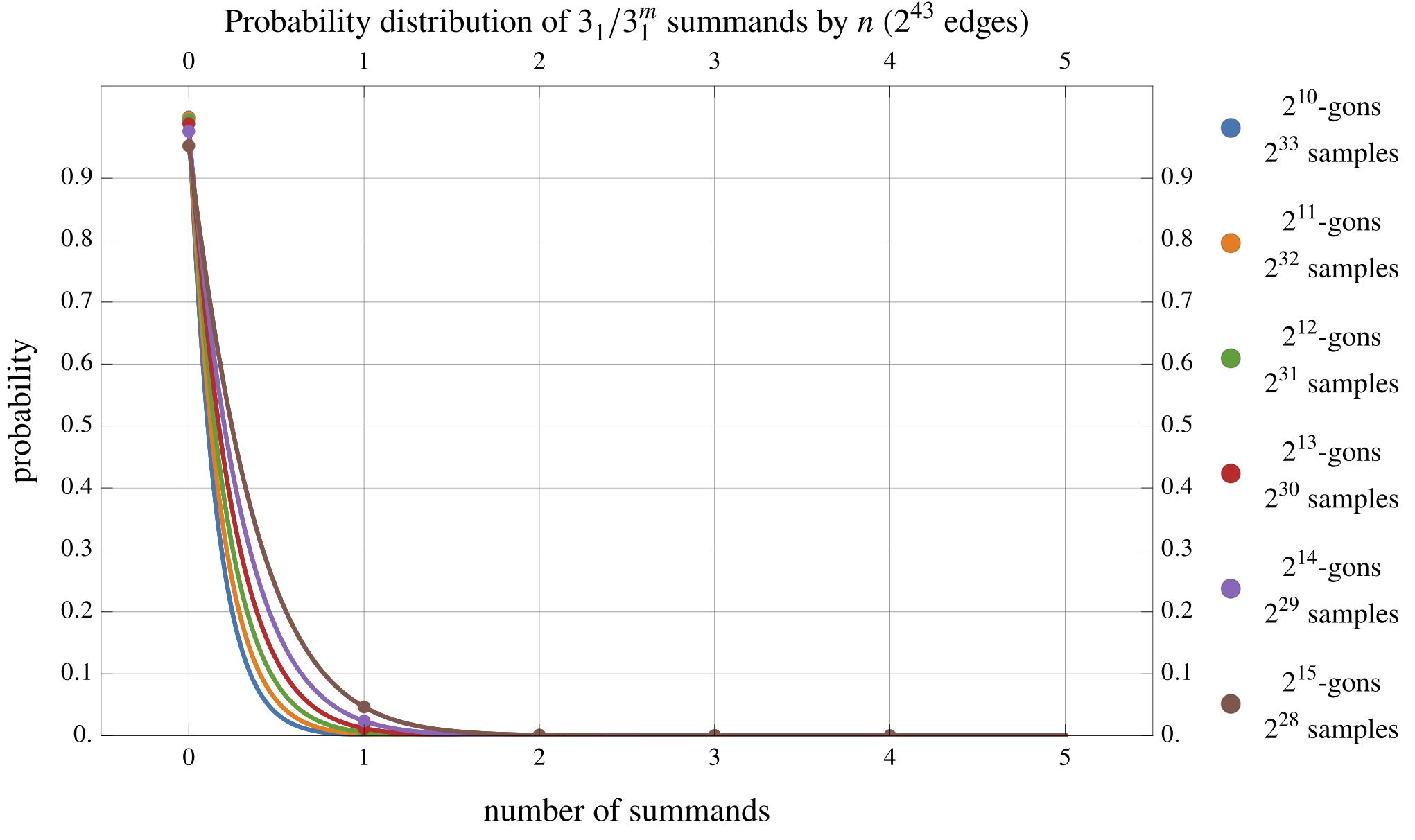
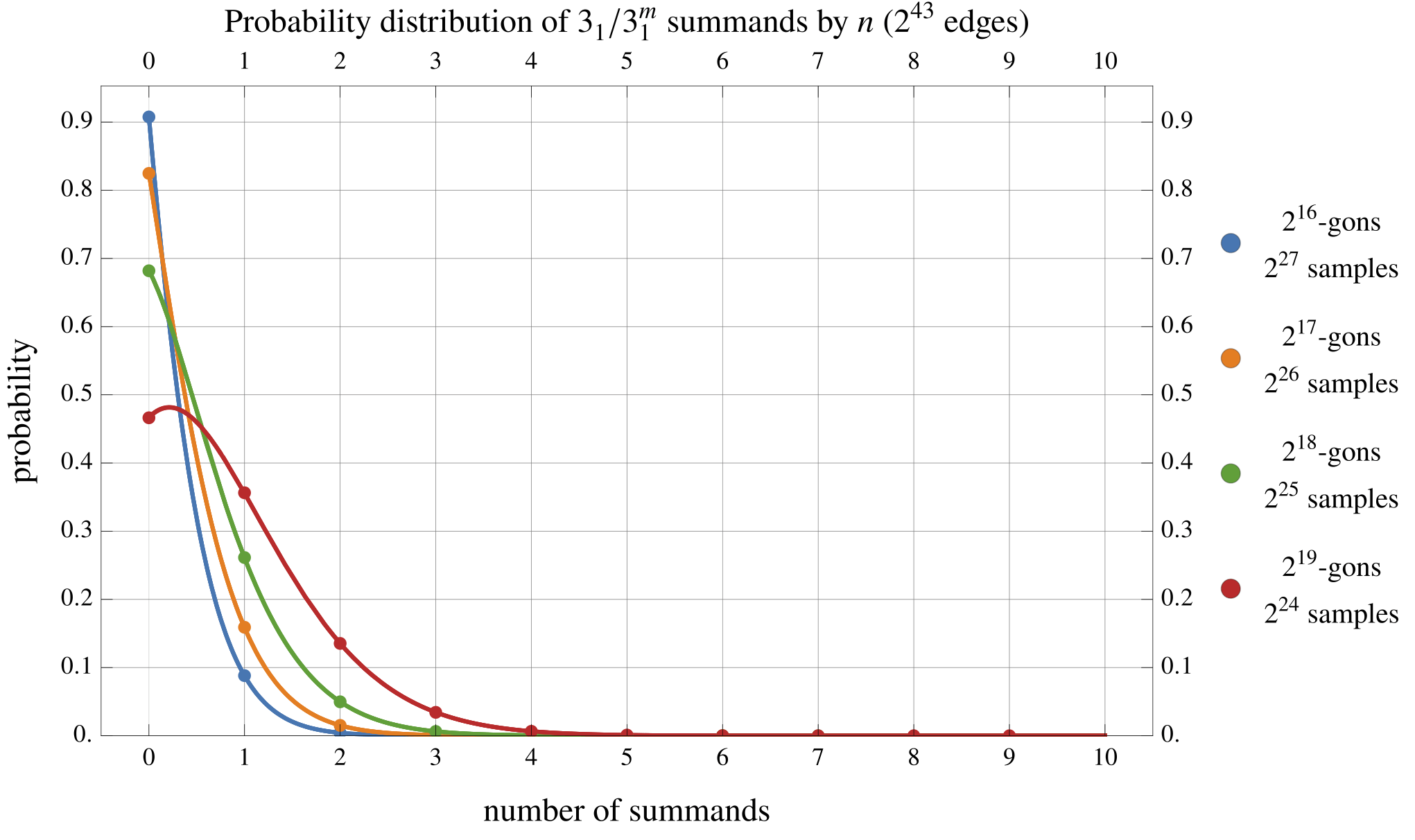
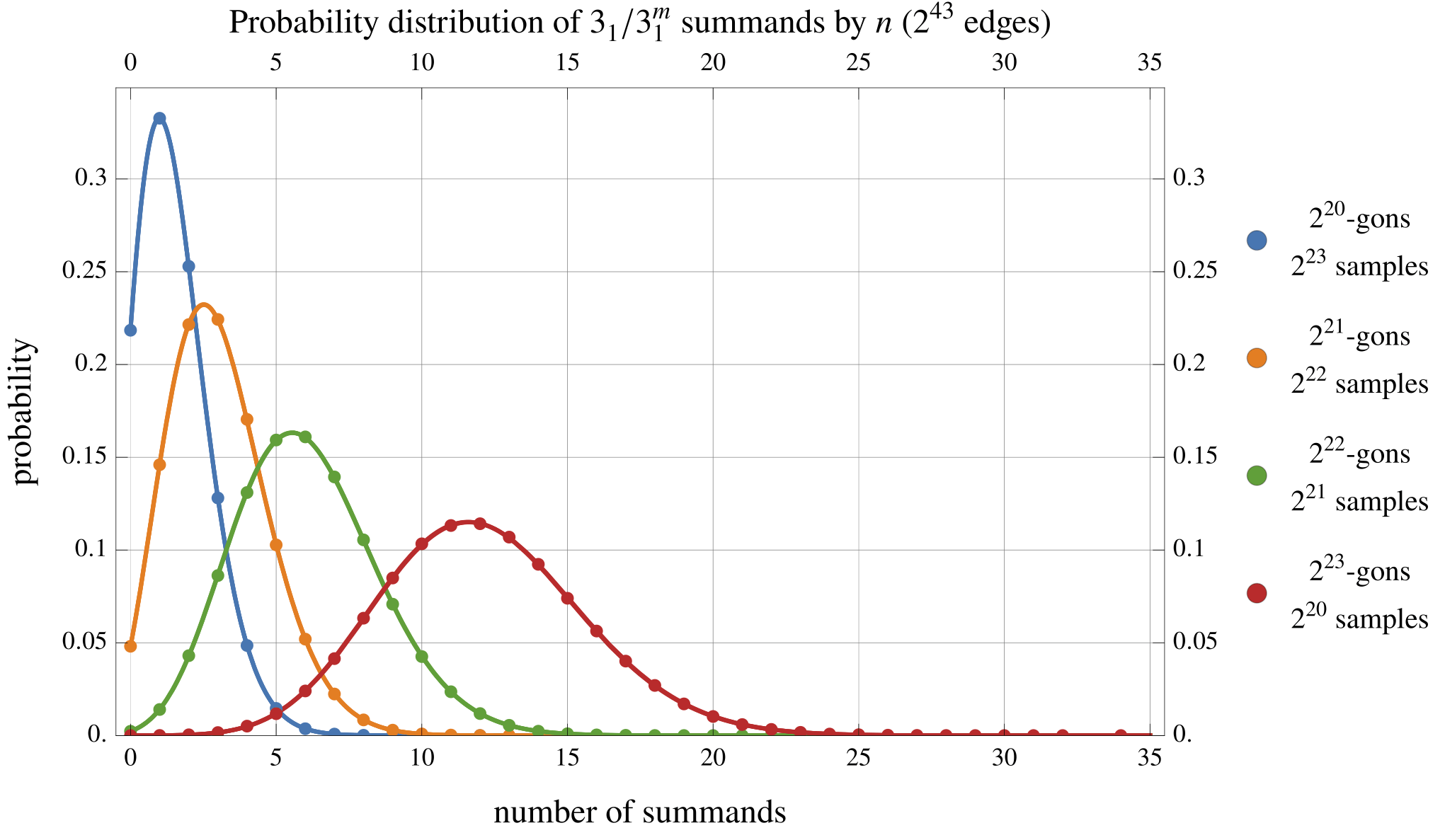
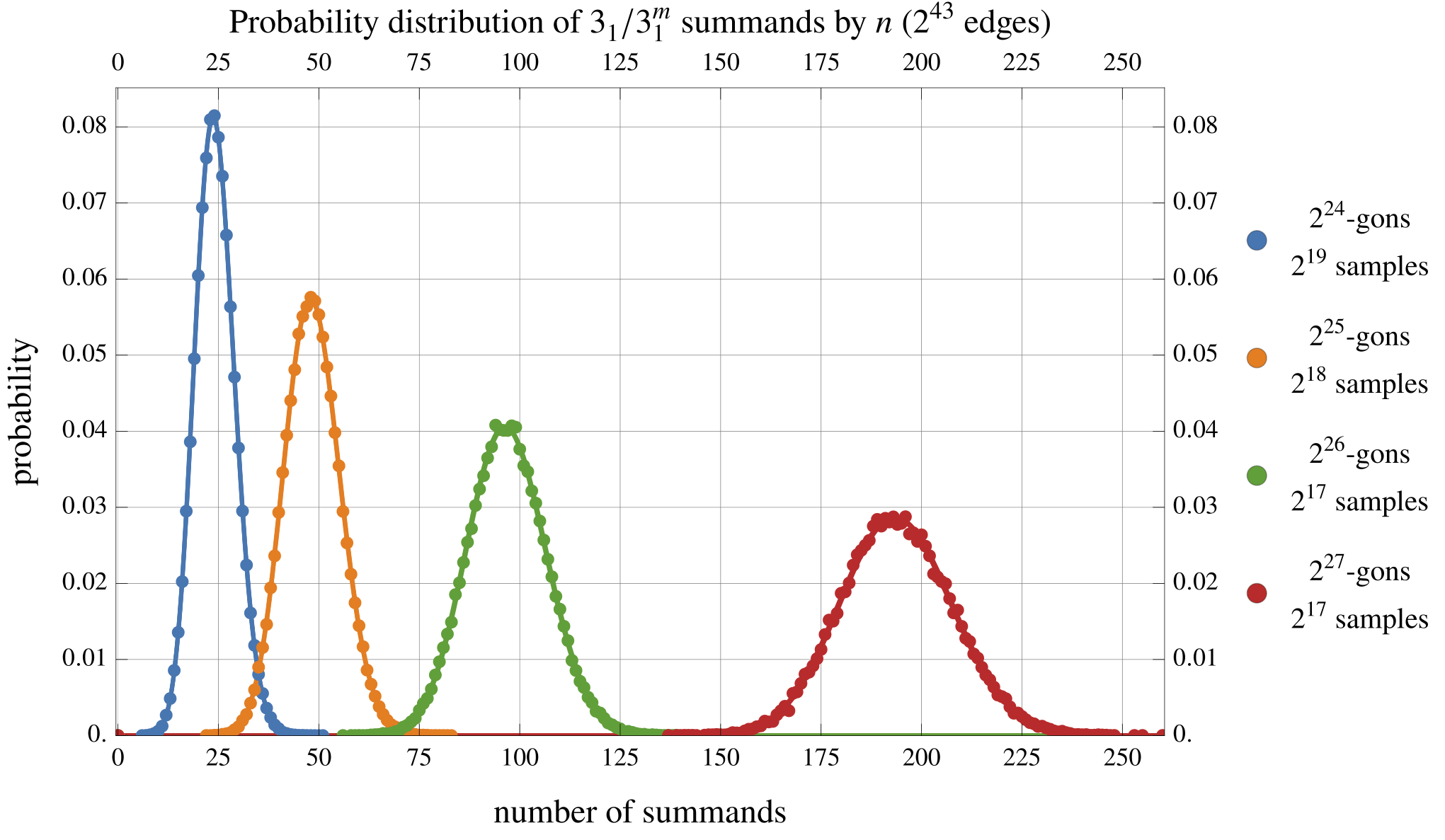
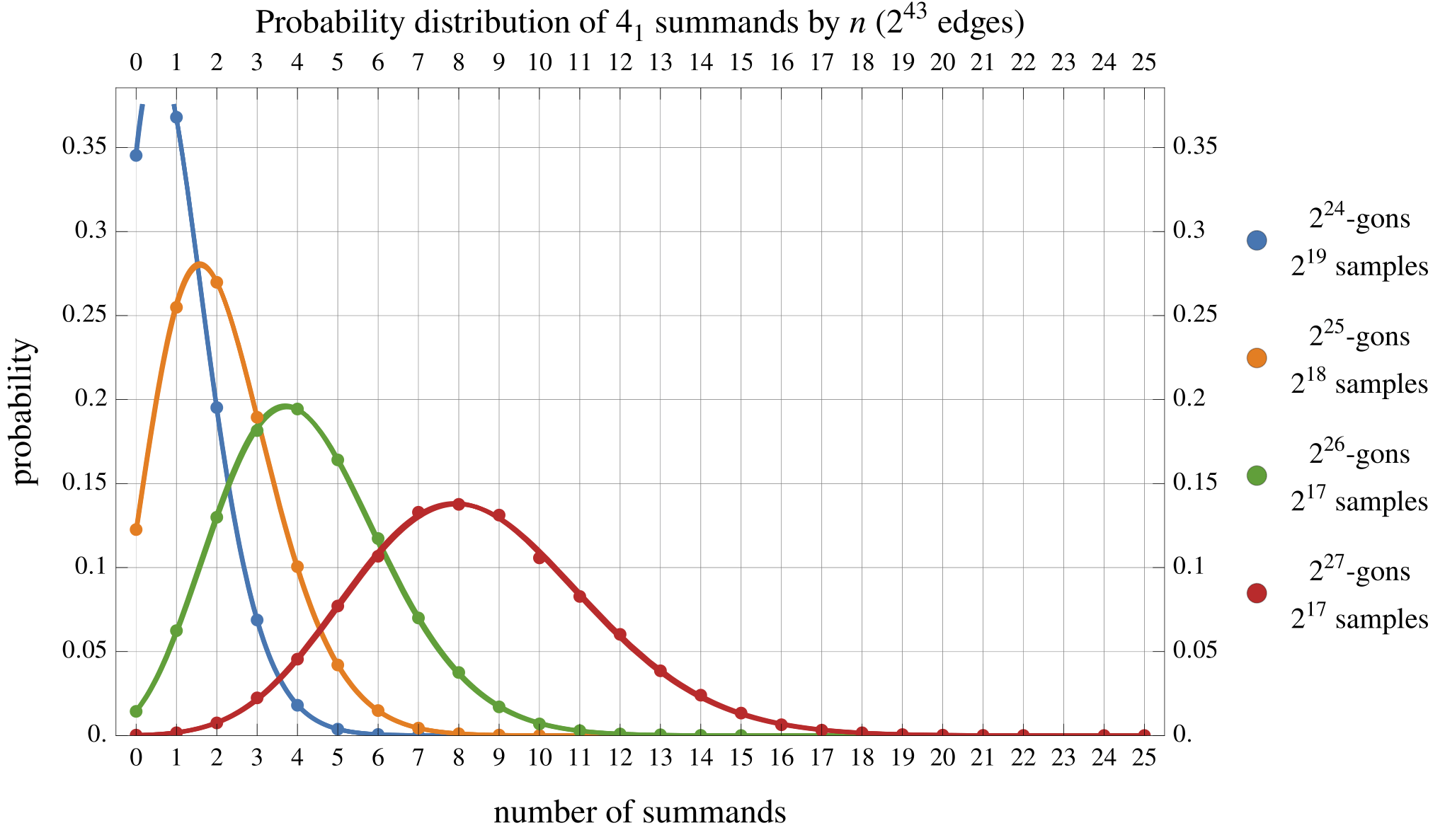
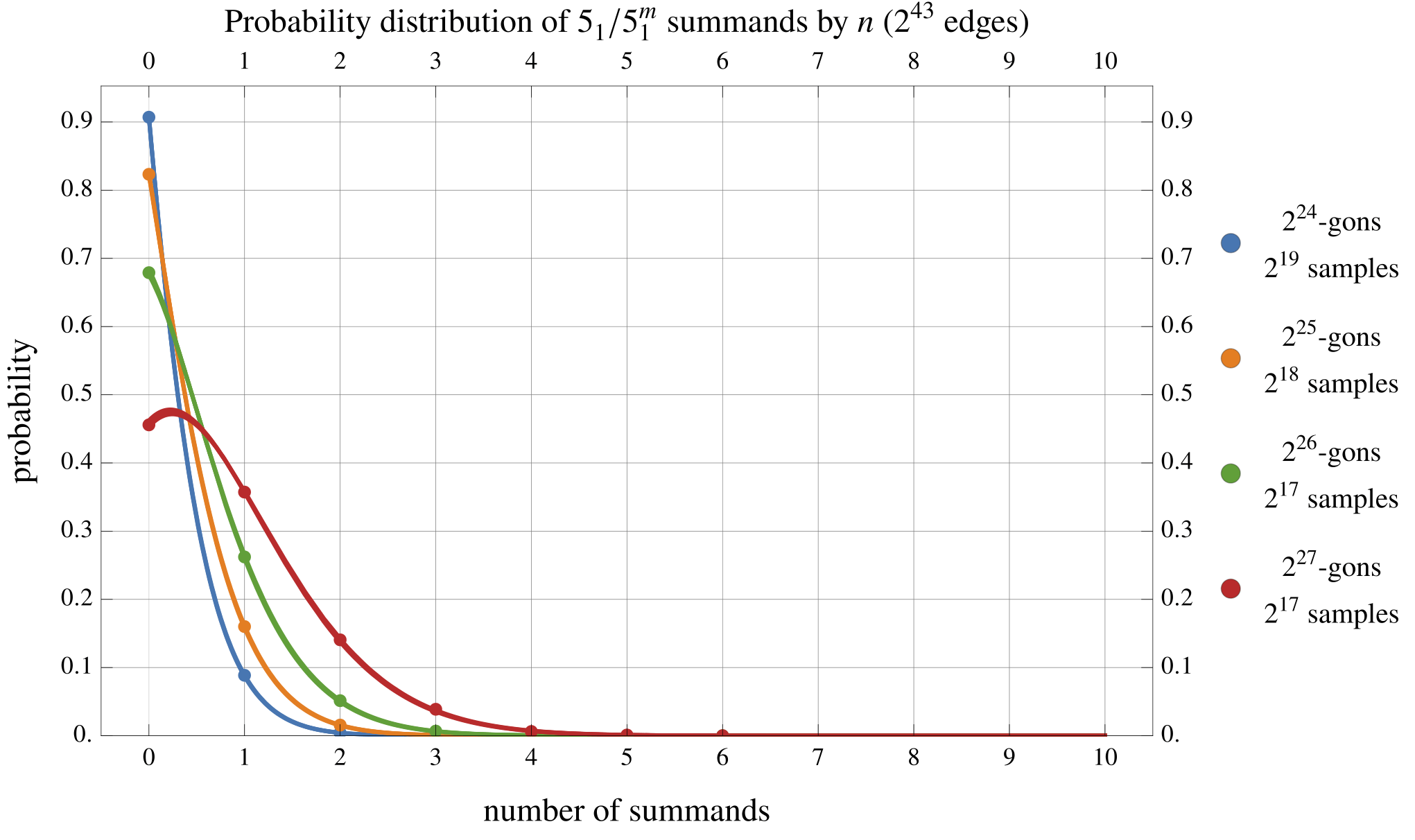
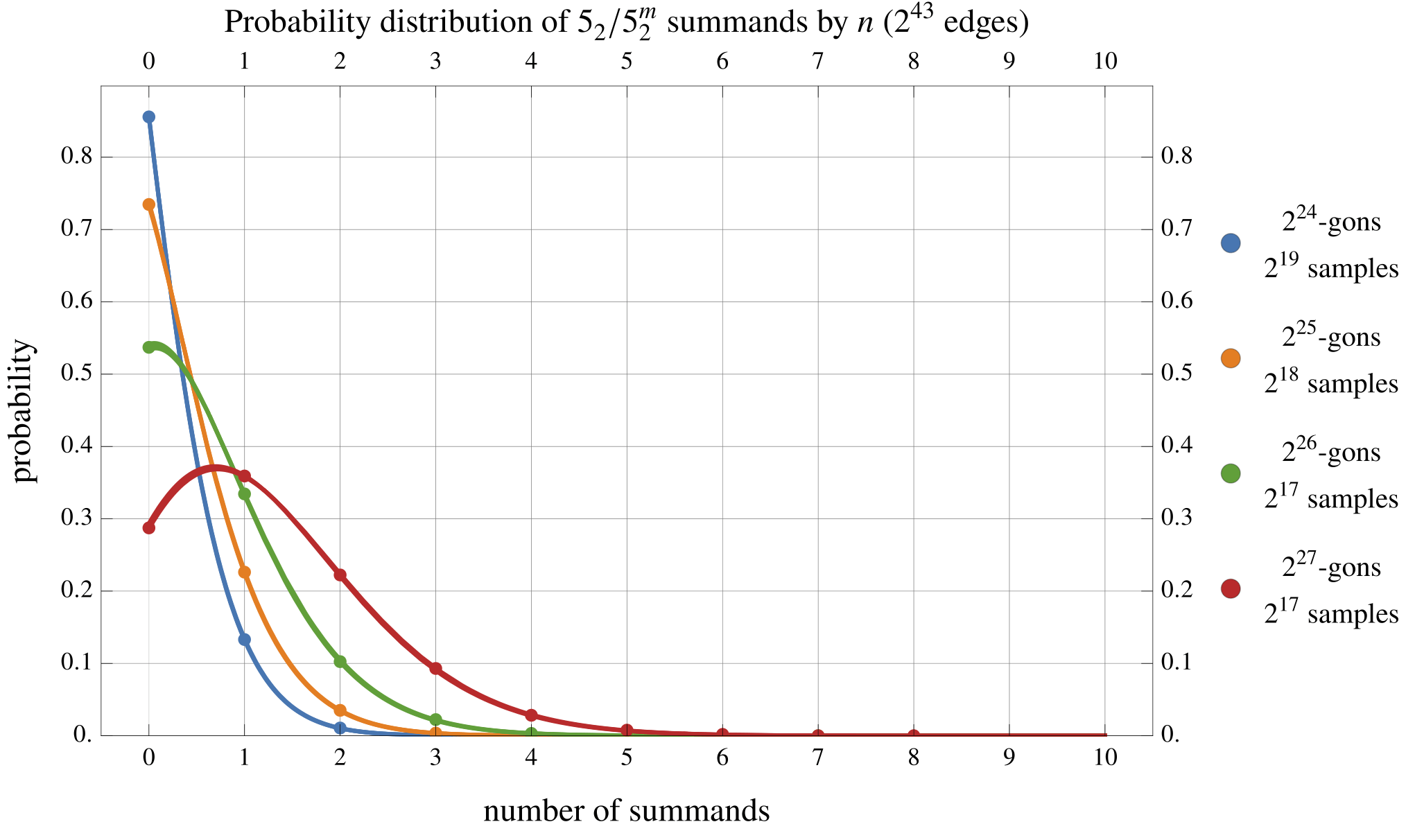
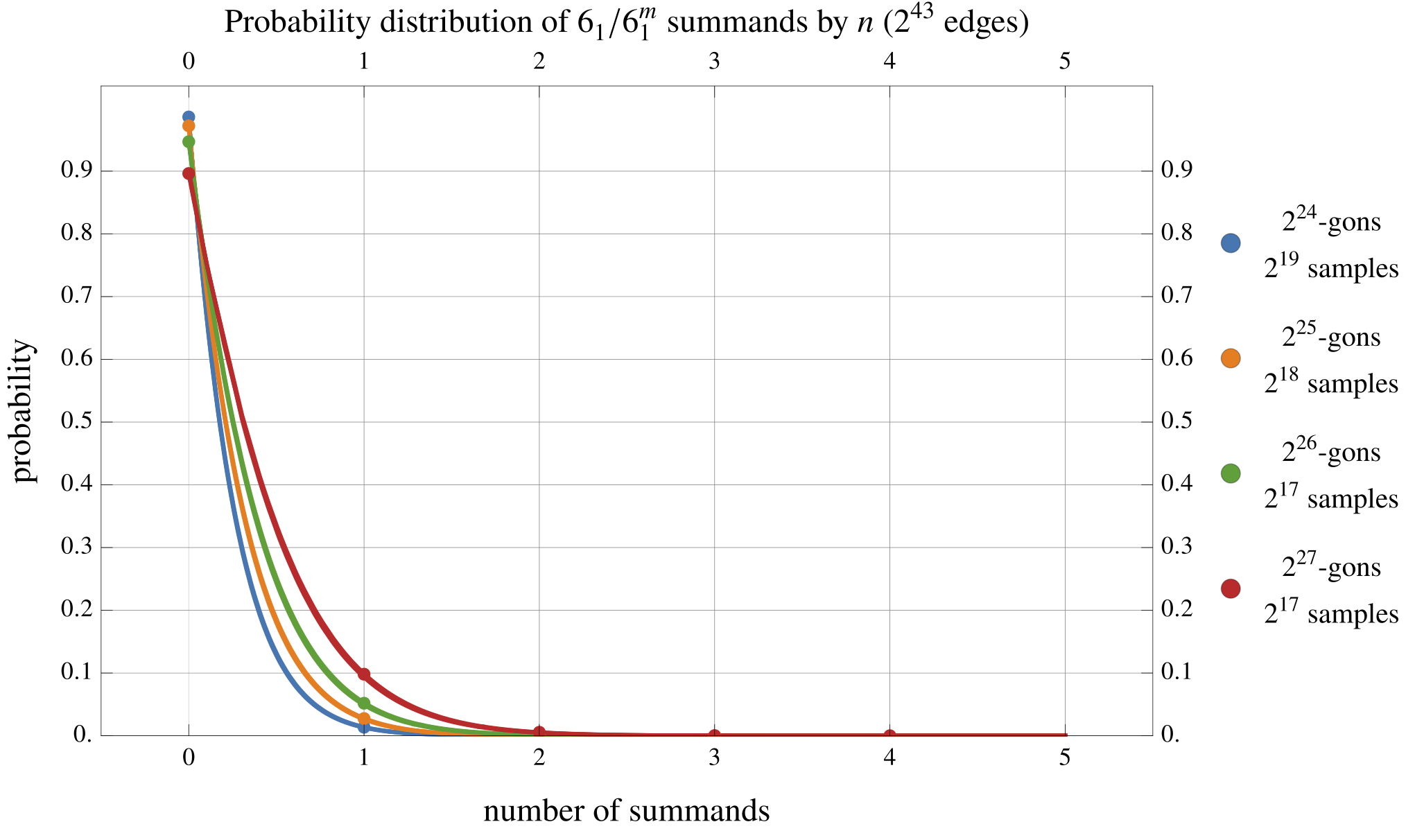
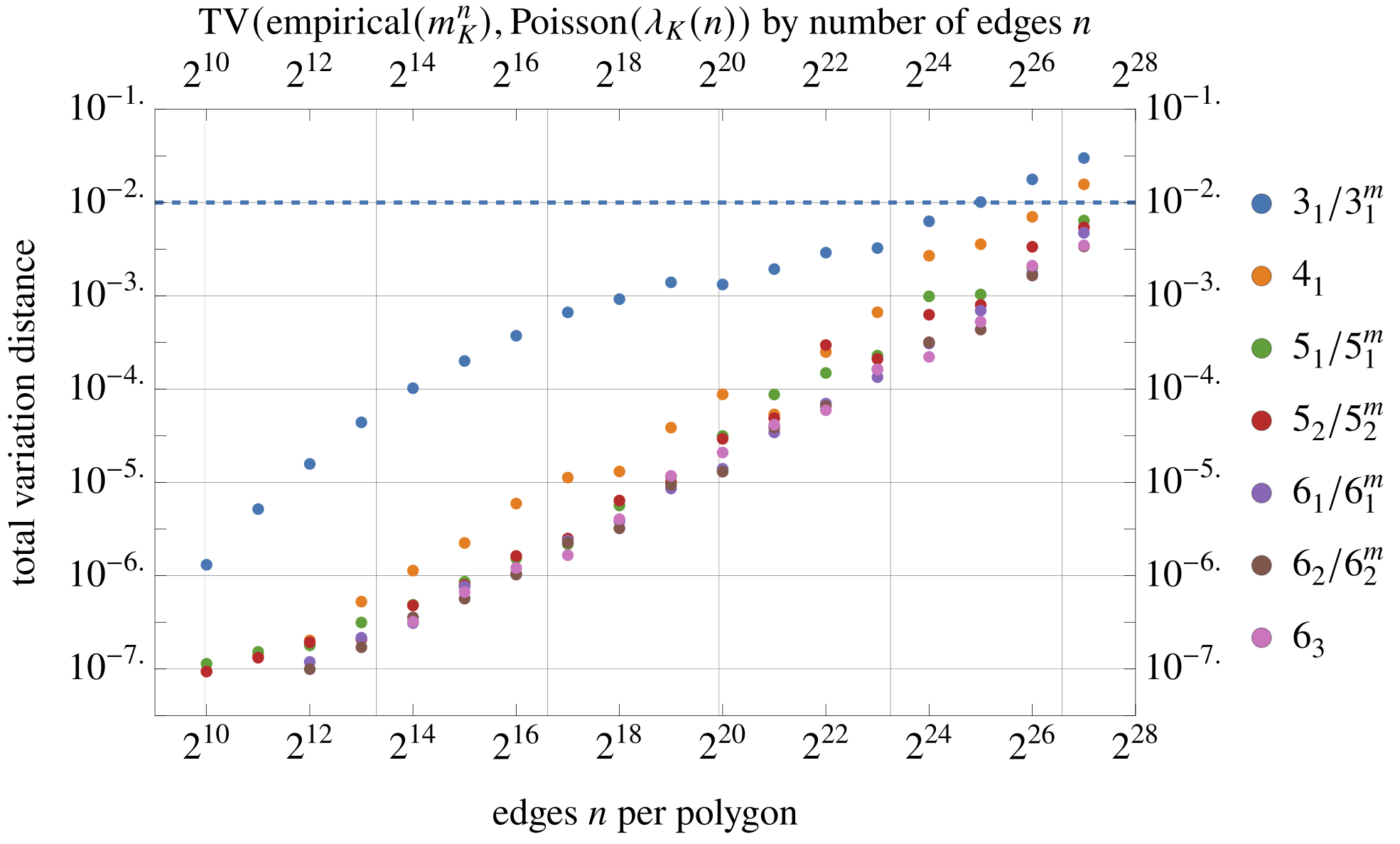
For \(n \gg 1\), \(m_K^n\) is approximately Poisson-distributed:
\(\mathbb{P}(m_K^n = m) \approx \frac{(\lambda_K(n))^m e^{-\lambda_K(n)}}{m!},\)
where \(\lambda_K(n)\) is the expected value of \(m_K^n\). Moreover, \(R_K(n) := \frac{\lambda_K(n)}{n} \to C_K\) as \(n \to \infty\) and, for \(K \neq K'\), \(m_K^n\) and \(m_{K'}^n\) are approximately independent.
Knot Entropy Conjecture [Orlandini, Tesi, Janse van Rensburg, Whittington 1996]
For any knot type \(K\) and \(n \gg 1\),
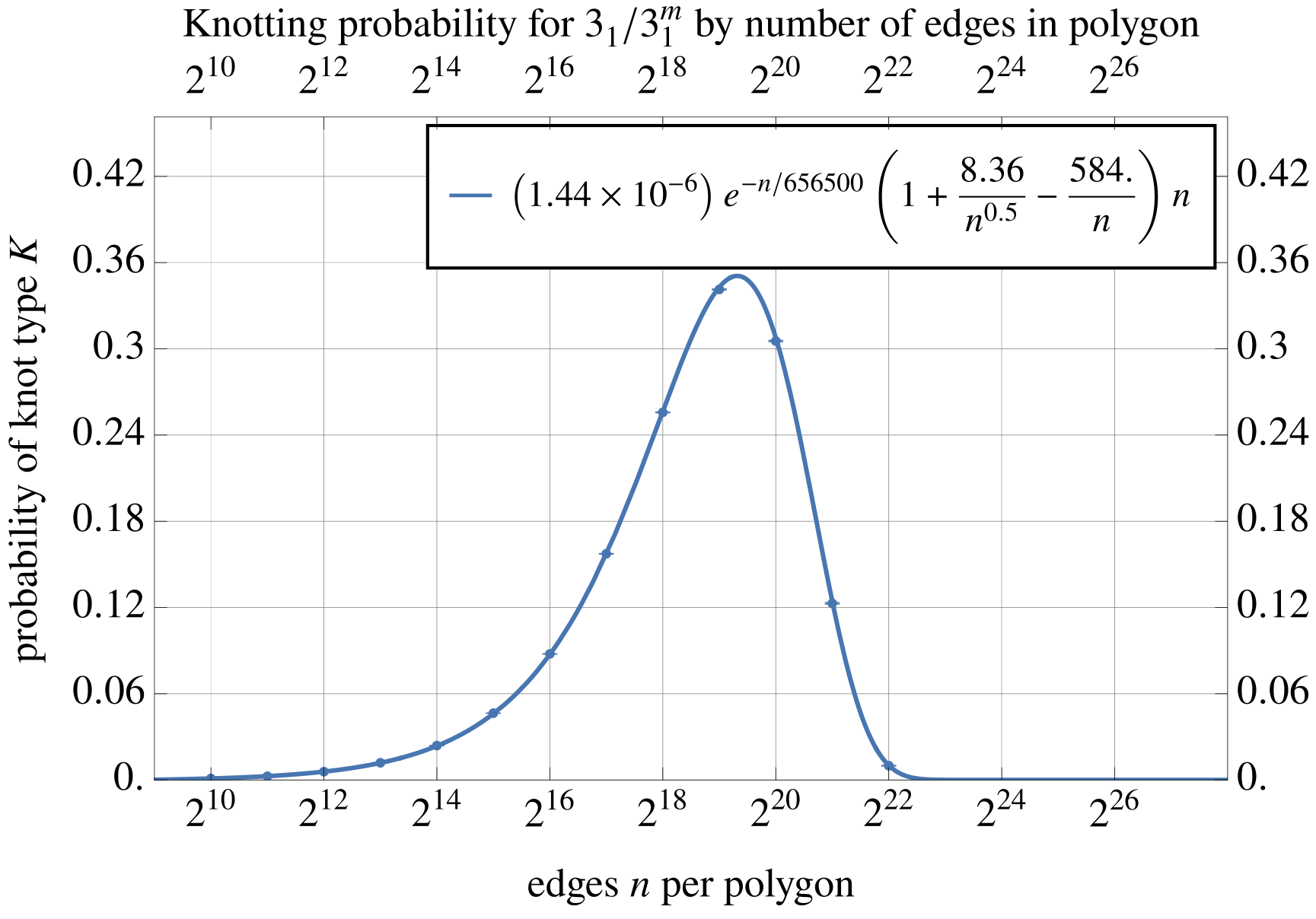
\(\mathbb{P}_{0_1}(n) \approx e^{-n/n_0} \quad \text{and} \quad \mathbb{P}_K(n) \approx C_K n^{m(K)}e^{-n/n_0} \left(1 + \frac{\beta_K}{n^{1/2}} + \frac{\gamma_K}{n}\right)\).
\(n_0\) is called the characteristic length of knotting.
Note: KEC has been proved for lattice polygons in tubes by Beaton et al. (2024).
\(\mathbb{P}_{0_1}(n)=\mathbb{P}(m_K^n=0 \text{ for all prime }K)\)
\(\approx \Pi_K \mathbb{P}(m_K^n = 0)\)
\(= \Pi_{K} e^{-R_K(n) n}\)
\(= e^{-\left(\sum_K R_K(n)\right) n}\)
Let \(R_K(n) = \lambda_K(n)/n\) be the rate of knot production, so SCC says
\(\mathbb{P}(m_K^n = m) \approx \frac{(R_K(n)n)^m e^{-R_K(n)n}}{m!}.\)
Unknot Probability
\(= e^{-n/n_0}\)
with \(n_0 = \frac{1}{\sum_K R_K(n)}\)
Prime Knot Probability
\(\mathbb{P}_{K}(n)=\mathbb{P}(m_K^n = 1 \text{ and }m_{K'}^n=0 \text{ for }K' \neq K)\)
\(\approx\mathbb{P}(m_K^n=1) \times \Pi_{K'} \mathbb{P}(m_{K'}^n = 0)\)
\(\approx R_K(n)n e^{-R_K(n)n}\Pi_{K'} e^{-R_{K'}(n) n}\)
\(= R_K(n)n e^{-\left(\sum_{K'} R_{K'}(n)\right) n}\)
\(= R_K(n)n e^{-n/n_0}\)
8,589,934,592
268,435,456
134,217,728
16,777,216
8,388,608
1,048,576
524,288
131,072
524,288
131,072
524,288
131,072
524,288
131,072
524,288
131,072
Pretty darn Poisson!
Conjecture
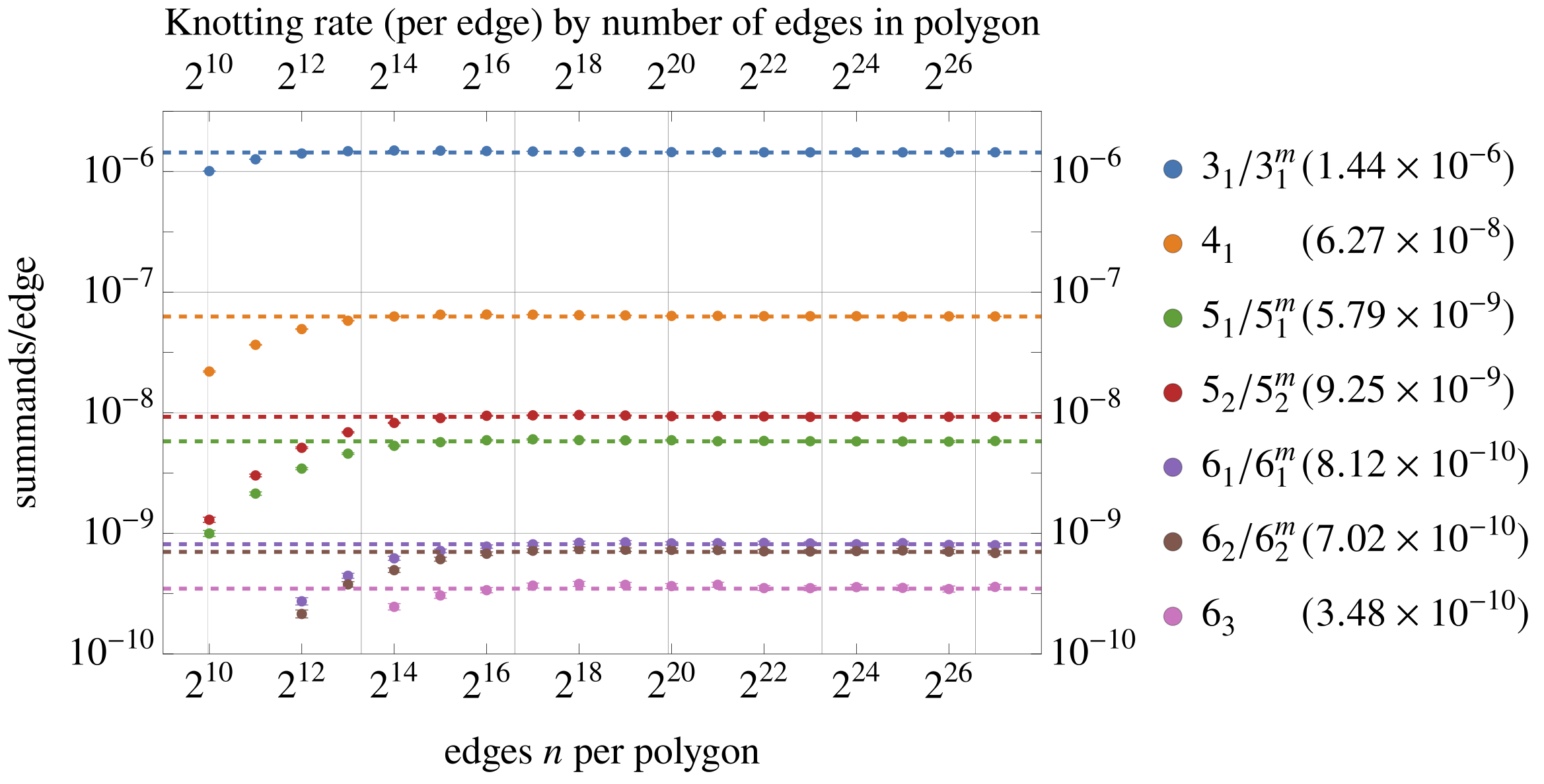
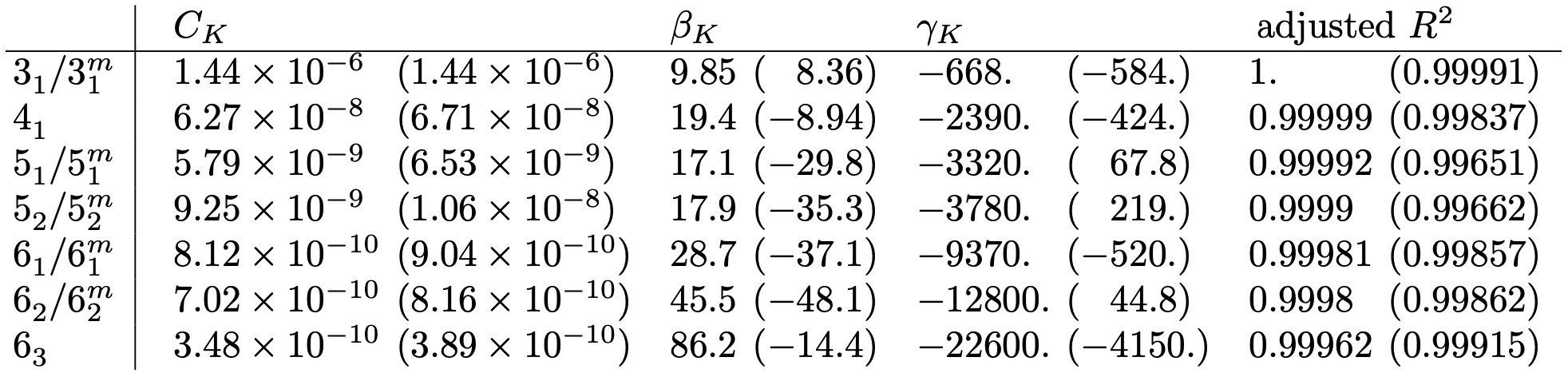
The knotting rate \(R_K(n) \to C_K\) as \(n \to \infty\).
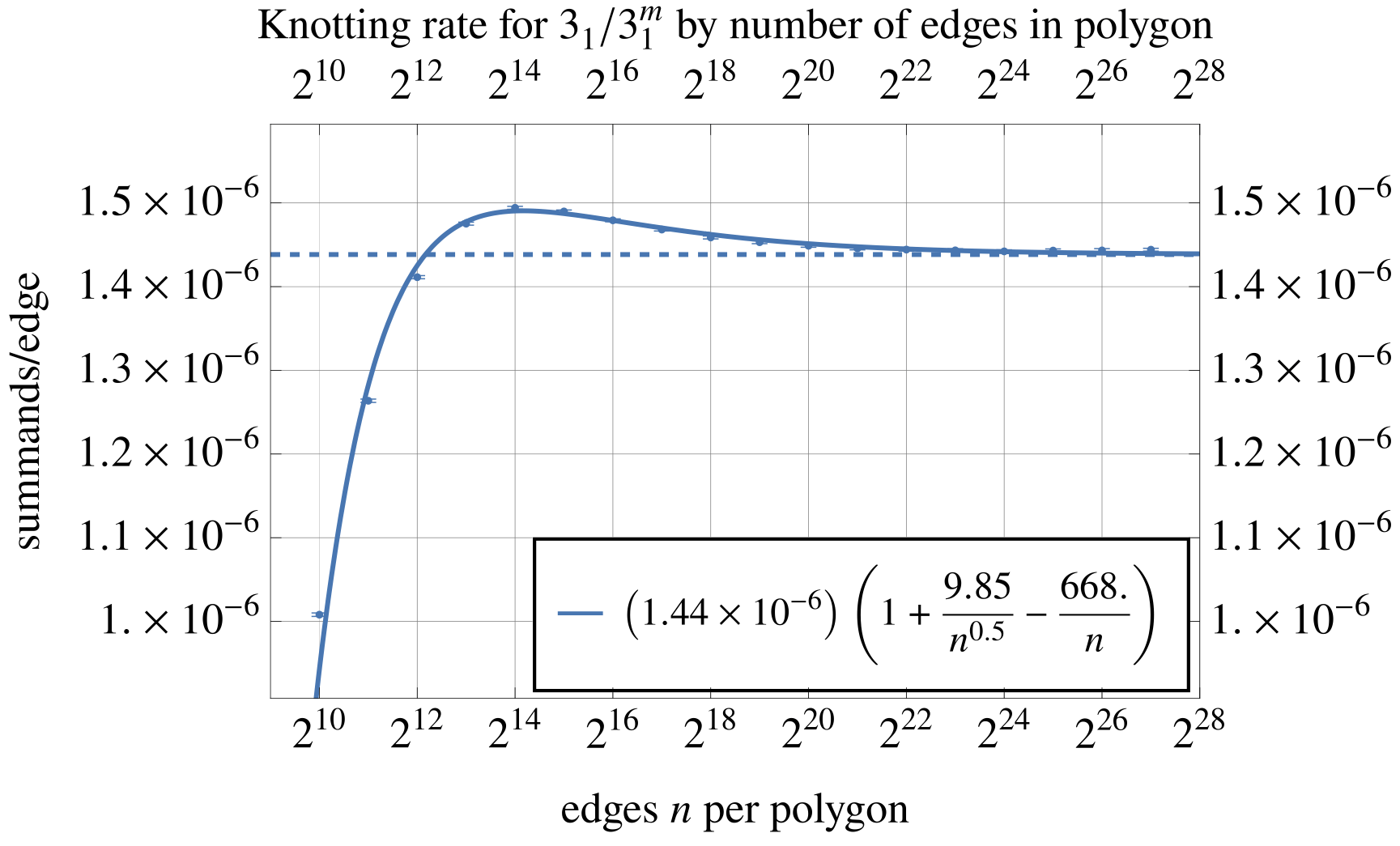
Conjecture
The knotting rate \(R_K(n) \approx C_K\left(1+\frac{\beta_K}{n^{0.5}} + \frac{\gamma_K}{n}\right)\).
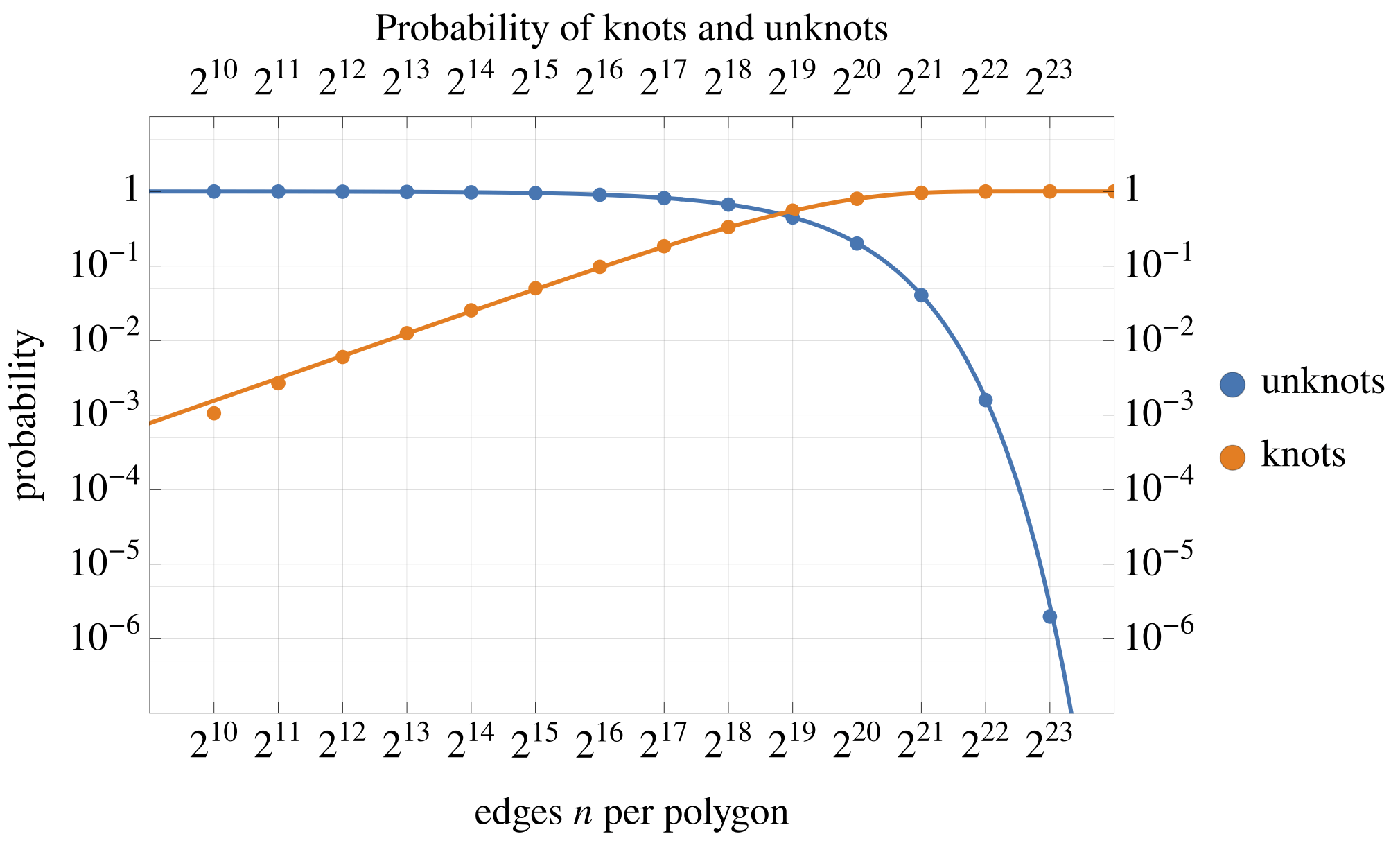
KEC: As \(n \to \infty\), \(\mathbb{P}_{0_1}(n) \approx e^{-n/n_0}\).
SCC: \(\mathbb{P}_{0_1}(n) \approx e^{-\left(\sum_K R_K(n)\right)n}\) and \(R_K(n) \to C_K\).
\(n_0 = \frac{1}{\sum_K C_K} = 656,\!600 \pm 2500\)
estimated \(n_0 \approx 800,\!000\) based on simulations with \(n\leq 1000\).
KEC: As \(n \to \infty\), \(\mathbb{P}_{K}(n) \approx C_K n e^{-n/n_0}\left(1 + \frac{\beta_K}{n^{1/2}} + \frac{\gamma_K}{n} \right)\).
SCC: \(\mathbb{P}_{K}(n) \approx R_K(n) n e^{-\left(\sum_K R_K(n)\right)n}\).
\(\approx C_K n e^{-n/656,500}\left(1 + \frac{\beta_K}{n^{1/2}} + \frac{\gamma_K}{n}\right)\)
What about equilateral random polygons (ERPs)?
What about tightly-confined ERPs?
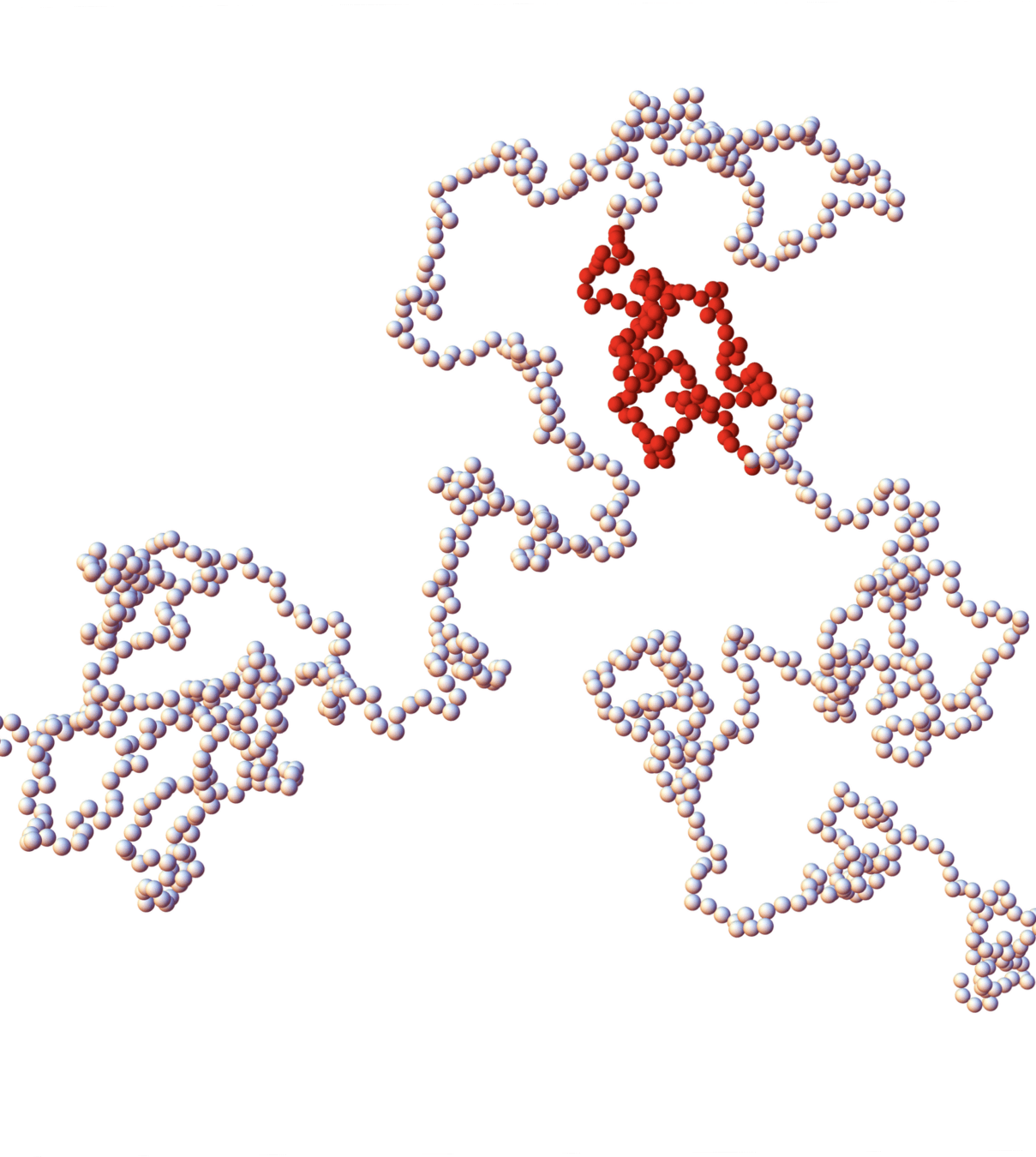
Prime summands seem to be statistically localized, but are they geometrically localized?
shonkwiler.org/gs26
Random knotting in very long off-lattice self-avoiding polygons
Jason Cantarella, Tetsuo Deguchi, Henrik Schumacher, Clayton Shonkwiler, and Erica Uehara
Journal of Physics A: Mathematical and Theoretical, https://doi.org/10.1088/1751-8121/ae55e3
Hard unknots are often easy from a different perspective
Jason Cantarella, Henrik Schumacher, and Clayton Shonkwiler
In preparation
By Clayton Shonkwiler