Research + the Libraries
Key skills and resources for Summer Scholars
S3P 2026
Andrea Baruzzi (she/her) • STEM Librarian
Christina Bush (she/her) • Research & Instruction Librarian
Simon Elichko (they/he) • Social Sciences & Data Librarian
-
Get to know each other
-
Introduction to Swarthmore's libraries
-
What is research?
-
How do we find it?
-
Databases & online research
-
In the libraries (McCabe scavenger hunt)
-
What are we doing here?
Introductions
- Part One:
- Share your name, pronouns if you want, hometown, and favorite dessert
- Share your name, pronouns if you want, hometown, and favorite dessert
- Part Two
- Break into groups of 4
-
Chat within your group about an experience or associations you have with libraries. This can be with a public library, a school library, etc.

Materials
People & Expertise
Programs
Spaces
{ books, articles, streaming media, collections, databases }
{ library staff, research librarians,
archivists }
{ internships, events, exhibits }
Swarthmore Library Resources
{ study, collaboration, viewing }
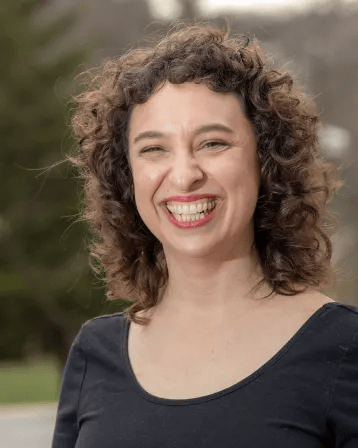
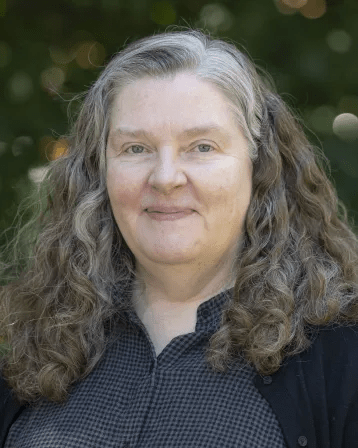
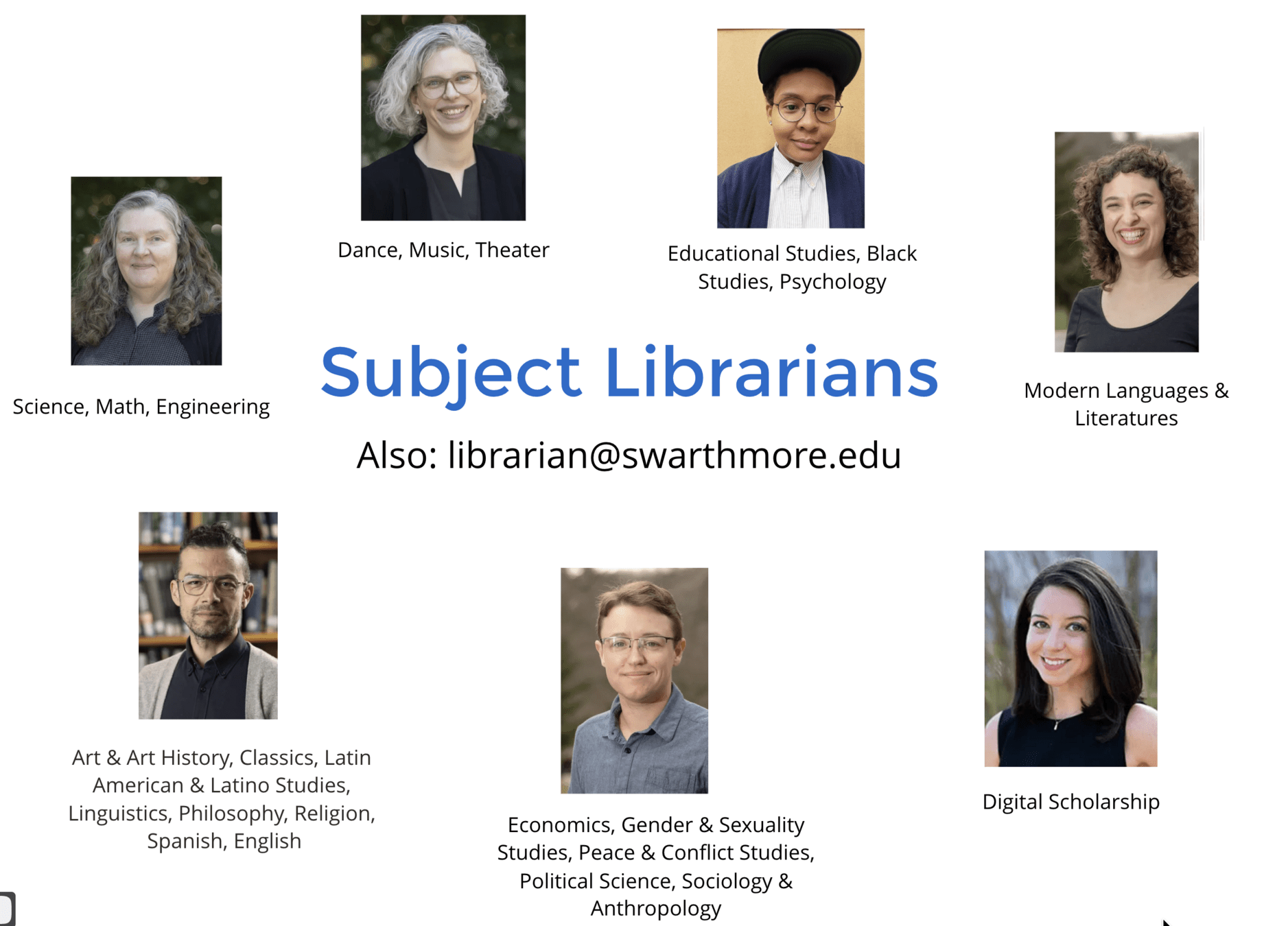
Subject Librarians
Also: librarian@swarthmore.edu
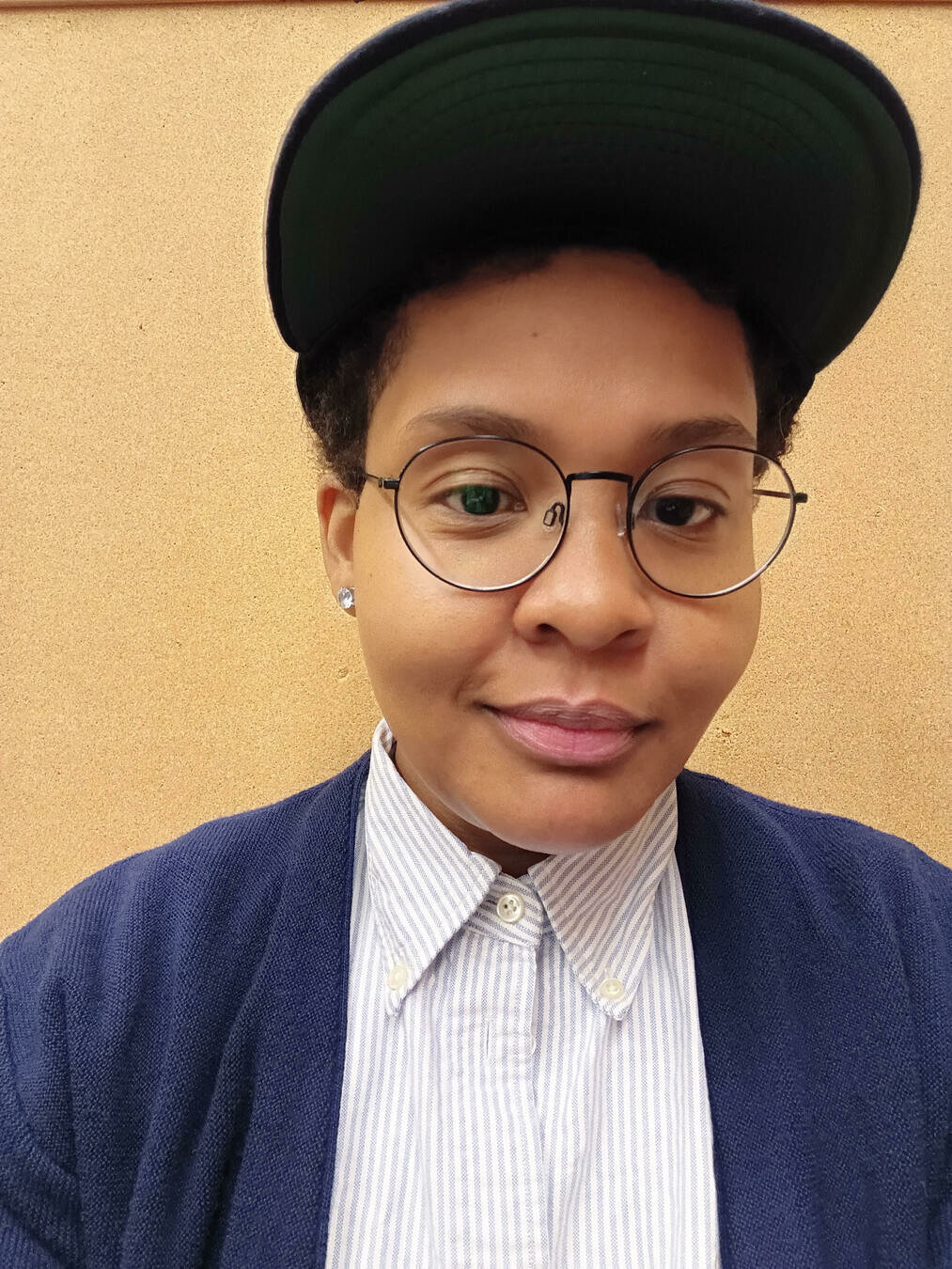

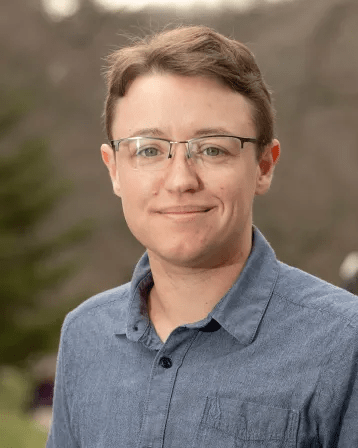
Science, Math, Engineering
Educational Studies, Black Studies, Psychology
Art & Art History, Classics, Latin American & Latino Studies, Linguistics, Philosophy, Religion, Spanish, English
Economics, Gender & Sexuality Studies, Peace & Conflict Studies, Political Science, Sociology & Anthropology
Dance, Music, Theater
Modern Languages & Literatures
Digital Scholarship

What is Research?
process
(something you do)
stuff
(something you find)
"I’m studying drosophila to determine whether odor changes mating behavior."
"I'm looking for articles on
olfactory response in the mating behavior of drosophila."
Speaking of research as stuff, what kinds of materials could you use?
- Print books
- Print journals
- eBooks
- Online journals
- Articles
- Book chapters
- Data and Statistics
- Maps
- Magazines and Newspapers
- DVDs and streaming video
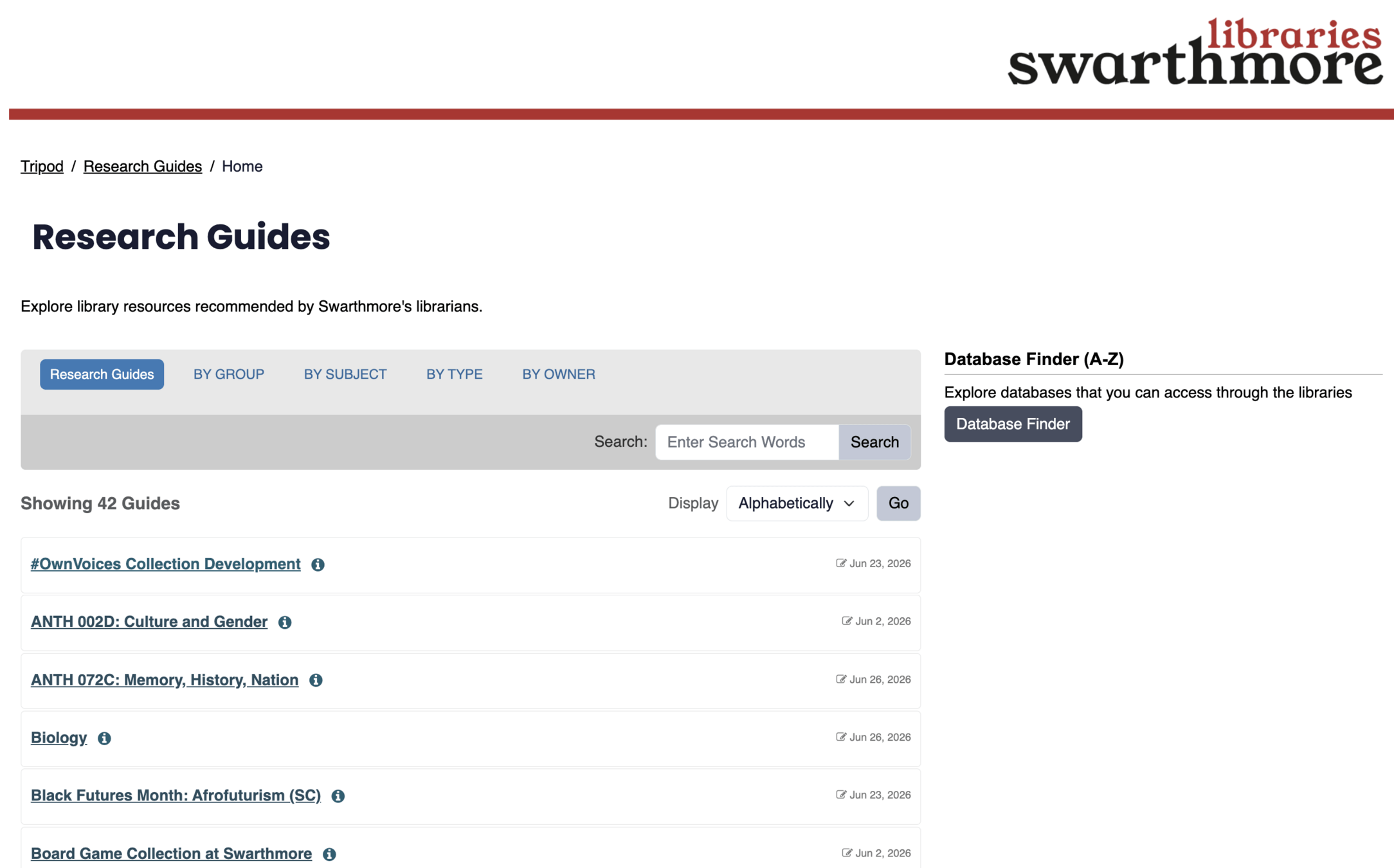
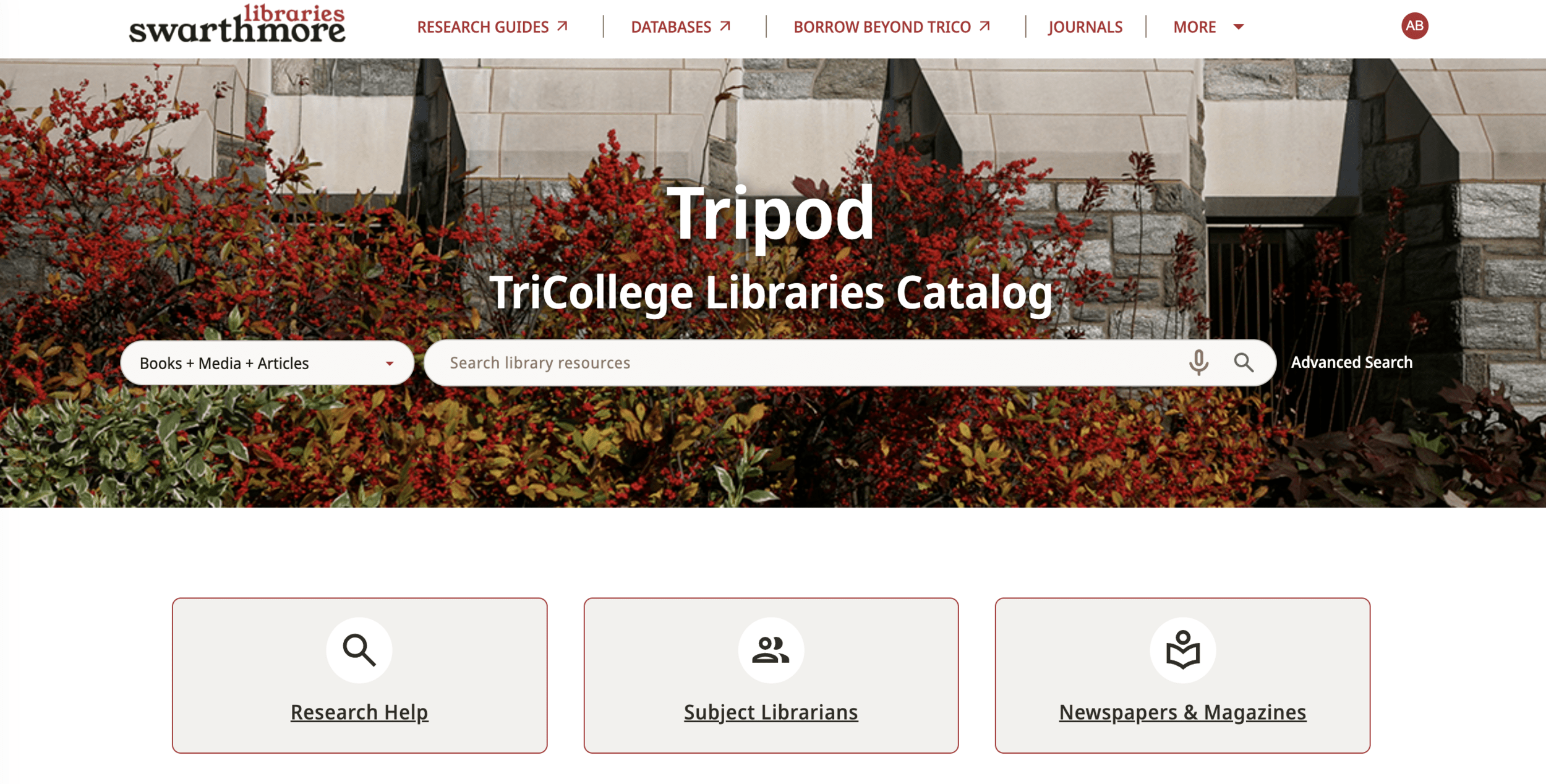
Where can you find it?
Homework for today
Swat Haverford Bryn Mawr
Which TriCo school (or schools) has a copy of
The Gene: An intimate history?
Finding research articles about
a topic of interest
Some useful tools
for finding research:
-
Databases (Web of Science, JSTOR, PubMed)
-
Google Scholar (scholar.google.com)
Librarians can help you learn to navigate the different resources available to you.
Web of Science
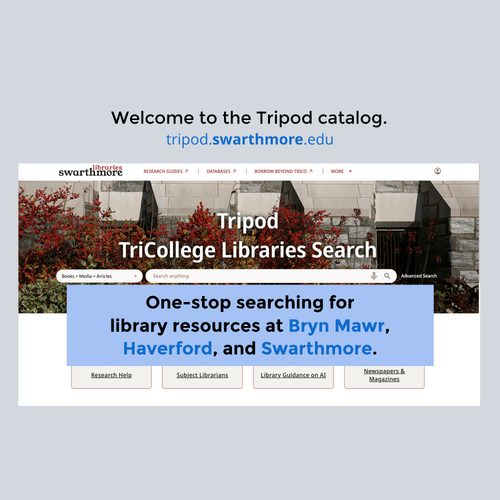
- Go to Tripod, then choose Database Finder
- Find the link to Web of Science
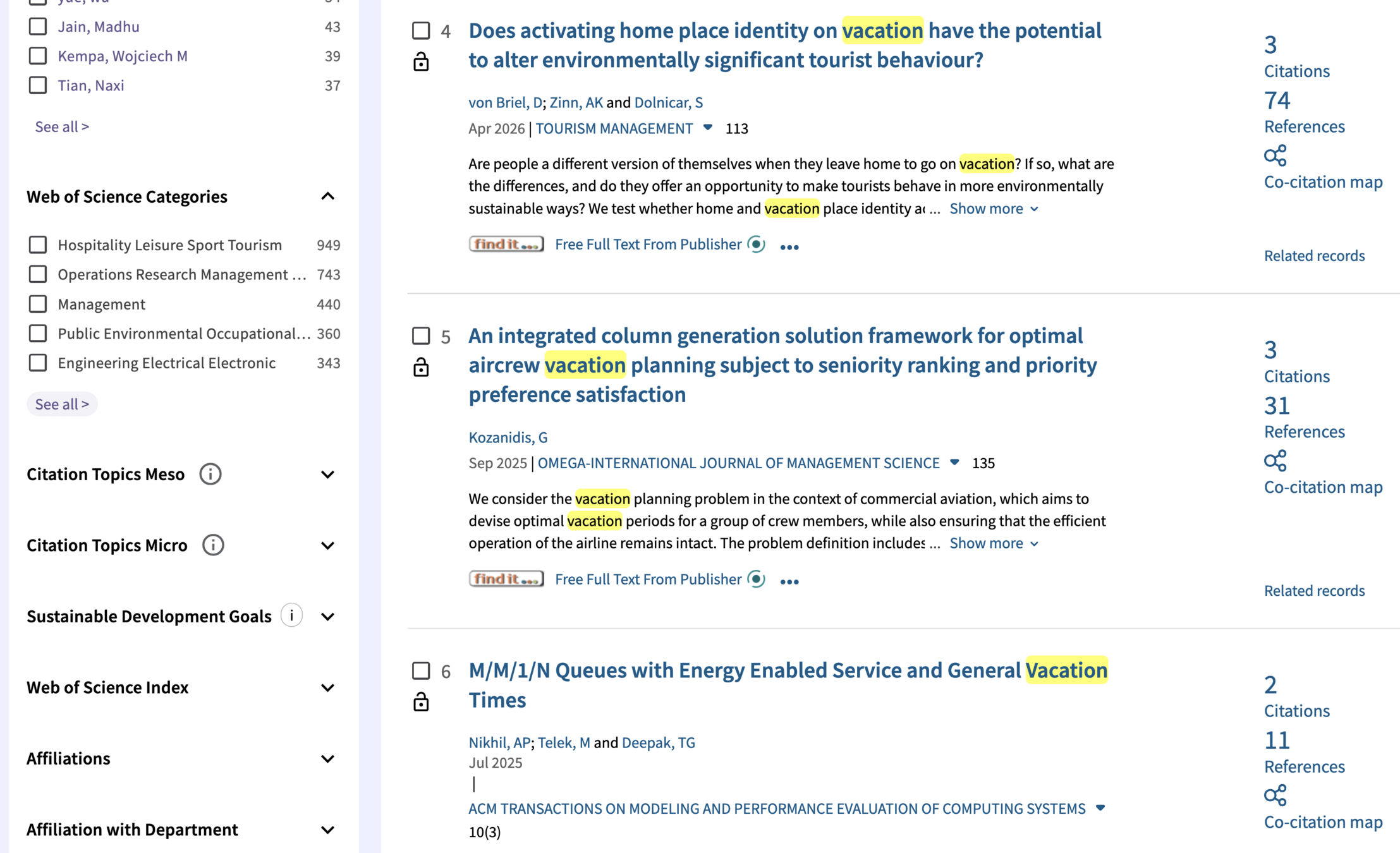
- In Web of Science, search for vacation
What do you notice?
What do you think is different about these results than if you searched in Google?
Making sense of citations
Split into 4 groups of 4
With your group, go to one of the whiteboard spaces
Label the different elements of your assigned citation. (Use the elements list provided.)
Web of Science
Look at your search results in Web of Science
(rerun the search for vacation if you need to)
For many articles, Web of Science shows you both
references and citations.
What does it tell you when an article has a lot of citations?
Narrow your results by academic discipline (broadly speaking) by choosing one of the Web of Science Categories in Filters
How does database searching work?
burger
AND
("french fries" OR salad)
Let's say you're looking for research related to The Listening Project.
listening
AND
("middle school" OR "junior high")
Now you try: run this search in Web of Science
Filter your results by Web of Science Categories to Music
Learning to search & AI
Three realities to consider:
- Constructing good Boolean searches is worthwhile. Plenty of collections and resources are still only accessible this way. But it takes practice and patience.
- Each search system (Web of Science, JSTOR, Google) has its own technical quirks.
- Familiarity with the terms used by researchers really helps.
So what can you do?
- Learn from the people around you: talk with your professors and classmates, get help from librarians
- Use the resources provided to help you learn: look at your syllabus, read the recommended readings
- You can selectively use AI tools to help with search mechanics and terminology, while still using your brain to discover and evaluate potential sources.
Using AI to help you search
(rather than to do the work for you)
Let's try this using one of Swarthmore's data-protected AI tools:
- LibreChat
- Gemini (only data-protected when accessed through Swarthmore)
Sample prompt:
Some example boolean searches to use in Web of Science to find research on helping middle schoolers strengthen their listening skills
Suggestions:
- Identify the platform/database
- Keep it plural ("some example...searches") so you can see different directions and choose from multiple possibilities
Using AI to help you search
Error message in Web of Science...now what?
Sample result:
- TS=("listening skill*" OR "listening comprehension" OR "auditory comprehension" OR "listening instruction" OR "listening strateg*")
AND
TS=("middle school*" OR "junior high*" OR adolescent* OR "grade 6" OR "grade 7" OR "grade 8" OR "sixth grade" OR "seventh grade" OR "eighth grade")
Copy and paste the search into Web of Science.
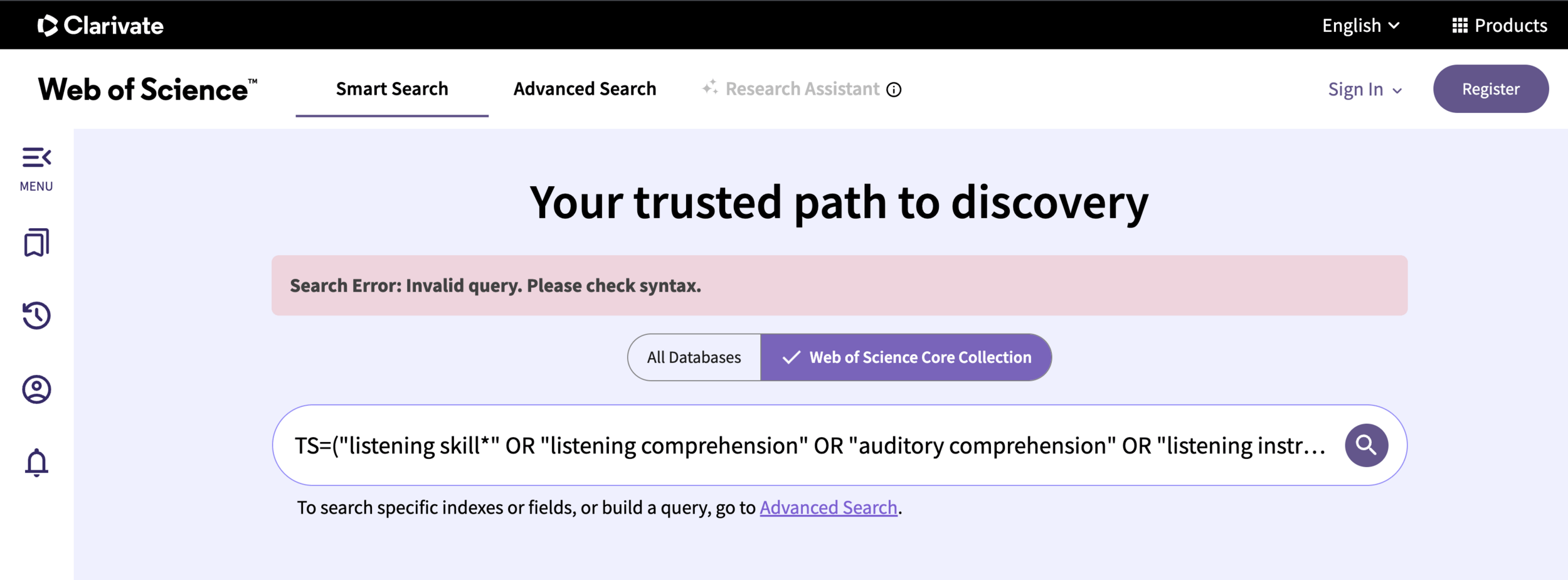
The query is valid, the syntax is fine - you just need to go to Advanced Search.
Using AI to help you search
Choose Query Builder
Paste your terms directly into Query Preview, then Search
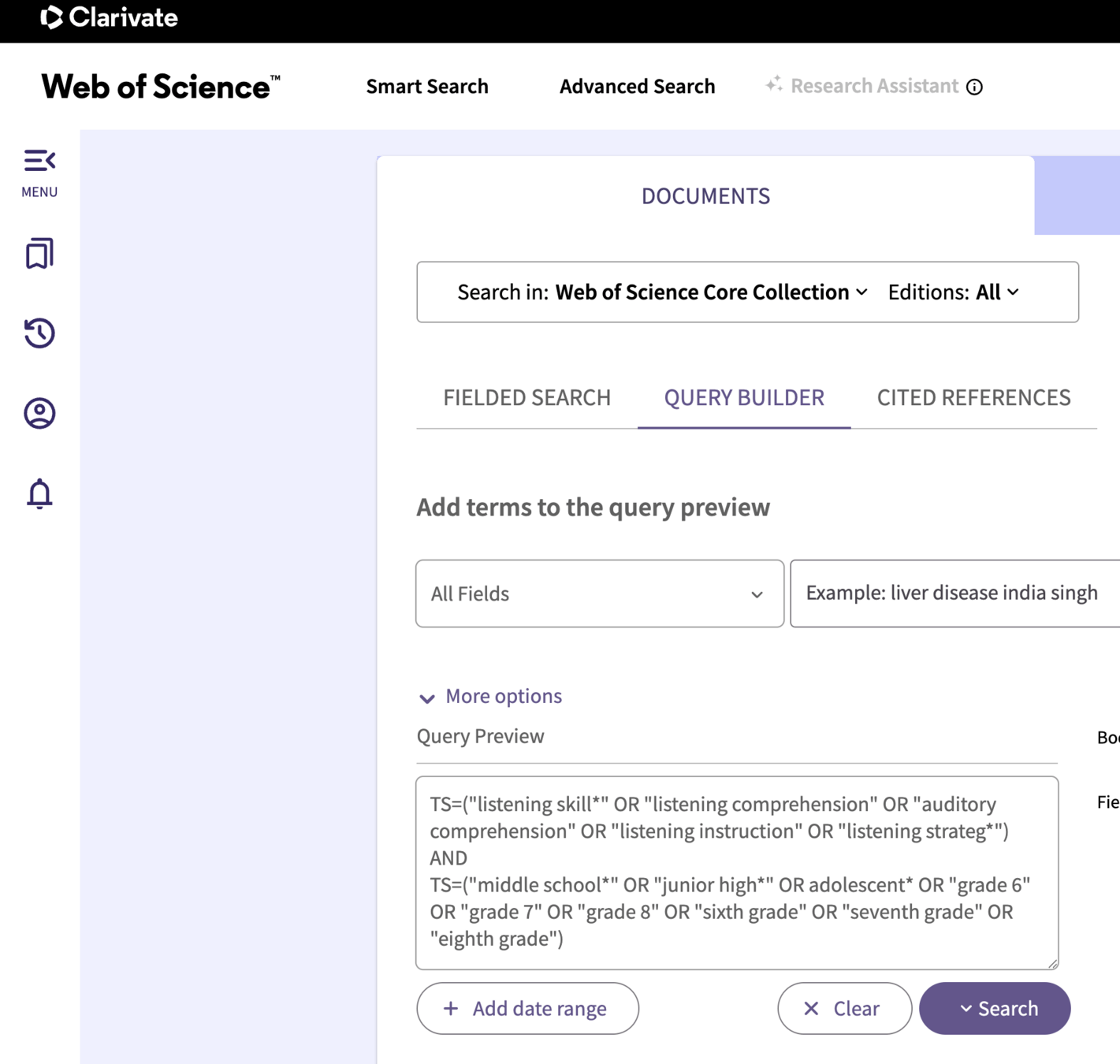
You'll get results that:
- Are research articles that were actually published in real journals
- You can filter by Web of Science Categories, Citation Topics, Date, etc.
How to verify a
journal article citation
Patterson, Trevor. 2007. "The Art of Peaceful Protest: Quaker Sketchbooks and American Social Movements," Quaker Historical Review, 47(3), 247-328.
Searching for an article directly is a good first step.
The best way to verify a citation is to check the issue of the journal where the article was (or wasn't!) published.
Forsythe, Mary. 2008. ""Universal friend of mankind": Gender dynamics in the founding of an eighteenth century religious community," American Historical Review, 113(4), 1003–1028.
Before we start moving around the library, do you have questions about...?
Using AI to help you search
Database Searching
Web of Science
Tripod & Library Resources
Citations & Journals
McCabe Scavenger Hunt
What questions do you have?
What's one thing you learned about the libraries today?
Library Help
Reach out and ask! We're here to help you learn and build your research skills.
- Your research projects
- Questions about library services
- Help accessing resources
How?
- Email us (librarian@swarthmore.edu)
- Make an appointment with a subject librarian
- Research Guides
-
During the school year, you can use
chat in Tripod to get help (from a real person)
Thank you!
Christina Bush (cbush1)
Research and Instruction Librarian
Andrea Baruzzi (abaruzz1)
STEM Librarian
Simon Elichko (selichk1)
Social Sciences & Data Librarian
S3P Summer Scholars: Research & Using the Libraries
By Swarthmore Reference