Python

tuple & dictionary & set
INFOR
100110
講師:張雲淞
- 暱稱:章魚
- 班級:223(三類)
- 職位:外交長兼學術

JavaScript & DC Bot
放課(星期三)
前次社課複習
迴圈 & list
9/19
迴圈
For loop
for i in range(100):
    print("Hello")
While loop
n = int(input())
sum = i = 0
while i <= n:
    sum += i
    i += 1
print(sum)
break
強制跳出迴圈
continue
跳過當次迴圈
List
宣告與讀取
scores = [100, 90, 80, 70, 60]
print(scores[0])  # 100
print(scores[0:2])  # [100, 90]
print(scores[-3])  # 80
print(scores[2:])  # [80, 70, 60]
print(scores[:2]) # [100, 90]- 索引值從 0 開始計
- : 可用於讀取多項,如 0:2、2:
- 負的索引值即為從後方讀取
List
操作串列
list1 = [10, 20, 30, 40, 50]
del list1[2]       # 刪除項目 [10, 20, 40, 50]
list1.append(60)   # 新增項目 [10, 20, 40, 50, 60]
list1.remove(20)   # 刪除指定值 [10, 40, 50, 60]
list1.insert(1, 0) # 插入項目 [10, 0, 40, 50, 60]
print(max(list1), min(list), sep=" ") # 最大最小值 60 10
list1.reverse()    # 反轉 [60, 50, 40, 0, 10]
list1.sort()       # 整理 [0, 10, 40, 50, 60]
tuple
元組
( ,)
tuple 怎麼念?
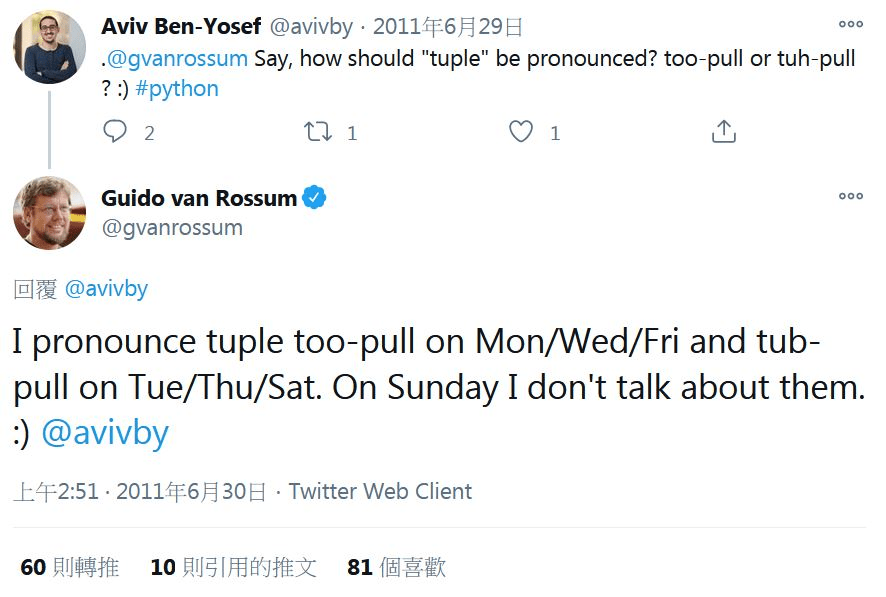
Python 的創造者
Guido van Rossum:
週一、三、五念 too-pull;
週二、四、六念 tub-pull,
週日我不會提到它。
上一堂的 list,這堂課的 tuple, dictionary, set 都是容器
list 和 tuple 都屬於序列的類型
- 容器 (Container)
- 序列 (Squence)
- 不可變 (Immutable)
最明顯的特性
tuple 元組
tuple 元組:創建
# 創建一個 tuple
a = 12345, 54321, "Hello"
print("a:", a) # output: a: (12345, 54321, 'Hello')
b = (12345, 54321, "Hello")
print("b:", b) # output: b: (12345, 54321, 'Hello')
可以使用小括號,或直接以逗號分隔值創建
( )
這是小括號
[ ]
這是中括號
{ }
這是大括號
tuple 元組:創建
# 只有一個元素時
c = (7,) # 需加逗號
只有一個元素時,需加逗號
讓電腦知道這是 tuple,而不是運算使用的括號
tuple 元組:不可變
# tuple 的值不可變
d = (12345, 54321, "Hello")
d[0] = 926
# TypeError: 'tuple' object does not support item assignment
使用陣列的方式修改 tuple 的值,會出現報錯
也不能使用 del 刪除元素
tuple 元組:運算與操作
# tuple 的運算與操作
e = (1, 2, 3) + (4, 5, 6) # 組合 (1, 2, 3, 4, 5, 6)
f = (1, 2, 3) * 3   # 重複 (1, 2, 3, 1, 2, 3, 1, 2, 3)
g = 3 in (1, 2, 3)  # 判斷是否有某元素 true
h = len((1, 2, 3))    # 長度 3
雖元素不能編輯,但可以對整個 tuple 進行連接、重複等操作
tuple 元組:取值
# tuple 的取值
i = (1, 3, 5, 7, 9)
print(i[0])   # output: 1
print(i[2:4]) # output: (5, 7)
print(i[-1])  # output: 9
與 List 的取值方式相同
tuple 元組:封裝與拆封
# tuple 的封裝與解封
j = 1, 2, 3 # 封裝 (Packing)
x, y, z = j # 解封 (Unpacking) x: 1, y: 2, z: 3
需注意拆封時變數個數需與元素個數一致,否則會發生報錯
dictionary
字典

dictionary 字典
- 類似於查字典,用索引找尋資料
- 較方便查找資料
- 通過「關鍵字 Key」回傳對應的「值 Value」
- 沒有順序性
dictionary 字典:創建
# 創建一個 dictionary
a = {'name': 'cat', 'age': 6, 'eat': ['cake', 'meat']
每個值的結構是 key: value,key 可以是數字或字串,value 的資料型態則沒有限制
key 不能重複出現
dictionary 字典:讀取
# 讀取 dictionary 的值
b = {'name': 'cat', 'age': 6, 'eat': ['cake', 'meat']}
print(b['name'])       # output: cat
print(b['eat'][0])     # output: cake
print(b.get('age'))    # output: 6
print(b.get('height')) # output: None
可以通過中括號 ['key'] 或是 get('key') 取值,使用 get 取值時若 key 不存在,將會回傳 None
dictionary 字典:刪除值
# 刪除 dictionary 的值
e = {'name': 'cat', 'age': 6}
del e['name']
print(e) # {'age': 6}

del e
print(e) # NameError: name 'e' is not defined
通過 del 可以刪除 dict 中的一項或整個 dict
dictionary 字典:刪除值
# 刪除 dictionary 的值
e = {'name': 'cat', 'age': 6}
e.pop('name')
print(e) # {'age': 6}

e.clear()
print(e) # {}
亦可使用 pop('key') 刪除元素
通過 clear() 可以清空整個 dict
set
集合
set 集合
- 無序、不重複的集合
- 儲存不需要排序、索引的元素
set 集合:創建
# 創建一個 set
a = {1, 2, 3, 4, 5}
print(a) # output: {1, 2, 3, 4, 5}
b = {1, 2, 3, 3, 4, 5}
print(b) # output: {1, 2, 3, 4, 5}
set 使用大括號包裹
定義時若出現重複的值會被自動去除
set 集合:操作
# set 的各種操作
c = {1, 2, 3, 4, 5}
print(len(c)) # 取得長度 output: 5
c.add(4) # 新增元素,如已存在則不會新增
c.add(6)
print(c) # output: {1, 2, 3, 4, 5, 6}

c.remove(2) # 刪除元素,如果刪除不存在的元素會報錯
print(c) # output: {1, 3, 4, 5, 6}
取得長度、新增、刪除元素
set 集合:操作
# set 的各種操作
d = {1, 2, 3, 4, 5}
d.discard(3) # 刪除元素,刪除不存在的元素時不會報錯
print(d) # output: {1, 2, 4, 5}

d.clear()
print(d) # output: {}
刪除元素、清空集合
set 集合:集合運算
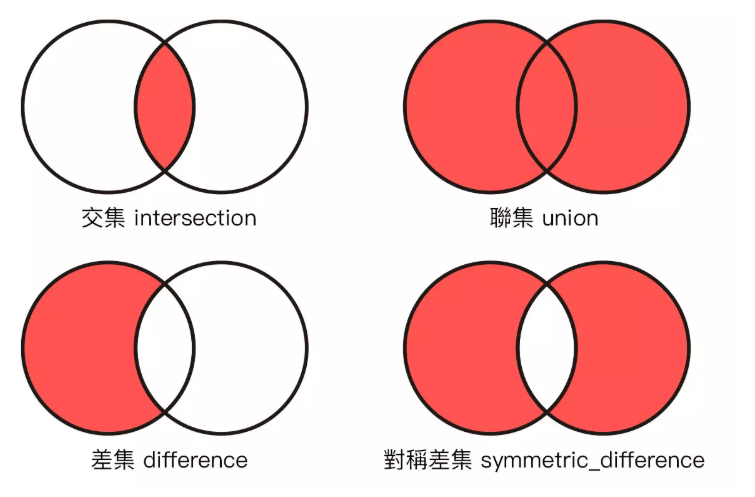
set 集合:集合運算
| 集合 | 方法 | 運算子 |
|---|---|---|
| 交集 | a.intersection(b) | a&b |
| 聯集 | a.onion(b) | a| |
| 差集 | a.difference(b) | a-b |
| 對稱差集 | a.symmetric_difference(b) | a^b |
有獎品 ^^


下週是段考前最後一次社課,記得來喔
下課囉

Python 第三堂社課
By 章魚