Folded optimal transport
and its application to
separable quantum optimal transport
Thomas Borsoni*
ArpiLYSM: Simplex vs Non-simplex
November 11, 2025
CERMICS, École Nationale des Ponts et Chaussées, France
*post-doc with Virginie Ehrlacher and Tony Lelièvre
funded by the ERC starting grant HighLEAP
pure states
pure states
mixed states
mixed states
classical
quantum
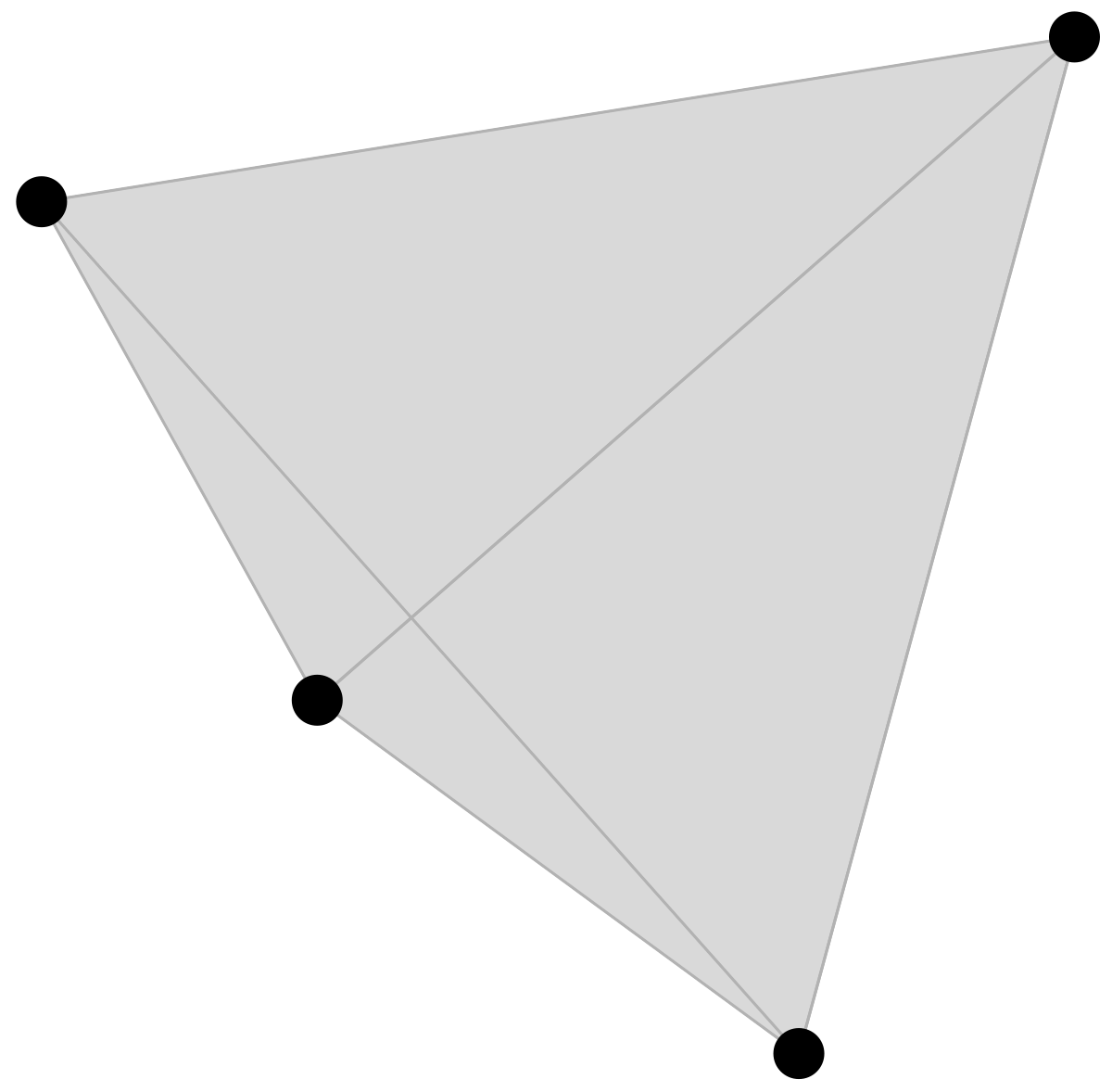
\(\bullet\) convex set \(C\)
\(\bullet\) extreme boundary \(E\)
How to extend a distance \(d\) from \(E\) to \(C\)?
d
D
d
D
\(\bullet\) convex set \(C\)
\(\bullet\) extreme boundary \(E\)
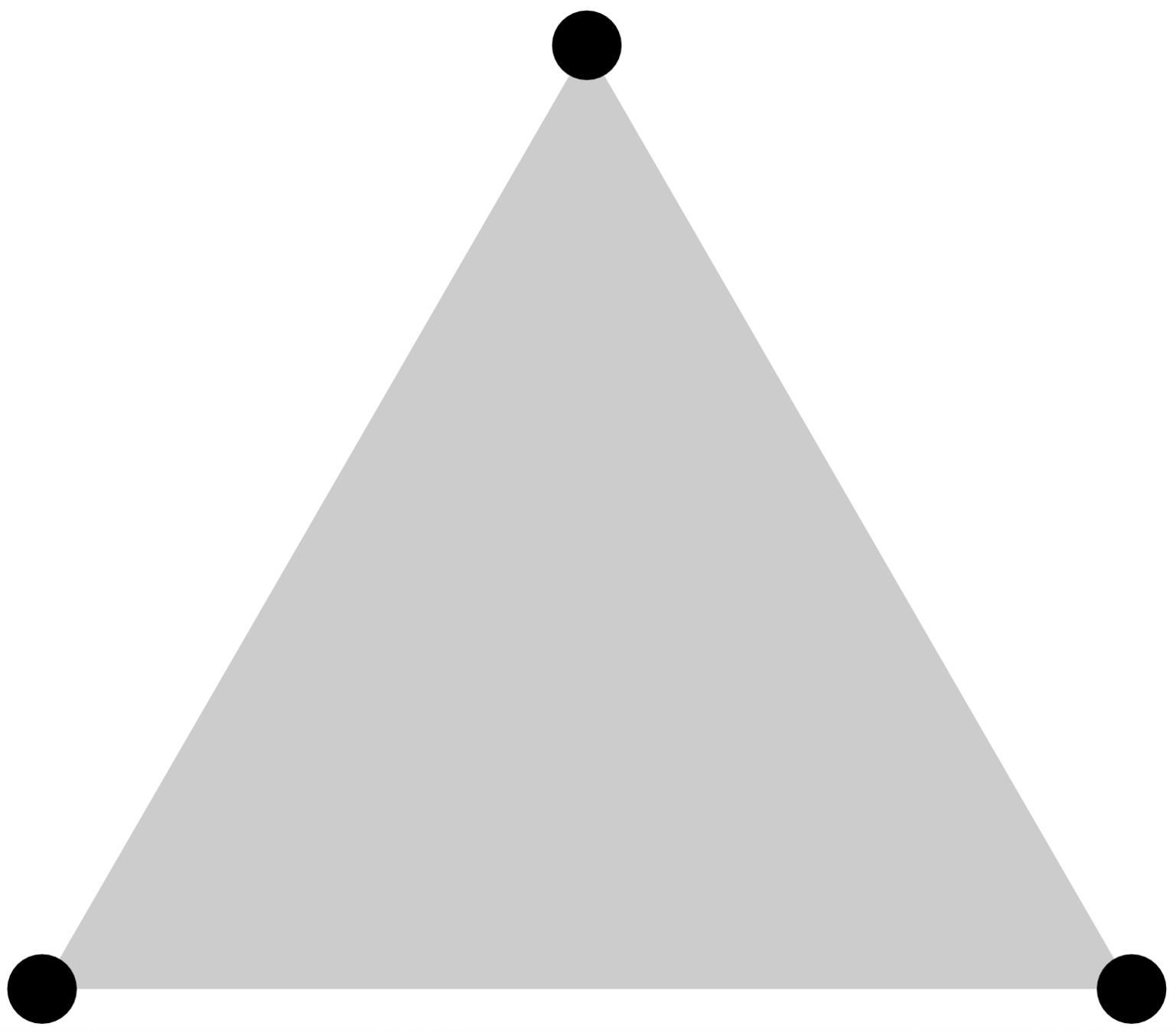
Simplex and set of probability measures
a
\mathcal{P}(\{a,b,c\})
probability measure on \(E\)
convex combination of points of \(E\)
b
c
\mathcal{P}(E)
E
Optimal transport answers
for simplices
C=\mathcal{P}(E)
How to extend a distance from \(E\) to \(C\)?
- Start with a Polish* space \((E,d)\)
* Polish = complete metric space with countable dense subset
For \(p\geq 1\), we can construct the Wasserstein-\(p\) distance \(W_p\) on \(\mathcal{P}(E)\)
- \(W_p(\bm{\delta}_x, \bm{\delta}_y) = d(x,y)\)
\bm{\delta}_x
\bm{\delta}_y
E \cong \{\bm{\delta}_z\}_{z \in E}
Let's do this for non-simplices!
Choquet theory
Representing every \(x \in C\) as a convex combination of points of \(E\)
Choquet-Bishop-DeLeeuw Theorem:
If \(C\) compact convex*, then
* and subset to a locally convex Hausdorff space
\forall x \in C, \; \; \exists \mu \in \mathcal{P}(E),
\(x\) is the barycenter associated with \(\mu\)
Let \(\sim\) be the equivalence relation on \(\mathcal{P}(E)\):
\mu \sim \nu \qquad \iff \qquad
\(\mu\) and \(\nu\) have the same barycenter \(x \in C\),
Choquet-Bishop-DeLeeuw
C \cong \mathcal{P}(E)/\sim
C
E
Folded optimal transport
C
(\mathcal{P}(E)/\sim, \; W_p / \sim)
(E,d)
unfold
\mathcal{P}(E)
(E,d)
extend
(\mathcal{P}(E),W_p)
fold back
\cong
(optimal transport)
the folded Wasserstein distance on \(C\) is \(D_p := W_p / \sim\)
(Choquet)
How to extend \(d\) from \(E\) to \(C\)?
?
?
Folded Wasserstein as a quotient (pseudo-)distance
*pseudo-distance: would be a distance if it separated points
\widehat{D}_p(x,y) := \inf_{\mu \in \mathcal{P}(E) \text{ represents } x} \;
\inf_{\nu \in \mathcal{P}(E) \text{ represents } y} \;
W_p(\mu, \nu)
(\mathcal{P}(E),W_p)
y
z
x
\widehat{D}_p(x,y)
a priori, fails the triangle inequality!
- Folded Wasserstein pseudo-distance*
D_p(x,y) := \inf_{z_1, \dots, \, z_N} \{ \widehat{D}_p(x,z_1) + \widehat{D}_p(z_1,z_2) + \dots + \widehat{D}_p(z_N,y) \}
W_p / \sim
x,y,z \in C
D_p(x,y)
The folded Wasserstein metric space
Theorem
(C,D_p)
(E,d)
- \(C\) compact convex subset of \((X,\|\cdot\|)\) Banach
- \((E,d)\) (compact) Polish and \(d\) continuous w.r.t. \(\|\cdot\|\)
- For all \(x,y \in E\), \(d(x,y) \geqslant \|x-y\| \)
Assume:
Then:
- \(D_p\) is a distance on \(C\), and if \(Ri(C) \neq \emptyset\), continuous w.r.t. \(\|\cdot\|\)
- For all \(x,y \in E\), \(D_p(x,y) \leqslant d(x,y) \) and if \(d(x,y) = \|x-y\|\), then \(D_p(x,y) = d(x,y) \)
- For all \(x,y \in C\), \(D_p(x,y) \geq \|x-y\|\)
- If \((E,d)\) geodesic and \(p>1\), then \((C,D_p)\) geodesic
Application to separable quantum optimal transport
C = S^+_1
E = \mathbf{P}_\mathcal{H}
C \subseteq (\mathcal{B}(\mathcal{H}), \|\cdot\|)
\(\mathcal{H}\) complex Hilbert of finite dimension
rank-one projectors on \(\mathcal{H}\)
pure states
self-ajoint semi-definite operators on \(\mathcal{H}\), with trace 1
mixed states
Quantum optimal transport: to define a distance on \(S^+_1\) from one on \(\mathbf{P}_{\mathcal{H}}\)
Families of existing formulations
- Dynamic (Carlen-Maas)
- Nonseparable* static (Biane-Voilescu, Golse-Mouhot-Paul, DePalma-Trévisan,...)
- Separable static (Tóth-Pitrik, Beatty-Stilck França)
*Includes entanglement
quantum folded Wasserstein
classical OT
separable quantum OT
Conclusion
folded optimal transport
also includes semiclassical cost (Golse-Paul)
classical OT
TH
NK
Y
U
for your attention!
Arpino
By Thomas Borsoni