Entropy methods
for the Boltzmann equation
and its quantum variant
Thomas Borsoni
Séminaire ANCS, LMB
June 19, 2025
CERMICS, École des Ponts, France
Motivation
Long-time behavior of solutions to the
Boltzmann-Fermi-Dirac equation
Main result
entropy inequality
Boltzmann
entropy inequality
Boltzmann-Fermi-Dirac
Tool
Entropy methods (functional inequalities)
Goal
Entropy inequalities for the Boltzmann-Fermi-Dirac equation
\implies
Outline
1. The (classical) Boltzmann equation
\(\mathrm{II})\) Trend to equilibrium
2. The (quantum) Boltzmann-Fermi-Dirac equation
\(\mathrm{I})\) Boltzmann equations
3. Entropies and equilibria
1. The entropy method
2. Overview of entropy inequalities
3. Transfer from Boltzmann to Boltzmann-Fermi-Dirac
1. The (classical) Boltzmann equation
2. The (quantum) Boltzmann-Fermi-Dirac equation
\(\mathrm{I})\) Boltzmann equations
3. Entropies and equilibria
\(\mathrm{II})\) Trend to equilibrium
1. The entropy method
2. Overview of entropy inequalities
3. Transfer from Boltzmann to Boltzmann-Fermi-Dirac
(\partial_t + v \cdot \nabla_x) g_{t,x}(v) = Q(g_{t,x})(v)
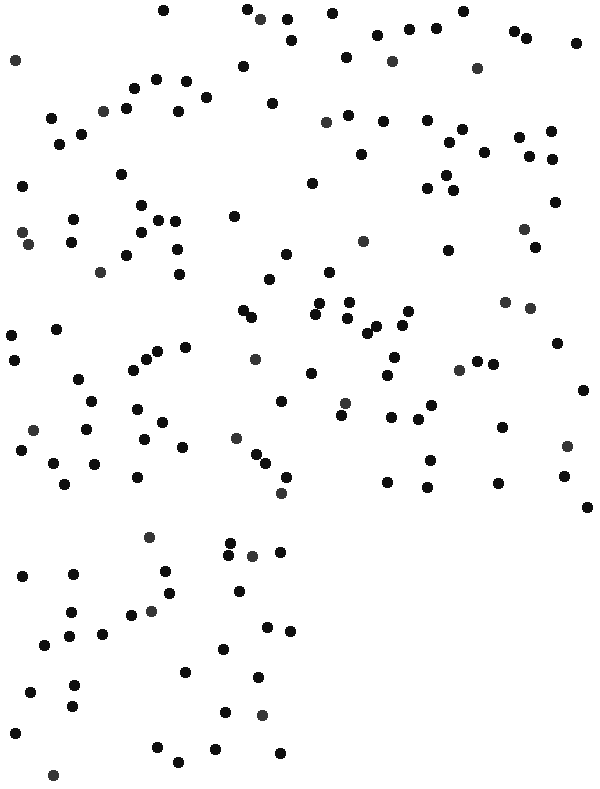
\(g \equiv g_{t,x}(v)\) density of molecules
+
x
the (classical) Boltzmann equation
v
Boltzmann equation:
v
v_*
v'
v'_*
\begin{align*}
v+v_*&=v'+v'_* \\
\frac12|v|^2 + \frac12|v_*|^2 &= \frac12|v'|^2 + \frac12|v'_*|^2 \\
\end{align*}
Conservation laws
Collision operator:
\newcommand{\dd}{\mathrm{d}}
Q_{\textcolor{green}{0}}(g)(v) = \iint_{\R^3 \times \mathbb{S}^2}
[g(v') g(v'_*) -
g(v) g(v_*)] \;
B \; \dd v_* \, \dd \sigma
\begin{align*}
v' = \frac{v+v_*}{2} + \frac{|v-v_*|}{2} \; \sigma \\
v'_* = \frac{v+v_*}{2} - \frac{|v-v_*|}{2} \; \sigma\\
\end{align*}
\newcommand{\Sb}{\mathbb{S}}
\sigma \in \Sb^2
\implies
(momentum)
(energy)
\(B \equiv B(v,v_*, \sigma) > 0 \) \(\leftrightarrow\) interaction potential
Collision kernel:
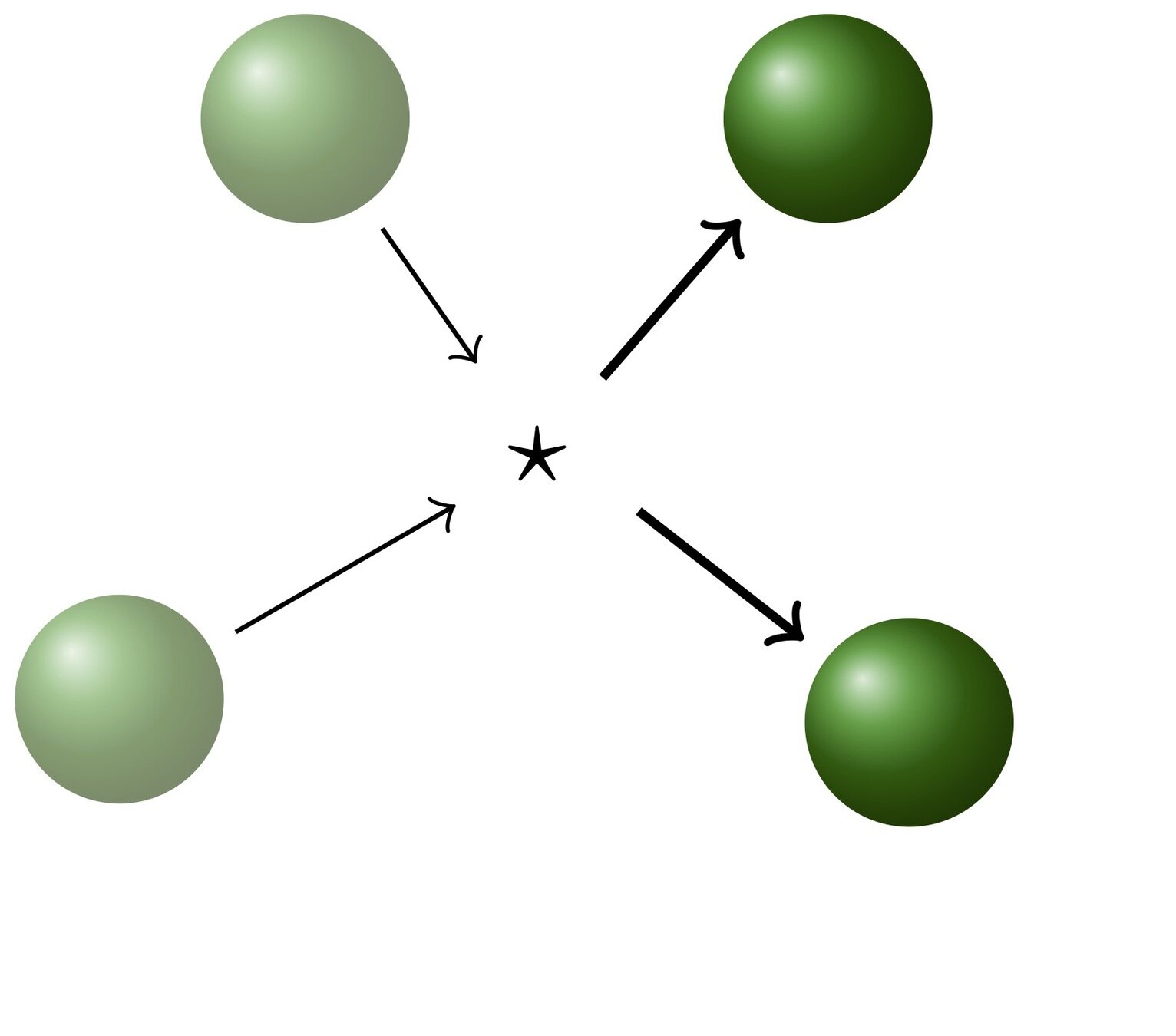
[A. Greg: Kinetic theory of gases, wikipedia.]
Statistical description of a monoatomic gas
\partial_t g_{t}(v) = Q_{\textcolor{green}{0}}(g_{t})(v)
\(g \equiv g_{t}(v)\) density of molecules
+
x
the space-homogeneous
(classical) Boltzmann equation
v
- Boltzmann equation
v
v_*
v'
v'_*
\begin{align*}
v+v_*&=v'+v'_* \\
\frac12|v|^2 + \frac12|v_*|^2 &= \frac12|v'|^2 + \frac12|v'_*|^2 \\
\end{align*}
Conservation laws
(momentum)
(energy)
[A. Greg: Kinetic theory of gases, wikipedia.]
v
v
\textcolor{blue}{u}
\textcolor{blue}{\sqrt{T}}
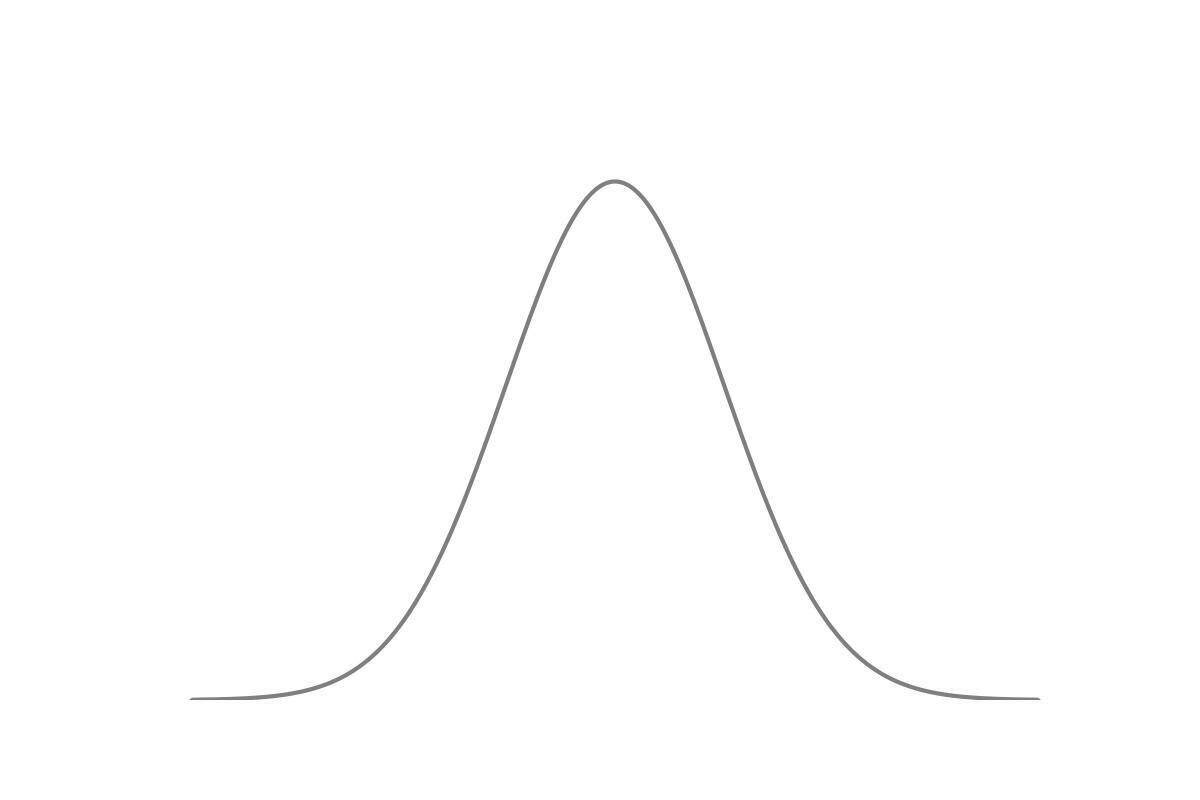
M^{g_0}_{\textcolor{green}{0}}(v) = \textcolor{blue}{\rho}\, (2 \pi \textcolor{blue}{T})^{-\frac32} \, \exp \left(-\frac{|v-\textcolor{blue}{u}|^2}{2 \, \textcolor{blue}{T}} \right)
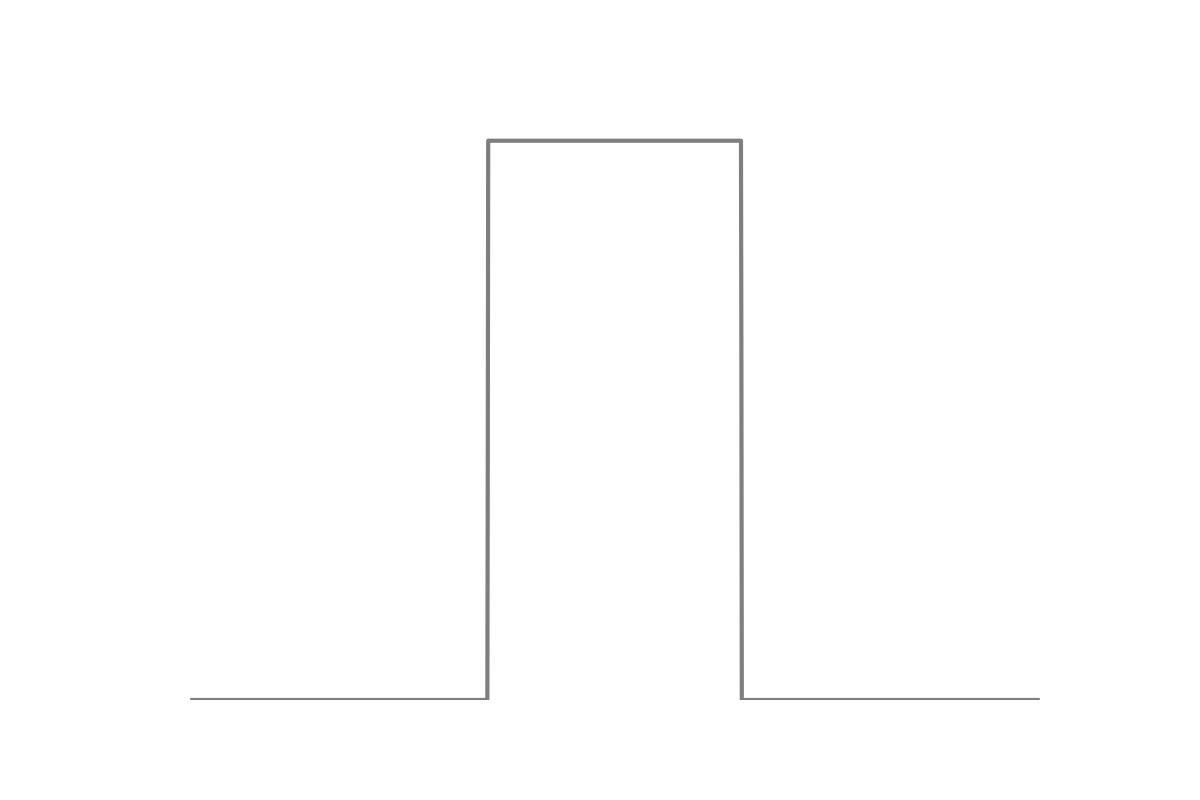
- Equilibrium
g_t \underset{t \to \infty}{\to} M^{g_0}_{\textcolor{green}{0}}
expected behaviour
g_0
Maxwellian
distribution
Entropy and equilibrium
The (classical) Boltzmann entropy functional \(H_{\textcolor{green}{0}} \)
2. \(D_{\textcolor{green}{0}}(g) = 0 \iff g =M_{\textcolor{green}{0}}^g \),
characterization of equilibrium
M^g_{\textcolor{green}{0}}(v) = \textcolor{blue}{\rho}\, (2 \pi \textcolor{blue}{T})^{-\frac32} \, \exp \left(-\frac{|v-\textcolor{blue}{u}|^2}{2 \, \textcolor{blue}{T}} \right)
Boltzmann's H Theorem
1. If \(\partial_t g_t = Q_{\textcolor{green}{0}}(g_t)\), then
\(2^{nd}\) principle of thermodynamics
\newcommand{\dd}{\mathrm{d}}
\frac{\dd}{\dd t}H_{\textcolor{green}{0}} (g_t) = - D_{\textcolor{green}{0}}(g_t) \leq 0
The (classical) Boltzmann entropy dissipation functional \(D_{\textcolor{green}{0}}\)
\newcommand{\dd}{\mathrm{d}}
D_{\textcolor{green}{0}} (g) := \frac14\iiint_{\R^3 \times \R^3 \times \mathbb{S}^2} (g' g'_* - g g_*) \log \frac{g'g'_*}{gg_*}
\; B(v,v_*,\sigma) \, \dd \sigma \, \dd v\, \dd v_*
\newcommand{\dd}{\mathrm{d}}
H_{\textcolor{green}{0}} (g) := \int_{\R^3} (g \log g - g)(v) \, \dd v
1. The (classical) Boltzmann equation
2. The (quantum) Boltzmann-Fermi-Dirac equation
\(\mathrm{I})\) Boltzmann equations
3. Entropies and equilibria
\(\mathrm{II})\) Trend to equilibrium
1. The entropy method
2. Overview of entropy inequalities
3. Transfer from Boltzmann to Boltzmann-Fermi-Dirac
\partial_t f_{t}(v) = Q_{\textcolor{purple}{\delta}}(f_{t})(v)
\(f \equiv f_{t}(v)\) density of fermions
the space-homogeneous
(quantum) Boltzmann-Fermi-Dirac equation
- Boltzmann-Fermi-Dirac equation
\begin{align*}
v+v_*&=v'+v'_* \\
\frac12|v|^2 + \frac12|v_*|^2 &= \frac12|v'|^2 + \frac12|v'_*|^2 \\
\end{align*}
Conservation laws
(momentum)
(energy)
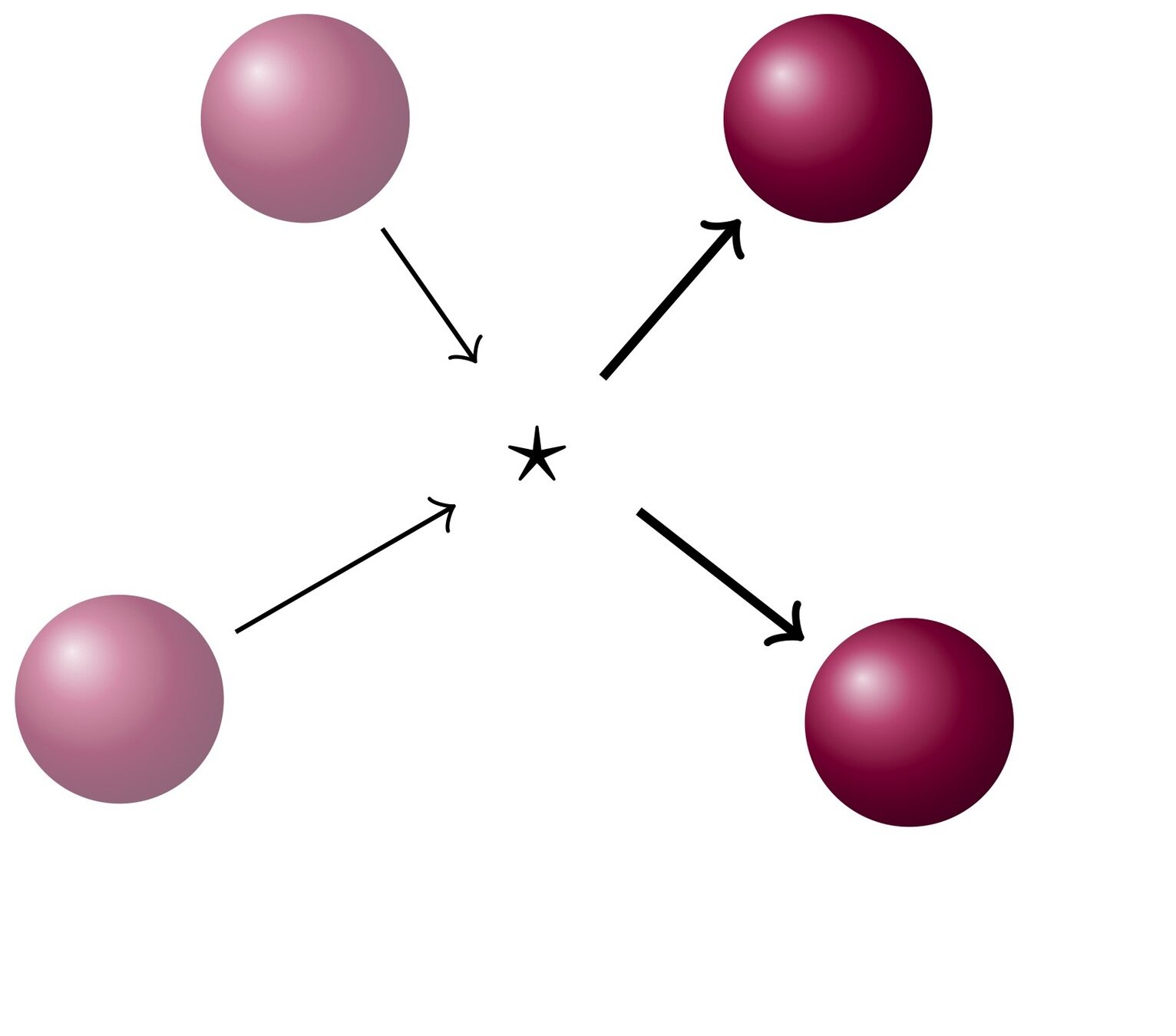
v
v_*
v'
v'_*
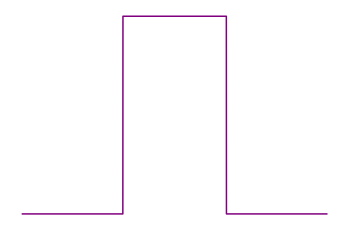
Pauli exclusion principle
0 \leq f_{t} \leq \frac{1}{\textcolor{purple}{\delta}}
0 < \textcolor{purple}{\delta} \ll 1
Q_{\color{purple} \delta}(f)(v) = \iint_{\R^3 \times \mathbb{S}^2}
\left[f' f'_* (1- \textcolor{purple}{\delta} f)(1- \textcolor{purple}{\delta} f_*) -
f f_* (1 - \textcolor{purple}{\delta} f')(1-\textcolor{purple}{\delta} f'_*) \right]
B \; \mathrm{d} v_* \, \mathrm{d} \sigma
- Collision operator
\frac{1}{\textcolor{purple}{\delta}}
v
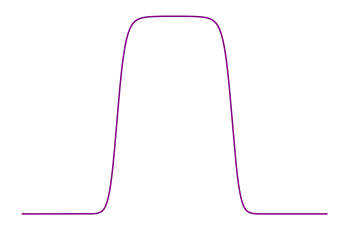
\frac{1}{\textcolor{purple}{\delta}}
v
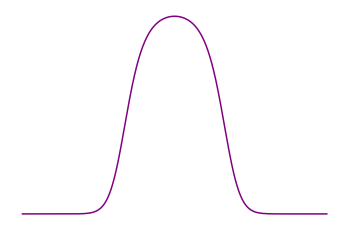
- Equilibrium
Fermi-Dirac
statistics
\frac{1}{\textcolor{purple}{\delta}}
v
Entropy and equilibrium
2. \(D_{\textcolor{purple}{\delta}}(g) = 0 \iff g =M_{\textcolor{purple}{\delta}}^g \),
characterization of equilibrium
M^g_{\textcolor{purple}{\delta}}(v) =
\frac{\exp \left(\textcolor{blue}{a}_{\textcolor{purple}{\delta}} - \textcolor{blue}{b}_{\textcolor{purple}{\delta}} \, |v-\textcolor{blue}{u}|^2 \right)}
{1 + \textcolor{purple}{\delta} \exp \left(\textcolor{blue}{a}_{\textcolor{purple}{\delta}} - \textcolor{blue}{b}_{\textcolor{purple}{\delta}} \, |v-\textcolor{blue}{u}|^2 \right)}
Boltzmann-Fermi-Dirac H Theorem
1. If \(\partial_t f_t = Q_{\textcolor{purple}{\delta}}(f_t)\), then
\(2^{nd}\) principle of thermodynamics
\newcommand{\dd}{\mathrm{d}}
\frac{\dd}{\dd t}H_{\textcolor{purple}{\delta}} (f_t) = - D_{\textcolor{purple}{\delta}}(f_t) \leq 0
The (quantum) Boltzmann-Fermi-Dirac entropy dissipation functional \(D_{\textcolor{purple}{\delta}}\)
\newcommand{\dd}{\mathrm{d}}
D_{\textcolor{purple}{\delta}} (g) := \frac14\iiint_{\R^3 \times \R^3 \times \mathbb{S}^2} (f' f'_*
(1-\textcolor{purple}{\delta}f) (1-\textcolor{purple}{\delta}f_*) - f f_* (1-\textcolor{purple}{\delta}f') (1-\textcolor{purple}{\delta}f'_*))
\log \frac{f' f'_*
(1-\textcolor{purple}{\delta}f) (1-\textcolor{purple}{\delta}f_*)}{f f_* (1-\textcolor{purple}{\delta}f') (1-\textcolor{purple}{\delta}f'_*)}
\; B(v,v_*,\sigma) \, \dd \sigma \, \dd v\, \dd v_*
The (quantum) Fermi-Dirac entropy functional \(H_{\textcolor{purple}{\delta}} \)
\newcommand{\dd}{\mathrm{d}}
H_{\textcolor{purple}{\delta}} (f) := \int_{\R^3} f \log f + \textcolor{purple}{\delta}^{-1}(1 - \textcolor{purple}{\delta} f)
\log (1 - \textcolor{purple}{\delta} f)
1. The (classical) Boltzmann equation
2. The (quantum) Boltzmann-Fermi-Dirac equation
\(\mathrm{I})\) Boltzmann equations
3. Entropies and equilibria
\(\mathrm{II})\) Trend to equilibrium
1. The entropy method
2. Overview of entropy inequalities
3. Transfer from Boltzmann to Boltzmann-Fermi-Dirac
Fermi-Dirac entropy
Boltzmann entropy
H_{\textcolor{green}{0}}(g) = \int g \log g - g
H_{\textcolor{purple}{\delta}}(f) = \int f \log f + {\textcolor{purple}{\delta}}^{-1} (1 - {\textcolor{purple}{\delta}} f)
\log (1-{\textcolor{purple}{\delta}} f)
M_{\textcolor{green}{0}}(v) = e^{a - b|v-u|^2}
\displaystyle M_{\textcolor{purple}{\delta}}(v) = \frac{e^{a - b|v-u|^2}}{1 + \textcolor{purple}{\delta} e^{a - b|v-u|^2}}
Equilibrium: Fermi-Dirac statistics
Equilibrium: Maxwellian
entropies and equilibria
Boltzmann
Boltzmann-Fermi-Dirac
Fermi-Dirac entropy
H_{\textcolor{green}{0}}(g) = \int \Phi_{\textcolor{green}{0}}(g)
H_{\textcolor{purple}{\delta}}(f) = \int \Phi_{\textcolor{purple}{\delta}}(f)
M_{\textcolor{green}{0}}(v) = (\Phi_{\textcolor{green}{0}}')^{-1} \left(\alpha + \beta \cdot v + \gamma |v|^2 \right)
\displaystyle M_{\textcolor{purple}{\delta}}(v) = (\Phi_{\textcolor{purple}{\delta}}')^{-1} \left(\alpha + \beta \cdot v + \gamma |v|^2 \right)
Equilibrium: Fermi-Dirac statistics
Equilibrium: Maxwellian
entropies and equilibria
Boltzmann
Boltzmann-Fermi-Dirac
\Phi_{\textcolor{purple}{\delta}}'(x) = \log \left(\frac{x}{1 - \textcolor{purple}{\delta} x} \right)
\Phi_{\textcolor{green}{0}}' = \log
entropy \(\displaystyle H : h \mapsto \int \Phi(h)\) \(\Phi\) \(\mathcal{C}^2\) st. convex
equilibrium
M = (\Phi')^{-1} (\alpha \, \text{mass} + \beta \cdot \text{momentum} + \gamma \, \text{energy})
Boltzmann entropy
relative entropy to equilibrium
\(\displaystyle H : f \mapsto \int \Phi(f)\) \(\Phi\) \(\mathcal{C}^2\) st. convex
equilibrium
M^f = (\Phi')^{-1} (\alpha_f\, \text{mass} + \beta_f \cdot \text{momentum} + \gamma_f \, \text{energy})
relative entropy to equilibrium
H(f|M^f) := H(f) - H(M^f) \geq 0
Proposition 1.
\newcommand{\dd}{\mathrm{d}}
H(f|M^f) = \int_0^1 (1-\tau) \left(\int (f - M^f)^2 \, \Phi''((1-\tau) M^f + \tau f) \right) \dd \tau
Taylor representation of the relative entropy to equilibrium
main theorem
Bonus: generalized \(L^p_\varpi\) Csiszár-Kullback-Pinsker
2024?
entropy
1. The (classical) Boltzmann equation
2. The (quantum) Boltzmann-Fermi-Dirac equation
\(\mathrm{I})\) Boltzmann equations
3. Entropies and equilibria
\(\mathrm{II})\) Trend to equilibrium
1. The entropy method
2. Overview of entropy inequalities
3. Transfer from Boltzmann to Boltzmann-Fermi-Dirac
- Existence & stability of solutions to homogeneous BFD for cut-off hard potentials
Lu, Wennberg
Existence and uniqueness of solutions to inhomogeneous BFD for cut-off kernels
Dolbeault
- Relaxation to equilibrium of such solutions:
either \(f_0 =\) or \(f_t \; \underset{t \to \infty}{\rightarrow}\)
Derivation of the equation from particles system (partially formal)
Benedetto, Castella, Esposito, Pulvirenti
at which rate?
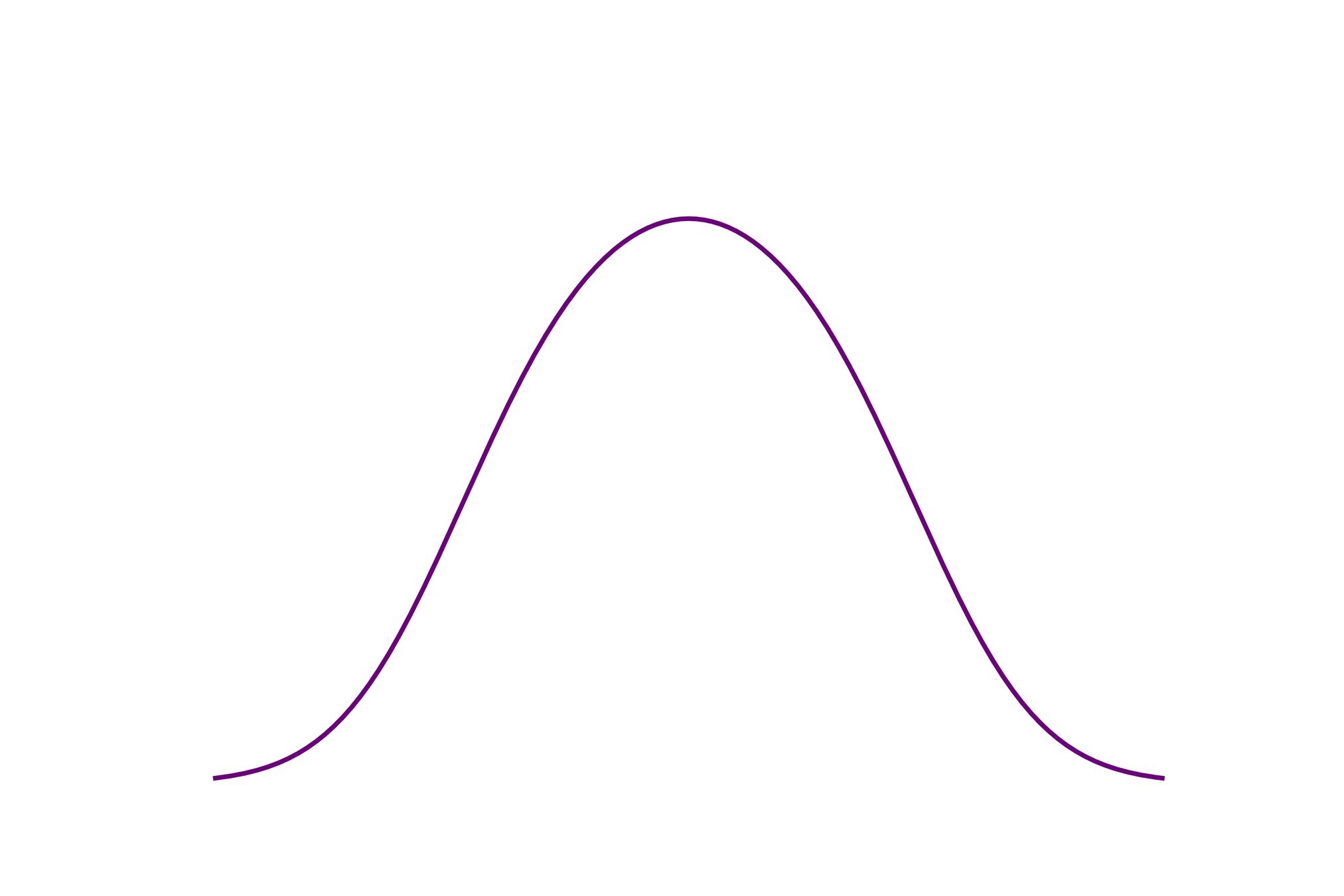
saturated state
Fermi-Dirac stat.
Some results on BFD
1. The (classical) Boltzmann equation
2. The (quantum) Boltzmann-Fermi-Dirac equation
\(\mathrm{I})\) Boltzmann equations
3. Entropies and equilibria
\(\mathrm{II})\) Trend to equilibrium
1. The entropy method
2. Overview of entropy inequalities
3. Transfer from Boltzmann to Boltzmann-Fermi-Dirac
\partial_t f_t = Q(f_t)
\(D(g) \gtrsim {H(g|M^g)}^{1+\alpha}\)
\displaystyle \frac{\mathrm{d}}{\mathrm{d} t} H(f_t|M^{f_0}) = - D(f_t)
\(D(g) \geqslant C H(g|M^g)\)
the entropy method
Relative entropy to equilibrium:
\(H(f_t|M^{f_0}) \lesssim t^{-1/\alpha}\)
\(H(f_t|M^{f_0}) \lesssim e^{-Ct} \)
Csiszár-Kullback-Pinsker
\|f_t - M^{f_0}\|_{L^1}^2 \lesssim H(f_t|M^{f_0})
H(g|M^g) = H(g) - H(M^g) \geq 0
1. The (classical) Boltzmann equation
2. The (quantum) Boltzmann-Fermi-Dirac equation
\(\mathrm{I})\) Boltzmann equations
3. Entropies and equilibria
\(\mathrm{II})\) Trend to equilibrium
1. The entropy method
2. Overview of entropy inequalities
3. Transfer from Boltzmann to Boltzmann-Fermi-Dirac
D_{\textcolor{green}{0}}(g) \gtrsim H_{\textcolor{green}{0}}(g|M_{\textcolor{green}{0}}^g)^{1 \textcolor{grey}{+ \alpha}}
Boltzmann
Carlen, Carvalho, Desvillettes, Toscani, Villani
1992 \(\to\) 2003
Landau
D_{Landau,\textcolor{purple}{\delta}}(f) \gtrsim H_{\textcolor{purple}{\delta}}(f
|M_{\textcolor{purple}{\delta}}^f)^{1 \textcolor{grey}{+ \alpha}}
LAndau-Fermi-Dirac
Desvillettes, Villani
2000
Alonso, Bagland, Desvillettes, Lods
2020-2021
D_{\textcolor{purple}{\delta}}(f) \gtrsim H_{\textcolor{purple}{\delta}}(f|M_{\textcolor{purple}{\delta}}^f)^{1 \textcolor{grey}{+ \alpha}}
Boltzmann-FERMI-DIRAC
Overview of entropy inequalities for kinetic equations
Fokker-Planck
log-Sobolev inequality
Fokker-Planck-Fermi-Dirac
D_{Landau, \, \textcolor{green}{0}}(g) \gtrsim H_{\textcolor{green}{0}}(g|M_{\textcolor{green}{0}}^g)^{1 + \textcolor{grey}{\alpha}}
D_{FP, \, \textcolor{green}{0}}(g) \gtrsim H_{\textcolor{green}{0}}(g|M_{\textcolor{green}{0}}^g)
D_{FP,\textcolor{purple}{\delta}}(g) \gtrsim H_{\textcolor{purple}{\delta}}(g|M_{\textcolor{purple}{\delta}}^g)
generalized
Gross
1975
+Kac, BGK
Toscani,...
\(\leq\) 1999
Carillo, Laurençot, Rosado
2009
D_{FP, \, \textcolor{green}{0}}(g) = \int |\nabla \sqrt{g}|^2 \equiv I(g)
\partial_t f_t = \Delta_v f_t + \nabla_v \cdot (v f_t)
D_{Landau, \, \textcolor{green}{0}}(g) = \iint \Psi(|v-v_*|) |\Pi_{(v-v_*)^\perp}(\nabla_v - \nabla_{v_*}) \sqrt{g g_*}|^2
\partial_t f_t = \nabla_v \cdot \int_{\R^3} \Psi(|v-v_*|) \, \Pi_{(v-v_*)^\perp} [f_* \nabla_v f - f \nabla_{v_*} f_*] \mathrm{d} v_*
D_{\textcolor{green}{0}}(g) = \iiint (f' f'_* - f f_*) \log \frac{f'f'_*}{ff_*}\, B
\, \mathrm{d} \sigma \, \mathrm{d} v \, \mathrm{d} v_*
\partial_t f_t = \iint_{\R^3 \times \mathbb{S}^2} (f' f'_* - f f_*) \, B \, \mathrm{d} \sigma \, \mathrm{d} v_*
H_{\textcolor{green}{0}}(g|M_{\textcolor{green}{0}}^g) = \int g \log \frac{g}{M_{\textcolor{green}{0}}^g}
our goal:
1. The (classical) Boltzmann equation
2. The (quantum) Boltzmann-Fermi-Dirac equation
\(\mathrm{I})\) Boltzmann equations
3. Entropies and equilibria
\(\mathrm{II})\) Trend to equilibrium
1. The entropy method
2. Overview of entropy inequalities
3. Transfer from Boltzmann to Boltzmann-Fermi-Dirac
transfer of inequalities
D_{\textcolor{green}{0}}(g) \gtrsim H_{\textcolor{green}{0}}(g|M_{\textcolor{green}{0}}^g)^{1 + \alpha}
We know:
\gtrsim \; \; D_{\textcolor{green}{0}}\left(\frac{f}{1 - \textcolor{purple}{\delta} f}\right)
entropy inequality for Boltzmann
\gtrsim \; \; H_{\textcolor{green}{0}} \left(\frac{f}{1- \textcolor{purple}{\delta} f} \left| M_{\textcolor{green}{0}}^{\frac{f}{1- \textcolor{purple}{\delta} f}} \right. \right)^{1 + \alpha}
entropy inequality for Boltzmann-Fermi-Dirac
We want:
D_{\textcolor{purple}{\delta}}(f) \gtrsim D_{\textcolor{green}{0}}\left(\frac{f}{1 - \textcolor{purple}{\delta} f}\right)
Fermi-Dirac dissipation of \(f\)
Boltzmann dissipation of \( \displaystyle \frac{f}{1-\textcolor{purple}{\delta} f} \)
\( \gtrsim\)
D_{\textcolor{purple}{\delta}}(f) \textcolor{red} \qquad \qquad \qquad \qquad \qquad \qquad \qquad
\qquad \qquad \quad \textcolor{red}{\gtrsim} \;H_{\textcolor{purple}{\delta}}(f|M_{\textcolor{purple}{\delta}}^f)^{1 + \alpha}
?
H_{\textcolor{green}{0}}\left(\left.\frac{f}{1 - \textcolor{purple}{\delta} f}\right|M^{\frac{f}{1 - \textcolor{purple}{\delta} f}}_{\textcolor{green}{0}}\right)
\geqslant H_{\textcolor{purple}{\delta}}(f|M^f_{\textcolor{purple}{\delta}}).
(as soon as all terms make sense)
Boltzmann relative entropy to equilibrium of \(\displaystyle \frac{f}{1-\textcolor{purple}{\delta} f}\)
Fermi-Dirac relative entropy to equilibrium of \(f\)
Theorem 2.
f \in L^1_2(\R^3)
\frac{f}{1 - \delta f} \in L^1_2(\R^3) \cap L \log L(\R^3),
\displaystyle 0 \leqslant f < \frac{1}{\delta}
For all
such that
and
\delta > 0
and
comparison of relative entropies
TB 2024
R_g : \delta \in \R_+ \mapsto H_{\delta}\left( \frac{g}{1 + \delta g} \left|M^{\frac{g}{1 + \delta g}}_{\delta} \right. \right).
Let
Then \(R_g\) is nonincreasing on \(\R_+\).
Proposition 3.
0 \leq g \in L^1_2(\R^3) \cap L \log L(\R^3)
and
Proof of the theorem
proof of the proposition
Key elements:
- Taylor representation of the relative entropy to eq.
- general link between entropy and equilibrium
- fact that \(x \mapsto -\left(\frac{x}{1+\delta x} \right)^2\) is decreasing
Other technicalities:
- differentiability on \(\R_+^*\)
- continuity at \(\delta = 0^+\)
general considerations
specific use of Fermi-Dirac features
Show \(R_g' \leq 0\) on \(\R_+^*\) and \(R_g\) continuous on \(\R_+ \)
2024
Proposition 4.
0\leqslant f \in L^1_2(\R^3)
\displaystyle \textcolor{black}{ 1 - \textcolor{purple}{\delta} f \geqslant} \kappa,
For all
such that
\textcolor{purple}{\delta} \textcolor{black}{> 0,} \;\; \kappa \textcolor{black}{\in (0,1)}
and
Classical / Fermi-Dirac equivalence
\textcolor{black}{H_{\textcolor{purple}{\delta}}(f|M^f_{\textcolor{purple}{\delta}}) \leqslant
H_{\textcolor{green}{0}}\left(\left.\frac{f}{1 - \textcolor{purple}{\delta} f}\right|M^{\frac{f}{1 - \textcolor{purple}{\delta} f}}_{\textcolor{green}{0}}\right)
\leqslant} \textcolor{black}{e}^{ \textcolor{black}{16} \, { \textcolor{black}{(}\kappa^{\textcolor{black}{-1}} \textcolor{black}{- 1)} } } \textcolor{black}{\; H_{\textcolor{purple}{\delta}}(f|M^f_{\textcolor{purple}{\delta}})}
\phantom{\frac{1-\kappa}{\kappa}}
\textcolor{black}{D_{\textcolor{purple}{\delta}}(f) \leqslant
D_{\textcolor{green}{0}}\left(\frac{f}{1 - \textcolor{purple}{\delta} f}\right)
\leqslant} \kappa^{\textcolor{black}{-4}} \textcolor{black}{ \; D_{\textcolor{purple}{\delta}}(f)}
For Boltzmann/BFD (& Landau/LFD) dissipations:
entropy inequality for Boltzmann
entropy inequality for Boltzmann-Fermi-Dirac
\kappa
\iff
1
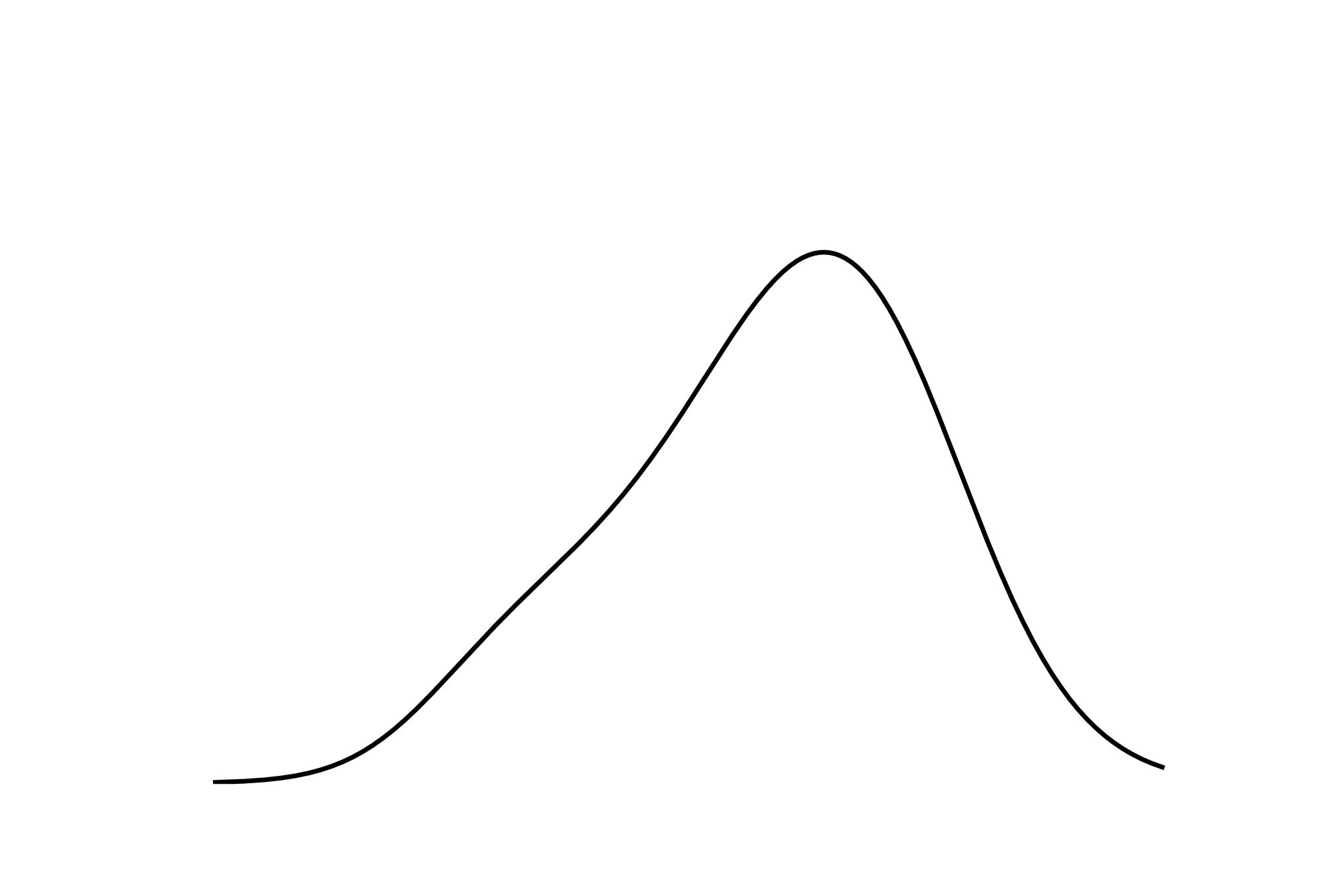
\textcolor{purple}{\delta} f
\kappa
D_{\textcolor{purple}{\delta}}(f) \gtrsim H_{\textcolor{purple}{\delta}}(f|M^f_{\textcolor{purple}{\delta}}), \; \; \forall f \in \mathcal{F}
\forall g \in \mathcal{G}, \; \; D_{\textcolor{green}{0}}\left(g\right) \gtrsim
H_{\textcolor{green}{0}}\left(\left.g\right|M^{g}_{\textcolor{green}{0}}\right)
Conclusion
2024
Thank you for your attention!

TB: Extending Cercignani's conjecture results from Boltzmann to Boltzmann-Fermi-Dirac equation, J. Stat. Phys. (2024).
Bonus: generalized \(L^p_\varpi\) Csiszár-Kullback-Pinsker
General weighted \(L^p\) Csiszár-Kullback-Pinsker
\|f-M^f\|^2_{L^p_{\varpi}} \leqslant {\small C_{\Phi, \varpi, p, f, M^f}} \; H(f|M^f),
Proposition.
(general entropy)
\(\displaystyle H(f) = \int\Phi(f)\), \(\Phi \; \; \mathcal{C}^2\) st. convex, \(M^f\) equilibrium, and
C_{\Phi, \varpi, p,f,M^f} = \left(\int_0^1 (1-\tau) \left\| \Phi''((1-\tau)M^f + \tau f)^{-1} \right\|_{L^{\frac{p}{2-p}}_{\varpi^2}}^{-1} \, \mathrm{d} \tau \right)^{-1}
For any \(f\), any \(p \in [1,2]\) and \(\varpi\) weight,
\|f-M_0^f\|^2_{L^p_{\varpi}} \leqslant 2 \max \left(\|f\|_{L^{\frac{p}{2-p}}_{\varpi^2}}, \|M_0^f\|_{L^{\frac{p}{2-p}}_{\varpi^2}} \right)\, H_{0}(f|M_0^f),
Corollary.
For any \(0\leq f \in L^1_2\cap L \log L(\R^3)\), \(p \in [1,2]\) and \(\varpi : \R^3 \to \R_+\),
(Boltzmann entropy)
\(\displaystyle H_0\) Boltzmann entropy and \(M_0^f\) Maxwellian.
[simplified]
Presentation Besancon
By Thomas Borsoni